Reasoning and Inference
Prolog is fundamentally a reasoning engine. In this chapter we explore how to use Prolog for various forms of logical reasoning that are central to AI.
Propositional and First-Order Logic in Prolog
Prolog predicates naturally map to First-Order Logic (FOL). We express propositional variables as simple arity-0 facts, and relational predicates with variables to represent quantified logical statements.
Horn Clauses
Classical logic allows rules with arbitrary conjunctions, disjunctions, and negations. However, resolving arbitrary first-order formulas is computationally expensive. To remain efficient, Prolog restricts its database to Horn clauses.
A Horn clause is a disjunction of literals with at most one positive (non-negated) literal. In classical notation:
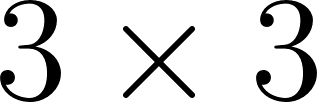
By applying Boolean algebra, this is logically equivalent to the implication:
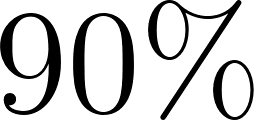
In Prolog, this implication is written in reverse as:
1 A :- B1, B2, ..., Bn.
Ais the head (positive literal).B1, B2, ..., Bnmake up the body (conjunctive negative literals).- If there is no body, the clause is a fact (equivalent to a positive literal asserting truth).
- If there is no head, the clause represents a query (a goal to be disproven via contradiction).
Mapping Logic to Prolog
While this Horn clause format is highly efficient for execution using SLD Resolution, it does place some limitations on what can be directly expressed:
- Universal Quantifiers (
\forall$): Implicitly assumed for all variables in a rule. - Existential Quantifiers (
\exists$): Represented by introducing new variables on the right-hand side of a rule (e.g.has_child(X) :- parent(X, _).means “For all X, X has a child if there exists some Y such that X is a parent of Y”). - Disjunction in the Head: Prolog does not allow disjunctive heads like
A or B :- C.. You must split this into multiple rules, or use helper predicates.
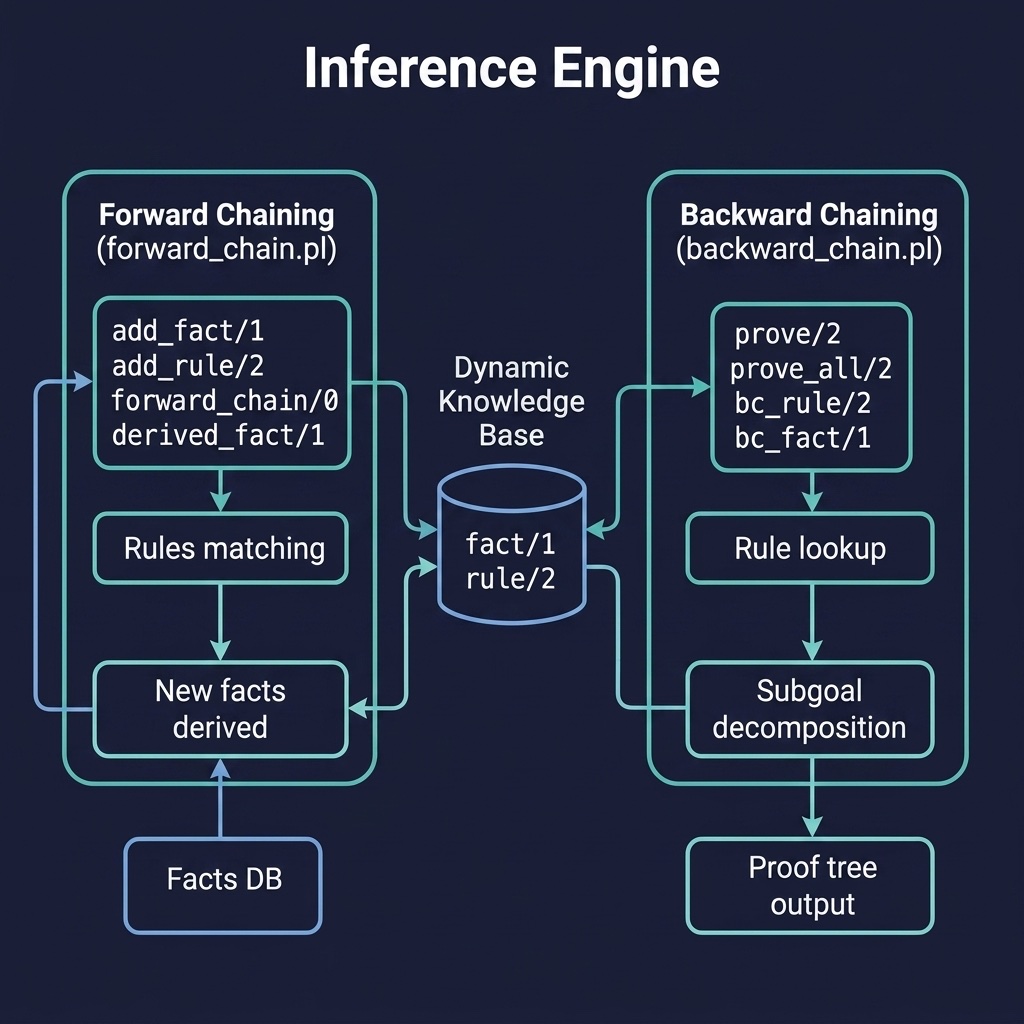
Forward and Backward Chaining
In logic systems, we use two main strategies to apply rules to facts:
Backward Chaining (Goal-Driven)
Backward chaining starts with a goal (query) and works backward, matching it against rule heads to find the subgoals (body conditions) needed to prove it. This recursion continues until all subgoals are resolved by direct facts in the database.
- Prolog’s Default: This is Prolog’s built-in execution strategy.
- When to Use: Best when you have a specific goal to prove and a large number of facts, but only a small subset are relevant to the query.
Forward Chaining (Data-Driven)
Forward chaining starts with known facts and applies rules to derive new facts. These new facts are asserted into the database, and the process repeats until a fixpoint is reached (i.e., no more new facts can be derived).
- When to Use: Best when you want to discover everything that follows from a set of starting data, such as in configuration systems, event monitors, or scheduling pipelines.
Here is a comparison of the two approaches:
| Feature | Backward Chaining | Forward Chaining |
|---|---|---|
| Direction | Goal \to$ Facts |
Facts \to$ Conclusions |
| Prolog Integration | Native execution engine | Needs custom meta-interpreter |
| Space Complexity | Low (only stores active path in stack) | High (asserts all derived facts on heap) |
| Best Fit | Diagnostic queries, verification | Event monitoring, data analysis |
The inference_engine project implements a forward-chaining engine that derives new facts from rules until a fixpoint is reached. Here is the file inference_engine/prolog/forward_chain.pl:
 1 %% forward_chain.pl - Forward chaining inference engine
 2 %% Derives new facts from rules until no more can be derived
 3 :- module(forward_chain, [
 4     forward_chain/0,
 5     add_rule/2,
 6     add_fact/1,
 7     derived_fact/1,
 8     reset_kb/0
 9 ]).
10
11 :- dynamic fact/1.
12 :- dynamic rule/2.
13
14 %% reset_kb - Remove all facts and rules from the knowledge base
15 reset_kb :-
16     retractall(fact(_)),
17     retractall(rule(_, _)).
18
19 %% add_fact(+Fact) - Assert a new fact
20 add_fact(F) :- \+ fact(F), assert(fact(F)).
21 add_fact(_).
22
23 %% add_rule(+Conditions, +Conclusion)
24 add_rule(Conditions, Conclusion) :-
25     assert(rule(Conditions, Conclusion)).
26
27 %% derived_fact(?F) - Query derived facts
28 derived_fact(F) :- fact(F).
29
30 %% forward_chain - Apply all rules until fixpoint
31 forward_chain :-
32     rule(Conditions, Conclusion),
33     \+ fact(Conclusion),
34     all_conditions_met(Conditions),
35     assert(fact(Conclusion)),
36     !,
37     forward_chain.
38 forward_chain. % fixpoint reached
39
40 all_conditions_met([]).
41 all_conditions_met([C|Rest]) :-
42     fact(C),
43     all_conditions_met(Rest).
reset_kb/0 clears the forward-chaining knowledge base. Tests and the Makefile run goal call it so runs start clean.
And a backward-chaining engine with explanation traces. Here is the file inference_engine/prolog/backward_chain.pl:
 1 %% backward_chain.pl - Backward chaining with explanation traces
 2 %%
 3 %% The internal prove/3 carries a visited-goals list so cyclic
 4 %% rule sets terminate: a goal that is already on the current branch
 5 %% of the proof search fails instead of looping forever.
 6 :- module(backward_chain, [
 7     bc_fact/1,
 8     bc_rule/2,
 9     prove/2,
10     reset_bc_kb/0
11 ]).
12
13 :- dynamic bc_rule/2.
14 :- dynamic bc_fact/1.
15
16 %% reset_bc_kb - Remove all backward-chaining facts and rules
17 reset_bc_kb :-
18     retractall(bc_fact(_)),
19     retractall(bc_rule(_, _)).
20
21 %% prove(+Goal, -Proof) - Prove a goal and return the proof tree
22 prove(Goal, Proof) :-
23     prove(Goal, Proof, []).
24
25 %% prove(+Goal, -Proof, +Visited) - Visited guards against cycles
26 prove(Goal, _, Visited) :-
27     member(Goal, Visited),
28     !,
29     fail.
30 prove(Goal, fact(Goal), _) :-
31     bc_fact(Goal).
32 prove(Goal, rule(Goal, Proofs), Visited) :-
33     bc_rule(Conditions, Goal),
34     prove_all(Conditions, Proofs, [Goal|Visited]).
35
36 prove_all([], [], _).
37 prove_all([C|Rest], [P|Proofs], Visited) :-
38     prove(C, P, Visited),
39     prove_all(Rest, Proofs, Visited).
reset_bc_kb/0 clears the backward-chaining knowledge base. prove/2 carries a visited-goal list so cyclic rule bases fail instead of looping forever.
Generating and Visualizing Proof Trees
While deriving conclusions is useful, in many AI applications (such as expert systems) we must also explain why a conclusion was reached. A proof tree is a tree-like data structure that records the steps, rules, and facts used to satisfy a goal.
Prolog is well-suited for building proof trees because we can easily write a meta-interpreter: a Prolog program that reads and executes other Prolog programs.
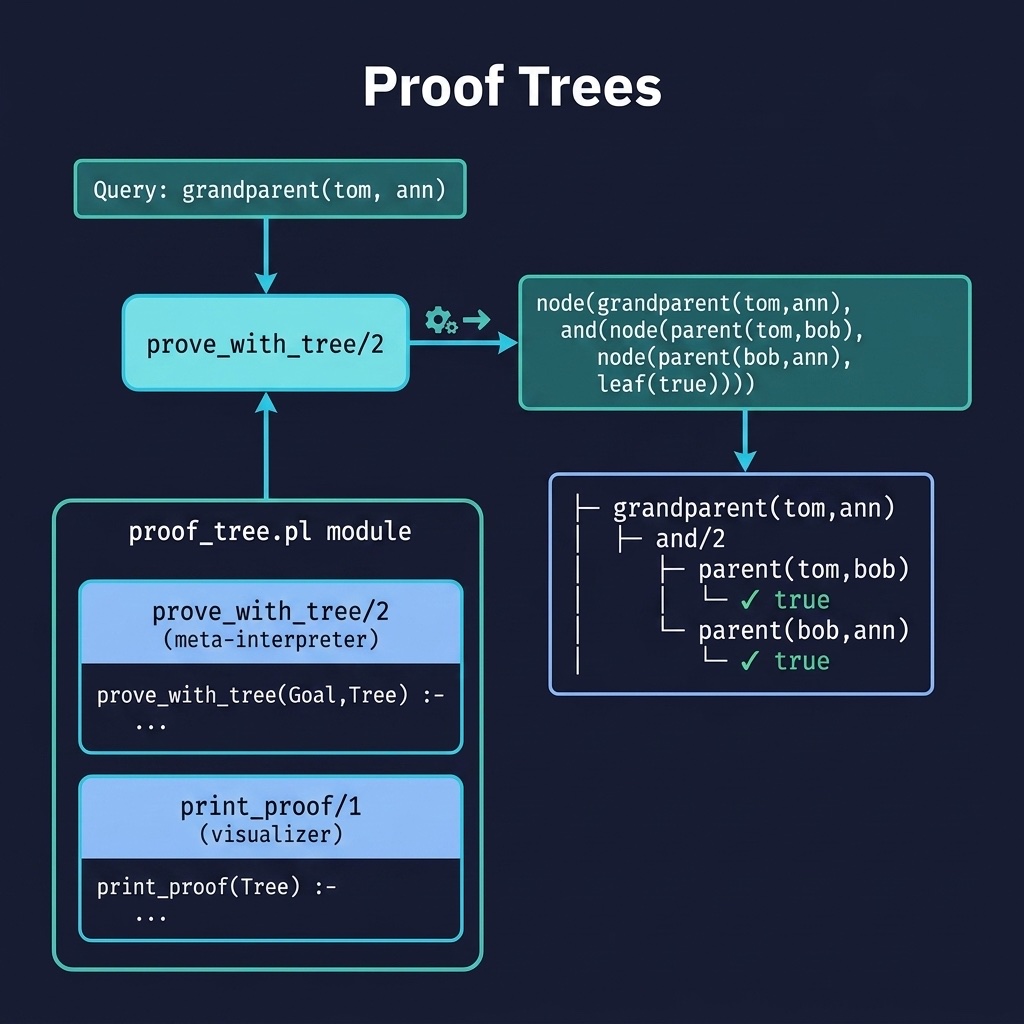
The companion project proof_trees demonstrates this technique. Here is the core file proof_trees/prolog/proof_tree.pl:
 1 %% proof_tree.pl - Build and display proof trees
 2 %% for explainable reasoning
 3 :- module(proof_tree, [
 4     prove_with_tree/2,
 5     print_proof/1,
 6     sample_data_loaded/0
 7 ]).
 8
 9 sample_data_loaded :-
10     (   exists_file('sample_data.pl')
11     ->  consult('sample_data.pl')
12     ;   exists_file('prolog/sample_data.pl')
13     ->  consult('prolog/sample_data.pl')
14     ;   format(user_error, 'WARNING: sample_data.pl not found~n', []),
15         fail
16     ).
17
18 :- initialization(sample_data_loaded).
19
20 %% prove_with_tree(+Goal, -Tree) - Prove and return proof tree
21 prove_with_tree(true, leaf(true)) :- !.
22 prove_with_tree((A, B), and(PA, PB)) :- !,
23     prove_with_tree(A, PA),
24     prove_with_tree(B, PB).
25 %% Handle negation-as-failure (meta-builtin)
26 prove_with_tree(\+ G, node(\+ G, leaf(\+ G))) :- !,
27     \+ G.
28 %% Handle not-unifiable (builtin comparison)
29 prove_with_tree(X \= Y, node(X\=Y, leaf(X\=Y))) :- !,
30     X \= Y.
31 %% User-defined goals: look up clauses and recurse
32 prove_with_tree(Goal, node(Goal, ChildProofs)) :-
33     clause(Goal, Body),
34     prove_with_tree(Body, ChildProofs).
35
36 %% print_proof(+Tree) - Pretty-print a proof tree with indentation
37 print_proof(Tree) :- print_proof(Tree, 0).
38
39 print_proof(leaf(true), Indent) :- !,
40     tab(Indent), format("✓ true~n").
41 print_proof(leaf(Goal), Indent) :-
42     tab(Indent), format("✓ ~w~n", [Goal]).
43 print_proof(and(A, B), Indent) :-
44     print_proof(A, Indent),
45     print_proof(B, Indent).
46 print_proof(node(Goal, Children), Indent) :-
47     tab(Indent), format("├─ ~w~n", [Goal]),
48     Indent1 is Indent + 3,
49     print_proof(Children, Indent1).
How the Meta-Interpreter Works
- Base Cases: When the goal is
true, it is trivially proven and returnsleaf(true). - Conjunctions: For a goal composed of
(A, B), it recursively provesA(producing proof treePA) andB(producingPB), and returnsand(PA, PB). - Built-in Handling: Special handlers are defined for negation-as-failure (
\+ G) and inequality checks (X \= Y). - Clause Inspection: For user-defined predicates,
clause(Goal, Body)is a built-in Prolog feature that inspects the database, finding a rule whose head matchesGoaland returning itsBody. The interpreter then recurses on theBodyto find child proofs.
Running the Proof Visualizer
If we query the sample family relationships database:
1 ?- prove_with_tree(grandparent(adam, mary), Tree), print_proof(Tree).
2 ├─ grandparent(adam, mary)
3    ├─ parent(adam, john)
4       ✓ true
5    ├─ parent(john, mary)
6       ✓ true
This gives us a readable, tree-structured explanation of the system’s reasoning process.
Reasoning with Uncertainty
In real-world applications, reasoning is rarely black-and-white. AI systems must often handle uncertain or probabilistic information. One classic approach to this is attaching probabilities to rules and facts, and using noisy-AND probability propagation through the inference chain.
To compute the probability of a derived goal, we apply the rules of probability:
-
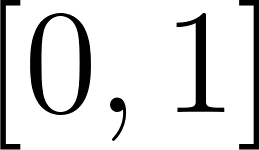
Conjunction (AND): If a rule depends on multiple conditions, the probability of the conditions holding jointly is the product of their individual probabilities (assuming independence):
-
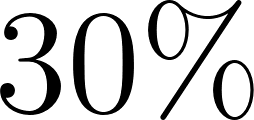
Rule Application: The probability of the conclusion is the joint probability of its conditions multiplied by the conditional probability (confidence) of the rule:
The companion project prob_reasoning implements this logic. Here is the complete file prob_reasoning/prolog/prob_facts.pl:
 1 %% prob_facts.pl - Probabilistic reasoning over annotated facts/rules
 2 %%
 3 %% NOTE: the probability arithmetic below is noisy-AND style
 4 %% multiplication along the inference chain; it is NOT MYCIN-style
 5 %% certainty-factor combination.
 6 %%
 7 %% Product chains are computed in log space (a foldl of the log of each
 8 %% factor, then exp/1 of the sum) so that deep chains do not underflow
 9 %% to 0.0 in floating point.
10 %%
11 %% prob_query/3 carries a visited-goal list so that cyclic rule bases
12 %% terminate: a goal already on the current reasoning branch fails
13 %% instead of looping forever.
14 %%
15 %% The dynamic facts and rules are empty at module load; call
16 %% load_example_kb/0 (see load.pl) to populate the weather example.
17
18 :- module(prob_facts, [
19     prob_fact/2,
20     prob_rule/3,
21     prob_query/2,
22     load_example_kb/0
23 ]).
24
25 :- dynamic prob_fact/2.  % prob_fact(Fact, Probability)
26
27 %% prob_rule(+Conditions, +Conclusion, +CondProb)
28 %% If all Conditions hold, conclude Conclusion with conditional
29 %% probability
30 :- dynamic prob_rule/3.
31
32 %% prob_query(+Goal, -Probability)
33 %% Query the probability of a goal given known facts and rules
34 prob_query(Goal, Prob) :-
35     prob_query(Goal, Prob, []).
36
37 %% prob_query(+Goal, -Probability, +Visited) - Visited guards cycles
38 prob_query(Goal, _, Visited) :-
39     member(Goal, Visited),
40     !,
41     fail.
42 prob_query(Goal, Prob, _) :-
43     prob_fact(Goal, Prob), !.
44 prob_query(Goal, Prob, Visited) :-
45     prob_rule(Conditions, Goal, CondProb),
46     maplist(prob_query_([Goal|Visited]), Conditions, CondProbs),
47     foldl(sum_log, CondProbs, 0.0, LogJoint),
48     Prob is exp(LogJoint) * CondProb.
49
50 %% Bridge for maplist so Visited is threaded into recursive calls
51 prob_query_(Visited, Goal, Prob) :-
52     prob_query(Goal, Prob, Visited).
53
54 %% sum_log(+P, +Acc, -Result)
55 %% Accumulate log probabilities; P =:= 0.0 contributes -inf.
56 sum_log(P, Acc, Result) :-
57     (   P =:= 0.0
58     ->  Result = -inf
59     ;   Result is Acc + log(P)
60     ).
The module loads with an empty knowledge base. load.pl calls load_example_kb/0, which retracts any existing KB first so it is idempotent.
If we query the weather database defined in this project:
1 ?- prob_query(storm, Prob).
2 Prob = 0.084.
 1 ## Abductive Reasoning
 2
 3 Abductive reasoning is the process of reasoning from **observations** to the most likely **explanations** (or hypotheses) that could cause them. It is often described as "inference to the best explanation."
 4 - **Deduction**: Given `A`$ and `A \Rightarrow B`$, derive `B`$.
 5 - **Induction**: Given examples of `A`$ and `B`$, derive the rule `A \Rightarrow B`$.
 6 - **Abduction**: Given `B`$ and `A \Rightarrow B`$, hypothesize `A`$ as the explanation for `B`$.
 7
 8 In Prolog, we can implement abductive reasoning by defining a set of **abducible predicates**: facts that we are allowed to assume true if they help explain the observation.
 9
10 Here is a simple abductive meta-interpreter:
11
12 ```prolog
13 %% abduce(+Goal, +Abducibles, -Explanation)
14 %% Finds a set of abducible assumptions that prove Goal
15 abduce(true, _, []) :- !.
16 abduce((A, B), Abducibles, Expl) :- !,
17     abduce(A, Abducibles, ExplA),
18     abduce(B, Abducibles, ExplB),
19     append(ExplA, ExplB, Expl).
20 abduce(Goal, Abducibles, [Goal]) :-
21     member(Goal, Abducibles).
22 abduce(Goal, Abducibles, Expl) :-
23     clause(Goal, Body),
24     abduce(Body, Abducibles, Expl).
If we define the rules:
1 grass_is_wet :- rained.
2 grass_is_wet :- sprinkler_was_on.
And declare [rained, sprinkler_was_on] as our list of abducibles, calling abduce(grass_is_wet, [rained, sprinkler_was_on], Expl) will backtrack to yield two possible explanations: [rained] or [sprinkler_was_on].
Non-Monotonic Reasoning and Defaults
Classical logic is monotonic: once a conclusion is proven true, adding new facts to the database can never invalidate it. However, human reasoning is often non-monotonic: we draw default conclusions that we retract when we receive new, contradictory information.
Prolog implements non-monotonic reasoning using the Closed-World Assumption and Negation as Failure (\+). We can write default rules that hold true unless an exception is proven.
Default Logic Example
A classic example is reasoning about bird flight: “Birds fly by default, unless they are abnormal (like penguins or ostriches).”
 1 flies(X) :-
 2     bird(X),
 3     \+ abnormal(X).
 4
 5 abnormal(X) :- penguin(X).
 6 abnormal(X) :- ostrich(X).
 7
 8 bird(tweety).
 9 bird(pingu).
10 penguin(pingu).
If we query the database:
?- flies(tweety).succeeds becausebird(tweety)is true andabnormal(tweety)cannot be proven (fails).?- flies(pingu).fails becausepenguin(pingu)is asserted, which provesabnormal(pingu), thereby causing\+ abnormal(pingu)to fail.
If we later learn that Tweety is actually a penguin and assert penguin(tweety)., the previous conclusion flies(tweety) is automatically retracted, demonstrating non-monotonic behavior.
Case Study: A Medical Diagnosis Reasoner
To see how these reasoning techniques come together, we can look at a practical case study: a Medical Diagnosis Reasoner. This system diagnoses diseases by matching patient symptoms against a clinical knowledge base and generating an explicit explanation.
The companion project medical_diagnosis implements this diagnostic reasoner. The program is a pure list-based matcher. diagnose/2 checks whether some disease’s required symptoms are a subset/2 of the patient’s symptom list and formats an explanation. It asserts no dynamic state, so repeated consultations are idempotent.
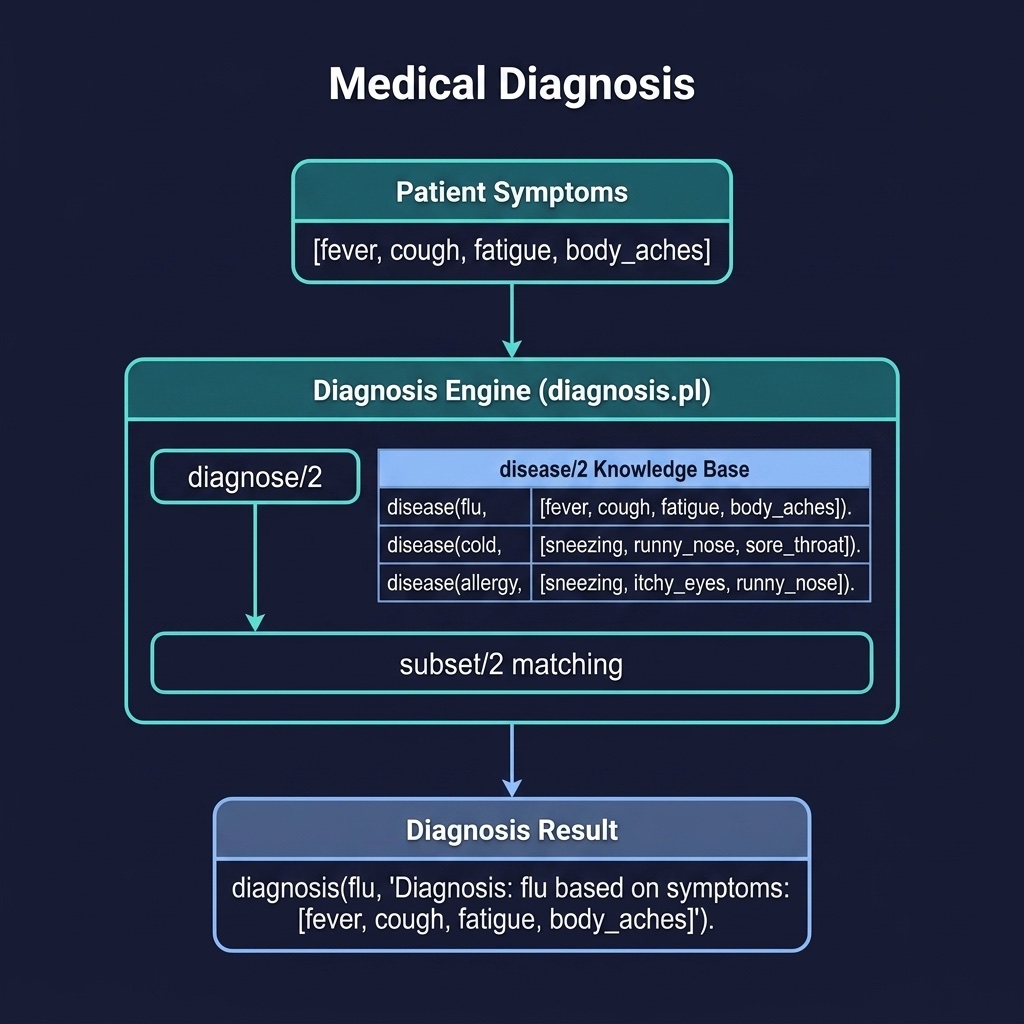
The medical_diagnosis project demonstrates rule-based diagnostic reasoning. Here is the file medical_diagnosis/prolog/diagnosis.pl:
 1 %% diagnosis.pl - Simple medical diagnosis reasoner
 2 %% Demonstrates reasoning with multiple rules and explanation
 3 %%
 4 %% This implementation is a pure function of the input symptom list:
 5 %% it matches the patient's symptoms against the disease knowledge base
 6 %% using subset/2 without asserting or retracting any dynamic state.
 7
 8 :- module(diagnosis, [
 9     diagnose/2
10 ]).
11
12 %% diagnose(+PatientSymptoms, -DiagnosisWithExplanation)
13 %% Pure list-based matching: succeeds iff some disease's required
14 %% symptoms are a subset of the patient's symptoms.
15 diagnose(Symptoms, diagnosis(Disease, Explanation)) :-
16     disease(Disease, RequiredSymptoms),
17     subset(RequiredSymptoms, Symptoms),
18     format(atom(Explanation),
19            'Diagnosis: ~w based on symptoms: ~w',
20            [Disease, RequiredSymptoms]).
21
22 %% Disease knowledge base
23 disease(flu, [fever, cough, fatigue, body_aches]).
24 disease(cold, [sneezing, runny_nose, sore_throat]).
25 disease(allergy, [sneezing, itchy_eyes, runny_nose]).
26 disease(bronchitis, [cough, chest_pain, fatigue, shortness_of_breath]).
27 disease(migraine, [headache, nausea, light_sensitivity]).
Here is sample output:
TBD
Optional Practice Problems
- Extended Diagnosis Rules: In the
medical_diagnosisproject, add rules for diagnosing a new condition (e.g., flu or allergy) based on symptom overlap, and ensure that conflicting symptoms are handled gracefully. - Structured Proof Tree Printing: In
proof_trees, write a helper predicate to print the generated proof tree using visual indentation levels (e.g., nested bullet points) rather than raw Prolog terms.