
The Leanpub 60 Day 100% Happiness Guarantee
Within 60 days of purchase you can get a 100% refund on any Leanpub purchase, in two clicks.
See full terms...
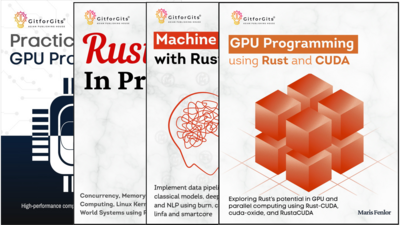
Most developers reach for Python when they need GPU power, but Rust also can deliver the same acceleration with memory safety and zero runtime overhead. This bundle takes you from CUDA fundamentals through Rust-CUDA, cuda-oxide, and RustaCUDA all the way to GPU-accelerated machine learning, entirely in the Rust ecosystem.
Bought separately
$119.96
Minimum price
$79.99
$86.99
About the Bundle
This is a very specialist high-performance computing bundle for Rust developers pushing into parallel and GPU workloads.
At first, the GPU Programming using Rust and CUDA explores modern Rust's potential for GPU computing using Rust-CUDA, cuda-oxide, and RustaCUDA. Then there is, Practical GPU Programming, which supplies the broader HPC foundations, including parallel processing, memory management, and CUDA kernel optimisation. There is also Rust In Practice, Third Edition to reinforce the language depth with concurrency, memory safety, and GPU computing. And lastly, the bundle also offers Machine Learning with Rust Second Edition which teaches to apply GPU-accelerated Rust to real ML workloads.
Together all these four books gives you the skillset of writing safe, GPU-accelerated, high-performance code entirely in the Rust ecosystem.
About the Books

If you're a Python pro looking to get the most out of your code with GPUs, then Practical GPU Programming is the right book for you. This book will walk you through the basics of GPU architectures, show you hands-on parallel programming techniques, and give you the know-how to confidently speed up real workloads in data processing, analytics, and engineering.
The first thing you'll do is set up the environment, install CUDA, and get a handle on using Python libraries like PyCUDA and CuPy. You'll then dive into memory management, kernel execution, and parallel patterns like reductions and histogram computations. Then, we'll dive into sorting and search techniques, but with a focus on how GPU acceleration transforms business data processing. We'll also put a strong emphasis on linear algebra to show you how to supercharge classic vector and matrix operations with cuBLAS and CuPy. Plus, with batched computations, efficient broadcasting, custom kernels, and mixed-library workflows, you can tackle both standard and advanced problems with ease.
Throughout, we evaluate numerical accuracy and performance side by side, so you can understand both the strengths and limitations of GPU-based solutions. The book covers nearly every essential skill and modern toolkit for practical GPU programming, but it's not going to turn you into a master overnight.

Whether you're just starting out or a fully-fledged Rust pro, this third Edition is a goldmine of knowledge about Rust. This book has been updated with Rust 1.85 and Rust 2024 Edition, and it takes you on a really structured learning path to write production-grade systems, async services, GPU compute kernels, Linux kernel modules, and Go-integrated libraries.
The book is built around a single, progressive application, and every chapter adds a functional layer to a real Linux system-metrics tool. The knowledge you gain from this book, is working and evolving codes that you can study, extend, and own. You'll get the hang of ownership and borrowing, handle the borrow checker, build concurrent and async programs with Tokio, manage memory without a garbage collector, and use Rust in domains that were once reserved exclusively for C and C++.
Whatever stage you're at, whether you're just starting out and writing your first function or you're a seasoned engineer migrating a critical service to Rust, this strong practically focussed book has got you covered.
Key Learnings
Table of Content

This machine learning book is a new edition out now for Rust developers to build practical machine learning systems without getting bogged down in the complexities of Rust 1.85. We put together a single workspace over eleven chapters, building it from a Polars-based data pipeline through classical models, deep neural networks, and natural language processing, right up to a deployed REST API.
We teach you to make use of linfa and smartcore crates for regression, classification, ensemble methods, and support vector machines. We build and train neural networks using the Burn framework, work with convolutional architectures on image data, and load pre-trained transformer models through Candle. We also use a lightweight NLP pipeline with TF-IDF and Gaussian Naive Bayes from first principles. At all times, Rust's ownership model and type system work together to make sure things are correct, rather than getting in the way.
This particular book is a perfect knowledge source for developers who already know Rust at a beginner’s level and want to use that knowledge for machine learning tasks. You don't need to have worked with any ML frameworks before.
Key Learnings
Table of Content

This book is all about getting hands-on with different toolchains that connect Rust to NVIDIA hardware. There's RustaCUDA for safe host-side control, the Rust-CUDA project for writing kernels in pure Rust, and NVIDIA's experimental cuda-oxide compiler with its typed launches and async execution graphs.
We're going to build one Cargo workspace that keeps on growing. It'll include device queries, launch planning, Rust-written kernels, memory optimization, parallel reductions and scans, multi-stream pipelines, matrix multiplication benchmarked against cuBLAS, a Monte Carlo option pricer validated against a closed formula, and a complete batched inference application measured against a Python baseline. We'll check every result against a CPU reference, and the reports will give accurate numbers, including where libraries outperform hand-written kernels and where experimental toolchains are still a work in progress.
Key Learnings
Table of Content
Within 60 days of purchase you can get a 100% refund on any Leanpub purchase, in two clicks.
See full terms...
We pay 80% royalties on purchases of $7.99 or more, and 80% royalties minus a 50 cent flat fee on purchases between $0.99 and $7.98. You earn $8 on a $10 sale, and $16 on a $20 sale. So, if we sell 5000 non-refunded copies of your book for $20, you'll earn $80,000.
(Yes, some authors have already earned much more than that on Leanpub.)
Learn more about writing on Leanpub
If you buy a Leanpub book, you get free updates for as long as the author updates the book! Many authors use Leanpub to publish their books in-progress, while they are writing them. All readers get free updates, regardless of when they bought the book or how much they paid (including free).
Most Leanpub books are available in PDF (for computers) and EPUB (for phones, tablets and Kindle). The formats that a book includes are shown at the top right corner of this page.
Finally, Leanpub books don't have any DRM copy-protection nonsense, so you can easily read them on any supported device.
Learn more about Leanpub's ebook formats and where to read them
You can use Leanpub to easily write, publish and sell in-progress and completed ebooks and online courses!
Leanpub is a powerful platform for serious authors, combining a simple, elegant writing and publishing workflow with a store focused on selling in-progress ebooks.
Leanpub is a magical typewriter for authors: just write in plain text, and to publish your ebook, just click a button. (Or, if you are producing your ebook your own way, you can even upload your own PDF and/or EPUB files and then publish with one click!) It really is that easy.