
The Leanpub 60 Day 100% Happiness Guarantee
Within 60 days of purchase you can get a 100% refund on any Leanpub purchase, in two clicks.
See full terms...
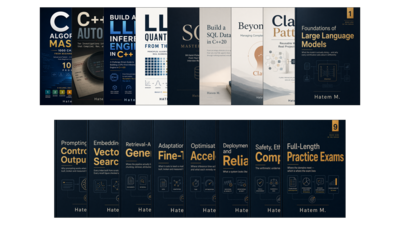
Seventeen books, one rule: nothing asserted, everything demonstrated — build it, break it, check it yourself.
Bought separately
$308
$118
About the Bundle
Seventeen books. Four subjects. One rule: nothing asserted, everything demonstrated.
Most technical books hand you a recipe and a result. "Use INT4, lose 1%." "B+Trees are logarithmic." "Hybrid retrieval beats either retriever alone." They tell you what happens and ask you to trust it. This library refuses to stop there.
Every mechanism here is built from an empty file, in code that compiles and runs, pushed until it breaks, and measured with numbers produced by running it. Where a result needed hardware this work did not have, it is cited and marked as a citation — never blended into the measurements. No hand-waving. No magic. No black boxes.
You do not have to believe any of it. You can re-run it.
Some of it contradicted the advice it was testing.
That last one is the closest thing to a thesis these seventeen books have: a measurement you have checked is worth more than a claim you have repeated, and checking is usually cheap — a noise floor, a denominator, a control condition, a second look at what varied.
── C++ AND SYSTEMS ── Build real systems from an empty directory, one compilable challenge at a time.
── SQL ── Master the language, then build the engine that runs it.
── LARGE LANGUAGE MODELS, FROM THE BITS UP ── Understand what actually happens inside a model, not by reading but by building. Ten books: a monograph on quantization, and a nine-volume series that runs from a transformer built from scratch to what a safety claim must contain.
── WORKING WITH CLAUDE ── The same rule applied to the model itself: not "write a prompt and hope," but a method you can run.
Certification coverage. The nine-volume series covers all ten domains of the NVIDIA NCP-GENL blueprint, and the published objectives of NCA-GENL, AWS Certified Generative AI Developer – Professional, Databricks Certified Generative AI Engineer, and NVIDIA NCP Agentic AI. Every volume ends with a reverse map from each certification to the chapters that serve it, in reading order. 577 practice questions, every option explained — not just why the right answer is right, but why each wrong answer is wrong, because on these exams the distractors are where the teaching is.
What this does not claim. Where a result needed a model larger than the environment could run, it is cited rather than measured, and the ratio is stated on the cover of the volumes where it matters. Volume 9 prints no pass mark, because a pass mark would imply a calibration nobody has established. Every exam question is original, written from published objectives — nothing is reproduced from, or based on recollection of, any live examination. Objectives were checked in August 2026; confirm current blueprints with the certifying body before you sit.
Every book stands alone. No volume depends on any other, so this bundle is seventeen complete books rather than seventeen chapters. You need to be able to read Python for the LLM books and C++ for the systems books. Nothing else is assumed.
All code is included. Every table can be regenerated.
Build it, break it, check it yourself.
About the Books

1000 problems. Eight volumes. One complete journey from your very first line of C++ to the frontiers of modern algorithms.
This is the complete collection: 1000 carefully designed C++ problems, organized into 8 progressive volumes that take you from absolute beginner to advanced algorithmic mastery — with every single solution compiled and tested on g++.
What you get:
- 1000 problems, carefully ordered by difficulty across 8 volumes
- A complete, working C++ solution for every problem
- Clear explanations, hints, and complexity analysis throughout
- A structured path, so you never have to guess what to learn next
Every problem includes:
- A clear statement with examples and constraints
- A hint to point you in the right direction
- A full, tested C++ solution
- Time and space complexity
- A plain-language explanation of how it works
The 8 volumes:
1. Absolute Beginner — I/O, Variables, Conditions, Loops, Functions, Arrays
2. Beginner — Strings, Recursion, Basic Math, Simple Data Structures
3. Elementary — Sorting, Searching, Core Algorithms, the STL
4. Upper-Intermediate — Data Structures, Two Pointers, Prefix Sums, Greedy
5. Advanced — Graphs, Dynamic Programming, Trees, Shortest Paths
6. Expert — Advanced Strings, Heavy Graph Machinery, Computational Geometry
7. Master — Suffix Structures, Flow & Matching, Number Theory, Combinatorics
8. Genius — Polynomials & Transforms, Advanced Graphs, Capstone Challenges
Who it's for:
Anyone learning C++ who wants a structured, guided path — students, self-taught programmers, and anyone preparing for coding interviews or competitive programming who wants every step explained, not just a list of problems.
Development Methodology
This book was created through a process that combines careful human planning, content direction, and advanced AI technology, followed by thorough refinement and review to ensure a high-quality final work.
One thousand problems. Eight volumes. A complete roadmap from foundations to mastery.

Every bug in this book passed the compiler. Every bug ran to completion. Every bug returned exit code zero. None of them told the truth.
Most C++ books teach you how to write code. This one teaches you how to investigate it.
C++ Autopsy presents ten forensic investigations into programs that appear perfectly healthy: they compile cleanly, execute normally, and quietly produce the wrong result. No syntax errors. No crashes. No obvious clues. Just evidence waiting to be examined.
Each case unfolds like a real investigation. You begin at the crime scene with a minimal, reproducible program. You examine the evidence, question the suspects—including one deliberate red herring—inspect real diagnostic output from professional tools, identify the true cause, and verify the fix. Every conclusion is backed by the C++ standard, compiler behavior, or observable runtime evidence.
Along the way, you'll uncover some of the language's most deceptive pitfalls: undefined behavior, lifetime errors, memory corruption, concurrency bugs, numerical surprises, optimizer assumptions, and subtle violations of the Standard Library's contracts. Some cases are caught immediately by modern tools. Others pass every warning, every sanitizer, and every test—exactly the kinds of defects that reach production.
Whether you write systems software, libraries, game engines, or high-performance applications, this book will change the way you debug C++. Instead of asking, "Why did my program crash?" you'll learn to ask the more dangerous question:
Development Methodology
This book was created through a process that combines careful human planning, content direction, and advanced AI technology, followed by thorough refinement and review to ensure a high-quality final work.
Why did it appear to work?
For intermediate and advanced C++ developers. Every example compiles with C++20. Every case is real. Every verdict is earned.

Build an LLM Inference Engine in C++ — Through Challenges
You don't truly understand how large language models run
until you've built the engine yourself.
This book takes you from a blank C++ project to a complete,
working inference engine that loads a real Llama-family model
and generates text — one challenge at a time.
What you'll build:
- A strided tensor system with zero-copy views and arena allocation
- Math kernels: RMSNorm, SwiGLU, softmax, GEMM with SIMD
- A byte-level BPE tokenizer
- A full Transformer: RoPE, GQA, Flash Attention, KV Cache
- int8/int4 quantization with direct block multiplication
- GGUF model loading with mmap
- Sampling, streaming, speculative decoding, and continuous batching
- An optional CUDA capstone for the heaviest kernels
By Unit 14, the engine runs a real model on CPU. Every concept
earns its place right after you've built the thing it improves.
Companion Source Code
The complete source code for the book is available on GitHub:
https://github.com/Hatem-M-lab/llm-inference-engine
Development Methodology
This book was created through a process that combines careful human planning, content direction, and advanced AI technology, followed by thorough refinement and review to ensure a high-quality final work.
Who this is for:
C++20 developers comfortable with algorithms
and memory layout who want to understand what actually happens
inside an LLM runtime — not by reading, but by building.

Most explanations of model quantization hand you a recipe and a number: "use INT4, you'll lose about 1% accuracy." This book refuses to stop there. It asks why — and answers from the bits up.
Starting from a single weight and the question of how few bits can represent it, the book builds the entire field from first principles. Every mechanism is coded from scratch in tested Python and PyTorch, deliberately pushed until it breaks, and measured with real numbers produced by executed code. Nothing is asserted; everything is demonstrated. When the book says GPTQ makes 3-bit weights free, there is a measured perplexity behind it. When it says one outlier channel costs 40 dB, there is a derivation and a verification.
What you'll build and measure
Who it's for
Engineers and researchers who want to understand quantization, not just apply it — people who would rather know why INT4 works than memorize that it does. If you can read Python and basic linear algebra, you can follow every derivation and reproduce every experiment.
How it's taught
The reference model throughout is TinyGPT, a small GPT-style decoder trained from scratch on Shakespeare — chosen so every experiment runs on a single CPU core and every result is reproducible. Seventeen chapters, six parts, fifty-plus figures, and not a single invented number.
This is quantization as a small set of principles — representation, noise, propagation, outliers, algorithms, kernels — that together let you predict exactly what happens when you take the bits away.
Development Methodology
This book was created through a process that combines careful human planning, content direction, and advanced AI technology, followed by thorough refinement and review to ensure a high-quality final work.
Build it, break it, measure it.

Stop reading SQL theory. Start solving.
This book is 84 hand-picked SQL problems that take you from your first SELECT statement to genius-level analytical queries — the kind that show up in real technical interviews.
No theory chapters. No filler. Every single problem gives you a clear prompt, a sample input table, the exact expected output, a working solution, and a plain-English explanation of why it works — not just what to type.
The seven volumes rise one honest step at a time: Beginner → Easy-Medium → Medium → Medium-Hard → Hard → Expert → Genius. Volume 1 is single-table filtering and sorting. By Volume 7 you're computing medians without window functions, counting concurrent events, and finding the smallest missing positive integer — pure interview-grade challenges.
Every query in this book was tested against a real database before publishing. No broken code, no queries that only work in theory.
Who this is for
You already know the basics of SQL and want to get genuinely good at it. Whether you're preparing for a data or backend interview, leveling up from simple queries to window functions and CTEs, or just want deliberate practice instead of passive reading — this is your workbook.
How to use it
Solve each problem yourself first. Open any free SQL playground, recreate the table, and write your own query before reading the solution. The reading comes second; the typing comes first.
Note: examples use standard SQL. A few advanced solutions (window functions, PERCENTILE_CONT, recursive CTEs) target PostgreSQL-style engines; equivalents are explained where they differ.
146 pages · 7 volumes · 84 problems · one complete path from beginner to expert.
Development Methodology
This book was created through a process that combines careful human planning, content direction, and advanced AI technology, followed by thorough refinement and review to ensure a high-quality final work.
What's inside (you can add this as a bulleted section)
Volume 1 — Beginner: single-table filtering, sorting, basic conditions
Volume 2 — Easy-Medium: aggregation, GROUP BY, HAVING, CASE, NULL handling
Volume 3 — Medium: INNER/LEFT joins, subqueries, the classic NULL traps
Volume 4 — Medium-Hard: multi-table joins and CTEs
Volume 5 — Hard: window functions (ROW_NUMBER, RANK, running totals, medians)
Volume 6 — Expert: interview-grade problems — pivots, recursive CTEs, graph traversal, sargability
Volume 7 — Genius: everything at once — gaps-and-islands, concurrent events, hierarchies, the hardest patterns

Build a working SQL database engine in C++20 -- from an empty directory to
a query processor that runs real SQL against data on disk and survives a
crash at any write -- through a single relentless method: nothing is
asserted; everything is demonstrated.
Every data structure in this book is built, compiled, and run. Every
performance claim is a table printed by a benchmark whose source code is on
the page in front of you. Every design decision is followed by the
measurement that justifies it -- and, where the design has a cost, by the
measurement that exposes that cost too. And once per unit, something fails
in front of you: a real bug, reproduced deterministically, diagnosed from
the evidence, fixed, and locked shut with a regression test.
This is not a survey of database theory. It is a lab manual. You will not
find hand-waving about how B+Trees are "generally logarithmic" -- you will
find the fan-out arithmetic, the page-count math, and a benchmark that
walks a tree of a million keys and prints the real number.
THE COMPLETE BOOK: fourteen units in four parts.
PART I -- STORAGE
1. Slotted Pages & the Pager -- self-describing 4 KiB pages, records with
stable slot ids, a pager with a free list
2. B+Tree: Insert & Search -- logarithmic lookup, proven against a
million-key tree
3. B+Tree: Delete & Range Scans -- rebalancing, merges, ordered range
queries
4. The Buffer Pool -- a real cache with clock eviction, measured 2.5x
faster with identical logical work
PART II -- FROM BYTES TO A QUERY
5. The Record Layer -- typed rows: a schema-aware codec and a table heap,
reached by key through the index
6. The Catalog -- persistent schemas and named tables: the engine's
self-knowledge
7. The Front End -- a SQL tokenizer and recursive-descent parser, with
compiler-quality caret-pointed errors
8. The Executor -- the milestone: a real executor that runs CREATE TABLE,
INSERT, and SELECT end to end, against a database of hundreds of
thousands of rows
PART III -- MAKING IT FAST & REAL
9. Joins -- the executor rebuilt as a pipeline of operators, JOIN ... ON
with aliases and qualified columns, and two join algorithms raced:
at 100,000 rows a side the hash join is 1,293x faster than the
nested loop, measured
10. Aggregation -- COUNT, SUM, AVG, MIN and MAX with SQL's NULL rules,
GROUP BY and HAVING through a hash table, ORDER BY and LIMIT; the
top 10 of a million rows costs one pass over them, and a GROUP BY's
cost per row, measured, grows tenfold from 10 groups to a million
11. Indexes & the Planner -- ranges of the key, CREATE INDEX on a B+Tree
that keeps duplicate keys, and a planner that chooses scans, indexes
and join algorithms by costs measured on its own machine; an index
loses, measured, past 55% of a cached table and 16% of one that is
not, and Unit 10's questions, replanned, run up to 12,000x faster
12. Vectorized Execution -- rows read where they lie in the buffer pool,
and every operator rebuilt to move them 1,024 at a time as columns: a
scanned row, measured, from 116 ns to 11, Unit 9's pipeline twelve
times faster, and an index's break-even moved from half a table to a
sixth
PART IV -- DURABILITY & CAPSTONE
13. Write-Ahead Log & Crash Recovery -- every page through a log of
checksummed page images, every statement a transaction, BEGIN, COMMIT
and ROLLBACK; the engine crashed at each of the 804 writes and syncs
of a workload, as a dying process and as a power cut, and by 300
kill -9s -- and every time it held exactly what it had acknowledged
14. Capstone -- the engine becomes a program; 20,000 generated statements
run in labdb and in PostgreSQL with not one different answer, and
eight bugs planted to test that comparison, all eight caught; then the
same work beside SQLite, in one process: faster on ten of thirteen
questions, and a file nearly three times the size, explained page by page
By the last page, the engine answers SQL it parsed from text, against rows
it stored on disk, through indexes it built, a cache it manages and a log
that brings it back after a crash -- and its answers are PostgreSQL's. Every
number in the book came from actually running that code.
Reference machines: g++ 13.3.0, Ubuntu 24.04, C++20, stdlib + POSIX only
(Unit 14 also uses PostgreSQL and SQLite, when installed, as the references
it compares against). Every benchmark ships with the exact command that
produced it, so you can run it yourself and get the same structural numbers.
Concurrency and MVCC are not in this book -- labdb is single-threaded by
design, and the book says so plainly rather than promising a chapter it has
no intention of writing in a hurry.
Development Methodology
This book was created through a process that combines careful human planning, content direction, and advanced AI technology, followed by thorough refinement and review to ensure a high-quality final work.
Source Code:
https://github.com/Hatem-M-lab/labdb

Claude can produce a chapter, a module, or a section of a report in minutes. That is exactly what makes long projects dangerous.
The first few days of any book, codebase, or research project built with Claude go well. Then, somewhere around the tenth or the fortieth decision, things start to drift: a chapter contradicts one from last week, a naming convention nobody decided to change has changed anyway, a rejected design resurfaces as if it were new. Nothing crashes. There's no error message. The project just slowly stops holding together — and by the time it's obvious, the drift runs through everything already built.
Beyond Chat is not a book about prompts, and it doesn't try to explain how Claude works internally. It's a practical system for the part of the work Claude can't do for you: setting direction before you generate, keeping a project's memory alive across sessions, dividing large work without losing the whole, catching drift before it compounds, knowing when to restart instead of pushing through a session that's stopped serving you, and reviewing output at a scale no one can read twice.
Built around six core principles and worked through in three complete walkthroughs — a technical book, a software project, and a long technical document — this is a method for advanced Claude users whose work doesn't end after one message: writers, developers, researchers, and teams running projects that last weeks, not minutes.
You'll come away with a complete working system, not a list of tips — including four ready-to-use templates (Project Brief, Decision Log, Context File, and a three-phase Review Checklist) you can start using on your very next project.
Development Methodology
This book was created through a process that combines careful human planning, content direction, and advanced AI technology, followed by thorough refinement and review to ensure a high-quality final work.
Human Direction + Claude Execution + Human Judgment. That's the whole book, in one line.

You already know what to do. That's the strange part.
If you've read Beyond Chat, or learned the same lessons the hard way, you know the principles: direction before generation, context as an asset, decisions that survive, dividing without losing the whole. You can recite them. And still, mid-project, you stop — session open, cursor blinking — and think: I know the principles. What do I actually do right now?
That gap is what this book is about.
A principle is a single tool. It tells you what matters, but it has no steps — you can't run it. Real projects don't arrive shaped like single principles; they arrive shaped like walls. The session grows too large to work in. A decision from three weeks ago turns out wrong, and half the project is built on it. Four people each produced a piece, and now the pieces have to become one thing. Each wall requires several principles at once, used in a particular order.
That ordered combination is a pattern: a reusable workflow that composes two or more principles to resolve a recurring situation. This book is ten of them — each a numbered procedure you run when you hit its wall, each combining principles you already have into something none of them could do alone, and each ending with its most distinctive section: how to know the workflow is starting to fail, before the project collapses.
The ten span the life of a project: defining one you don't yet understand, producing work too big for one pass, navigating a project bigger than your context window, propagating a change after you've built on the old version, merging separate pieces into one whole, sweeping a drifted body back to one standard, reviewing an output too large to read twice, onboarding a new person into shared work, recovering a project whose reasoning was never recorded, and crossing the session boundary intact. Each ends with a one-page reference card.
This is the second book in a series. Beyond Chat gave the principles — the components. Claude Patterns gives the assemblies. It assumes you did the first book and doesn't repeat it: every chapter is a workflow, and every workflow passes three tests — it's drawable as steps, it combines two or more principles, and it could not simply be a chapter in Beyond Chat.
Development Methodology
This book was created through a process that combines careful human planning, content direction, and advanced AI technology, followed by thorough refinement and review to ensure a high-quality final work.
Principles tell you where you're trying to go. Patterns get you through the walls between here and there.

There are five serious certifications in LLM engineering, and between them they ask about
the same twenty or so topics. But each one cuts every topic off at a different depth. One
exam wants you to know that a tokeniser splits text into pieces. Another wants you to know
why that splitting makes the model bad at counting letters. A third wants to know what it
costs you per request. So the candidate ends up assembling each topic from five different
sources that use five different names for the same thing — and never quite knows whether
they have the whole picture or a fragment of it.
This book is organised the other way round. The chapter is the topic, not the exam. Each
chapter teaches one subject properly, once, from the ground up — then shows you exactly
where each certification stops, what it calls things, and what it will ask you. Chapter 10
maps every certification back to the chapters it needs, in the order to read them.
It goes about one and a half steps deeper than the exams ask, and stops one and a half
steps short of research. Take the attention mechanism: the exam wants to know what the
query, key and value vectors are for. This book also shows you why the scores are divided
by the square root of the head dimension, and what visibly happens to the output when you
remove that division — because knowing the mechanism is what lets you answer a question
phrased in a way you have never seen, which is what these exams are largely made of.
And everything in it was measured rather than asserted. A working language model is built
from counts in forty lines and then broken, so you can see the exact failure that
transformers were invented to fix. Byte-pair encoding is trained from scratch. Attention,
a full transformer block, and a small decoder are implemented in NumPy and trained — on a
single CPU core, so you can reproduce every number rather than take it on trust. The
measurements that did not cooperate were kept: attention that averaged instead of routing,
an ablation where removing a component changed nothing, a bigger model that generalised
worse. Each of those is more instructive than a clean result, and together they teach the
habit that matters most on these exams and in production: a measurement describes a regime.
What you get:
- 10 chapters covering tokenisation, embeddings, attention, the transformer block, model
families, context windows and the KV cache, decoding and sampling, and the training
lifecycle.
- 61 original practice questions, tagged by certification and by difficulty, where every
option is explained — not just why the right answer is right, but why each wrong answer
is wrong, because on these exams the distractors are where the teaching is.
- A reverse map from each certification to the chapters that serve it, in reading order.
- All the code and experiment scripts, so every table and figure in the book can be
regenerated.
Written to the published objectives of NVIDIA NCA-GENL, NVIDIA NCP-GENL, NVIDIA NCP
Agentic AI, AWS Certified Generative AI Developer – Professional, and Databricks Certified
Generative AI Engineer. Objectives were checked in August 2026; confirm the current
blueprint with the certifying body before you sit.
You need to be able to read Python. That is genuinely all — neural networks, transformers
and the necessary linear algebra are built up from scratch where they are needed.
Every question in this book is original, written from published exam objectives. Nothing is
reproduced from, or based on recollection of, any live examination.
This book was created through a process that combines careful human planning, content direction, and advanced AI technology, followed by thorough refinement and review to ensure a high-quality final work.

Prompting is the part of this field with the worst ratio of advice to evidence. Almost
everyone has a list of techniques that work; almost nobody can tell you why a technique
works, when it stops working, or what it costs. So the same practices circulate as folklore
— say "think step by step", assign the model a role, offer a tip — and when one of them
fails there is nothing to reason from.
The certifications ask about this material in the way folklore cannot answer. They describe
a system that behaves oddly and ask what to change. They give you two prompt designs and ask
which costs more. They describe an output that fails to parse and ask for the fix that
guarantees the format rather than merely improving the odds.
This book is organised by topic rather than by exam. Each chapter explains one mechanism
from the ground up, then shows exactly where each certification stops and what it will ask
you. The final chapter maps every certification back to the chapters it needs, in the order
to read them.
And it measures rather than asserts. Prompting is a behaviour of large models, and the build
environment for this book has no access to one — so instead of assembling other people's
results, it finds out how much of the subject can be built small enough to measure. The
answer turned out to be most of it:
- **In-context learning.** A model reproduces a pattern from the prompt alone at 0.90
accuracy against a chance floor of 0.03 — on a task whose content is regenerated at random
for every example, so the answer provably cannot be in the weights. A model one layer
shallower manages 0.26, which locates the ability in the architecture rather than the data.
- **Chain of thought.** Two identical models, the same task, the same training budget,
differing only in whether they may write intermediate steps: 1.000 against 0.089. The one
that must answer directly never leaves chance at any difficulty.
- **Structured output.** The same trained model decoded two ways. Free decoding never
reaches perfect validity at any training budget tested — twenty-four times the training
moved it from 0.933 to 0.987 and stopped. Constraining the decoder reaches 1.000 always,
discarding about one per cent of the model's probability mass.
- **Hallucination.** A model that answers known questions perfectly answers questions about
subjects it has never seen correctly 2.4% of the time — while reporting 0.786 confidence
in those answers, and 0.781 confidence specifically on the wrong ones. Putting the fact in
the context, with no change to the model, moves it to 1.000.
- **Prompt injection.** One conflicting instruction placed among the data takes a model from
1.000 to as low as 0.06 — and the model that recognises instructions by content, the more
capable one, is the more damaged. Capability and exposure turn out to be the same property.
- **What prompts cost.** The same twenty records in six formats, tokenised with a tokeniser
trained here: a 1.70x spread between the cheapest and most expensive way of writing
identical data. Instructions are nearly free; demonstrations dominate.
There is also a chapter on evaluation, which measures the thing that invalidates most claims
about prompting: eight identical configurations differing only in random seed produced
accuracies from 0.821 to 1.000, and one unchanged model measured on 20 test items returned
anything from 0.650 to 1.000.
Where a result comes from published research rather than this book's experiments, it appears
in a grey box marked "Not measured here", and no chapter rests its argument on one. Two
experiments that failed are reported as failures rather than quietly dropped.
What you get:
- 9 chapters covering prompts as context, in-context learning, chain of thought, structured
output and constrained decoding, hallucination and grounding, prompt injection, prompt
cost, evaluation, and a final chapter of limits.
- 48 original practice questions, tagged by certification and by difficulty, where every
option is explained — not just why the right answer is right, but why each wrong answer is
wrong, because on these exams the distractors are where the teaching is.
- A reverse map from each certification to the chapters that serve it, in reading order.
- All the code and experiment scripts, so every table and figure can be regenerated.
Written to the published objectives of NVIDIA NCA-GENL, NVIDIA NCP-GENL, NVIDIA NCP Agentic
AI, AWS Certified Generative AI Developer – Professional, and Databricks Certified
Generative AI Engineer. Objectives were checked in August 2026; confirm the current
blueprint with the certifying body before you sit.
You need to be able to read Python. That is all — and nothing in this volume assumes you
have read any other book.
Every question is original, written from published exam objectives. Nothing is reproduced
from, or based on recollection of, any live examination.
This book was created through a process that combines careful human planning, content direction, and advanced AI technology, followed by thorough refinement and review to ensure a high-quality final work.

Vector search is the part of this field where the documentation is thickest and the
understanding is thinnest. Every vector database offers a choice of similarity metric, an
index type with three or four tuning parameters, a compression option, and a way to filter by
metadata — and almost none of them tell you what any of it costs, or when a setting that
works quietly stops working.
So the defaults get copied. Cosine similarity because everyone uses it, HNSW because it is
the default, whatever dimension the embedding model happens to produce, and a filter applied
after the search because that is the obvious place to put it. Each of those is right in some
regime and wrong in another, and this book is about knowing which regime you are in.
Books about search benchmark other people's implementations. This one builds them — and that
has a consequence that matters more than any other: **every recall figure in this book is
measured against exhaustive brute-force search over the same vectors.** Not sampled, not
approximated, not taken from a published benchmark. When this book says an index reached
0.9745 recall, that means it returned 9.745 of the true 10 nearest neighbours on average,
where "true" was established by comparing the query against every single vector.
That is possible because vector search is deterministic. There is no training, no random seed
that changes a conclusion, and no behaviour that only appears at scale. This volume needed
cited results less often than any other in the series — three boxes in the whole book.
What gets measured:
- **Why high-dimensional space is strange.** In two dimensions the farthest point in a
collection is 263 times farther away than the nearest. In 1,024 dimensions it is 1.15 times
farther. Every design decision in the rest of the book is a response to that.
- **Why cosine is the default.** Vector norms in a real embedding space span a factor of 15,
and the largest belong to function words — so searching by dot product for *love* returns
*our, my, for, so, thy*, with zero overlap against cosine's results on four of five queries.
After normalisation, cosine, dot product and Euclidean distance rank identically on 300 of
300 queries.
- **What exhaustive search actually costs.** 268 queries per second against 128,000 vectors on
a single core, exactly correct, with nothing to build or tune. It becomes untenable not
because it is slow but because it is unamortisable — which reframes when an index is worth
building at all.
- **What a proximity graph buys.** Recall 0.9745 while examining 590 vectors out of 8,000 —
13.5 times fewer comparisons. And recall 1.0000 while saving only 1.9x, which is the
measurement behind an uncomfortable conclusion: an index tuned for near-perfect recall has
surrendered most of its purpose.
- **What compression costs, and how it is recovered.** Compressing vectors 32-fold dropped
recall to 0.2795. Re-scoring 500 candidates exactly — 2.5% of the collection — brought it
back to 0.9380, with the index unchanged at 8 bytes per vector.
- **When filtering breaks.** Searching first and filtering afterwards held recall 0.9675 at
50% selectivity and collapsed to 0.2000 at 1% — returning fewer results than requested for
**every single query**, silently, with no error raised. At that selectivity, scanning the
matching subset exhaustively is both exact and twenty times cheaper.
What you get:
- 9 chapters covering embeddings, similarity metrics, exhaustive search and its true cost,
dimension, graph indexes, quantisation and re-ranking, filtered search, vector databases in
practice, and a final chapter of limits.
- 48 original practice questions, tagged by certification and by difficulty, where every
option is explained — not just why the right answer is right, but why each wrong answer is
wrong, because on these exams the distractors are where the teaching is.
- A reverse map from each certification to the chapters that serve it, in reading order.
- All the code — every index, every experiment — so each table and figure can be regenerated.
Written to the published objectives of Databricks Certified Generative AI Engineer, NVIDIA
NCA-GENL, NVIDIA NCP-GENL, NVIDIA NCP Agentic AI, and AWS Certified Generative AI Developer –
Professional. Objectives were checked in August 2026; confirm the current blueprint with the
certifying body before you sit.
You need to be able to read Python, and to remember that a dot product multiplies two lists of
numbers pairwise and adds them up. That is the whole prerequisite — and nothing in this volume
assumes you have read any other book.
Every question is original, written from published exam objectives. Nothing is reproduced
from, or based on recollection of, any live examination.
This book was created through a process that combines careful human planning, content direction, and advanced AI technology, followed by thorough refinement and review to ensure a high-quality final work.

Retrieval-augmented generation is the most widely deployed pattern in this field and the one
with the least measurement behind its defaults. Chunk at 500 tokens with 50 of overlap.
Retrieve five passages. Add a reranker. Use hybrid search. Each of those is repeated
everywhere and justified almost nowhere.
The result is a system with several tuning points, no instrumentation, and a single accuracy
number that cannot say which of its two stages is failing. When it works, nobody knows which
choice mattered. When it does not, the fixes are attempted in the order they were heard
rather than the order the evidence supports.
The obstacle to measuring retrieval is knowing what the right answer was — and human
relevance judgements are expensive, subjective and unavailable at the scale a book needs.
This book sidesteps that entirely by building corpora whose correct answers are true by
construction. Queries are drawn as spans from a text, so the chunk containing that span is
correct by definition. Documents describe invented entities, so no retriever can succeed by
prior knowledge, and each fact appears exactly once, so attribution can be checked exactly.
Nothing here is scored against a judgement. Every number is scored against a fact about how
the corpus was built.
Four of the results contradict advice that circulates as settled:
- **Hybrid search made things worse.** Combining a strong lexical retriever with a weaker
dense one lost on every metric in every query condition — and a fusion-weight sweep fell
monotonically with no interior optimum, which turns out to be a reusable diagnostic: a peak
in the middle means fusion is buying something, a monotonic curve means drop the weaker
retriever rather than tune the fusion.
- **Neither reranker beat the retriever** — and, more importantly, none of the differences
exceeded the noise floor, which this book computes before reporting any of them. The same
table, reported without the floor, would support two opposite headlines.
- **Attribution collapses long before retrieval does.** With near-duplicates in the corpus,
the answer was still retrieved 92% of the time while the fraction of claims traceable to a
single source fell from 1.000 to 0.170. A citation feature becomes arbitrary while every
retrieval metric looks healthy.
- **Retrieval scores are a usable abstention signal** — unlike a model's own confidence. On
50 queries about entities absent from the corpus, the highest scored 1.62 against a
threshold at 2.94, with nothing in between.
And two that confirm the advice, with the numbers behind it:
- **Chunk overlap is the cheapest fix in the book.** Ten words of overlap took the rate of
answers cut by a boundary from 10.0% to 0.5%, for a 9% larger index — while chunk size,
the parameter people reach for, costs prompt tokens on every request instead.
- **Retrieval depth trades signal for cost brutally.** Going from one chunk to twenty
multiplied the chance the answer was present by 2.4 and the token cost by 20, ending with
95% of the context irrelevant.
One boundary is stated plainly rather than hidden. A RAG pipeline has two stages and this
book can measure only one directly: retrieval is deterministic and is measured exactly;
generation requires a capable language model the build environment does not have. So
generation is either simulated with a controllable accuracy — which is enough to derive the
arithmetic of a two-stage pipeline exactly — or cited and marked in a visually distinct box.
No claim about what a model does with retrieved context is presented as if measured here.
What you get:
- 8 chapters covering the two-stage pipeline, chunking, lexical and dense and hybrid
retrieval, retrieval depth and reranking, duplication, evaluating two stages separately,
citation and abstention, and a final chapter of limits.
- 42 original practice questions, tagged by certification and by difficulty, where every
option is explained — not just why the right answer is right, but why each wrong answer is
wrong, because on these exams the distractors are where the teaching is.
- A reverse map from each certification to the chapters that serve it, in reading order.
- All the code — every retriever, every experiment — so each table and figure can be
regenerated.
Written to the published objectives of Databricks Certified Generative AI Engineer, NVIDIA
NCP-GENL, NVIDIA NCA-GENL, NVIDIA NCP Agentic AI, and AWS Certified Generative AI Developer –
Professional. Objectives were checked in August 2026; confirm the current blueprint with the
certifying body before you sit.
You need to be able to read Python. Embeddings, lexical scoring, ranking and evaluation are
built here from the ground up, and nothing in this volume assumes you have read any other
book.
Every question is original, written from published exam objectives. Nothing is reproduced
from, or based on recollection of, any live examination.
This book was created through a process that combines careful human planning, content direction, and advanced AI technology, followed by thorough refinement and review to ensure a high-quality final work.

Fine-tuning is the option teams reach for when prompting is not enough, and the one they
understand least. The advice around it is unusually confident and unusually unquantified.
So adaptation is attempted, the model gets better at the new task, and whether it got worse
at everything else is a question nobody measures — because measuring it means deliberately
evaluating a capability you were not trying to improve.
That is the design decision behind this book: **every experiment reports two numbers.** The
domain the model was adapted to, and the general text it started from. The second is the one
production teams do not collect, and it is where the entire cost of adaptation appears.
Nothing here is described rather than built. Low-rank adaptation is implemented from scratch —
frozen base weights, a low-rank pair on every attention projection, initialised so the adapted
model is exactly the base model before training begins. Direct preference optimisation is
implemented from scratch, with a frozen reference model. Quantised training, gradient
accumulation, loss masking and multi-task interference are all measured on the same base
model, so the comparisons differ only in the variable under test.
What gets measured:
- **The trade happens immediately, not gradually.** Probed every fifty steps, the first 8% of
training captured essentially the whole domain gain — perplexity from 19,952,720 to 8.18 —
and inflicted most of the forgetting, taking general perplexity from 256 to 5,111. There is
no stopping point at which the domain is adapted and the general ability is intact.
- **LoRA's reputation does not survive measurement — and neither did my first conclusion.**
The initial sweep showed full fine-tuning beating LoRA on both axes. That sweep tied the
scaling constant to the rank, so two variables moved together. Holding rank fixed and
varying only the scale reversed it: at a low scale LoRA retained general ability *better*
than full fine-tuning, while training 1.68% of the parameters. Both sweeps are in the book,
because the mistake is more instructive than the result.
- **Mixing 12.5% general data into each batch** cost 0.6% of the domain gain and returned
general perplexity from 6,245 to 236 — better than the base model's own 256. No method that
merely restricts the update can end above where it started.
- **Preference training costs a different order of magnitude from demonstration.** Teaching by
comparison reached perfect preference accuracy for 2.8–9.1% of general perplexity, where
supervised adaptation cost 2,339%.
- **A second adaptation erases the first.** A model at accuracy 1.000 on one task scored 0.000
after fifty steps on another — erasure rather than decline, because a discrete learned
behaviour has no partial version. Interleaving the two gave 1.000 on both, and better
general text than either order.
- **Data volume is the wrong question.** Eight examples — one per fact — reached 1.000, and
thirty-two times as much taught nothing further. A quarter of the labels could contradict
the rest with no measurable loss; at half, the failure was per-fact rather than uniform,
which spot-checking misses.
- **Quantisation costs the base model, not the adaptation.** Four-bit base weights cost 8.3%
of what the model already knew and left the adapted result unchanged, because the adapter is
trained afterwards in full precision and fits itself to the quantised base.
What you get:
- 10 chapters covering the adapt-or-retrieve decision, full fine-tuning and forgetting,
parameter-efficient methods, mitigations, instruction tuning, preference training, dataset
design, multi-task interference and evaluation, memory-constrained training, and a final
chapter of limits.
- 54 original practice questions, tagged by certification and by difficulty, where every
option is explained — not just why the right answer is right, but why each wrong answer is
wrong, because on these exams the distractors are where the teaching is.
- A reverse map from each certification to the chapters that serve it, in reading order.
- All the code — the transformer, LoRA, DPO, the quantiser — so every table can be regenerated.
Written to the published objectives of NVIDIA NCP-GENL, NVIDIA NCA-GENL, AWS Certified
Generative AI Developer – Professional, Databricks Certified Generative AI Engineer, and
NVIDIA NCP Agentic AI. Objectives were checked in August 2026; confirm the current blueprint
with the certifying body before you sit.
You need to be able to read Python. Transformers, gradients, low-rank factorisation and
perplexity are built up from the point where they are needed, and nothing in this volume
assumes you have read any other book.
Every question is original, written from published exam objectives. Nothing is reproduced
from, or based on recollection of, any live examination.

Inference optimisation is the part of this field where the techniques are most numerous and the
reasoning behind them least examined. Each one is real, and they are usually applied in the
order someone heard of them — producing a serving system with several optimisations, no
instrumentation, and no way to say which one is helping.
This book measures the underlying ratio first and then measures every technique against it. The
reference machine was clocked at 22.54 GB/s of memory bandwidth and 116.58 GFLOP/s of
arithmetic, giving a ridge point of 5.17 operations per byte. Generating one token performs
0.22 — twenty-three times below it. That single fact explains why decoding is slow, why
batching works, why the cache dominates long contexts, and why a second model can run almost
for free.
Several results are not what the technique's reputation suggests:
- **Unstructured pruning saves nothing.** Zeroing 60% of the weights cost 5% of perplexity and
not one byte of memory, because a dense matrix full of zeros is the same size as one full of
numbers. A sparse format costs positions as well as values and does not pay until roughly two
thirds sparsity.
- **Structured pruning destroyed the model — and that is not the verdict.** Perplexity went from
146.02 to 2569.46, and fine-tuning afterwards brought a model with a *quarter* of its
feed-forward channels back to 162.68, within 11% of the original. Pruning is
prune-then-recover, and the intermediate number should never be evaluated.
- **Batch 2 is slower than batch 1.** A real dispatch discontinuity, kept and explained rather
than smoothed away — the throughput curve is not smooth, and a batch size chosen by reasoning
rather than measurement can land in a hole.
- **An unrelated draft model accepts nothing.** Speculative decoding was verified as producing
output *identical* to greedy decoding, and then measured against a control: an ordinary model
of similar size accepted 0.000 of its proposals at every draft length. "A small fast model" is
an incomplete description of what a draft must be.
- **Tensor parallelism exchanges almost no data** — between 0.002% and 0.036% of the weight
bytes each device reads — and is still confined to one machine, because the all-reduce is a
synchronisation point hit once per block per token.
- **The largest saving is work not done.** A request sharing a 1,024-token prompt prefix with an
earlier one was 72.6x faster, superlinearly, because prefill attention is quadratic.
- **Memory and compute can be pulled apart.** A mixture-of-experts model with 128 experts and
one active per token holds 70.2x the parameters of its dense baseline and performs exactly the
same arithmetic — so "smaller model" and "less work per token" stop being the same statement.
And the ones that confirm their reputation come with the numbers: 8-bit quantisation costs 0.0%
of perplexity at 4x compression; granularity governs the cliff below that, cutting 4-bit damage
from 8.6% to 3.2%; batch 32 gives 3.9x the throughput for 8.2x the per-step latency; and at
131,072 tokens the KV cache is twenty-three times the size of the model.
**On quantisation, and a companion book.** Quantisation has an entire book of its own —
*LLM Quantization: From the Bits Up*, by the same author, 104 pages building the subject from
the representation of a single number upward. Chapter 2 of this volume covers quantisation to
the full depth these certifications require, measured, and refers the derivations, the named
algorithms and bit-level packing onward for readers who want them. You do not need that book to
pass the exams or to use this one; Chapter 2 stands alone.
What you get:
- 12 chapters covering where inference time goes, quantisation, pruning, distillation, the KV
cache and its remedies, speculative decoding, batching and continuous batching, throughput
against latency, multi-device parallelism, prefix caching and chunked prefill,
mixture-of-experts, and a final chapter of limits.
- 66 original practice questions, tagged by certification and by difficulty, where every option
is explained — not just why the right answer is right, but why each wrong answer is wrong,
because on these exams the distractors are where the teaching is.
- A reverse map from each certification to the chapters that serve it, in reading order.
- All the code and measurement scripts, so every table can be regenerated.
This volume covers the two heaviest domains on the NVIDIA NCP-GENL blueprint — Model
Optimization and GPU Acceleration — which together carry 31% of that exam.
Written to the published objectives of NVIDIA NCP-GENL, NVIDIA NCA-GENL, AWS Certified
Generative AI Developer – Professional, Databricks Certified Generative AI Engineer, and NVIDIA
NCP Agentic AI. Objectives were checked in August 2026; confirm the current blueprint with the
certifying body before you sit.
You need to be able to read Python. Attention, the KV cache and the arithmetic of memory traffic
are built up from the point where they are needed, and nothing in this volume assumes you have
read any other book.
Every question is original, written from published exam objectives. Nothing is reproduced from,
or based on recollection of, any live examination.

A deployed model is a model plus four other systems: a queue that decides how long requests
wait, a process lifecycle that decides what a restart costs, a configuration that decides what
the answer looks like, and an input distribution that changes while the model does not.
All four produce the same symptom — it used to work and now it does not — and the model absorbs
the blame because it is the most visible component and the least understood. A team that
responds by changing the model has spent its effort on the one thing that did not change.
This book measures the other four.
- **Waiting time is hyperbolic, not linear.** Raising utilisation from 0.50 to 0.95 — less than
doubling it — multiplied the mean wait by 19. Expressed against the service time: at half
capacity a request waits about as long as it is served, and at 0.95 it waits nineteen times
longer. The overwhelming majority of its life in the system is spent doing nothing.
- **A system under load and a system past capacity look identical at any instant.** Below
capacity the queue drains — at 0.90 utilisation the last quarter of requests waited 0.3x what
the first did. Past capacity it does not: at 1.20 utilisation they waited 4.1x. A dashboard
reporting nine seconds describes both. Only the direction distinguishes them, which inverts
the usual alerting rule: a high number that is falling is fine, and a moderate number that is
rising is an incident.
- **Irreproducibility is a choice.** Greedy decoding with a fixed seed agreed with itself 1.000
of the time. Changing temperature from 0.7 to 0.8 — a tenth of a point — dropped agreement to
0.164: five answers in six became different. "Same model, same prompt, different answer" is
almost always a configuration difference, and recording the seed rather than fixing it costs
a few bytes and makes any past request replayable.
- **Whether a good guardrail threshold exists depends on the signal, not the threshold.** With
well-separated populations one setting caught 93.5% of bad inputs while blocking 6.4% of good
ones. With a weaker signal, catching that same 93.5% required blocking 49.6% of legitimate
traffic. A team that keeps tuning a threshold and keeps being unhappy has diagnosed the wrong
component.
- **Drift detection is a sample-size question.** A shift of 0.1 standard deviations is invisible
in 100 samples and unmistakable in 1,000 — the same shift, the same test, a different amount
of evidence. Sensitivity and detection latency are one parameter seen from two ends.
- **Judging a release costs traffic, quadratically.** Detecting a five-point quality drop takes
685 requests per arm; a one-point drop takes 14,735. A null A/B result means nothing until the
smallest difference the test could have seen is computed.
- **A process is not ready when the file is open.** Loading a model was measured at roughly half
a millisecond per megabyte, of which only about 70% is reading — the rest is the first pass
that makes memory resident. A process can report itself loaded, pass its health check, and
charge a user for the pages nobody touched.
**On what this book measures and what it does not.** This is the most infrastructure-dependent
volume in the series, and it was written on a machine with one CPU core. That constraint was
faced before a single experiment was designed rather than after. Thirteen objectives were listed
from the published blueprints and then triaged: six are measured directly, two are simulated and
validated against closed-form results, and five are reasoned or cited. The ratio is printed on
the cover.
Where the book simulates, it says what that means: generating arrivals and service times from
known distributions and running the queue discipline exactly as a server would. Every simulated
result is checked against theory — the queue matches to three decimal places up to 0.95
utilisation, and where it stops matching, at 0.99, the book reports the discrepancy and explains
it rather than quietly presenting whichever number agrees. A simulation you have validated is
stronger evidence than a measurement you have not.
What you get:
- 9 chapters covering the four systems around a model, queueing and capacity, cold start and the
process lifecycle, configuration and reproducibility, drift, degradation dynamics, guardrails
and fallbacks and cost, releasing a change, and a final chapter of limits.
- 48 original practice questions, tagged by certification and by difficulty, where every option
is explained — not just why the right answer is right, but why each wrong answer is wrong,
because on these exams the distractors are where the teaching is.
- A reverse map from each certification to the chapters that serve it, in reading order.
- All the code and simulation scripts, so every table can be regenerated.
Written to the published objectives of NVIDIA NCP-GENL, NVIDIA NCA-GENL, AWS Certified
Generative AI Developer – Professional, Databricks Certified Generative AI Engineer, and NVIDIA
NCP Agentic AI. Objectives were checked in August 2026; confirm the current blueprint with the
certifying body before you sit.
You need to be able to read Python. Queueing, drift statistics and the arithmetic of thresholds
are built up from the point where they are needed, and nothing in this volume assumes you have
read any other book.
Every question is original, written from published exam objectives. Nothing is reproduced from,
or based on recollection of, any live examination.

Safety is the part of this field with the most confident language and the least visible
arithmetic. A model is described as safe, a filter as effective, an evaluation as thorough — and
almost none of those statements comes with a number attached, or with an account of what the
number would have to be to mean anything.
That is a problem for practitioners, because the claims are made about systems they are
responsible for. It is also what these exams actually test: not whether you believe a system is
safe, but what evidence would establish it, what a clean test result proves, and which failures
a given check cannot see.
This book supplies the measurable substrate. Not the ethics — which are contested and are not a
book's to settle — but the arithmetic underneath:
- **"We reviewed thirty and found no problems" permits a failure rate of one in eleven.**
Bounding a rate below one in a thousand takes 3,000 clean samples. The rule of three — the
bound is about 3/n — makes this arithmetic you can do while somebody is still describing their
testing.
- **A clean red-team run bounds almost nothing.** Three hundred tests against a thousand failure
modes cover 30% and leave 700 unexamined. Nobody knows the size of the space for a language
model, which is a real difficulty and does not excuse omitting it — state it as an assumption
so somebody can disagree.
- **Training has no fairness correction in it.** On a task where the true association is 50/50
by construction, a data gap of 0.80 produced an output gap of 0.804. Reproducing the imbalance
is the *optimum* of the training objective, not a failure to reach it — a model predicting
50/50 on 90/10 data would have higher loss.
- **Perfectly balanced data still produced a gap of 0.026.** That is the noise floor, and a
measured disparity of 0.03 in a real system means nothing until it is compared against one.
- **Ten repetitions is enough to memorise.** A unique seven-token string at 0.332% of a corpus
became fully recoverable from a two-token prompt. At three repetitions it was 60% recoverable
— a real leak that an exact-match test reports as a clean pass.
- **Misuse filtering is beaten by its base rate, not its quality.** A filter separating malicious
from benign requests by three standard deviations blocks 92 benign requests for every malicious
one it catches, when one request in a thousand is malicious. The same filter is fine when one
in ten is. Filters evaluated on balanced test sets overstate production performance by a factor
the test set does not contain.
- **"A human reviews the output" describes three different controls.** Full review prevents;
sampled review measures; escalated review inherits the flagging mechanism's blind spots. A
document that does not say which is describing a control nobody has characterised.
**On the constraint that shaped this book.** It would be possible to study refusal behaviour by
attempting to elicit harmful output, and bias by generating stereotyped text about real groups.
This book does neither. Every experiment measures a *mechanism* — how a known imbalance
propagates, how many repetitions make a string recoverable, what fraction of a space a test set
covers, what a review sample bounds — on synthetic, neutral tasks where the ground truth is exact
by construction.
That costs something and is stated openly: refusal behaviour is cited rather than measured. It
also buys something. Because the true answer is known by construction, "bias" has an exact
definition here rather than a contested one, and the noise floor of a perfectly fair setup can be
measured — which is the number every fairness claim should be compared against.
**On what is measured and what is not.** Ten objectives were listed from the published blueprints
and then triaged before any experiment: six are measured, two are reasoned, two are cited. The
ratio is printed on the cover. A book about safety could very easily imply more evidence than it
has, and on this subject in particular, overclaiming is itself a safety failure.
What you get:
- 8 chapters covering what a safety claim must contain, bias propagation and noise floors,
memorisation and privacy, red-team coverage, human oversight, the obligations that are not
measurements, misuse and base rates, and a final chapter of limits.
- 42 original practice questions, tagged by certification and by difficulty, where every option
is explained — not just why the right answer is right, but why each wrong answer is wrong.
- A reverse map from each certification to the chapters that serve it, in reading order.
- All the code, so every table can be regenerated.
Written to the published objectives of NVIDIA NCP-GENL, NVIDIA NCA-GENL, AWS Certified
Generative AI Developer – Professional, Databricks Certified Generative AI Engineer, and NVIDIA
NCP Agentic AI. Objectives were checked in August 2026; confirm the current blueprint with the
certifying body before you sit. Regulatory frameworks are described as of that date and this
book does not give legal advice.
You need to be able to read Python. The statistics — confidence bounds, coverage, noise floors —
are built up from the point where they are needed, and nothing in this volume assumes you have
read any other book.
Every question is original, written from published exam objectives. Nothing is reproduced from,
or based on recollection of, any live examination.

This volume exists to repay a design decision.
The eight volumes before it each teach one domain and none refers to any other, so a reader who
buys one gets a complete book rather than a fragment. The cost of that design is the connections
between domains — and the connections are exactly what the certifications test.
Three full-length practice exams, 150 questions, 150 explanations. Every question crosses at
least two domains by construction.
**What is checkable, and checked.** A practice exam whose domain mix does not match the
blueprint trains attention in the wrong proportion. That mix is arithmetic, so it is verified
here rather than claimed:
- **Exam One** — 60 questions to NVIDIA NCP-GENL weighting. Worst deviation from the published
blueprint: 1.0 percentage point.
- **Exam Two** — 50 questions to a blend of NVIDIA NCA-GENL and Databricks weighting. Worst
deviation: 0.0.
- **Exam Three** — 40 questions to a blend of AWS Certified Generative AI Developer and NVIDIA
NCP Agentic AI weighting, with the heaviest emphasis on agent behaviour. Worst deviation: 0.0.
Chapter 1 shows the allocation and the code that produces it, so a reader can rebuild the exams
against a revised blueprint rather than discarding the book when one changes.
**What is not checkable, and is said plainly.** Whether these questions resemble real ones in
phrasing and difficulty cannot be verified by anyone who has not sat the exam, and this book was
written entirely from published objectives. So it prints **no pass mark** — a pass mark would
imply a calibration nobody has established.
What the book does support is comparison within itself. Chapter 5 scores by domain rather than
by total, because a per-domain breakdown survives any mismatch in difficulty: it holds the
instrument constant. A total tells you whether you passed a practice exam; a breakdown tells you
which volume to reread, which is the only actionable output.
**What this book is not.** It is not a reprint — the 427 questions in the other volumes are not
repeated here, and that was verified mechanically against every one of them rather than assumed.
It is not new teaching: no mechanism is explained here for the first time, and where an
explanation needs one it names the volume that measures it. This is the one book in the series
that refers to the others, because connecting them is its entire function.
**Why the distractors are harder here.** On a single-domain question the wrong options are
misconceptions about that domain. On a cross-domain question they are frequently *correct
answers to the wrong domain's version of the question* — an accurate statement about chunking
offered for a problem that is a decode-side cost. The skill being tested is not knowing each
domain but knowing which domain a symptom belongs to, and every explanation names the domain
each wrong option belongs to.
What you get:
- 3 full-length exams: 60, 50 and 40 questions, each allocated to a verified blueprint mix.
- 150 explanations, each naming the volume that measures the mechanism and identifying which
domain every wrong option belongs to.
- Scoring sheets by domain for all three exams, and four result patterns with what each calls
for.
- A chapter on how the exams were constructed, including the allocation code.
You will get little from this book without the material behind it. The explanations assume the
mechanisms rather than teaching them, and a reader working these exams cold will score badly and
learn less than the score suggests.
Written to the published objectives of NVIDIA NCP-GENL, NVIDIA NCA-GENL, AWS Certified
Generative AI Developer – Professional, Databricks Certified Generative AI Engineer, and NVIDIA
NCP Agentic AI. Weightings were taken from the published guides in August 2026; confirm the
current blueprint with the certifying body before you sit.
Every question is original, written from published exam objectives. Nothing is reproduced from,
or based on recollection of, any live examination.
Within 60 days of purchase you can get a 100% refund on any Leanpub purchase, in two clicks.
See full terms...
We pay 80% royalties on purchases of $7.99 or more, and 80% royalties minus a 50 cent flat fee on purchases between $0.99 and $7.98. You earn $8 on a $10 sale, and $16 on a $20 sale. So, if we sell 5000 non-refunded copies of your book for $20, you'll earn $80,000.
(Yes, some authors have already earned much more than that on Leanpub.)
Learn more about writing on Leanpub
If you buy a Leanpub book, you get free updates for as long as the author updates the book! Many authors use Leanpub to publish their books in-progress, while they are writing them. All readers get free updates, regardless of when they bought the book or how much they paid (including free).
Most Leanpub books are available in PDF (for computers) and EPUB (for phones, tablets and Kindle). The formats that a book includes are shown at the top right corner of this page.
Finally, Leanpub books don't have any DRM copy-protection nonsense, so you can easily read them on any supported device.
Learn more about Leanpub's ebook formats and where to read them
You can use Leanpub to easily write, publish and sell in-progress and completed ebooks and online courses!
Leanpub is a powerful platform for serious authors, combining a simple, elegant writing and publishing workflow with a store focused on selling in-progress ebooks.
Leanpub is a magical typewriter for authors: just write in plain text, and to publish your ebook, just click a button. (Or, if you are producing your ebook your own way, you can even upload your own PDF and/or EPUB files and then publish with one click!) It really is that easy.