

- 1. From a Model to a Service
- Four things that are not the model
- The shape of every result in this book
- What this book measures, and what it reasons about
- 2. The Curve Nobody Plans For
- Why a queue forms below capacity
- The measurement
- What follows for capacity
- 3. Before the First Answer
- What "loading" actually involves
- What it costs when it matters
- Reducing it
- 4. Everything That Is Not the Weights
- How much a parameter controls
- Reproducibility is available, and is usually declined
- The floor below all of this
- 5. The Inputs Change and the Model Does Not
- Two things called drift
- The measurement
- What to compare against
- What to actually monitor
- 6. The Shape of a Failure in Progress
- The measurement
- Why below capacity always recovers
- What to alert on
- 7. The Things That Sit In Front
- Every guardrail is a threshold on a score
- The asymmetry that decides the setting
- What happens after a block
- Cost, which is a metric like the others
- 8. Releasing a Change
- Why a change needs evidence at all
- What a canary actually costs in time
- What the endpoint has to say for itself
- Caching, and how much of the traffic is repeats
- 9. Limits, and Where Each Exam Goes
- The limits, and what causes each
- What operating a model does reliably
- What this book did not establish
- The reverse map: your certification to these chapters
Deployment, Monitoring and Reliability
What a system looks like as it fails — not after

This book is 100% completeLast updated on 2026-08-22
A model that works in development and fails in production usually fails for reasons that have
nothing to do with the model. It waits behind other requests. It loads slowly after a restart.
It answers differently because somebody moved a decoding parameter by a tenth of a point. A
guardrail blocks a third of legitimate traffic and reports itself as working.
None of those appear in a benchmark. They appear in an incident — and almost every one of them
is invisible in an instantaneous measurement and obvious in a trend.
Minimum price
$16.00
$16.00
You pay
Author earns
PDF
About
About the Book
A deployed model is a model plus four other systems: a queue that decides how long requests
wait, a process lifecycle that decides what a restart costs, a configuration that decides what
the answer looks like, and an input distribution that changes while the model does not.
All four produce the same symptom — it used to work and now it does not — and the model absorbs
the blame because it is the most visible component and the least understood. A team that
responds by changing the model has spent its effort on the one thing that did not change.
This book measures the other four.
- **Waiting time is hyperbolic, not linear.** Raising utilisation from 0.50 to 0.95 — less than
doubling it — multiplied the mean wait by 19. Expressed against the service time: at half
capacity a request waits about as long as it is served, and at 0.95 it waits nineteen times
longer. The overwhelming majority of its life in the system is spent doing nothing.
- **A system under load and a system past capacity look identical at any instant.** Below
capacity the queue drains — at 0.90 utilisation the last quarter of requests waited 0.3x what
the first did. Past capacity it does not: at 1.20 utilisation they waited 4.1x. A dashboard
reporting nine seconds describes both. Only the direction distinguishes them, which inverts
the usual alerting rule: a high number that is falling is fine, and a moderate number that is
rising is an incident.
- **Irreproducibility is a choice.** Greedy decoding with a fixed seed agreed with itself 1.000
of the time. Changing temperature from 0.7 to 0.8 — a tenth of a point — dropped agreement to
0.164: five answers in six became different. "Same model, same prompt, different answer" is
almost always a configuration difference, and recording the seed rather than fixing it costs
a few bytes and makes any past request replayable.
- **Whether a good guardrail threshold exists depends on the signal, not the threshold.** With
well-separated populations one setting caught 93.5% of bad inputs while blocking 6.4% of good
ones. With a weaker signal, catching that same 93.5% required blocking 49.6% of legitimate
traffic. A team that keeps tuning a threshold and keeps being unhappy has diagnosed the wrong
component.
- **Drift detection is a sample-size question.** A shift of 0.1 standard deviations is invisible
in 100 samples and unmistakable in 1,000 — the same shift, the same test, a different amount
of evidence. Sensitivity and detection latency are one parameter seen from two ends.
- **Judging a release costs traffic, quadratically.** Detecting a five-point quality drop takes
685 requests per arm; a one-point drop takes 14,735. A null A/B result means nothing until the
smallest difference the test could have seen is computed.
- **A process is not ready when the file is open.** Loading a model was measured at roughly half
a millisecond per megabyte, of which only about 70% is reading — the rest is the first pass
that makes memory resident. A process can report itself loaded, pass its health check, and
charge a user for the pages nobody touched.
**On what this book measures and what it does not.** This is the most infrastructure-dependent
volume in the series, and it was written on a machine with one CPU core. That constraint was
faced before a single experiment was designed rather than after. Thirteen objectives were listed
from the published blueprints and then triaged: six are measured directly, two are simulated and
validated against closed-form results, and five are reasoned or cited. The ratio is printed on
the cover.
Where the book simulates, it says what that means: generating arrivals and service times from
known distributions and running the queue discipline exactly as a server would. Every simulated
result is checked against theory — the queue matches to three decimal places up to 0.95
utilisation, and where it stops matching, at 0.99, the book reports the discrepancy and explains
it rather than quietly presenting whichever number agrees. A simulation you have validated is
stronger evidence than a measurement you have not.
What you get:
- 9 chapters covering the four systems around a model, queueing and capacity, cold start and the
process lifecycle, configuration and reproducibility, drift, degradation dynamics, guardrails
and fallbacks and cost, releasing a change, and a final chapter of limits.
- 48 original practice questions, tagged by certification and by difficulty, where every option
is explained — not just why the right answer is right, but why each wrong answer is wrong,
because on these exams the distractors are where the teaching is.
- A reverse map from each certification to the chapters that serve it, in reading order.
- All the code and simulation scripts, so every table can be regenerated.
Written to the published objectives of NVIDIA NCP-GENL, NVIDIA NCA-GENL, AWS Certified
Generative AI Developer – Professional, Databricks Certified Generative AI Engineer, and NVIDIA
NCP Agentic AI. Objectives were checked in August 2026; confirm the current blueprint with the
certifying body before you sit.
You need to be able to read Python. Queueing, drift statistics and the arithmetic of thresholds
are built up from the point where they are needed, and nothing in this volume assumes you have
read any other book.
Every question is original, written from published exam objectives. Nothing is reproduced from,
or based on recollection of, any live examination.
Feedback
Bundles
Bundles that include this book
The LLM Engineering Series
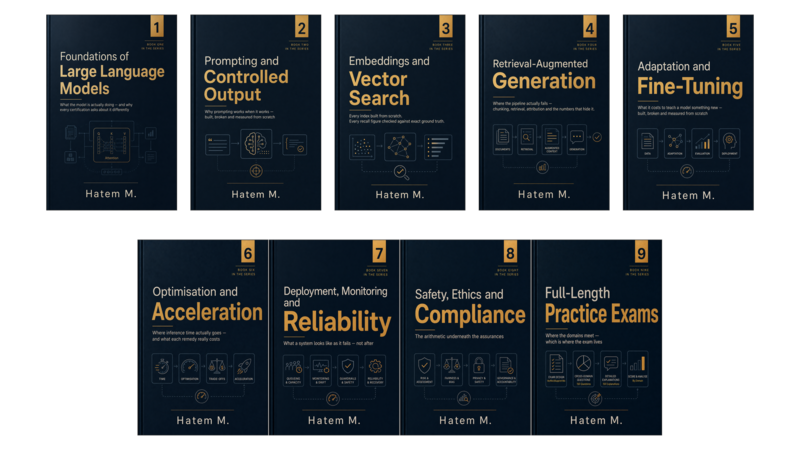
9 Books
- Pricing
$55.00
Minimum priceBought separately$144Suggested price$55.00
- Pricing
$118
Minimum priceBought separately$308Suggested price$118
- Pricing
$70.00
Minimum priceBought separately$220Suggested price$70.00
- Pricing
$139
Minimum priceBought separately$383Suggested price$139
Author
About the Author

Hatem M.
Hatem M. is a programmer and technical author whose work focuses on modern C++, large language models, and AI systems.
His books combine first-principles explanations with complete implementations and reproducible experiments. They include C++ Algorithmic Mastery, an eight-volume series on algorithms and problem solving; Build an LLM Inference Engine in C++, which constructs a GPT-style inference engine from scratch; LLM Quantization: From the Bits Up, which develops the theory and practice of neural network quantization from the bit level upward; and C++ Autopsy, a forensic investigation of ten subtle C++ bugs that compiled successfully, ran correctly, and still produced the wrong answers.
Contents
Table of Contents
The Leanpub 60 Day 100% Happiness Guarantee
Within 60 days of purchase you can get a 100% refund on any Leanpub purchase, in two clicks.
See full terms...
Earn $8 on a $10 Purchase, and $16 on a $20 Purchase
We pay 80% royalties on purchases of $7.99 or more, and 80% royalties minus a 50 cent flat fee on purchases between $0.99 and $7.98. You earn $8 on a $10 sale, and $16 on a $20 sale. So, if we sell 5000 non-refunded copies of your book for $20, you'll earn $80,000.
(Yes, some authors have already earned much more than that on Leanpub.)
Learn more about writing on Leanpub
Free Updates. DRM Free.
If you buy a Leanpub book, you get free updates for as long as the author updates the book! Many authors use Leanpub to publish their books in-progress, while they are writing them. All readers get free updates, regardless of when they bought the book or how much they paid (including free).
Most Leanpub books are available in PDF (for computers) and EPUB (for phones, tablets and Kindle). The formats that a book includes are shown at the top right corner of this page.
Finally, Leanpub books don't have any DRM copy-protection nonsense, so you can easily read them on any supported device.
Learn more about Leanpub's ebook formats and where to read them
Write and Publish on Leanpub
You can use Leanpub to easily write, publish and sell in-progress and completed ebooks and online courses!
Leanpub is a powerful platform for serious authors, combining a simple, elegant writing and publishing workflow with a store focused on selling in-progress ebooks.
Leanpub is a magical typewriter for authors: just write in plain text, and to publish your ebook, just click a button. (Or, if you are producing your ebook your own way, you can even upload your own PDF and/or EPUB files and then publish with one click!) It really is that easy.