Leanpub Header

Skip to main content

Next live session: Thursday, October 15, 2026 · 9:00 am – 10:30 am Pacific · Free · Live on Zoom · No replayReserve My Free Seat →

For anyone who has said “I’m going to write a book” and still hasn’t published one

Books Die Alone.

Yours is probably dying right now. In a folder. Around chapter three.

I’m Peter Armstrong, the founder of Leanpub. Since April 2010 we’ve paid authors over $15 million in royalties, and in these past sixteen years I’ve watched thousands of books grow and flourish.

I've also seen too many others wither and die. It's almost always the same story.

In 90 minutes, live, I’ll show you exactly what a first version actually needs, when to put it in front of readers, and why it's so important to do so.

If you see yourself as an author, but you have never published a book, you need to come to this event. You'll thank me later.

A free 90-minute live presentation on Zoom. No recording, no replay: if you can’t make this date, pick another one. Your link comes by email before we start.

90 minutes · Live on Zoom · Q&A at the end · Free

Next Event

Thursday, October 15, 2026

9:00 am – 10:30 am Pacific

(4:00 PM – 5:30 PM UTC)

The Year Your Book Started Dying

You know the year.

The year you first told someone, “I’m going to write a book.” Maybe it was your partner. Maybe a colleague. Maybe it was the year someone told you that you should.

Then something came up.

A month. “I’ll get to it.”

Two months. “Not right now.”

Six months. Then a year. Then, somehow, two or three years.

And whenever anyone asks, it’s not ready yet.

If you started it, it’s on a hard drive somewhere. Maybe on your desktop for a month or two. Then your home directory. Then a folder called “unfinished books.” Then you don’t see it again.

Here’s what nobody told you: that year wasn’t the year you decided to write a book. It was the year your book started dying.

“Oh, I’m not done.”
— the most common wrong answer in sixteen years of Leanpub support email, when we ask an author with hundreds of good pages why they haven’t published

It Was Never Your Discipline. You Were Following The Wrong Plan.

So you blamed yourself.

I’m not disciplined enough. I don’t have enough time. I have other commitments. Life got in the way. Maybe I’m not really a writer.

I’ve heard every one of those. I’ve said most of them.

What you didn’t know is that you were running a plan that almost never works:

Step 1. Write it in private, until it’s finished.

Step 2. Try to get a publisher, or self-publish it.

Sound familiar? It should. It’s what everyone told you to do. “Don’t show anyone until it’s ready.” “Polish it first.” “Agents only look at finished manuscripts.” “Keep it secret, then do a big launch.”

In software, we have a name for “finish the whole thing, then ship it.” It’s called waterfall. It stopped being cool twenty-five years ago.

And here’s the part that should actually make you feel better. In 2013, the editor of The New York Times Magazine wrote an essay about the shoebox in his closet: twenty-five years of little notebooks full of books he never wrote. His words: “My confidence always collapsed under the weight of my withering self-criticism.”

The editor of The New York Times Magazine had a shoebox.

So it isn’t talent. And it isn’t discipline. More discipline on a plan that doesn’t work just means your book dies at chapter five instead of chapter three.

Writing a book in private is a solitary exercise that takes hundreds of hours. And it is really, really easy to not finish.

Between the day you start and the day you’re done, you’ve got no one. Nobody is waiting. Nobody is reading. Nobody knows. You stopping was not a character flaw. It was the predicted outcome of the conditions.

That’s the diagnosis, in three words:

Books die alone.

Four Ways a Private Book Starves

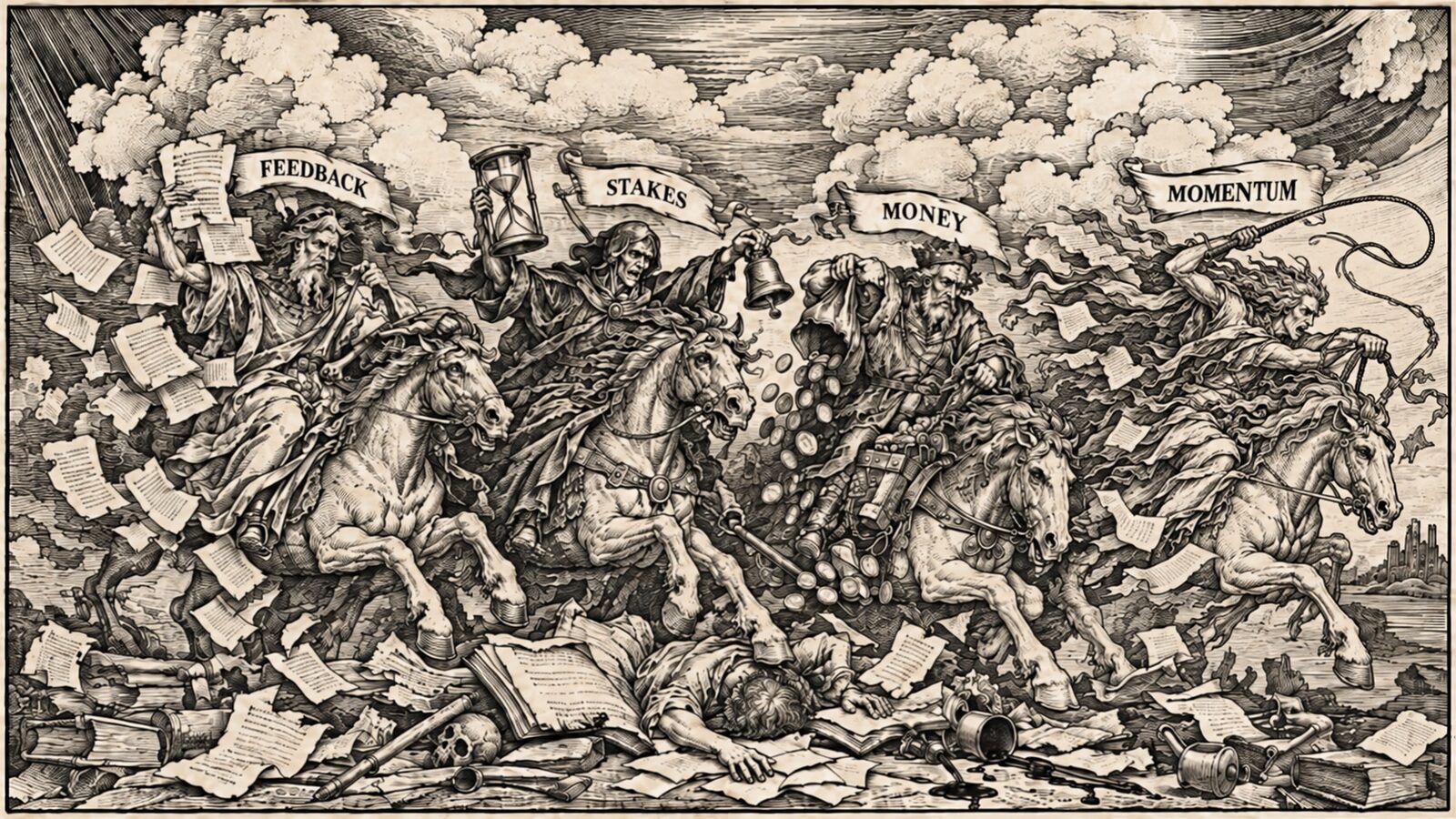
A woodcut of four horsemen labelled Feedback, Stakes, Money and Momentum riding over a fallen writer and the scattered pages of their manuscript

When you write in private, you are starving in four different ways at once. These are the four things that finish books, and the private plan cuts off every one of them.

1. Feedback. In private, you can’t course-correct. You’re guessing, alone, for years.
2. Stakes. In private, nobody’s waiting. Quitting is free.
3. Money. In private, the reward is deferred to the end of a multi-year desert.
4. Momentum. In private, nothing pulls the next chapter out of you.

Starve a book of all four and it dies. Quietly. Around chapter three. In a folder you stop opening.

One honest question: how many of the four is your book starving of right now?

The presentation is where that recognition turns into a plan.

Stealth Mode Isn’t a Cocoon. It’s a Coffin.

A green chrysalis hanging from a blade of grass, beaded with water

Silicon Valley had a name for going away and building the whole thing in secret before anyone sees it. Stealth mode. It was the cool thing to do, until a founder named Steve Blank, six startups, one of them worth over a billion dollars, looked back at his career and said: this is silly. Get out of the building. Talk to the people who are going to buy the thing.

Your book doesn’t have a writing problem. Your book is in stealth mode.

On Leanpub that’s literal. We have a Stealth Mode checkbox. Authors begged us for it, so we built it. And on that page we tell you not to check it, and we link to this presentation.

You might think of stealth mode as a cocoon: the manuscript goes in a caterpillar and comes out a butterfly. It doesn’t. Nothing happens in there. No readers. No feedback. No money. No momentum.

A book in stealth mode isn’t a book. It’s a manuscript. We have a different word for a book that hasn’t been published, and buried in that word is this: it might never be a book. A manuscript is a book whose existence is uncertain.

It was hiding in the language the whole time. The opposite of private is public. And publish means: make public. Same root. Same act.

So here’s the fundamentally different move, and it’s the whole presentation in one sentence:

Publish the book while you’re writing it.

Get real, paying readers, from the first version that can genuinely help someone. Publish early. Publish often. A published book, a book with readers, can’t die alone. Having readers finishes books.

The Most Money I Ever Made From My Book Wasn’t From a Sale

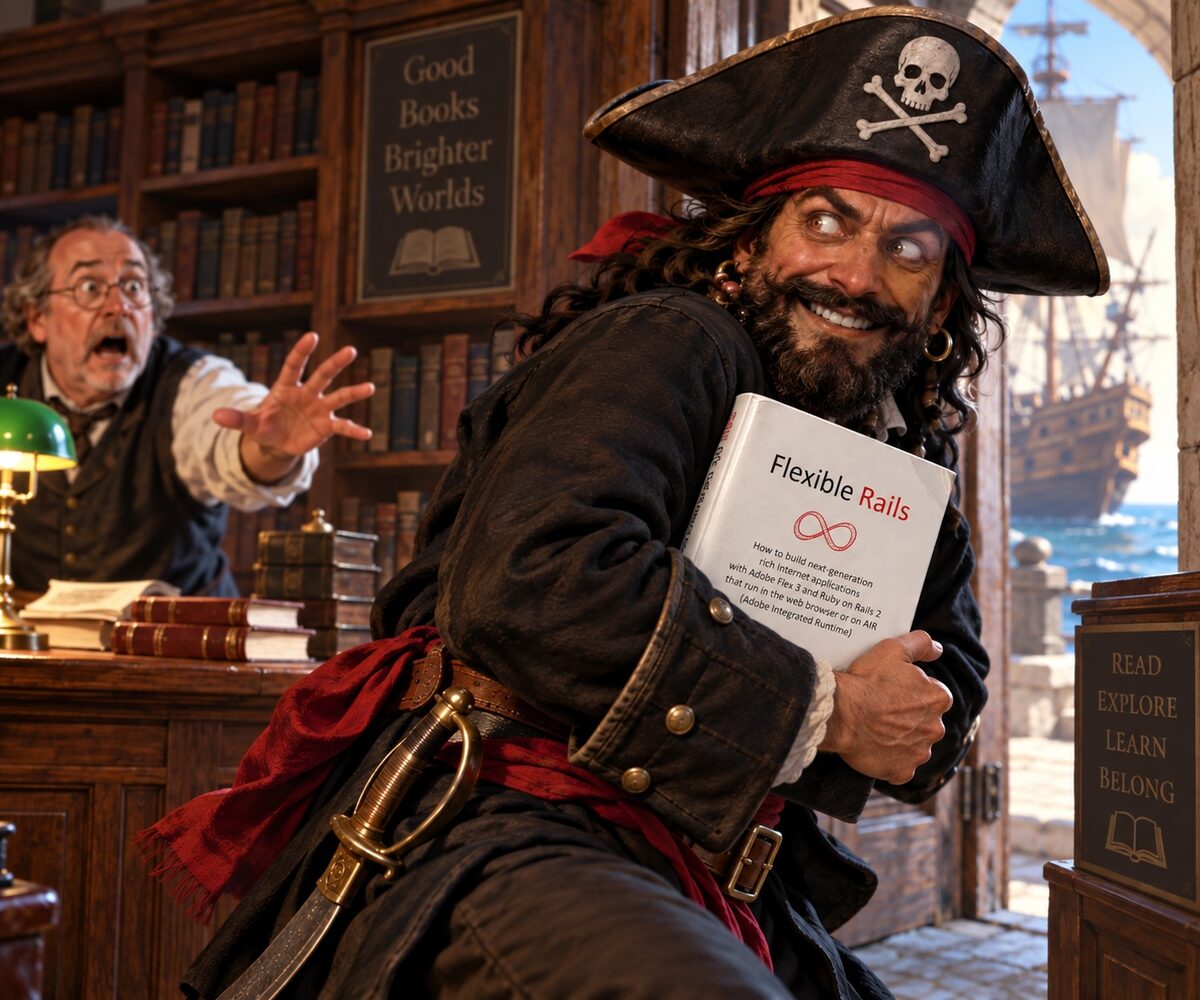
A grinning pirate running out of a bookshop clutching a copy of Flexible Rails while the bookseller shouts after him

In 2007 I was a programmer in a basement in Maple Ridge, BC, and I’d laid the flooring myself. Nobody outside California knew what I could do, and I’m too introverted to fix that by networking.

However, I’d written a book, Flexible Rails, and I published it in progress. Unfinished. With a thank-you note and a secret URL for updates. About a thousand readers around the world bought it before it was done.

Then a stranger in Virginia emailed me asking for an introduction. When we finally met, he told me how he’d found me.

He’d pirated my book.

Someone I had never met saw me as a world expert in his field, because of a book I wrote in a basement. That pirated copy became my fledgling company’s largest client. Millions of dollars of consulting revenue over the years, and the primary funding for the early years of Leanpub.

The unfinished book got hundreds of readers around the world, earning over $13,000 while in-progress, and about $50,000 over its lifetime. Manning turned it into a print book in 2008, because it already had traction. It even got translated into German.

How on earth could I have predicted any of that from a basement? I couldn’t. That’s the point.

It’s not what you know. It’s not who you know. It’s who knows that you know what you know. And a book is the only way I’ve found to scale that if you’re introverted like me.

I. Was. Nobody.

In February 2013 I got on stage in New York at O’Reilly’s Tools of Change conference, in front of a few hundred people from the publishing industry, and gave a talk about publishing books in progress. Leanpub had no funding. I was a random nobody from a bootstrapped startup, and the talk was three years of ideas I’d iterated in public, in a manifesto, in talks, and in a book.

It got written up in The New Yorker. And mentioned on Time.com.

“A book is a startup,” declared Peter Armstrong in a speech about his serialized book company, Leanpub. “I said it in 2010, and I’ll say it again.”
— The New Yorker, March 14, 2013

Believe me, it wasn’t my stage presence. A commenter on the YouTube video said so, and he was right. It was the material. And the material was good because it had been published, iterated and corrected in public for three years before I walked on that stage.

“In stealth mode, it’s very easy to create something that nobody wants.”
— from the same article

This Is Sixteen Years of Proof. And Two Hundred Years Before That.

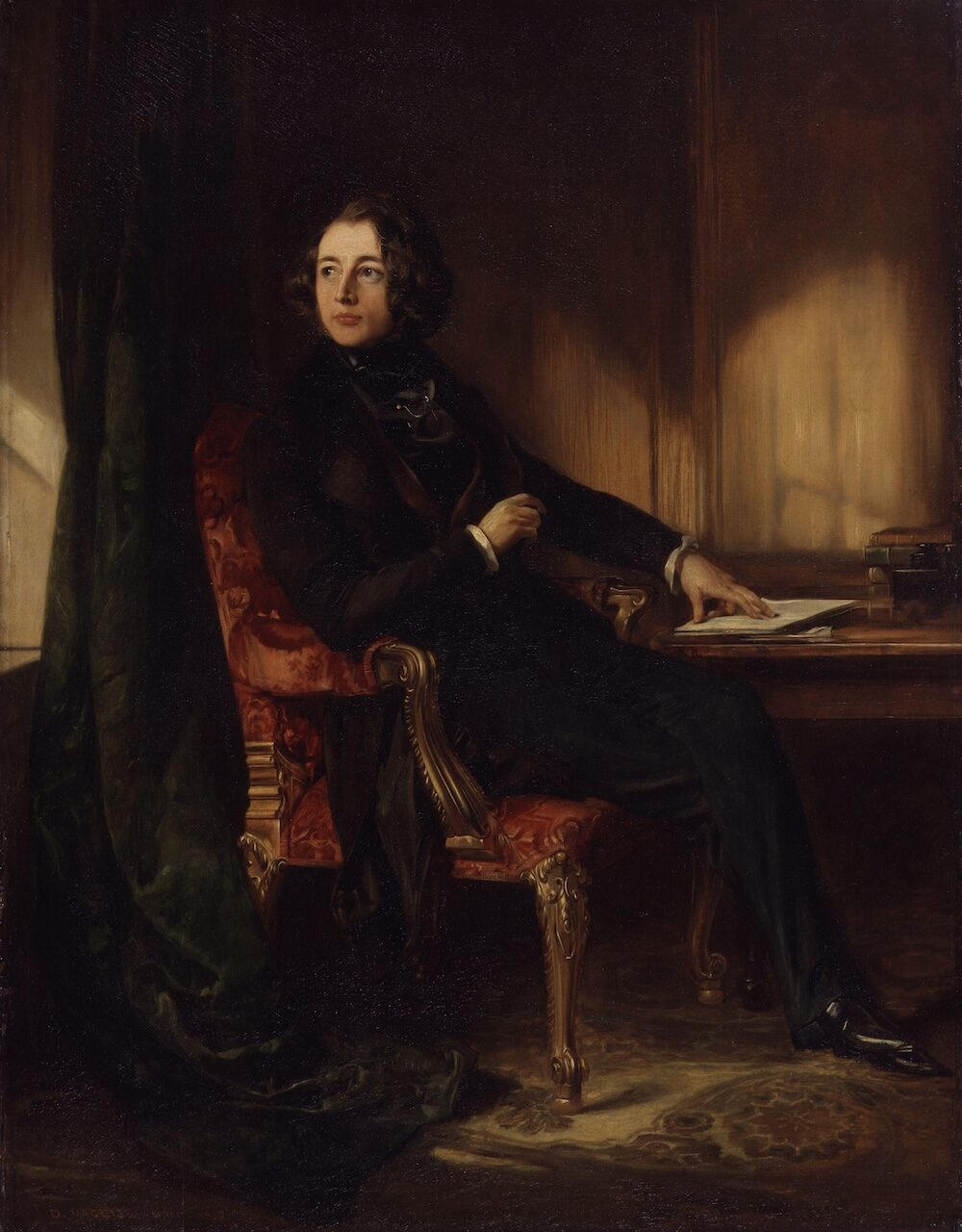
A painted portrait of a young Charles Dickens seated at his desk
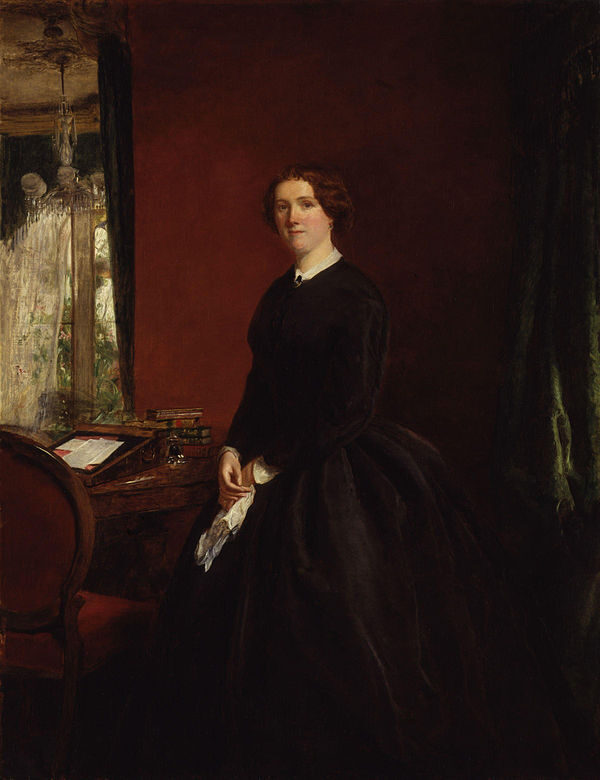
A painted portrait of Mary Elizabeth Braddon standing beside her writing desk

Charles Dickens was twenty-four when he started The Pickwick Papers as a monthly serial in 1836. A few chapters in, his illustrator killed himself and the book had almost no traction. He kept going, because a few hundred readers were waiting for the next instalment. In chapter ten he invented Sam Weller and England fell in love. The first instalment sold 400 copies. The last sold 40,000.

Mary Elizabeth Braddon was told by her publisher, in 1861, “even if you were strong enough to fill the position, there is no time.” She asked how long she had. “Until tomorrow morning.” The opening chapters of Lady Audley’s Secret were on his breakfast table at breakfast. It became the biggest sensation novel of the decade. She went on to write more than eighty novels, two or three a year, while raising six children and editing a magazine.

Anna Karenina, War and Peace, The Brothers Karamazov, Great Expectations, A Tale of Two Cities, The Woman in White: all published in progress, before they were finished. That was the norm. “Finish the whole book first” is about a hundred and twenty years old, an artifact of mass print. Finish-first is the new trick. And it’s the one that rarely works.

Then, from 2010 on, on Leanpub:

  • Jeff Geerling wrote a blog post in 2015 titled “$25,000 in book sales, and I’m almost ready to publish.” He’d iterated Ansible for DevOps in public for almost two years. It’s still on Leanpub, with over 100,000 readers.
  • OpenIntro Statistics, a textbook from a nonprofit, minimum price free: over half a million readers on Leanpub. Most paid nothing. Half a million people found it.
  • Manuel Kiessling joined Leanpub “to just give it a try.” Over 28,000 book sales later, he calls himself the biggest Leanpub fan on the planet.
  • Aaron Sumner went “from first draft to first sale in days, not months or years.”
  • Eric Ries was Leanpub’s first customer, in April 2010. His blog, published post by post, became the Leanpub book we launched with, and then The Lean Startup, a New York Times bestseller. Leanpub is named after it.

Sixteen years. Thousands of in-progress books. Over $15 million paid to authors. Readers regularly pay full price for books that are 30 or 40 percent done.

Building in public built a generation of startups. Early access built the biggest games in the world. Everywhere humans try publish-while-building, the same two things happen: the thing gets finished, and an audience exists on launch day.

Books are not the exception. Books were just the last holdout.

About Peter Armstrong

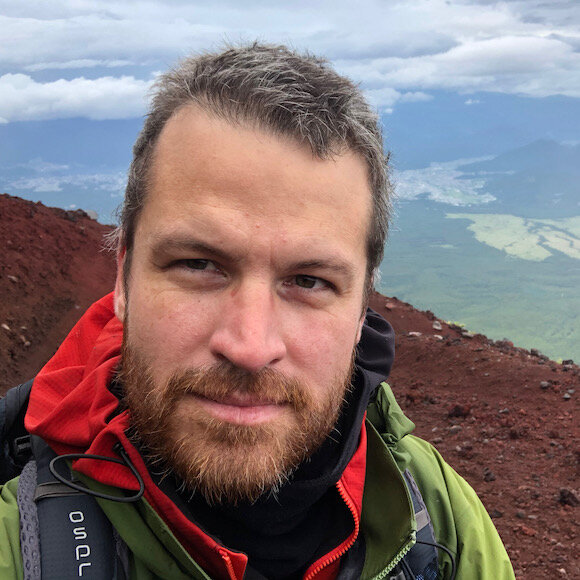
Peter Armstrong, on a mountainside in a red and green jacket

I’m Peter Armstrong, the founder of Leanpub. I’m a programmer who became an author by accident, and a founder because of what the book did.

The highlights, in case we haven’t met:

  • I ran the experiment on myself first, both ways, before Leanpub existed. Flexible Rails, 2006 to 2007: published in progress, about a thousand readers, a Manning print deal and a German edition. Then two publishing contracts at the same time, done “properly,” in private. One died at a few chapters. The other went to print and was obsolete a week later. I’m not describing you from the outside. I’m patient zero.
  • I said “a book is a startup” in 2010 and built a company on it. Leanpub launched in April 2010. Our first customer was Eric Ries. Our motto was, and is, publish early, publish often. Our logo is a progress bar inside a book.
  • In 2013 I got a university library card, fourteen years after I graduated, to find out how serial fiction actually worked in the 1800s, before I said it on stage. Dickens, Braddon, Collins. Everything in the presentation’s history section comes from those books, not from a summary of them.
  • Tools of Change, New York, 2013. The talk that put Leanpub in The New Yorker and on Time.com, then a round-the-world tour giving it: Frankfurt, Brisbane, San Francisco, Edinburgh, Abu Dhabi.
  • Sixteen years of author email. Thousands of books I’ve watched grow and live, and thousands more I’ve watched wither and die. Nobody else has that dataset, because Leanpub books don’t use ISBNs. My co-founder called it the dark matter of the publishing industry.

And one confession, because it’s the reason I’m doing this at all: after 2015, I stopped giving the talk. I’d done the manifesto and the book and I just wanted to write code. A decade of doing and no telling. As a founder, or an author, that’s nowhere near enough. You have to market your ideas. This presentation is me taking my own advice again, in public, weekly, getting better each time.

“But I’ve Followed the Writing Advice.”

Some of you did everything right. You bought the courses. You built the outline. You got up at 5 am. You told yourself: this time.

And it still isn’t published.

Here’s why, and it matters: every one of those things is a better shovel for the same hole. Word. Development editors. Publishers. Courses. Coaches. Retreats. Apps. Not one of them changes where your book lives. And where it lives is what’s killing it.

A development editor is a proxy for readers. A better proxy for readers is readers.

“I Don’t Have Time.”

I know. Braddon didn’t either. Six kids, a magazine to edit, and a publisher telling her there was no time. She put the first chapters on his breakfast table the next morning. She did not write a novel overnight. She wrote enough to start. That was enough.

It used to take somewhere between a hundred and a thousand hours to get a book out. The presentation shows you what a first version actually needs, and it’s a lot less than you think. Books a lot less done than yours are out there, helping people. You could too.

“Nobody Knows Who I Am.”

Neither did anyone know me. I was nobody, in a basement, with a book. Then a stranger pirated it and became my biggest client. Then The New Yorker quoted me. Not because I was somebody. Because my ideas were good enough to get me on a stage where they could hear them.

One of the most important reasons to write a book is to increase what Jason Roberts calls your luck surface area. Luck equals doing times telling. A published book is doing and telling at the same time, over and over, with every new version.

“Someone Will Steal My Idea.”

It does happen. It’s not an illegitimate fear. I’ve had my ideas copied. And so what? What if nobody wants to steal your idea? That’s the way worse thing. The only real fear is obscurity. By default, nobody cares about your book, and getting them to care is work that only starts once it’s public.

“Isn’t Publishing With AI Just Slop?”

We did not build our AI tools as tools for slop. First and foremost, they are a way to pull an outline out of you, either for a book or for a specific chapter of the book. Chances are that's what you need the most. You can get tons of benefit from AI tools even if you don't use a single word that AI can help you write. We built them to get you, the author, from the blank page to a first version faster, in your voice. You talk. It writes. You fix. Then you iterate in public, with your readers. You don’t need them: authors have earned fifteen million dollars on Leanpub without AI. I’ll show you both ways in the presentation. We have improved outlining modes that are free, and we have paid AI outlining and writing tools that help you get there even faster. You can use AI like a development editor, like a copy editor, like an outliner, like a co-author, or like a ghostwriter. It's entirely up to you. We don't care. We support all of it.

What’s a Week Worth?

Weeks since then:

(this year − that year) × 52

Each of those weeks is one you will never get back. Never again.

Now the other side of it. Every version you publish is a new reason for someone to find you: a reader, a client, a job, a stage. How much serendipity has stealth mode cost you this month? What lucky breaks did you miss because the only copy of your expertise is on your hard drive?

If you’re working nine to five and coasting in your spare time, you’re not starting your snowball. Every week you don’t, the inertia gets heavier.

Don’t be one of those people who “has a book in them.” That’s a tragic statement.

Is This Presentation Actually For You?

Be honest. It’s built for one of three people:

Person 1. You’ve started. More than once. There’s a file. Maybe two or three. One or two chapters in, and then a deadline at work, or something at home, and you’ve forgotten where you were. You’re smarter and more ambitious than most, and harder on yourself than most. You want to know why it keeps stopping, because “more discipline” clearly isn’t it.
Person 2. You’ve got hundreds of pages. You’re “not done.” It’s good. You know it’s good. And it has never been seen by anyone but you and, occasionally, your spouse. Every time someone asks, it’s not ready yet. You need to hear, from someone who has watched thousands of books, what “ready” actually means.
Person 3. You’ve been told for years that you should write a book. By clients, by colleagues, by your family. You have decades of experience, a unique perspective, something the world would be better off reading. And your book doesn’t exist. You want to see what the first step actually looks like before you take it.

If any of those is you, this is the most useful 90 minutes you’ll spend this year, and it costs nothing.

If you want to keep writing in private until it’s perfect and then do a big launch, this presentation will spend 90 minutes explaining, politely, why that plan almost never works. Come anyway. But that’s what you’re signing up for.

Inside the 90 Minutes: What You’ll Walk Away With

This isn’t a seminar. It’s a keynote with a chat window, and everything in it is about getting your book out of your head and into the world. No filler, no busywork, no “mindset.”

  • The what, the why and the when. What to publish first, why it works when everything else you’ve tried has failed, and when to do it. The whole method. Yours to keep. Free.
  • The diagnosis. Why books die alone, and the four things a private book starves of: feedback, stakes, money and momentum. Once you can name them, you can feed them.
  • The villain, named. Stealth mode: where it came from, why the whole industry believed in it for a hundred and twenty years, and why you did too. It’s not your fault.
  • The history nobody taught you. Dickens at chapter two, Braddon at the breakfast table, Tolstoy in a magazine. How every great book was published before it was finished, and what changed in 1900.
  • The Minimum Viable Book. What a first version actually needs to genuinely help someone, and why readers pay full price for a book that’s 30 percent done.
  • The three free ways to write on Leanpub, live in the browser: minimal, visual and source, plus outline mode, built for the one question I hear most from stuck authors: “how do I proceed?”
  • The AI tools, shown honestly. GhostAI and AI Studio, outlining a real in-progress book on screen, and exactly where they cost money.
  • Book Weekend, and the deal. At the end, I’ll show you the guaranteed way to go from nothing to a published in-progress book in two days. Some of what you’ll see is free. Some costs money. I’ll be completely straight with you when we get there. Deal?
  • Live Q&A. Ask me anything about your book, your topic, your title.

Real Authors. Real Books. All Public.

Every one of these is on our site right now, or said on camera on the Leanpub Podcast and in our launch videos.

  • “I went from first draft to first sale in days, not months or years.”

    Aaron Sumner, Everyday Rails Testing with RSpec

  • “Four years ago, I joined Leanpub to just give it a try. Today, over 28,000 book sales later, I cannot help but say that I'm the biggest Leanpub fan on this planet!”

    Manuel Kiessling, The Node Beginner Book

  • “With Leanpub, the first person who purchased my book for $9.99 almost two years ago (and only received a preface, and two short intro chapters) has had access to almost every bit of knowledge I've gained in those two years, and that's the value.”

    Jeff Geerling, Ansible for DevOps

  • “Leanpub helped me gauge interest in my book, get payments early on when it was only a few chapters, and has got me a bunch of sales just from people browsing around the site.”

    Phil Sturgeon, Build APIs You Won't Hate

  • “I earn more royalties from my books on Leanpub than I do with well established publishers or through Amazon.”

    Paul Bradshaw, runs the MA in Online Journalism at Birmingham City University

  • “Leanpub helps me see my books as I write them. Even better, I can find readers early, to read my books and offer suggestions. I can pivot, if I see the need.”

    Johanna Rothman, author of 18 Leanpub books and counting

  • “Its simple, easy to use interface got my book up and making money within weeks.”

    Samantha Laing, Growing Agile

  • “I spent my entire time budget and energy budget writing the first two chapters. And then your platform helped me to stay alive and push it all the way.”

    Dr. Ryan Rad, The Agentic AI Book

  • “I've written a couple of books on this already, published through traditional publishers. I don't think this book would have happened without Leanpub.”

    Hillel Wayne, Logic for Programmers

  • “As an academic, I like Leanpub because it lets me write and get my ideas out there quickly. Leanpub is simply the best place for publishing my books.”

    Roger D. Peng, Associate Professor of Biostatistics, Johns Hopkins

  • “You can just write a chapter, commit, and boom, you have your book in your hand. I would never have finished that book with Word.”

    Romano Roth, The Cybernetic Enterprise

  • “I decided to terminate my contract with my publisher and just go my own, because I want to write directly to the people without anyone in between calling any shots.”

    Jay LaCroix, Learn Linux TV, Switching to Linux

  • “Having written for some of those big publishers, I received my first royalty statement for 27 cents.”

    Pete Zerger, CISSP: The Last Mile, on why 80% royalties matter

  • “Thanks to Leanpub, it did very well. They translated it into 13 languages. That has started a speaking tour all around the world.”

    Joe Justice, Scrum Master

  • “I love Leanpub. It's great.”

    Jeff Sutherland, co-creator of Scrum, First Principles in Scrum

Days. Weeks. A few chapters. Those aren’t my words.

Here’s Everything You Get. For Free.

The Free seat

  • The full 90-minute live presentation on Zoom with Leanpub founder Peter Armstrong. Live, with the chat open.
  • The whole method: what to publish first, why it works, and when. Yours to keep.
  • Live Q&A at the end.
  • A Leanpub account, free, if you don’t have one. You can write, preview and publish an in-progress book on it the same day, for nothing.

Your price: Free.

Thursday, October 15, 2026

9:00 am – 10:30 am Pacific

(4:00 PM – 5:30 PM UTC)

Enter your email to get started

Already have a Leanpub account?

By registering you agree to being recorded, to Leanpub quoting what you say as a testimonial, and to email about the event.

A free 90-minute live presentation on Zoom. No recording, no replay: if you can’t make this date, pick another one. Your link comes by email before we start.

Want to arrive with pages? Add the Pro Ticket, $79.

Most people come to the presentation with an idea. Pro Ticket holders come with an outline and real chapters, because the AI tools are live from the moment you buy.

  • One month of Ultra Author Membership, Leanpub’s top author tier, live the day you buy ($99 value).
  • GhostAI in the Leanpub editor, with ten times the monthly AI usage of our Max membership. Enough to outline your whole book and edit real chapters before the presentation.
  • VIP support, and progress toward a month on The Shelf.
  • Unlimited previews and publishes, custom themes, print-ready PDF export.
  • Your $79 applies in full to Book Weekend, credited automatically at checkout when you’re signed in.

Your price: $79, once. Nothing renews. When the month ends, it ends.

Every Leanpub purchase, this one included, carries the Leanpub 60 Day 100% Happiness Guarantee: a full refund, in two clicks, within 60 days.

If You Want It Published In-Progress In A Weekend

The presentation teaches the what, the why and the when. The how is a weekend.

Book Weekend is two days live on Zoom with me, Saturday and Sunday, 7 am to 2 pm Pacific. In the first hour on Saturday, your book has a public landing page. Stealth mode: unchecked. By lunch it’s outlined, with the AI doing the pulling. On Sunday at eleven, everybody clicks publish at the same time. Then we work on marketing it.

Published in progress on Sunday. Guaranteed. Publish your first version on Sunday, or choose a seat at any later Book Weekend or a full refund.

It’s $497, once, with six months of Ultra Author and the GhostAI Plugin, forever, in the ticket. Twenty seats a weekend. And when you publish on Sunday, you win the black Leanpub T-shirt and the Finish Line prices.

You don’t need to decide that today. Come to the presentation first. That’s what it’s for.

Questions

Is there a replay?

No. The presentation is live and it isn't recorded for registrants. If you can't make this date, pick another one: it typically runs several times a week, live, and every session is a little better than the last, because I'm running this playbook on the presentation itself.

When is it, and in what time zone?

9:00 to 10:30 am Pacific on the date you pick; the page shows it in your local time. The page shows the next date; “Can't make it? Pick another date” shows the ones after it.

How do I join?

On Zoom. Your link comes by email before the session, and it's on your Leanpub library's Events page.

Is it a sales pitch?

The first hour is the method, and it's yours to keep. At the end I'll show you the ways Leanpub can help: some free, some paid, including Book Weekend. I'll tell you which is which, and I'll be completely straight with you when we get there. You'll have already got the whole method by then.

Do I need a Leanpub account?

Reserving a seat creates one, free. You can write and publish an in-progress book on it for nothing, the same day.

I'm not technical. Is this for me?

Yes. You write in your web browser, in an editor that gets out of your way. Nothing to install. The programmers get their own tools; you don't need them.

My book is fiction. Does any of this apply?

Dickens, Braddon, Tolstoy and Collins were all fiction. Yes.

I've never written anything. Can I still come?

Bring the idea. That's the floor. The presentation is about what to do with it first.

What's the Pro Ticket?

$79, once, for a month of Ultra Author live from the moment you buy: GhostAI in the editor, ten times Max's AI usage, VIP support. Enough to arrive at the presentation with an outline and real chapters. The $79 comes off the Book Weekend ticket in full.

What if I buy the Pro Ticket and change my mind?

The Leanpub 60 Day 100% Happiness Guarantee. Two clicks, full refund.

What's Book Weekend?

The guaranteed way to go from nothing to a published in-progress book in two days, live on Zoom with me. $497, twenty seats, and publishing on Sunday wins the black Leanpub T-shirt and the Finish Line prices. It has its own page. The presentation is where you decide whether you want it.

Books die alone. Yours doesn't have to.

Learn the right way forward, in 90 minutes.

Free · 90 minutes · Live on Zoom · No replay · Your link comes by email

The Leanpub 60 Day 100% Happiness Guarantee

Within 60 days of purchase you can get a 100% refund on any Leanpub purchase, in two clicks.

See full terms...

Earn $8 on a $10 Purchase, and $16 on a $20 Purchase

We pay 80% royalties on purchases of $7.99 or more, and 80% royalties minus a 50 cent flat fee on purchases between $0.99 and $7.98. You earn $8 on a $10 sale, and $16 on a $20 sale. So, if we sell 5000 non-refunded copies of your book for $20, you'll earn $80,000.

(Yes, some authors have already earned much more than that on Leanpub.)

In fact, authors have earned over $15 million writing, publishing and selling on Leanpub.

Learn more about writing on Leanpub

Write and Publish on Leanpub

You can use Leanpub to easily write, publish and sell in-progress and completed ebooks and online courses!

Leanpub is a powerful platform for serious authors, combining a simple, elegant writing and publishing workflow with a store focused on selling in-progress ebooks.

Leanpub is a magical typewriter for authors: just write in plain text, and to publish your ebook, just click a button. (Or, if you are producing your ebook your own way, you can even upload your own PDF and/or EPUB files and then publish with one click!) It really is that easy.

Learn more about writing on Leanpub