

- 1. How These Exams Are Built
- The part that can be verified
- The part that cannot be verified
- What makes these questions different
- Answering a cross-domain question
- Summary
- 2. Practice Exam One
- Questions
- Answers and Explanations
- 3. Practice Exam Two
- Questions
- Answers and Explanations
- 4. Practice Exam Three
- Questions
- Answers and Explanations
- 5. Scoring by Domain
- The sheets
- Reading the result
- Working the explanations
- Closing
Full-Length Practice Exams
Where the domains meet — which is where the exam lives

This book is 100% completeLast updated on 2026-08-22
The eight volumes before this one each teach a single domain, and each is deliberately
self-contained. The exams do not ask about domains — they ask about systems, and a system spans
all of them at once.
"A retrieval system is slow, expensive and occasionally wrong — which do you fix first?" needs
retrieval, optimisation and operations together. Every one of the 150 questions here crosses at
least two domains, because that is the specific thing a single-domain book cannot teach you.
Minimum price
$16.00
$16.00
You pay
Author earns
PDF
About
About the Book
This volume exists to repay a design decision.
The eight volumes before it each teach one domain and none refers to any other, so a reader who
buys one gets a complete book rather than a fragment. The cost of that design is the connections
between domains — and the connections are exactly what the certifications test.
Three full-length practice exams, 150 questions, 150 explanations. Every question crosses at
least two domains by construction.
**What is checkable, and checked.** A practice exam whose domain mix does not match the
blueprint trains attention in the wrong proportion. That mix is arithmetic, so it is verified
here rather than claimed:
- **Exam One** — 60 questions to NVIDIA NCP-GENL weighting. Worst deviation from the published
blueprint: 1.0 percentage point.
- **Exam Two** — 50 questions to a blend of NVIDIA NCA-GENL and Databricks weighting. Worst
deviation: 0.0.
- **Exam Three** — 40 questions to a blend of AWS Certified Generative AI Developer and NVIDIA
NCP Agentic AI weighting, with the heaviest emphasis on agent behaviour. Worst deviation: 0.0.
Chapter 1 shows the allocation and the code that produces it, so a reader can rebuild the exams
against a revised blueprint rather than discarding the book when one changes.
**What is not checkable, and is said plainly.** Whether these questions resemble real ones in
phrasing and difficulty cannot be verified by anyone who has not sat the exam, and this book was
written entirely from published objectives. So it prints **no pass mark** — a pass mark would
imply a calibration nobody has established.
What the book does support is comparison within itself. Chapter 5 scores by domain rather than
by total, because a per-domain breakdown survives any mismatch in difficulty: it holds the
instrument constant. A total tells you whether you passed a practice exam; a breakdown tells you
which volume to reread, which is the only actionable output.
**What this book is not.** It is not a reprint — the 427 questions in the other volumes are not
repeated here, and that was verified mechanically against every one of them rather than assumed.
It is not new teaching: no mechanism is explained here for the first time, and where an
explanation needs one it names the volume that measures it. This is the one book in the series
that refers to the others, because connecting them is its entire function.
**Why the distractors are harder here.** On a single-domain question the wrong options are
misconceptions about that domain. On a cross-domain question they are frequently *correct
answers to the wrong domain's version of the question* — an accurate statement about chunking
offered for a problem that is a decode-side cost. The skill being tested is not knowing each
domain but knowing which domain a symptom belongs to, and every explanation names the domain
each wrong option belongs to.
What you get:
- 3 full-length exams: 60, 50 and 40 questions, each allocated to a verified blueprint mix.
- 150 explanations, each naming the volume that measures the mechanism and identifying which
domain every wrong option belongs to.
- Scoring sheets by domain for all three exams, and four result patterns with what each calls
for.
- A chapter on how the exams were constructed, including the allocation code.
You will get little from this book without the material behind it. The explanations assume the
mechanisms rather than teaching them, and a reader working these exams cold will score badly and
learn less than the score suggests.
Written to the published objectives of NVIDIA NCP-GENL, NVIDIA NCA-GENL, AWS Certified
Generative AI Developer – Professional, Databricks Certified Generative AI Engineer, and NVIDIA
NCP Agentic AI. Weightings were taken from the published guides in August 2026; confirm the
current blueprint with the certifying body before you sit.
Every question is original, written from published exam objectives. Nothing is reproduced from,
or based on recollection of, any live examination.
Bundles
Bundles that include this book
The LLM Engineering Series
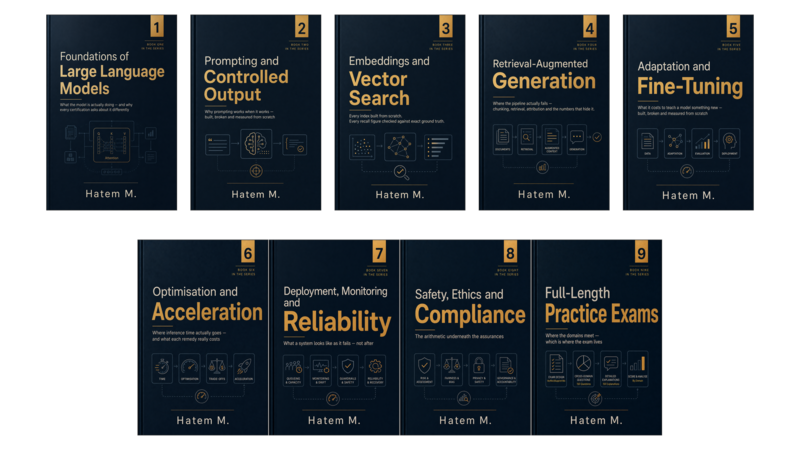
9 Books
- Pricing
$55.00
Minimum priceBought separately$144Suggested price$55.00
- Pricing
$118
Minimum priceBought separately$308Suggested price$118
- Pricing
$70.00
Minimum priceBought separately$220Suggested price$70.00
- Pricing
$139
Minimum priceBought separately$383Suggested price$139
Author
About the Author

Hatem M.
Hatem M. is a programmer and technical author whose work focuses on modern C++, large language models, and AI systems.
His books combine first-principles explanations with complete implementations and reproducible experiments. They include C++ Algorithmic Mastery, an eight-volume series on algorithms and problem solving; Build an LLM Inference Engine in C++, which constructs a GPT-style inference engine from scratch; LLM Quantization: From the Bits Up, which develops the theory and practice of neural network quantization from the bit level upward; and C++ Autopsy, a forensic investigation of ten subtle C++ bugs that compiled successfully, ran correctly, and still produced the wrong answers.
Contents
Table of Contents
The Leanpub 60 Day 100% Happiness Guarantee
Within 60 days of purchase you can get a 100% refund on any Leanpub purchase, in two clicks.
See full terms...
Earn $8 on a $10 Purchase, and $16 on a $20 Purchase
We pay 80% royalties on purchases of $7.99 or more, and 80% royalties minus a 50 cent flat fee on purchases between $0.99 and $7.98. You earn $8 on a $10 sale, and $16 on a $20 sale. So, if we sell 5000 non-refunded copies of your book for $20, you'll earn $80,000.
(Yes, some authors have already earned much more than that on Leanpub.)
Learn more about writing on Leanpub
Free Updates. DRM Free.
If you buy a Leanpub book, you get free updates for as long as the author updates the book! Many authors use Leanpub to publish their books in-progress, while they are writing them. All readers get free updates, regardless of when they bought the book or how much they paid (including free).
Most Leanpub books are available in PDF (for computers) and EPUB (for phones, tablets and Kindle). The formats that a book includes are shown at the top right corner of this page.
Finally, Leanpub books don't have any DRM copy-protection nonsense, so you can easily read them on any supported device.
Learn more about Leanpub's ebook formats and where to read them
Write and Publish on Leanpub
You can use Leanpub to easily write, publish and sell in-progress and completed ebooks and online courses!
Leanpub is a powerful platform for serious authors, combining a simple, elegant writing and publishing workflow with a store focused on selling in-progress ebooks.
Leanpub is a magical typewriter for authors: just write in plain text, and to publish your ebook, just click a button. (Or, if you are producing your ebook your own way, you can even upload your own PDF and/or EPUB files and then publish with one click!) It really is that easy.