Leanpub Header

Skip to main content

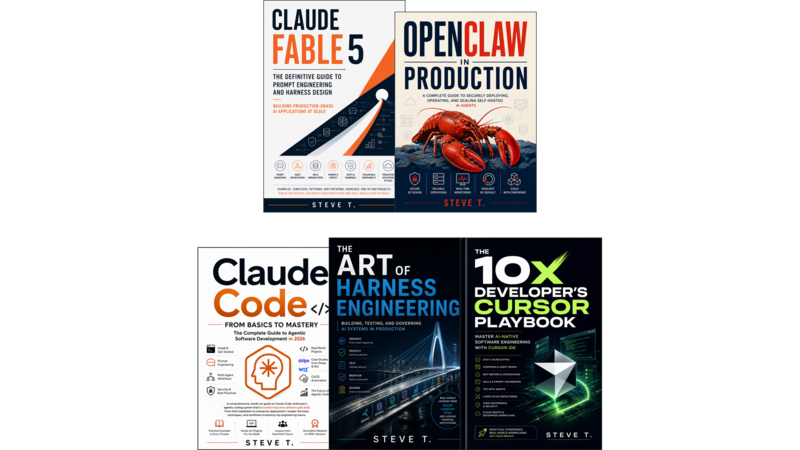
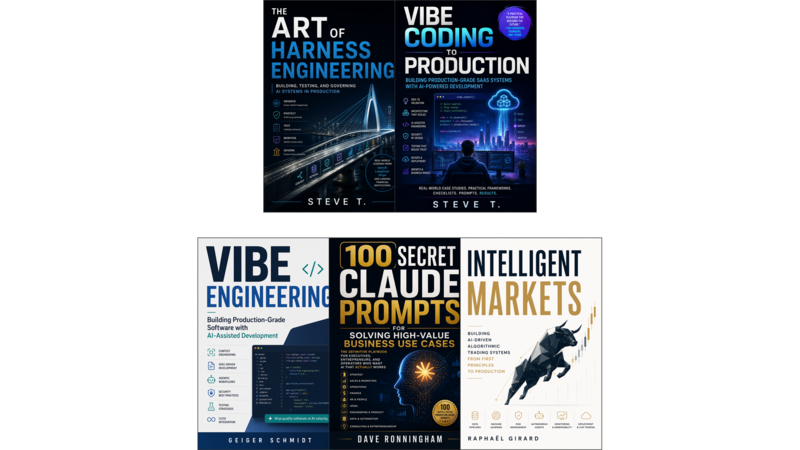
The Art of Harness Engineering

Building, Testing, and Governing AI Systems in Production

This book is 100% completeLast updated on 2026-07-03
The hardest part of building AI is not the model. It is everything around it. The Art of Harness Engineering is a practical guide to the systems, processes, and controls that turn AI prototypes into production-ready products. Covering testing, guardrails, observability, governance, and more, it provides a blueprint for building AI systems that users can trust and organizations can operate with…

Minimum price

$29.00

$39.00

You pay

Author earns

$

Also available for 2 book credits with a Reader Membership

PDF
EPUB
About

About

About the Book

This book is a comprehensive guide to harness engineering: the discipline of designing the scaffolding that wraps around AI models to make them reliable, observable, and governable in production. Whether you are building an internal AI copilot, a customer-facing chatbot, or an autonomous agent system, the model alone will not deliver. The surrounding infrastructure: context management, guardrails, testing, monitoring, and governance: determines whether your AI system succeeds or fails. This book covers the principles, architectures, tools, and practices that constitute the emerging discipline of harness engineering, with real-world case studies from companies like OpenAI, LangChain, Stripe, and major financial institutions. Written for software engineers, AI practitioners, technical leaders, and advanced students.

Bundles

Bundles that include this book

Author

About the Author

Steve T. Publications

Steve T. is a cybersecurity leader, researcher, and engineer with more than 20 years of experience across application security, infrastructure security, vulnerability management, software development, and secure engineering practices. Having built his career alongside the growth of the modern internet, he has worked through multiple generations of technology, evolving security threats, and changing development methodologies.

He is currently part of the advanced research organization at a leading cybersecurity company, where he focuses on emerging threats, security innovation, and the practical application of research. His work involves investigating new attack techniques, evaluating emerging technologies, conducting deep technical analysis, and helping organizations better understand and manage complex security risks.

In addition to his research responsibilities, Steve leads a team of senior engineers and subject matter experts who create technical books, training programs, and educational resources for security professionals. Through this work, he helps engineers, developers, architects, and security practitioners strengthen their skills and build more secure systems.

Steve's technical expertise spans software development, reverse engineering, web application security, penetration testing, security architecture, incident response, vulnerability research, operating system internals, and secure software development. His ability to analyze systems at both the source code and binary levels enables him to bridge the worlds of software engineering, security research, and practical defense.

Over the course of his career, Steve has worked with organizations across a wide range of industries, helping them identify, assess, and remediate security weaknesses in critical applications and infrastructure. He is recognized for combining deep technical expertise with a pragmatic approach to security, focusing on solutions that are effective, sustainable, and aligned with business goals.

Through his work in research, engineering, leadership, and education, Steve continues to contribute to the advancement of cybersecurity and the development of secure, resilient technology systems.

Contents

Table of Contents

Building, Testing, and Governing AI Systems in Production

Introduction: The Model Is Not the Product

  1. A Five-Month Experiment That Changed How We Think About Software Engineering
  2. Why This Book Matters Now
  3. What You Will Learn
  4. How to Read This Book
  5. A Note on Scope

Chapter 1: What Is a Harness? The AI Systems Engineering Problem

  1. From Model to Product: Why AI Needs More Than an API
  2. Anatomy of an Agent Harness: Components and Layers
  3. The Stochasticity Problem: Deterministic Software vs. Probabilistic Models
  4. Cost of Ignoring the Harness: Real-World Failure Stories
  5. Defining the Discipline: What “Harness Engineering” Actually Means
  6. Visualizing the Harness: Architecture Diagrams
  7. Looking Ahead

Chapter 2: Historical Context: From Scripts to AI Pipelines

  1. The Pre-AI Era: Traditional Software Wrappers and Abstractions
  2. Early Machine Learning: Batch Processing and Offline Pipelines
  3. The Deep Learning Revolution: Models as Services
  4. The LLM Inflection Point: From API Calls to Conversational Agents
  5. What History Teaches Us: Patterns of Repeated Innovation

Chapter 3: Foundational Architecture: Designing the Harness

  1. The Canonical AI Application Architecture
  2. Input Preprocessing and Guardrails
  3. Model Orchestration: Routing, Chaining, and Aggregation
  4. Output Postprocessing and Validation
  5. State Management and Context Windows
  6. Scaling Patterns: From Prototype to Production

Chapter 4: Testing AI Systems: A New Paradigm

  1. Why Traditional Testing Fails for AI Outputs
  2. Evaluation Datasets and Test Suites
  3. Regression Testing with Golden Sets
  4. Adversarial and Red-Team Testing
  5. Performance and Latency Testing
  6. Continuous Evaluation Pipelines

Chapter 5: Evaluation Frameworks: Measuring What Matters

  1. Dimensions of AI Quality
  2. Automated vs. Human Evaluation
  3. LLM-as-Judge and Auto-Evaluation Methods
  4. Benchmark Suites and Standardized Evaluations
  5. Building Custom Evaluation Pipelines
  6. Tracking Quality Over Time: Dashboards and Scorecards
  7. Trade-offs: Aggregation Methods for Multi-Dimensional Scores

Chapter 6: Guardrails, Safety, and Governance

  1. The Safety Stack: Input Filters, Output Validators, Policy Engines
  2. Jailbreaks and Adversarial Attacks: What to Guard Against
  3. Content Moderation at Scale
  4. Compliance and Regulatory Requirements
  5. Incident Response and Rollback Strategies
  6. Auditability and Explainability

Chapter 7: Automation, CI/CD, and MLOps for Harnesses

  1. CI/CD for AI Applications (Not Just Models)
  2. Automated Evaluation as a Gate
  3. Model Versioning and A/B Testing
  4. Monitoring and Observability in Production
  5. Alerting, On-Call, and Incident Management
  6. The Feedback Loop: Learning from Production

Chapter 8: Tools of the Trade: Frameworks, Platforms, and Libraries

  1. Orchestration Frameworks: LangChain, LlamaIndex, DSPy, and Alternatives
  2. Evaluation Platforms: Ragas, DeepEval, Arize, WhyLabs
  3. Guardrail Tools: NeMo Guardrails, Guardrails AI, LLM Guard
  4. Monitoring and Observability: LangSmith, Phoenix, Langfuse
  5. Open Source vs. Commercial Tooling Trade-offs
  6. Choosing the Right Stack for Your Team

Chapter 9: Real-World Case Studies

  1. Case Study 1: Enterprise AI Copilot (Internal Tooling)
  2. Case Study 2: Customer-Support Chatbot (Public-Facing)
  3. Case Study 3: AI-Powered Search and RAG System
  4. Case Study 4: Autonomous Agent Workflow (Multi-Step Reasoning)
  5. Cross-Cutting Lessons: What Works, What Does Not

Chapter 10: Economic and Organizational Considerations

  1. The Cost of AI Inference: Token Economics and Optimization
  2. Build vs. Buy Decisions for Harness Components
  3. Team Structures: Who Owns the Harness?
  4. Vendor Lock-In and Portability Strategies
  5. ROI Measurement and Business Value Tracking

Chapter 11: Emerging Trends and Future Directions

  1. Agentic AI and Multi-Agent Orchestration
  2. Multimodal Harnesses: Text, Image, Audio, Video
  3. On-Device and Edge AI Harnesses
  4. The Future of Evaluation: Automated, Continuous, Adaptive
  5. Regulatory Landscape and Compliance Automation
  6. Is Harness Engineering Becoming a Distinct Career?

Chapter 12: Conclusion: The Engineer’s Responsibility

  1. Ten Principles of Great AI Harness Engineering
  2. What We Have Learned About Building with Uncertainty
  3. The Ethical Dimension: Engineers as System Designers
  4. The Open Questions: What We Don’t Know Yet
  5. A Call for Rigor, Humility, and Craftsmanship
  6. The Horse Is Powerful and Fast

References

Get the free sample chapters

Click the buttons to get the free sample in PDF or EPUB, or read the sample online here

The Leanpub 60 Day 100% Happiness Guarantee

Within 60 days of purchase you can get a 100% refund on any Leanpub purchase, in two clicks.

See full terms...

Earn $8 on a $10 Purchase, and $16 on a $20 Purchase

We pay 80% royalties on purchases of $7.99 or more, and 80% royalties minus a 50 cent flat fee on purchases between $0.99 and $7.98. You earn $8 on a $10 sale, and $16 on a $20 sale. So, if we sell 5000 non-refunded copies of your book for $20, you'll earn $80,000.

(Yes, some authors have already earned much more than that on Leanpub.)

In fact, authors have earned over $15 million writing, publishing and selling on Leanpub.

Learn more about writing on Leanpub

Free Updates. DRM Free.

If you buy a Leanpub book, you get free updates for as long as the author updates the book! Many authors use Leanpub to publish their books in-progress, while they are writing them. All readers get free updates, regardless of when they bought the book or how much they paid (including free).

Most Leanpub books are available in PDF (for computers) and EPUB (for phones, tablets and Kindle). The formats that a book includes are shown at the top right corner of this page.

Finally, Leanpub books don't have any DRM copy-protection nonsense, so you can easily read them on any supported device.

Learn more about Leanpub's ebook formats and where to read them

Write and Publish on Leanpub

You can use Leanpub to easily write, publish and sell in-progress and completed ebooks and online courses!

Leanpub is a powerful platform for serious authors, combining a simple, elegant writing and publishing workflow with a store focused on selling in-progress ebooks.

Leanpub is a magical typewriter for authors: just write in plain text, and to publish your ebook, just click a button. (Or, if you are producing your ebook your own way, you can even upload your own PDF and/or EPUB files and then publish with one click!) It really is that easy.

Learn more about writing on Leanpub