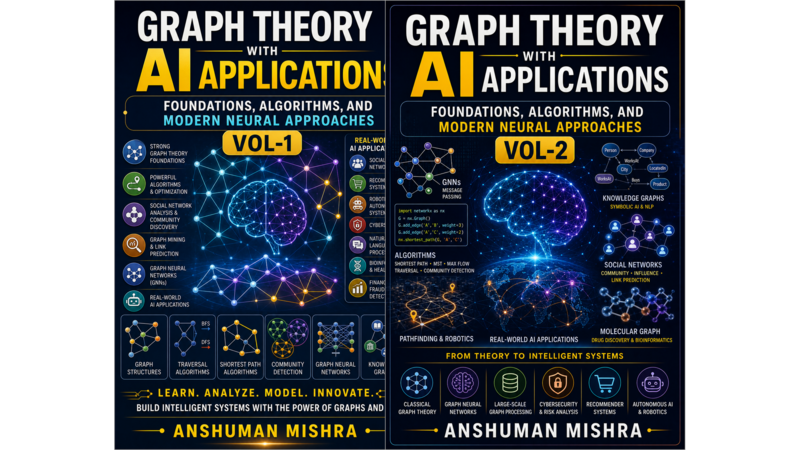
Graph Theory with AI Applications VOL-2
Algorithms and Modern Neural Approaches


The future of Artificial Intelligence is connected.
From social networks and recommendation engines to autonomous vehicles and cybersecurity systems, modern AI increasingly relies on understanding relationships rather than isolated data points.
How do Graph Neural Networks learn from complex networks?
How do recommendation systems predict user preferences?
How can AI detect fraud, misinformation, and cyber threats using graph structures?
How will future Graph Foundation Models transform machine intelligence?
Graph Theory with AI Applications: Foundations, Algorithms, and Modern Neural Approaches (VOL-2) provides a comprehensive guide to the technologies driving the next generation of AI.
Explore Graph Neural Networks, graph embeddings, knowledge graphs, explainable AI, distributed graph learning, and cutting-edge research topics that are reshaping artificial intelligence.
Whether you are a student, researcher, educator, or AI professional, this book will help you understand how intelligent systems learn from relationships, networks, and connected data.
Learn the science behind Graph AI. Build the intelligence behind tomorrow's connected world.
Minimum price
$9.99
$19.99
You pay
Author earns
About
About the Book
Graph Theory with AI Applications: Foundations, Algorithms, and Modern Neural Approaches (VOL-2) continues the journey from classical graph theory into the rapidly evolving world of Graph Artificial Intelligence (Graph AI). While Volume I established the mathematical foundations, graph algorithms, social network analysis, and graph mining techniques, this volume focuses on modern graph representation learning, Graph Neural Networks (GNNs), graph embeddings, explainable graph AI, and emerging research frontiers.
As modern data increasingly takes the form of interconnected networks rather than traditional tabular structures, graph-based machine learning has emerged as one of the most important fields in artificial intelligence. Social networks, recommendation systems, knowledge graphs, cybersecurity infrastructures, molecular structures, financial transaction networks, and autonomous systems all generate graph-structured data that requires specialized learning techniques.
This book provides a comprehensive exploration of Graph Neural Networks, including Graph Convolutional Networks (GCNs), Graph Attention Networks (GATs), GraphSAGE, Message Passing Neural Networks (MPNNs), Relational GNNs, Temporal GNNs, and large-scale industrial graph learning systems.
Readers will learn how graph embeddings such as DeepWalk, Node2Vec, LINE, and Graph Autoencoders enable machines to learn meaningful representations from complex networks. The book further demonstrates how these techniques power recommendation engines, social network analysis, cybersecurity systems, knowledge graphs, natural language processing applications, robotics, and intelligent decision-making systems.
A distinguishing feature of this volume is its strong emphasis on modern AI applications and future research directions. Topics such as explainable graph learning, fairness in graph AI, privacy-preserving graph analytics, distributed graph processing, graph foundation models, neural-symbolic graph reasoning, and quantum graph neural networks are presented in a structured and accessible manner.
Designed for students, researchers, educators, and industry professionals, this book serves as both an academic textbook and a practical reference guide for anyone seeking expertise in graph-based artificial intelligence and modern network learning systems.
Categories
Feedback
Bundle
Bundles that include this book
- Pricing
$29.00
Minimum priceBought separately$39.98Suggested price$29.00
Author
About the Author

Anshuman Kumar Mishra, M.Tech (Computer Science) Assistant Professor, Doranda College, Ranchi University
Prolific Author of 50+ Books on AI, Machine Learning & Computer Science | 20+ Years Experience
Anshuman Kumar Mishra is a dedicated educator, researcher, and highly prolific author with over 20 years of experience in Computer Science and Information Technology. Holding an M.Tech in Computer Science from BIT Mesra, he brings a rare combination of academic depth and practical teaching expertise.
Currently serving as Assistant Professor at Doranda College under Ranchi University, he has mentored thousands of students, helping them build strong foundations in programming, data science, and artificial intelligence. His student-centric teaching style emphasizes conceptual clarity, hands-on practice, and real-world application.
Anshuman is a prolific author with more than 50 books published across a wide spectrum of computer science and emerging technology domains. From foundational programming languages to advanced topics in Artificial Intelligence, Machine Learning, Reinforcement Learning, Decision Theory, and Computer Vision — his books are widely appreciated by students, educators, and professionals for their clear explanations, strong theoretical foundation, and practical approach.
His extensive body of work reflects his deep commitment to making complex subjects accessible and meaningful for learners at all levels. He is particularly recognized for creating well-structured learning paths that help readers progress from beginner to advanced levels with confidence.
Driven by the mission to democratize quality technical education, Anshuman continues to write and update books that bridge the gap between academic theory and industry practice.
When not teaching or writing, he actively follows and explores new developments in AI, Quantum Machine Learning, and Ethical Intelligence systems.
Contents
Table of Contents
The Leanpub 60 Day 100% Happiness Guarantee
Within 60 days of purchase you can get a 100% refund on any Leanpub purchase, in two clicks.
See full terms...
Earn $8 on a $10 Purchase, and $16 on a $20 Purchase
We pay 80% royalties on purchases of $7.99 or more, and 80% royalties minus a 50 cent flat fee on purchases between $0.99 and $7.98. You earn $8 on a $10 sale, and $16 on a $20 sale. So, if we sell 5000 non-refunded copies of your book for $20, you'll earn $80,000.
(Yes, some authors have already earned much more than that on Leanpub.)
Learn more about writing on Leanpub
Free Updates. DRM Free.
If you buy a Leanpub book, you get free updates for as long as the author updates the book! Many authors use Leanpub to publish their books in-progress, while they are writing them. All readers get free updates, regardless of when they bought the book or how much they paid (including free).
Most Leanpub books are available in PDF (for computers) and EPUB (for phones, tablets and Kindle). The formats that a book includes are shown at the top right corner of this page.
Finally, Leanpub books don't have any DRM copy-protection nonsense, so you can easily read them on any supported device.
Learn more about Leanpub's ebook formats and where to read them
Write and Publish on Leanpub
You can use Leanpub to easily write, publish and sell in-progress and completed ebooks and online courses!
Leanpub is a powerful platform for serious authors, combining a simple, elegant writing and publishing workflow with a store focused on selling in-progress ebooks.
Leanpub is a magical typewriter for authors: just write in plain text, and to publish your ebook, just click a button. (Or, if you are producing your ebook your own way, you can even upload your own PDF and/or EPUB files and then publish with one click!) It really is that easy.