From Zero to ChatGPT VOL-2
The Complete Journey of Building Your Own AI Chatbot


As the author, I (Anshuman Mishra) have written this book with the spirit of mentorship — not just to explain how chatbots work, but to help you build one confidently and ethically. I have taught AI, programming, and computer science for nearly two decades, and I have seen countless students struggle to bridge the gap between theory and implementation.
This book closes that gap. It teaches you what to do, why to do it, and how to do it right. It’s not just a manual — it’s a journey from curiosity to mastery.
You are not just learning to build a chatbot; you are learning to create intelligence — responsibly, creatively, and with purpose.
Minimum price
$19.00
$29.00
You pay
Author earns
About
About the Book
PREFACE
The Rise of Conversational AI
In the last two decades, humanity has witnessed a digital transformation that transcends imagination. Computers have evolved from simple calculators to intelligent systems capable of understanding human language, emotions, and context. Among these milestones, one of the most revolutionary breakthroughs is Conversational Artificial Intelligence (AI) — the art and science of enabling machines to talk, reason, and respond like humans.
The roots of conversational AI can be traced back to the early 1960s, when Joseph Weizenbaum at MIT created ELIZA, a rule-based program that mimicked a psychotherapist. Though limited in its capability, ELIZA marked the dawn of human–machine dialogue. Over the years, technological evolution gave birth to ALICE, Siri, Cortana, Alexa, and Google Assistant — each more capable, contextual, and human-like than its predecessor.
However, the true leap came with Transformer-based architectures introduced by Google in 2017. This innovation unlocked the potential of Large Language Models (LLMs), capable of understanding not just words, but relationships, context, and intent. With OpenAI’s GPT series, conversational AI entered a new era — an age where chatbots could write essays, solve equations, generate poetry, design code, and engage in philosophical discussions.
Today, conversational AI is no longer a novelty — it is a necessity. From customer service and healthcare assistance to education, programming, and entertainment, chatbots have become integral parts of our digital ecosystem. They streamline workflows, bridge communication gaps, and extend human intelligence through machine augmentation.
The rise of ChatGPT and similar models represents a paradigm shift — from interaction to collaboration. These systems are not just answering questions; they are thinking companions, learning assistants, and creative co-authors. They can summarize vast data, personalize responses, and even adapt to a user’s tone or style.
The fusion of Machine Learning (ML), Natural Language Processing (NLP), and Deep Learning has made it possible to replicate aspects of human cognition in computational form. Yet, behind this innovation lies complexity — architectures, datasets, fine-tuning, ethical design, and vast infrastructure. This complexity inspired the need for this book.
Why This Book?
As a researcher and educator with more than eighteen years of experience in computer science, I have seen how rapidly AI technologies evolve — and how students, developers, and even professionals often find it difficult to keep pace. When the world talks about ChatGPT, Bard, Claude, or Gemini, most discussions remain surface-level: “It’s a chatbot that answers questions.” But what lies beneath these systems?
How do they actually understand human intent, generate coherent text, and learn from feedback?
How does one build such a system — from zero?
This book was written to answer those questions — not as an abstract discussion, but as a complete, step-by-step journey. It is designed for those who not only want to use chatbots but also create, train, and deploy them with full technical understanding.
The title — From Zero to ChatGPT — symbolizes exactly that journey:
starting from fundamental principles and ending with advanced AI-driven architectures. The book does not merely teach how to code a chatbot; it reveals how to think like an AI engineer — how to integrate data, design NLP pipelines, train models, deploy them, and optimize performance in real-world settings.
This book was born out of a dual motivation:
- Educational Purpose: To provide a clear, structured, and practical guide that transforms theoretical AI knowledge into actionable skills.
- Inspirational Purpose: To empower learners to go beyond imitation — to innovate, experiment, and contribute meaningfully to the evolving field of conversational intelligence.
Every chapter of this book bridges academic concepts with industry practice. It combines the logical precision of a computer scientist with the creative curiosity of a researcher. Whether you’re a student aiming to build your first chatbot or a professional architecting an enterprise-grade AI system, this book is your roadmap.
Who Should Read This Book
This book is written with three primary audiences in mind — yet its scope extends to anyone curious about AI-driven communication.
1. Students and Learners
If you are pursuing Computer Science, BCA, MCA, or B.Tech, and are eager to understand how machines think and communicate, this book is your guide. It begins with simple rule-based chatbots and gradually takes you to the realm of large-scale AI systems.
You will learn how to preprocess text, design conversation flows, implement transformer models, and even fine-tune LLMs.
Each concept is supported with step-by-step coding examples, making learning experiential and practical.
2. Developers and Industry Professionals
For software engineers, data scientists, and NLP practitioners, this book provides real-world implementation insights. You will explore frameworks like Rasa, Dialogflow, LangChain, and Hugging Face, understand API integration, and learn deployment strategies using Docker, Flask, Kubernetes, and cloud environments.
The book helps bridge the gap between theoretical AI and scalable production systems — a crucial skill in today’s fast-evolving tech industry.
3. Researchers and Innovators
For research scholars, educators, and scientists exploring Natural Language Understanding, Reinforcement Learning, or Cognitive AI, this book serves as both a reference and a catalyst. It includes discussions on transformer architecture, Reinforcement Learning from Human Feedback (RLHF), ethical implications, and AI alignment.
The goal is not just to replicate ChatGPT but to understand its foundation and improve upon it — ethically, technically, and creatively.
How to Use This Book
This book is designed as both a learning companion and a technical reference. The chapters are arranged sequentially to represent the complete lifecycle of building a chatbot — from concept to deployment.
Here’s how to navigate it effectively:
1. Progressive Learning Path
- Part I introduces the foundational theory — NLP basics, chatbot evolution, and transformer models.
- Part II walks you through building your first chatbot step-by-step, starting with rule-based systems.
- Part III explores AI-powered and GPT-based chatbots, focusing on model training, fine-tuning, and integration.
- Part IV addresses infrastructure, deployment, and optimization — making your chatbot production-ready.
- Part V expands into research, team structure, ethics, and future directions, essential for professionals and scholars.
2. Coding Alongside Concepts
Each chapter provides Python code examples, clearly commented and explained. You are encouraged to code while reading — experimenting with the examples on your own system or in a cloud notebook.
All implementations are framework-neutral, allowing you to adapt them using TensorFlow, PyTorch, or Hugging Face Transformers, depending on your comfort level.
3. Research-Oriented Understanding
Beyond programming, the book integrates academic rigor. Key mathematical and architectural principles are simplified and connected with practical relevance.
Diagrams, equations, and structured examples make even complex topics — such as attention mechanisms or RLHF — accessible to learners of all levels.
4. Real-World Focus
You will find case studies from OpenAI, Google, and Meta, along with comparative insights on real chatbot architectures. These serve as blueprints for developing your own scalable solutions.
5. Ethical Awareness
Each technical section is accompanied by a discussion of ethical implications — ensuring you not only build powerful AI but also responsible AI.
You will learn about fairness, bias, data privacy, and international AI laws like GDPR and EU AI Act — preparing you for professional accountability in this field.
6. Learning Outcomes
By the end of this book, you will be able to:
- Understand the complete chatbot architecture, from data collection to deployment.
- Implement a fully functional AI chatbot using open-source tools.
- Integrate large language models (LLMs) such as GPT, Llama, or Claude.
- Apply NLP and ML techniques for contextual conversation.
- Deploy chatbots on web, mobile, and social platforms.
- Contribute to AI research and innovation with clarity and confidence.
Tools, Frameworks, and Code Resources
One of the strengths of this book lies in its hands-on approach. The tools and frameworks discussed are open-source or freely accessible, enabling readers to experiment without expensive licenses or enterprise systems.
Below is a categorized summary of the technologies featured throughout the chapters.
1. Programming and Scripting Languages
- Python 3.10+ – Core language for chatbot and AI development
- JavaScript (Node.js) – For front-end chatbot integration
- HTML/CSS – For web interface creation
2. Core Libraries and AI Frameworks
- TensorFlow / PyTorch – Deep Learning model training
- Hugging Face Transformers – Pre-trained model integration
- NLTK, spaCy, Gensim – NLP preprocessing and linguistic tasks
- LangChain – For LLM application orchestration
- Rasa Framework – For dialogue management and chatbot logic
3. Cloud and Infrastructure Tools
- Google Colab / Jupyter Notebook – For experiments and tutorials
- AWS / Azure / GCP – For large-scale deployment and hosting
- Docker & Kubernetes – For containerized deployment and scalability
- Git & GitHub – For version control and collaborative development
4. Datasets and Training Sources
- Cornell Movie Dialogs Corpus
- PersonaChat
- DailyDialog
- Custom domain-specific datasets
5. Deployment and Integration Tools
- Flask / FastAPI – For creating REST APIs
- Streamlit / Gradio – For interactive chatbot UIs
- Twilio / Telegram / Slack APIs – For cross-platform chatbot integration
6. Visualization and Debugging Tools
- TensorBoard – To visualize model performance
- Weights & Biases (wandb) – For experiment tracking
- Matplotlib / Plotly – For data visualization and analysis
7. Ethics, Evaluation, and Governance
- Fairlearn – For bias detection
- LIME / SHAP – For model interpretability
- Data privacy frameworks based on GDPR and OECD guidelines
All code samples and datasets referenced in this book can be recreated or extended using open resources available on GitHub or official documentation pages.
Author’s Note
As the author, I (Anshuman Mishra) have written this book with the spirit of mentorship — not just to explain how chatbots work, but to help you build one confidently and ethically.
I have taught AI, programming, and computer science for nearly two decades, and I have seen countless students struggle to bridge the gap between theory and implementation.
This book closes that gap. It teaches you what to do, why to do it, and how to do it right.
It’s not just a manual — it’s a journey from curiosity to mastery.
You are not just learning to build a chatbot; you are learning to create intelligence — responsibly, creatively, and with purpose.
Feedback
Bundle
Bundles that include this book
chatgpt
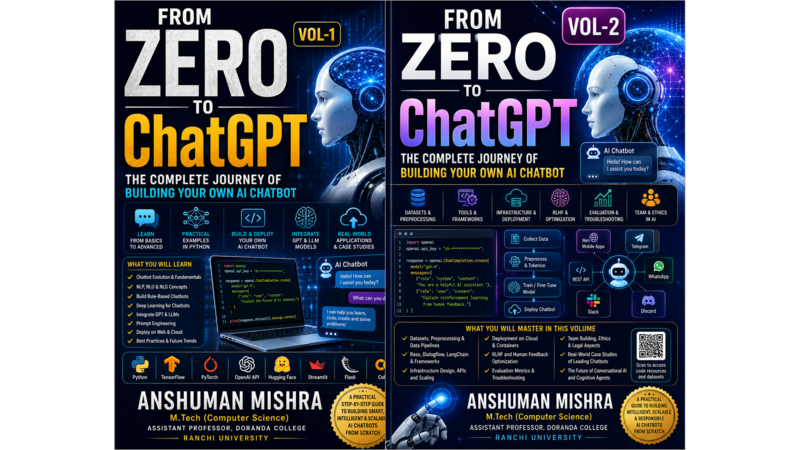
2 Books
- Pricing
$29.00
Minimum priceBought separately$48.99Suggested price$29.00
Author
About the Author

Anshuman Kumar Mishra, M.Tech (Computer Science) Assistant Professor, Doranda College, Ranchi University
Prolific Author of 50+ Books on AI, Machine Learning & Computer Science | 20+ Years Experience
Anshuman Kumar Mishra is a dedicated educator, researcher, and highly prolific author with over 20 years of experience in Computer Science and Information Technology. Holding an M.Tech in Computer Science from BIT Mesra, he brings a rare combination of academic depth and practical teaching expertise.
Currently serving as Assistant Professor at Doranda College under Ranchi University, he has mentored thousands of students, helping them build strong foundations in programming, data science, and artificial intelligence. His student-centric teaching style emphasizes conceptual clarity, hands-on practice, and real-world application.
Anshuman is a prolific author with more than 50 books published across a wide spectrum of computer science and emerging technology domains. From foundational programming languages to advanced topics in Artificial Intelligence, Machine Learning, Reinforcement Learning, Decision Theory, and Computer Vision — his books are widely appreciated by students, educators, and professionals for their clear explanations, strong theoretical foundation, and practical approach.
His extensive body of work reflects his deep commitment to making complex subjects accessible and meaningful for learners at all levels. He is particularly recognized for creating well-structured learning paths that help readers progress from beginner to advanced levels with confidence.
Driven by the mission to democratize quality technical education, Anshuman continues to write and update books that bridge the gap between academic theory and industry practice.
When not teaching or writing, he actively follows and explores new developments in AI, Quantum Machine Learning, and Ethical Intelligence systems.
Contents
Table of Contents
The Leanpub 60 Day 100% Happiness Guarantee
Within 60 days of purchase you can get a 100% refund on any Leanpub purchase, in two clicks.
See full terms...
Earn $8 on a $10 Purchase, and $16 on a $20 Purchase
We pay 80% royalties on purchases of $7.99 or more, and 80% royalties minus a 50 cent flat fee on purchases between $0.99 and $7.98. You earn $8 on a $10 sale, and $16 on a $20 sale. So, if we sell 5000 non-refunded copies of your book for $20, you'll earn $80,000.
(Yes, some authors have already earned much more than that on Leanpub.)
Learn more about writing on Leanpub
Free Updates. DRM Free.
If you buy a Leanpub book, you get free updates for as long as the author updates the book! Many authors use Leanpub to publish their books in-progress, while they are writing them. All readers get free updates, regardless of when they bought the book or how much they paid (including free).
Most Leanpub books are available in PDF (for computers) and EPUB (for phones, tablets and Kindle). The formats that a book includes are shown at the top right corner of this page.
Finally, Leanpub books don't have any DRM copy-protection nonsense, so you can easily read them on any supported device.
Learn more about Leanpub's ebook formats and where to read them
Write and Publish on Leanpub
You can use Leanpub to easily write, publish and sell in-progress and completed ebooks and online courses!
Leanpub is a powerful platform for serious authors, combining a simple, elegant writing and publishing workflow with a store focused on selling in-progress ebooks.
Leanpub is a magical typewriter for authors: just write in plain text, and to publish your ebook, just click a button. (Or, if you are producing your ebook your own way, you can even upload your own PDF and/or EPUB files and then publish with one click!) It really is that easy.