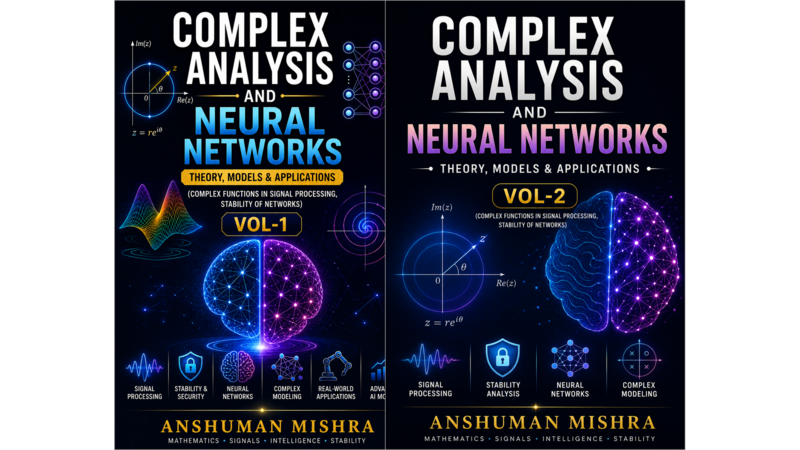
Complex Analysis and Neural Networks Theory Models & Applications VOL-1


⭐ A Few of the Key Highlights Inside the Book
✔ Complete journey from complex numbers to deep neural networks ✔ Elegant derivations with intuitive explanations ✔ Step-by-step contour integration and frequency transforms ✔ Comprehensive guide to complex-valued backpropagation ✔ Rich discussions on stability, robustness, and convergence ✔ Modern architectures including CV-CNN, CV-RNN, CV-Transformers ✔ Radar, ECG, EEG, and communication applications ✔ Industry-level case studies ✔ Python & PyTorch code templatesYou will finish this book with a totally new perspective: AI is not only computation—it is mathematics in motion.
⭐ Message From the Author — Anshuman Mishra
"I wrote this book to fill a gap that no one was addressing. Students were learning deep learning without understanding the mathematics that powers it. Researchers were exploring complex neural networks without a unified, structured foundation. Developers were building AI systems without mathematical stability principles.
This book is my way of contributing to the AI community—by bringing together the beauty of complex analysis and the capability of neural networks in a single practical, inspiring volume.
I want this book to equip you with the confidence, clarity, and tools to succeed in the next generation of artificial intelligence." — Anshuman Mishra
⭐ Final Promise to the Reader
By the time you finish reading this book, you will:
· Understand complex analysis like never before
· Build complex-valued neural networks confidently
· Apply complex functions in real signal-processing scenarios
· Analyze network stability with mathematical precision
· Develop AI models with superior performance
You will not simply learn. You will transform the way you think about AI.
This is your gateway to mastering the intersection of mathematics, signal processing, and next-generation neural networks.
Minimum price
$19.00
$29.00
You pay
Author earns
About
About the Book
Complex Analysis and Neural Networks: Theory, Models & Applications
By Anshuman Mishra
In an age where artificial intelligence is transforming every industry—from communication networks to medical diagnostics, from autonomous systems to next-generation robotics—the demand for deeper, transparent, and more mathematically grounded models has never been higher. While the world talks endlessly about deep learning, the real breakthrough for the next decade lies in complex-valued deep learning—a rapidly emerging, high-performance, mathematically elegant field powered by the remarkable machinery of Complex Analysis.
The book you hold in your hands, Complex Analysis and Neural Networks: Theory, Models & Applications, is not merely another textbook. It is a power-packed bridge between classical mathematics and cutting-edge AI research. Written in an accessible yet deeply insightful style by Anshuman Mishra, this work brings to life one of the most powerful ideas in modern computation: using the geometry, smoothness, analyticity, and stability principles of complex numbers to build superior neural networks.
This book is for three kinds of readers—and each will gain something transformative:
✔ Studentslooking for a solid and understandable introduction to complex analysis, neural networks, and their revolutionary intersection.
✔ Researchersexploring stability theory, new activation functions, complex gradient dynamics, CVNNs (Complex-Valued Neural Networks), and state-of-the-art signal processing architectures.
✔ Developers and engineerswho want practical tools to build safer, stable, more powerful neural systems for real-world applications in imaging, audio, radar, finance, medical decision-making, wireless communication, and autonomous intelligence.
⭐ Why This Book Matters
(And why it has the power to transform your understanding of AI forever)
We live in a world generating trillions of signals every second—audio waves, electromagnetic signals, MRI patterns, radar pulses, seismic vibrations, financial trends, and biological oscillations. Nearly all of these signals are fundamentally complex-valued. And yet, traditional neural networks work only on real numbers.
This mismatch is one of the biggest hidden limitations in modern AI.
Complex-valued neural networks (CVNNs) remove this limitation.
They naturally capture:
· Phase information
· Amplitude variations
· Oscillatory behavior
· Complex frequency components
· Holomorphic smoothness
· Stability conditions through analyticity
This book shows you how—and why—complex numbers revolutionize neural networks in a way that real-valued models simply cannot.
⭐ A Revolutionary Blend of Mathematics and AI
Unlike many books that treat mathematics and neural networks as separate worlds, this text unifies them into one powerful story. You will see how:
· Cauchy–Riemann equations frame activation stability
· Conformal mappings influence neural transformations
· Residue calculus empowers advanced signal models
· Euler’s formula explains oscillatory neural behavior
· Holomorphic activation functions offer superior regularization
· Complex domain gradients create more stable learning paths
· Laplace and Fourier transforms connect directly to network architecture
· Complex-valued RNNs outperform classical RNNs in time-series
· Complex convolution improves radar and sonar analysis
· Complex Transformers excel in communication and signal domains
Every chapter has been written to ensure that you not only learn, but actually see how mathematics becomes a computational engine behind next-generation AI.
⭐ What Makes This Book Unique
If you're wondering what sets this book apart from all others in the marketplace, here are the top reasons:
1. Deep Mathematical Rigor Made Ridiculously SimpleEverything—from analyticity to residues to contour integration—is explained visually, intuitively, and step by step.
2. Real AI Applications, Not Just TheoryReaders learn to apply complex analysis in:
· Wireless networks
· Radar signal processing
· Biomedical analytics
· Image segmentation
· Speech processing
· Financial modelling
· Quantum-inspired neural architectures
3. Full Complex-Valued Neural Network FrameworkThe book builds CVNN from the ground up:
· Complex neurons
· Complex weights
· Complex activation functions
· Complex CNN
· Complex RNN, LSTM, GRU
· Complex Transformers
· Complex reinforcement learning
4. Stability Theory for Deep Learning
You learn how to design provably stable neural networks using:
· Lyapunov theory
· Pole-zero analysis
· Complex gradient stability
· Jacobian spectral analysis
5. Practical Implementation GuideThe final modules include:
· PyTorch code
· Custom complex layers
· Training loops
· Debugging guides
· Case studies
This book is not only theoretical excellence, it is practical mastery.
⭐ Who Should Read This Book?
Undergraduate and Postgraduate StudentsYou will find this book an extraordinary companion if you study:
· Computer Science
· Electronics
· Mathematics
· Artificial Intelligence
· Signal Processing
ResearchersThis text opens many research pathways:
· Complex deep learning
· Holomorphic activation functions
· Complex optimization
· Complex-valued transformers
· Quantum-representational learning
Developers and EngineersWhether building:
· Radar systems
· AI medical devices
· Audio-processing pipelines
· Wireless communication algorithms
· Autonomous navigation systems
…this book gives you the mathematical foundations and real-life tools you need.
⭐ The Writing Style
This work is written in an extremely readable, compelling, and engaging style. It brings together the intellectual beauty of mathematics with the practical power of modern AI. The explanations are motivational, clear, highly visual, and structured.
Readers will feel guided, supported, and inspired as they explore complex ideas without confusion.
⭐ A Life-Changing Resource for AI Enthusiasts
Many readers will experience something extraordinary:
A moment when complex analysis, which once seemed purely theoretical, suddenly becomes the very heart of modern artificial intelligence.
Engineers will see why complex numbers are indispensable.
Students will finally understand what analyticity means in real-world systems.
Researchers will find new directions for publications and research papers.
Developers will write better models, faster, with fewer bugs and more stability.
This is more than a book.
This is a gateway to the future of AI.
⭐ A Few of the Key Highlights Inside the Book
✔ Complete journey from complex numbers to deep neural networks ✔ Elegant derivations with intuitive explanations ✔ Step-by-step contour integration and frequency transforms ✔ Comprehensive guide to complex-valued backpropagation ✔ Rich discussions on stability, robustness, and convergence ✔ Modern architectures including CV-CNN, CV-RNN, CV-Transformers ✔ Radar, ECG, EEG, and communication applications ✔ Industry-level case studies ✔ Python & PyTorch code templatesYou will finish this book with a totally new perspective:
AI is not only computation—it is mathematics in motion.
⭐ Message From the Author — Anshuman Mishra
"I wrote this book to fill a gap that no one was addressing. Students were learning deep learning without understanding the mathematics that powers it. Researchers were exploring complex neural networks without a unified, structured foundation. Developers were building AI systems without mathematical stability principles.
This book is my way of contributing to the AI community—by bringing together the beauty of complex analysis and the capability of neural networks in a single practical, inspiring volume.
I want this book to equip you with the confidence, clarity, and tools to succeed in the next generation of artificial intelligence."
— Anshuman Mishra
⭐ Final Promise to the Reader
By the time you finish reading this book, you will:
· Understand complex analysis like never before
· Build complex-valued neural networks confidently
· Apply complex functions in real signal-processing scenarios
· Analyze network stability with mathematical precision
· Develop AI models with superior performance
You will not simply learn.
You will transform the way you think about AI.
This is your gateway to mastering the intersection of mathematics, signal processing, and next-generation neural networks.
Categories
Feedback
Bundle
Bundles that include this book
- Pricing
$29.00
Minimum priceBought separately$58.00Suggested price$29.00
Author
About the Author

Anshuman Kumar Mishra, M.Tech (Computer Science) Assistant Professor, Doranda College, Ranchi University
Prolific Author of 50+ Books on AI, Machine Learning & Computer Science | 20+ Years Experience
Anshuman Kumar Mishra is a dedicated educator, researcher, and highly prolific author with over 20 years of experience in Computer Science and Information Technology. Holding an M.Tech in Computer Science from BIT Mesra, he brings a rare combination of academic depth and practical teaching expertise.
Currently serving as Assistant Professor at Doranda College under Ranchi University, he has mentored thousands of students, helping them build strong foundations in programming, data science, and artificial intelligence. His student-centric teaching style emphasizes conceptual clarity, hands-on practice, and real-world application.
Anshuman is a prolific author with more than 50 books published across a wide spectrum of computer science and emerging technology domains. From foundational programming languages to advanced topics in Artificial Intelligence, Machine Learning, Reinforcement Learning, Decision Theory, and Computer Vision — his books are widely appreciated by students, educators, and professionals for their clear explanations, strong theoretical foundation, and practical approach.
His extensive body of work reflects his deep commitment to making complex subjects accessible and meaningful for learners at all levels. He is particularly recognized for creating well-structured learning paths that help readers progress from beginner to advanced levels with confidence.
Driven by the mission to democratize quality technical education, Anshuman continues to write and update books that bridge the gap between academic theory and industry practice.
When not teaching or writing, he actively follows and explores new developments in AI, Quantum Machine Learning, and Ethical Intelligence systems.
Contents
Table of Contents
The Leanpub 60 Day 100% Happiness Guarantee
Within 60 days of purchase you can get a 100% refund on any Leanpub purchase, in two clicks.
See full terms...
Earn $8 on a $10 Purchase, and $16 on a $20 Purchase
We pay 80% royalties on purchases of $7.99 or more, and 80% royalties minus a 50 cent flat fee on purchases between $0.99 and $7.98. You earn $8 on a $10 sale, and $16 on a $20 sale. So, if we sell 5000 non-refunded copies of your book for $20, you'll earn $80,000.
(Yes, some authors have already earned much more than that on Leanpub.)
Learn more about writing on Leanpub
Free Updates. DRM Free.
If you buy a Leanpub book, you get free updates for as long as the author updates the book! Many authors use Leanpub to publish their books in-progress, while they are writing them. All readers get free updates, regardless of when they bought the book or how much they paid (including free).
Most Leanpub books are available in PDF (for computers) and EPUB (for phones, tablets and Kindle). The formats that a book includes are shown at the top right corner of this page.
Finally, Leanpub books don't have any DRM copy-protection nonsense, so you can easily read them on any supported device.
Learn more about Leanpub's ebook formats and where to read them
Write and Publish on Leanpub
You can use Leanpub to easily write, publish and sell in-progress and completed ebooks and online courses!
Leanpub is a powerful platform for serious authors, combining a simple, elegant writing and publishing workflow with a store focused on selling in-progress ebooks.
Leanpub is a magical typewriter for authors: just write in plain text, and to publish your ebook, just click a button. (Or, if you are producing your ebook your own way, you can even upload your own PDF and/or EPUB files and then publish with one click!) It really is that easy.