
The Leanpub 60 Day 100% Happiness Guarantee
Within 60 days of purchase you can get a 100% refund on any Leanpub purchase, in two clicks.
See full terms...
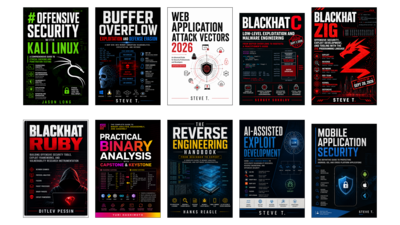
Explore the world of cybersecurity from the inside out with 10 powerful books covering ethical hacking, exploit development, reverse engineering, malware analysis and AI-assisted security research. From breaking down memory corruption and web vulnerabilities to building your own security tools and uncovering how software really works, this bundle delivers the technical knowledge and hands-on insights to sharpen your skills and stay ahead of emerging threats.
Bought separately
$300
Minimum price
$149
$169
About the Bundle
Take your cybersecurity skills to the next level with this collection of 10 in-depth books covering ethical hacking, exploit development, reverse engineering, malware analysis and modern application security. Whether you're a penetration tester, security researcher, developer or aspiring exploit engineer, this bundle brings together the knowledge and practical techniques needed to understand how attacks work and how to defend against them.
Each book focuses on a different area of cybersecurity, giving you a broad foundation and the technical depth to explore more advanced topics.
Offensive Security with Kali Linux walks you through the full penetration testing process, from Linux and networking fundamentals to exploitation, security assessments and professional reporting.
Buffer Overflow Exploitation and Defense Evasion explores memory corruption vulnerabilities, including stack and heap overflows, use-after-free bugs and format string attacks. It also covers exploit development techniques and modern defenses such as ASLR, DEP and Control Flow Integrity.
Web Application Attack Vectors 2026 dives into advanced web security testing, covering injection attacks, authentication bypasses, SSRF, API vulnerabilities, request smuggling, cache poisoning and cloud-native weaknesses.
BlackHat C takes a low-level look at exploitation and malware engineering using C. It focuses on memory manipulation, stack and kernel-level techniques, exploit development and the defensive measures used to detect and prevent these attacks.
BlackHat Zig explores the use of Zig for security-focused development, including exploit research, reverse engineering, network security tools, kernel instrumentation and malware analysis. It shows how a modern systems language can be applied to both offensive research and defensive engineering.
BlackHat Ruby teaches you to build practical security tools with Ruby, from network scanners and protocol analyzers to fuzzers, binary parsers and exploit frameworks. It also examines how these tools work and how defenders can detect and mitigate their use.
Practical Binary Analysis with Capstone & Keystone focuses on disassembly, assembly and binary manipulation. Through hands-on examples in multiple programming languages, you'll learn how to build tools for reverse engineering, binary patching, shellcode analysis and automated code analysis.
The Reverse Engineering Handbook: From Beginner to Expert provides a structured path into software deconstruction, covering assembly, executable formats, debugging, malware analysis, firmware, mobile applications, symbolic execution, fuzzing and modern AI-assisted analysis techniques.
AI-Assisted Exploit Development shows how large language models and AI-powered tools can support vulnerability research, reverse engineering and exploit development. Learn how to integrate AI into existing workflows while accounting for accuracy, validation and operational security.
Mobile Application Security covers the security of Android, iOS and cross-platform applications. It combines penetration testing, reverse engineering, runtime instrumentation, secure coding, cryptography and incident response with practical tools and hands-on labs.
Together, these 10 books offer a broad and technically focused resource for understanding vulnerabilities, analyzing software, developing security tools and strengthening defenses across systems, networks, web applications and mobile platforms.
Whether you're expanding your professional toolkit or building deeper expertise in offensive and defensive security, this bundle gives you plenty to explore, practice and put into action in authorized lab environments.
About the Books

This book takes you on a structured journey through the complete offensive security lifecycle, from foundational Linux and networking concepts to advanced exploitation techniques and professional reporting. Using Kali Linux as your primary platform, you will learn the theory behind every attack vector, the methodology for systematic assessment, and the practical skills needed to conduct authorized penetration tests. Every chapter builds upon previous material, ensuring that complex topics are grounded in solid fundamentals. The emphasis throughout is on ethical practice, defensive understanding, and responsible disclosure within legal, controlled environments.

This book provides a comprehensive, technically rigorous treatment of memory corruption vulnerabilities, from the CPU architecture foundations that make them possible to the advanced exploitation techniques and modern defenses that define today's security landscape. Beginning with computer memory architecture, process layout, and assembly language fundamentals, it progresses through stack-based and heap-based buffer overflows, use-after-free, format string vulnerabilities, and related memory corruption bugs. The book covers exploit development concepts including shellcode, return-oriented programming, jump-oriented programming, and information leaks across both Windows and Linux platforms. Modern mitigations such as DEP/NX, ASLR, stack canaries, Intel CET, ARM PAC, and Control Flow Integrity are examined in depth, along with the ongoing arms race between exploitation research and defense mechanisms. The final chapters address vulnerability research methodologies, fuzzing, secure coding practices, and incident response. This book is intended for security professionals, reverse engineers, vulnerability researchers, and advanced students who want to understand memory corruption at the deepest level for defensive purposes. All techniques described are presented in the context of ethical security research and responsible disclosure.

This book delivers a deep technical exploration of advanced web application attack vectors across modern application architectures. Moving far beyond introductory concepts, it examines sophisticated exploitation techniques including injection attacks, authentication bypasses, client-side vulnerabilities, Server-Side Request Forgery (SSRF), insecure deserialization, API security testing, business logic abuse, web cache poisoning, HTTP request smuggling, cloud-native security weaknesses, evasion methods, exploit chaining, and emerging attack trends.
New in the 2026 Edition
This fully updated edition includes extensive new coverage of the latest research, vulnerabilities, and real-world attack techniques:
Written for intermediate to advanced security professionals, this guide equips penetration testers, application security engineers, security researchers, and developers with the knowledge and practical methodologies required to identify, assess, exploit, and defend against the evolving threats facing modern web applications.

This book teaches how modern attacks work at the level where they actually happen: in memory, on the stack, inside the kernel. It is written for security engineers, penetration testers, malware analysts, and advanced students who already know C and want a rigorous, code-first understanding of exploitation and malware engineering. Each chapter pairs offensive techniques with defensive countermeasures. All examples are intended for isolated, legal, ethical use in a controlled lab environment.

This book explores how Zig, a modern systems programming language focused on zero-cost abstractions, compile-time metaprogramming, explicit memory management, and seamless C interoperability, can be applied across a wide range of cybersecurity disciplines. Topics include exploit development, reverse engineering, network security tooling, red team tradecraft, kernel instrumentation, malware analysis, and defensive security engineering.
The chapters progress from core language concepts to increasingly advanced security applications, combining practical explanations with real-world examples, case studies, and hands-on projects. Along the way, readers will learn how Zig's emphasis on performance, predictability, and low-level control makes it a strong fit for security-focused development.
The book takes an ethical and educational approach throughout. The goal is to understand modern threats and defensive techniques by building and studying the tools used to analyze, detect, and respond to security challenges.

This book teaches intermediate to advanced developers and security practitioners how to use Ruby for offensive cybersecurity work. You will learn to build professional-grade penetration testing tools, network scanners, protocol analyzers, fuzzers, packet processors, binary parsers, and exploit frameworks in controlled laboratory environments. Every chapter provides production-quality, fully functional code that runs in isolated labs, with thorough explanations of mechanisms, tradeoffs, and real-world applicability. Ethical considerations and legal boundaries are woven throughout. By the end, you will understand not only how to build offensive security tooling in Ruby, but also how defenders detect and mitigate these techniques, making you a more effective security professional regardless of which side of the keyboard you sit on.

This is a comprehensive, production-quality guide to two of the most important tools in binary analysis: the Capstone disassembler engine and the Keystone assembler engine. Written for readers ranging from curious beginners to seasoned reverse engineers, it covers theoretical foundations, practical implementation, API usage across multiple programming languages, and real-world applications including malware analysis, exploit development, compiler tooling, and automated binary rewriting. Every chapter includes complete, executable source code examples in C, Python, Rust, Go, Java, and C#, along with case studies, architecture diagrams, comparison tables, best practices, and troubleshooting guidance. By the end of this book, you will be able to build your own disassemblers, assemblers, binary patchers, shellcode analyzers, and reverse engineering automation tools from scratch.

Reverse engineering is the art of understanding software from the inside out. Whether you are a security researcher hunting vulnerabilities, a developer debugging compiled code, or simply someone who wants to understand what really happens when a program runs, this book takes you on a complete journey from fundamental computer science concepts to expert-level binary analysis techniques. Every chapter builds systematically on the last, covering CPU architecture, assembly language, executable formats, static and dynamic analysis tools, malware analysis, mobile reverse engineering, firmware examination, network protocol analysis, obfuscation bypass, symbolic execution, fuzzing, and the emerging role of artificial intelligence in binary analysis. By the time you finish, you will have the knowledge, tooling expertise, and practical experience to deconstruct any binary with confidence.

This book is a practical guide for security professionals who want to integrate large language models and AI-powered tools into their vulnerability research workflows. It covers how to use AI with platforms like IDA Pro, Ghidra, Binary Ninja, Burp Suite, debuggers, fuzzers, and MCP-enabled tooling to analyze code, automate repetitive tasks, identify vulnerabilities, generate proof-of-concept exploits, and streamline exploit development pipelines. Through real-world case studies, hands-on examples, and offensive security exercises, readers learn how to combine human expertise with AI assistance to improve efficiency across binary analysis, web application testing, malware research, and vulnerability discovery, while understanding the limitations, validation requirements, and operational security considerations of AI-generated results. Designed for exploit developers, penetration testers, reverse engineers, red team operators, and security researchers.

This book is a comprehensive, expert-level reference on mobile application security. It covers Android, iOS, and cross-platform ecosystems from fundamentals through advanced offensive and defensive techniques. You will find detailed chapters on reverse engineering, malware analysis, penetration testing, runtime instrumentation, secure coding, cryptography, compliance, incident response, and real-world case studies. Each chapter includes hands-on labs with real tools including Frida, JADX, Ghidra, Burp Suite, MobSF, Drozer, ADB, Hopper, IDA Pro, Radare2, mitmproxy, Wireshark, and many more. Whether you are a developer seeking to secure your apps, a security engineer building defense strategies, or a penetration tester sharpening your skills, this book provides the technical depth and practical guidance you need.
Within 60 days of purchase you can get a 100% refund on any Leanpub purchase, in two clicks.
See full terms...
We pay 80% royalties on purchases of $7.99 or more, and 80% royalties minus a 50 cent flat fee on purchases between $0.99 and $7.98. You earn $8 on a $10 sale, and $16 on a $20 sale. So, if we sell 5000 non-refunded copies of your book for $20, you'll earn $80,000.
(Yes, some authors have already earned much more than that on Leanpub.)
Learn more about writing on Leanpub
If you buy a Leanpub book, you get free updates for as long as the author updates the book! Many authors use Leanpub to publish their books in-progress, while they are writing them. All readers get free updates, regardless of when they bought the book or how much they paid (including free).
Most Leanpub books are available in PDF (for computers) and EPUB (for phones, tablets and Kindle). The formats that a book includes are shown at the top right corner of this page.
Finally, Leanpub books don't have any DRM copy-protection nonsense, so you can easily read them on any supported device.
Learn more about Leanpub's ebook formats and where to read them
You can use Leanpub to easily write, publish and sell in-progress and completed ebooks and online courses!
Leanpub is a powerful platform for serious authors, combining a simple, elegant writing and publishing workflow with a store focused on selling in-progress ebooks.
Leanpub is a magical typewriter for authors: just write in plain text, and to publish your ebook, just click a button. (Or, if you are producing your ebook your own way, you can even upload your own PDF and/or EPUB files and then publish with one click!) It really is that easy.