
Leanpub Header

Skip to main content

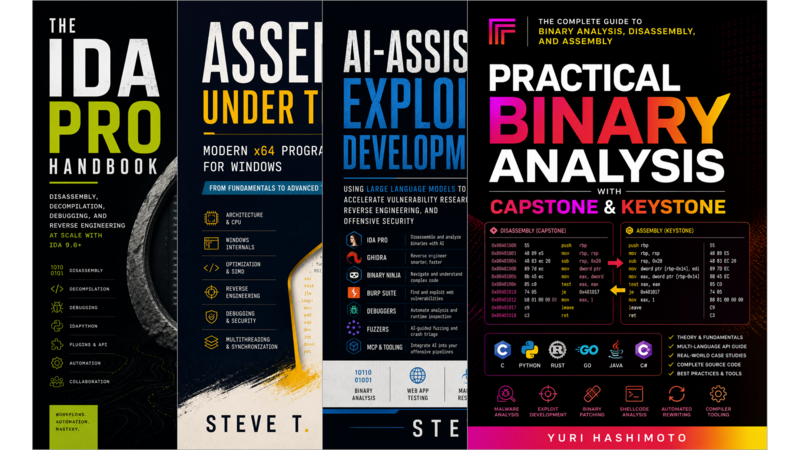
AI-Assisted Exploit Development

Using Large Language Models to Accelerate Vulnerability Research, Reverse Engineering, and Offensive Security

This book is 100% completeLast updated on 2026-07-03
What if your next exploit development workflow had an AI-powered copilot? AI-Assisted Exploit Development explores how large language models are transforming vulnerability research, reverse engineering, and offensive security. From accelerating binary analysis in IDA Pro, Ghidra, and Binary Ninja to enhancing web application testing, fuzzing, debugging, and proof-of-concept exploit creation, this…

Minimum price

$19.00

$29.00

You pay

Author earns

$

Also available for 1 book credit with a Reader Membership

PDF
EPUB
About

About

About the Book

This book is a practical guide for security professionals who want to integrate large language models and AI-powered tools into their vulnerability research workflows. It covers how to use AI with platforms like IDA Pro, Ghidra, Binary Ninja, Burp Suite, debuggers, fuzzers, and MCP-enabled tooling to analyze code, automate repetitive tasks, identify vulnerabilities, generate proof-of-concept exploits, and streamline exploit development pipelines. Through real-world case studies, hands-on examples, and offensive security exercises, readers learn how to combine human expertise with AI assistance to improve efficiency across binary analysis, web application testing, malware research, and vulnerability discovery, while understanding the limitations, validation requirements, and operational security considerations of AI-generated results. Designed for exploit developers, penetration testers, reverse engineers, red team operators, and security researchers.

Bundles

Bundles that include this book

Author

About the Author

Steve T. Publications

Steve T. is a cybersecurity leader, researcher, and engineer with more than 20 years of experience across application security, infrastructure security, vulnerability management, software development, and secure engineering practices. Having built his career alongside the growth of the modern internet, he has worked through multiple generations of technology, evolving security threats, and changing development methodologies.

He is currently part of the advanced research organization at a leading cybersecurity company, where he focuses on emerging threats, security innovation, and the practical application of research. His work involves investigating new attack techniques, evaluating emerging technologies, conducting deep technical analysis, and helping organizations better understand and manage complex security risks.

In addition to his research responsibilities, Steve leads a team of senior engineers and subject matter experts who create technical books, training programs, and educational resources for security professionals. Through this work, he helps engineers, developers, architects, and security practitioners strengthen their skills and build more secure systems.

Steve's technical expertise spans software development, reverse engineering, web application security, penetration testing, security architecture, incident response, vulnerability research, operating system internals, and secure software development. His ability to analyze systems at both the source code and binary levels enables him to bridge the worlds of software engineering, security research, and practical defense.

Over the course of his career, Steve has worked with organizations across a wide range of industries, helping them identify, assess, and remediate security weaknesses in critical applications and infrastructure. He is recognized for combining deep technical expertise with a pragmatic approach to security, focusing on solutions that are effective, sustainable, and aligned with business goals.

Through his work in research, engineering, leadership, and education, Steve continues to contribute to the advancement of cybersecurity and the development of secure, resilient technology systems.

Contents

Table of Contents

Using Large Language Models to Accelerate Vulnerability Research, Reverse Engineering, and Offensive Security

Dedication

Introduction: The New Exploit Developer’s Toolkit

  1. How This Book Is Organized
  2. Who This Book Is For
  3. What This Book Does Not Cover
  4. A Note on Ethics and Responsibility
  5. How to Use This Book

Chapter 1: The New Exploit Developer’s Toolkit

  1. The New Reality: What Has Changed
  2. A Second Case: Finding a Linux Kernel Zero-Day with o3
  3. A Third Case: Autonomous Exploit Generation Against Modern Mitigations
  4. What AI Does Well: The Force Multiplier Effect
  5. Thinking About AI as a Tool, Not a Replacement
  6. A Note on Ethics and Responsibility

Chapter 2: Foundations of AI-Assisted Security Research

  1. How Transformers Work: Enough to Understand What They Can and Cannot Do
  2. Prompt-Based Inference vs. Fine-Tuning: Choosing Your Approach
  3. Prompt Engineering Paradigms for Security
  4. The Trust Boundary: Formalizing Human-AI Interaction
  5. Key Principles for Working with AI in Security Workflows
  6. Hands-On Lab: Evaluating LLM Output Reliability

Chapter 3: The Evolution of Automation in Security Research

  1. The Early Era: Signature-Based Detection and Rule Matching
  2. The Structural Analysis Era: Static and Dynamic Program Analysis
  3. The Generative AI Era: LLMs as Security Co-Pilots
  4. The Quantitative Leap: What AI Adds to Each Era
  5. Why AI Represents a Qualitative Shift
  6. The Limits of Automation: What No Paradigm Can Do
  7. Hands-On Lab: Tracing the Evolution of Automation

Chapter 4: Setting Up an AI-Augmented Research Environment

  1. The Landscape of AI Tools for Security Research
  2. Local LLM Deployment Options
  3. Cloud API Considerations
  4. Integrating AI with Reverse Engineering Platforms
  5. The Model Context Protocol: Connecting AI to Tools
  6. Operational Security for AI-Assisted Workflows
  7. Hands-On Lab: Deploying a Local AI Research Environment

Chapter 5: AI in Binary Analysis and Reverse Engineering

  1. Automated Function Identification and Naming
  2. Decompilation Refinement with LLMs
  3. Guided Reverse Engineering: Asking the Right Questions
  4. Case Study: AI-Assisted Analysis of XLoader 8.0
  5. Limitations and Failure Modes
  6. Hands-On Lab: AI-Assisted Binary Analysis with Evidence-First Prompting

Chapter 6: Vulnerability Discovery with AI and Fuzzing

  1. The State of AI-Guided Fuzzing
  2. Key Research: FuzzGPT, CHATAFL, TitanFuzz, and Beyond
  3. Performance Comparison: Traditional vs. AI-Guided Fuzzing
  4. The Validation Problem
  5. Static Analysis Augmentation with AI
  6. Web Application Vulnerability Discovery
  7. Case Study: Sean Heelan’s CVE-2025-37899 Discovery
  8. Hands-On Lab: AI-Guided Protocol Fuzzing with CHATAFL Principles

Chapter 7: Proof-of-Concept Exploit Development

  1. The Landscape: AI-Powered Exploit Development Platforms
  2. Shellcode Generation
  3. ROP Chain Construction
  4. Mitigation Bypass Techniques
  5. Case Study: Sean Heelan’s QuickJS Exploit Experiments
  6. Safety, Ethics, and Responsible Disclosure
  7. Hands-On Lab: Building an AI-Assisted Shellcode Test Harness

Chapter 8: Malware Analysis and AI-Assisted Triage

  1. The Malware Analysis Pipeline
  2. AI-Powered Initial Triage
  3. Benchmarking LLMs for Malware Triage
  4. Automated YARA Rule Generation
  5. Unpacking and Deobfuscation with AI
  6. Case Study: Rapid Triage of a New Malware Family
  7. Limitations and Risks
  8. Hands-On Lab: AI-Assisted Malware Triage with YARA Generation

Chapter 9: Web Application Exploit Development with AI

  1. The Web Application Attack Surface
  2. Burp Suite and AI Integration
  3. AI-Assisted Vulnerability Discovery Workflows
  4. Common Pitfalls and How to Avoid Them
  5. Hands-On Lab: AI-Assisted Web Application Vulnerability Discovery

Chapter 10: Advanced Workflows and Automation

  1. Building AI-Powered RE/ED Pipelines
  2. MCP-Enabled Tooling: Connecting LLMs to Debuggers and Disassemblers
  3. Automated Report Generation and Documentation
  4. Multi-Agent Workflows: Orchestrating Multiple AI Models
  5. Case Study: End-to-End AI-Assisted Vulnerability Research Pipeline
  6. Scaling Your Workflow: From Individual Researcher to Team Operations

Chapter 11: Operational Security and Risk Management

  1. The Data Flow Problem: What Goes Where, When, and Why
  2. Practitioner Pushback: Why Many Reverse Engineers Refuse AI
  3. Operational Security Protocols: A Practical Framework
  4. The Economic Reality of AI-Assisted Security Work
  5. Legal and Ethical Considerations
  6. Hands-On Lab: Building an OpSec-Secure AI Research Environment

Chapter 12: The Future of AI-Assisted Exploit Development

  1. Multimodal Models and Vision-Based Reverse Engineering
  2. Specialized Security LLMs: The Domain-Specific Revolution
  3. The Arms Race: AI-Assisted Attacks vs. AI-Assisted Defense
  4. Skills That Will Remain Valuable as AI Matures
  5. What the Next Five Years Look Like
  6. Preparing for the Future: A Strategic Framework

Chapter 13: Becoming the AI-Augmented Expert

  1. The Expert’s Mental Model: A Decision Framework
  2. The Iterative Refinement Loop
  3. Building Your Personal AI Toolkit
  4. The Professional’s Code: Ethical Guidelines for AI-Assisted Security Research
  5. The Long Game: Sustaining Effectiveness Over Time

Chapter 14: Conclusion

References

Appendix A: Quick Reference Card — Model Selection Guide

Appendix B: Prompt Templates — Quick Reference

Appendix C: Common Failure Modes — Quick Reference

Appendix D: Glossary of Key Terms

Get the free sample chapters

Click the buttons to get the free sample in PDF or EPUB, or read the sample online here

The Leanpub 60 Day 100% Happiness Guarantee

Within 60 days of purchase you can get a 100% refund on any Leanpub purchase, in two clicks.

See full terms...

Earn $8 on a $10 Purchase, and $16 on a $20 Purchase

We pay 80% royalties on purchases of $7.99 or more, and 80% royalties minus a 50 cent flat fee on purchases between $0.99 and $7.98. You earn $8 on a $10 sale, and $16 on a $20 sale. So, if we sell 5000 non-refunded copies of your book for $20, you'll earn $80,000.

(Yes, some authors have already earned much more than that on Leanpub.)

In fact, authors have earned over $15 million writing, publishing and selling on Leanpub.

Learn more about writing on Leanpub

Free Updates. DRM Free.

If you buy a Leanpub book, you get free updates for as long as the author updates the book! Many authors use Leanpub to publish their books in-progress, while they are writing them. All readers get free updates, regardless of when they bought the book or how much they paid (including free).

Most Leanpub books are available in PDF (for computers) and EPUB (for phones, tablets and Kindle). The formats that a book includes are shown at the top right corner of this page.

Finally, Leanpub books don't have any DRM copy-protection nonsense, so you can easily read them on any supported device.

Learn more about Leanpub's ebook formats and where to read them

Write and Publish on Leanpub

You can use Leanpub to easily write, publish and sell in-progress and completed ebooks and online courses!

Leanpub is a powerful platform for serious authors, combining a simple, elegant writing and publishing workflow with a store focused on selling in-progress ebooks.

Leanpub is a magical typewriter for authors: just write in plain text, and to publish your ebook, just click a button. (Or, if you are producing your ebook your own way, you can even upload your own PDF and/or EPUB files and then publish with one click!) It really is that easy.

Learn more about writing on Leanpub