
The Leanpub 60 Day 100% Happiness Guarantee
Within 60 days of purchase you can get a 100% refund on any Leanpub purchase, in two clicks.
See full terms...
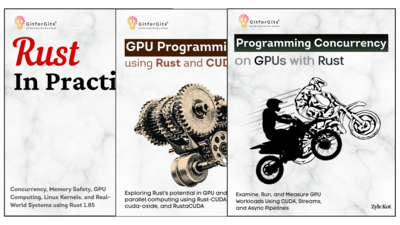
A special package for engineers who are into high-performance GPU computing in Rust.
Bought separately
$89.97
Minimum price
$75.99
$79.99
About the Bundle
This is a special package for engineers who are into high-performance GPU computing in Rust. Programming Concurrency on GPUs with Rust is a great book for getting to grips with GPU workloads. It shows you how to examine, run and measure them using CUDA, streams and asynchronous pipelines. GPU Programming using Rust and CUDA complements it with broader GPU programming via Rust-CUDA, cuda-oxide, and RustaCUDA. Rust In Practice Third Edition gives you all the language depth you need, including concurrency, memory safety and GPU computing on Rust 1.85. All three of these books give systems and ML engineers a rare and highly marketable skill set. That is, they teach them how to write safe, concurrent, GPU-accelerated code entirely in the Rust ecosystem. This covers everything from first kernels to measured, production-grade async GPU pipelines.
About the Books

Whether you're just starting out or a fully-fledged Rust pro, this third Edition is a goldmine of knowledge about Rust. This book has been updated with Rust 1.85 and Rust 2024 Edition, and it takes you on a really structured learning path to write production-grade systems, async services, GPU compute kernels, Linux kernel modules, and Go-integrated libraries.
The book is built around a single, progressive application, and every chapter adds a functional layer to a real Linux system-metrics tool. The knowledge you gain from this book, is working and evolving codes that you can study, extend, and own. You'll get the hang of ownership and borrowing, handle the borrow checker, build concurrent and async programs with Tokio, manage memory without a garbage collector, and use Rust in domains that were once reserved exclusively for C and C++.
Whatever stage you're at, whether you're just starting out and writing your first function or you're a seasoned engineer migrating a critical service to Rust, this strong practically focussed book has got you covered.
Key Learnings
Table of Content

This book is all about getting hands-on with different toolchains that connect Rust to NVIDIA hardware. There's RustaCUDA for safe host-side control, the Rust-CUDA project for writing kernels in pure Rust, and NVIDIA's experimental cuda-oxide compiler with its typed launches and async execution graphs.
We're going to build one Cargo workspace that keeps on growing. It'll include device queries, launch planning, Rust-written kernels, memory optimization, parallel reductions and scans, multi-stream pipelines, matrix multiplication benchmarked against cuBLAS, a Monte Carlo option pricer validated against a closed formula, and a complete batched inference application measured against a Python baseline. We'll check every result against a CPU reference, and the reports will give accurate numbers, including where libraries outperform hand-written kernels and where experimental toolchains are still a work in progress.
Key Learnings
Table of Content

The bottleneck is not your kernel. In fact, it almost never is.
After spending enough time in Nsight, the way you read a timeline becomes as intuitive as a mechanic listening to an engine. The same faults keep cropping up, such as a GPU with thousands of cores sitting idle behind a blocking copy, a single default stream or a host thread frozen at a synchronisation point that was never necessary. This book is about identifying that fault early and eliminating it.
Designed for programming professionals, this book is written for GPU developers, Rust engineers and AI practitioners who want their devices to be busy, not just correct. Our approach is to stay in pure Rust throughout, using cuda-oxide for SIMT kernels and cutile-rs for the tile model. We also rely heavily on the type system to ensure that data races fail at compile time rather than at 3 AM during production. We will overlap transfers with compute using streams and pinned memory, build a staging ring that pipelines every stage and feed the GPU through Tokio producers with bounded-channel backpressure. Each technique is profiled, verified against a CPU reference and measured.
Key Learnings
Table of Content
Target Audience
If you're a programmer looking for a hands-on guide to GPU programming, Rust techniques and AI principles, this book is for you. It's designed to help you make the most of your device's processing power.
Within 60 days of purchase you can get a 100% refund on any Leanpub purchase, in two clicks.
See full terms...
We pay 80% royalties on purchases of $7.99 or more, and 80% royalties minus a 50 cent flat fee on purchases between $0.99 and $7.98. You earn $8 on a $10 sale, and $16 on a $20 sale. So, if we sell 5000 non-refunded copies of your book for $20, you'll earn $80,000.
(Yes, some authors have already earned much more than that on Leanpub.)
Learn more about writing on Leanpub
If you buy a Leanpub book, you get free updates for as long as the author updates the book! Many authors use Leanpub to publish their books in-progress, while they are writing them. All readers get free updates, regardless of when they bought the book or how much they paid (including free).
Most Leanpub books are available in PDF (for computers) and EPUB (for phones, tablets and Kindle). The formats that a book includes are shown at the top right corner of this page.
Finally, Leanpub books don't have any DRM copy-protection nonsense, so you can easily read them on any supported device.
Learn more about Leanpub's ebook formats and where to read them
You can use Leanpub to easily write, publish and sell in-progress and completed ebooks and online courses!
Leanpub is a powerful platform for serious authors, combining a simple, elegant writing and publishing workflow with a store focused on selling in-progress ebooks.
Leanpub is a magical typewriter for authors: just write in plain text, and to publish your ebook, just click a button. (Or, if you are producing your ebook your own way, you can even upload your own PDF and/or EPUB files and then publish with one click!) It really is that easy.