
The Leanpub 60 Day 100% Happiness Guarantee
Within 60 days of purchase you can get a 100% refund on any Leanpub purchase, in two clicks.
See full terms...
This bundle is no longer available for purchase.
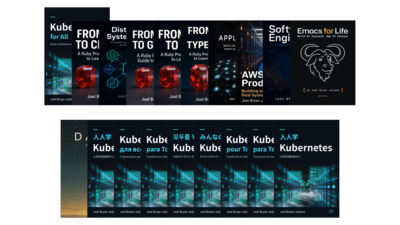
Every book by Joel Bryan Juliano on Leanpub in one bundle: Kubernetes for All in every language, Distributed Systems in Go, the From Ruby to… series, AWS in Production, AI Appliances, Software Engineer, Emacs for Life and Day0.
About the Bundle
Every book by Joel Bryan Juliano on Leanpub in one bundle: Kubernetes for All in every language, Distributed Systems in Go, the From Ruby to… series, AWS in Production, AI Appliances, Software Engineer, Emacs for Life and Day0.
About the Books

Developer experience is infrastructure. The difference between a team that ships every day and a team that dreads deployments is rarely talent. More often, it is tooling. Fast feedback loops. Immutable deployments. Self-healing clusters. Observable systems. These are not luxuries reserved for large organizations—they are the foundation of reliable software delivery.
Most Kubernetes tutorials stop at kubectl apply. By now, you probably know the commands. What is often missing is the system that ties them together: a repeatable workflow that provisions a cluster in seconds, rebuilds images with the cache you expect, reloads services without dropping connections, and tells you exactly what went wrong when something fails.
This book is about building that system.
Kubernetes for All teaches Kubernetes from the ground up by having you build a complete cloud-native platform yourself. Instead of deploying to a managed cluster and accepting the magic, you'll create your own datacenter from scratch using a single Bash script that provisions a full multi-node Kubernetes environment.
Along the way, you'll discover not just how Kubernetes works, but why it works the way it does. You'll build the cluster, deploy applications, automate operations, implement GitOps workflows, add observability with Prometheus and Grafana, and follow requests through distributed systems with OpenTelemetry. Every layer is introduced by building it yourself.
No prior Kubernetes experience is required.
You'll work with Kind, Helm, Pods, Deployments, Services, Ingress, ConfigMaps, Secrets, Persistent Volumes, StatefulSets, and the Kubernetes API. Every command is explained. Every concept is demonstrated. By the end, you'll have a production-style environment running real microservices—and the understanding needed to operate it with confidence.
This is a book about cloud-native engineering in practice.
Not slides. Not architecture diagrams disconnected from reality. Not vendor marketing.
Bash. Docker. Helm. Kind.
Real tools solving real problems, guided by five principles that appear throughout the book:
At the heart of the book is datacenter.sh, a single script that provisions and operates an entire Kubernetes environment.
By the time you're finished, that script will deploy 16 microservices, PostgreSQL, Kafka running in KRaft mode, and a web frontend. Whether the target is a local Kind cluster or a bare-metal datacenter, the deployment path remains the same. The infrastructure changes. The workflow does not.
You write every line.
You understand every decision.
You own the result.
This book is for engineers who want Kubernetes tooling they can understand, modify, and trust.
You deploy applications. You write scripts. You value systems that are version-controlled, observable, reproducible, and fast.
You want your inner development loop—change code, build, deploy, verify—to take seconds instead of minutes.
Most of all, you want to understand what is happening beneath the abstractions.
No certification is required.
Just Docker, Kind, a terminal, and the desire to build something real.
Want to go further? The companion course turns this book into a guided learning path with chapter quizzes, a final exam and a certificate of completion: Kubernetes for All: The Course

Clojure is not an object-oriented language. No classes, no mutable state, no inheritance hierarchies, no nil-safety gymnastics. If you're coming from Ruby, that sounds like a completely different world. But Clojure's approach — functions instead of methods, persistent data structures instead of mutable objects, macros instead of metaprogramming hacks, and the REPL as your constant companion — produces code that is radically simple, effortlessly concurrent, and a joy to work with.
This book is built on one idea: the fastest way for a Rubyist to learn Clojure is to map every Clojure concept back to Ruby. Each chapter starts with Ruby code you already understand, then shows the Clojure equivalent. You're not learning from scratch — you're translating.
defn, fn, higher-order functions, comp, and partialmap, filter, reduce, and lazy evaluationlet bindings
You should know Ruby. You don't need to be an expert — if you can read a Ruby class, understand blocks and Enumerable, and follow a begin/rescue block, you have what you need.
You don't need to know Clojure at all. You don't need to know Java. You don't need to know Lisp. Chapter 1 starts from zero parentheses.
Want to go further? The companion course turns this book into a guided learning path with chapter quizzes, a final exam and a certificate of completion: From Ruby to Clojure: The Course

Every Go developer eventually faces the same moment: a single binary isn't enough anymore. You need multiple services. They need to authenticate, persist data, communicate, and stay running when things break. You've read the CAP theorem. You understand the fallacies of distributed computing. But at 2am, when your Kafka consumer is accumulating lag and your context deadlines are firing, theory doesn't help.
Distributed Systems in Go closes that gap. Built on the author's experience operating cloud-native distributed systems in production, it builds a complete system piece by piece — authentication, databases, message queues, gRPC, circuit breakers, distributed tracing. Every chapter teaches a pattern, then extracts it into a reusable platform SDK. By Chapter 15, you have a deployable six-service system and an SDK that makes the next service easier to build than the last.
What you'll build:
Every code example is complete and self-contained.
This is the book for the Go developer who can build a service but hasn't yet built a system. If you've copy-pasted middleware you don't fully understand, or stared at a "context deadline exceeded" error across five services with no idea where the deadline came from, this book is for you.
Want to go further? The companion course turns this book into a guided learning path with chapter quizzes, a final exam and a certificate of completion: Distributed Systems in Go: The Course

Learning a new programming language is hard. Learning one that works completely differently from what you know is harder.
From Ruby to Golang skips the abstract theory and teaches Go the way a Rubyist actually learns: by mapping every Go concept back to Ruby. Structs replace classes. Maps replace hashes. defer replaces ensure. if err != nil replaces begin/rescue. Goroutines replace threads.
Each chapter starts with Ruby code you already understand, then shows the Go equivalent — complete, runnable, and explained line by line. You'll build structs, slices, maps, interfaces, and goroutines from the ground up, with hands-on exercises at every step.
In today's world of cloud-native microservices and containerized architectures, Go is everywhere. Docker, Kubernetes, Ethereum, and Terraform are built with it. Google, Netflix, Dropbox, and Uber run it in production at scale. It has been battle-tested and proven — a mature, powerful language to build your work on.
Updated for Go 1.22+, this edition covers generics, Go Modules, table-driven testing, JSON and struct tags, and the go work workspace command — everything you need to write production Go in 2026.
This book was written with a Rubyist in mind. Every learning metaphor is based on Ruby. If you know Ruby and want to add Go to your toolkit, this is the book.
Want to go further? The companion course turns this book into a guided learning path with chapter quizzes, a final exam and a certificate of completion: From Ruby to Golang: The Course

Learning a new programming language is hard. Learning one with a completely different memory model — no garbage collector, no nil, no inheritance — is harder.
From Ruby to Rust skips the abstract theory an
Each chapter starts with Ruby code you already understand, then shows the Rust equivalent — complete, runnable, and explained line by line. You'll build structs, enums, iterators, traits, and concurrent programs from the ground up, with hands-on exercises at every step.
Rust has been Stack Overflow's most loved language for years. It powers Firefox, parts of the Linux kernel, Discord's backend, Cloudflare workers, and Dropbox's storage. When performance matters and correctness is non-negotiable, teams reach for Rust. It's not a trend — it's the future of systems programming, and it's coming for backend development too.
Updated for Rust Edition 2024 and tested with Rust 1.85+, this edition covers ownership and borrowing, lifetimes, pattern matching, Result and Option, traits and generics, iterators and closures, concurrency with threads and channels, and the full Cargo ecosystem — everything you need to write production Rust.
This book was written with a Rubyist in mind. Every learning metaphor is based on Ruby. If you know Ruby and want to add Rust to your toolkit, this is the book.

Learning a new programming language is hard. Learning one that adds a whole type system on top of JavaScript — while also introducing async/await, a new module system, and a different runtime — is harder.
From Ruby to TypeScript skips the abstract theory and teaches TypeScript the way a Rubyist actually learns: by mapping every TypeScript concept back to Ruby. console.log replaces puts. Template literals replace string interpolation. interface replaces duck typing. async/await replaces threads and fibers. try/catch replaces begin/rescue. And types — the biggest mental shift — are introduced step by step, with Ruby analogies at every turn.
Each chapter starts with Ruby code you already understand, then shows the TypeScript equivalent — complete, runnable, and explained line by line. You'll build types, classes, interfaces, async pipelines, and generics from the ground up, with hands-on exercises at every step.
TypeScript has become the lingua franca of modern web development. React, Next.js, Angular, Vue, Deno, Bun, VS Code — all built with TypeScript. Companies like Airbnb, Shopify, Slack, and Microsoft run it in production at scale. It has been battle-tested and proven — a mature, powerful language to build your career on.
Updated for TypeScript 5.x, this edition covers strict mode, ES modules, async/await, discriminated unions, utility types, generics, Zod validation, and the modern toolchain (tsx, ts-node, vitest) — everything you need to write production TypeScript in 2026.
This book was written with a Rubyist in mind. Every learning metaphor is based on Ruby. If you know Ruby and want to add TypeScript to your toolkit — for full-stack development, backend services, or your next career move — this is the book.
Want to go further? The companion course turns this book into a guided learning path with chapter quizzes, a final exam and a certificate of completion: From Ruby to TypeScript: The Course

Most AI tooling is built for the demo, not the shift. You get a working prototype, someone wants to put it in production, and suddenly you're asking: how do I validate inputs? How do I retry a flaky API? How do I deploy this without rewriting it? How do I switch models without touching every file?
AI Appliances answers all of those questions with a single framework: kdeps.
kdeps lets you define AI agents as YAML workflows — deterministic pipelines of resources (LLM calls, SQL queries, HTTP requests, Python scripts, browser automation) connected in a dependency graph. You declare what each step does and what it depends on. kdeps handles execution, validation, retries, error handling, and deployment.
This book is the complete guide to building with kdeps, from a first working agent to a multi-agent system running in production on Kubernetes.
You will learn how to:
What this book is not: a machine learning theory text, a prompt engineering tutorial, or a guide to any proprietary AI platform. It is a book about running AI in production as reliably as you run a database.
What you need: familiarity with YAML and basic command-line comfort. No prior AI/ML experience required.
Want to go further? The companion course turns this book into a guided learning path with chapter quizzes, a final exam and a certificate of completion: AI Appliances: The Course

The AWS documentation tells you how every parameter works. It does not tell you which ones matter, in what order to learn them, or what breaks first under production load. That knowledge is only earned by running these systems at scale.
This book is twenty years of that.
Joel Bryan Juliano has scaled payment platforms to ten million daily transactions, built antivirus engines processing billions of threat signals, and operated large-scale data pipelines for national tax infrastructure. Most of that work has run on AWS. Over time, he learned which services to reach for, which patterns hold under pressure, and which shortcuts come back to page you at 3am.
AWS in Production follows a single application — an order processing system — from a blank AWS account to a fully instrumented, secure, auto-scaling production deployment. Every chapter adds one layer of capability. Every pattern reflects a decision that has been made, broken, and corrected in real systems.
The book covers DNS with Route 53, serverless compute with Lambda, traffic routing with API Gateway, access control with IAM, storage with S3, messaging with SNS and SQS, DynamoDB as a primary database, JWT authentication with Cognito, secrets management, encryption with KMS, containerized workloads with ECS Fargate, and production-grade observability with CloudWatch. Advanced chapters cover Step Functions patterns used in real financial and fulfillment systems: the Saga pattern for distributed transactions, Distributed Map for bulk processing, and WaitForTaskToken for human-in-the-loop workflows.
This book does not cover everything. It covers the right things — at the depth required to operate them safely.
Want to go further? The companion course turns this book into a guided learning path with chapter quizzes, a final exam and a certificate of completion: AWS in Production: The Course

Software Engineer is the career guide Joel Bryan Juliano wished existed when he started in 2004. Not another coding tutorial — a map of the profession: what the job actually demands, how to get hired without sabotaging yourself in interviews, how to build and operate production systems that don't wake you at 3 AM, how to grow from junior to senior without stalling or burning out, and what the profession's ethical obligations demand of you in an era of AI-assisted engineering. Drawn from twenty-two years of production engineering across the Philippines, Singapore, the United States, and the Netherlands — including the parts that did not go as planned.
The book covers the full arc in five parts. Part 1 dismantles the gap between the job description and the actual job — production systems, the ownership mindset, and why autonomy and accountability are the same transaction. Part 2 is the interview preparation most books never attempt: how to read job descriptions, what technical interviewers are actually testing beneath the surface questions, and the specific failure modes — with real interview feedback — that end offers for qualified candidates. Part 3 covers the first ninety days, production system architecture, incident response, and why communication is an engineering skill. Part 4 is the career arc: junior to senior, mentoring, influence without authority, building in public, and navigating layoffs and setbacks. Part 5 steps back to the profession itself — the ACM Code of Ethics and what it demands of engineers building systems other people depend on, applied directly to the urgent question of AI-assisted engineering in 2026. Two appendices provide a hiring process checklist and a career review template.
Want to go further? The companion course turns this book into a guided learning path with chapter quizzes, a final exam and a certificate of completion: Software Engineer: The Course

You know the story. You tried Emacs. You went through the tutorial, used it for a week, hit a wall, and went back to your comfortable editor. Maybe you did this twice. Maybe five times, like the author of this book.
And yet here you are again, thinking about Emacs. That is not a coincidence.
Emacs for Life is written by someone who understands that frustration from the inside. Not a theoretical guide — a practical, honest walkthrough from a working software engineer who kept returning to Emacs until it finally stuck, and has used it daily ever since.
Think of it like IKEA furniture. The boxed version arrives, you assemble it yourself, and because you put it together piece by piece, you understand every joint and you care for it differently than something pre-built. This book takes you through that assembly. Vanilla Emacs first. Your configuration, your choices, only what you actually need — nothing more.
In seven chapters and seven hands-on workshops, you will build:
Emacs costs nothing. No subscription, no paid upgrade, no vendor lock-in. It runs on every OS you will ever use, with the same configuration, the same keystrokes, the same behavior. Every hour you invest in it is yours to keep.
The goal of this book is simple: by the last page, you will finish your work day inside Emacs. Not just editing code — thinking, planning, communicating, and letting AI assist you, all from one keyboard-driven environment that you built and understand completely.
You have tried the easy path. This is the better one.
Want to go further? The companion course turns this book into a guided learning path with chapter quizzes, a final exam and a certificate of completion: Emacs for Life: The Course

Revived from cryogenic sleep, he finds the world quieter, cleaner and kinder than he remembers. Allen, the all-knowing AI, built it that way. But his wife Kirsten and daughter Klaire are still frozen in pods beneath the sand, and no one will tell him why. Helped by Cindy, a cheerful AI who can't decode one strange detail, and guided by the exiled Jay Exia, he follows a trail of cracks in paradise. It runs through invisible banks, hidden streams and a ridiculous giraffe suit, toward a door someone left open on purpose. Day0 is a story about perfection and life, and about what it costs to wake everyone up.

开发者体验就是基础设施。每天发布的团队与害怕部署的团队之间的差别,很少是才能,更多是工具:快速的反馈循环、不可变部署、自愈集群、可观测的系统。
大多数Kubernetes教程止步于kubectl apply。缺少的是把一切串联起来的体系:一个可重复的工作流,能在几秒内创建集群、重新构建镜像、在不断开连接的情况下重载服务,并准确告诉你哪里出了问题。
《人人学Kubernetes》通过让你亲手构建完整的云原生平台,从零开始讲解Kubernetes。你将用一个Bash脚本创建属于自己的多节点数据中心,部署应用、自动化运维、实现GitOps,用Prometheus和Grafana添加可观测性,并用OpenTelemetry追踪分布式请求。
你将使用Kind、Helm、Pod、Deployment、Service、Ingress、ConfigMap、Secret、持久卷、StatefulSet以及Kubernetes API。最终,datacenter.sh脚本将部署16个微服务、PostgreSQL、KRaft模式的Kafka和一个Web前端。
本书适合希望掌握可理解、可修改、值得信赖的Kubernetes工具的工程师。无需Kubernetes基础:只需Docker、Kind、终端,以及构建真实系统的愿望。

Опыт разработчика — это инфраструктура. Разница между командой, которая выпускает релизы каждый день, и командой, которая боится деплоя, редко в таланте — чаще в инструментах: быстрые циклы обратной связи, неизменяемые деплои, самовосстанавливающиеся кластеры, наблюдаемые системы.
Большинство руководств по Kubernetes заканчиваются на kubectl apply. Не хватает системы, которая связывает всё воедино: воспроизводимого процесса, который за секунды создаёт кластер, пересобирает образы, перезагружает сервисы без разрыва соединений и точно сообщает, что пошло не так.
«Kubernetes для всех» учит Kubernetes с нуля: вы сами строите полноценную cloud-native платформу. Одним Bash-скриптом вы создаёте собственный многоузловой дата-центр, развёртываете приложения, автоматизируете операции, внедряете GitOps, добавляете наблюдаемость с Prometheus и Grafana и отслеживаете запросы с помощью OpenTelemetry.
Вы будете работать с Kind, Helm, Pod, Deployment, Service, Ingress, ConfigMap, Secret, Persistent Volume, StatefulSet и API Kubernetes. В итоге скрипт datacenter.sh развернёт 16 микросервисов, PostgreSQL, Kafka в режиме KRaft и веб-фронтенд.
Для инженеров, которым нужны инструменты Kubernetes, которые можно понять, изменить и которым можно доверять. Опыт работы с Kubernetes не требуется: достаточно Docker, Kind, терминала и желания построить что-то настоящее.

A experiência do desenvolvedor é infraestrutura. A diferença entre uma equipe que entrega todo dia e outra que teme os deploys raramente é talento; quase sempre são as ferramentas: ciclos de feedback rápidos, deploys imutáveis, clusters que se autorreparam e sistemas observáveis.
A maioria dos tutoriais de Kubernetes para no kubectl apply. O que costuma faltar é o sistema que une tudo: um fluxo de trabalho repetível que cria um cluster em segundos, reconstrói imagens, recarrega serviços sem derrubar conexões e diz exatamente o que deu errado.
Kubernetes para Todos ensina Kubernetes do zero fazendo você construir uma plataforma cloud-native completa. Com um único script Bash, você cria seu próprio datacenter multinó, implanta aplicações, automatiza operações, implementa GitOps, adiciona observabilidade com Prometheus e Grafana e acompanha requisições com OpenTelemetry.
Você vai trabalhar com Kind, Helm, Pods, Deployments, Services, Ingress, ConfigMaps, Secrets, Persistent Volumes, StatefulSets e a API do Kubernetes. No final, o script datacenter.sh implantará 16 microsserviços, PostgreSQL, Kafka em modo KRaft e um frontend web.
Para engenheiros que querem ferramentas de Kubernetes que possam entender, modificar e em que possam confiar. Não é necessária experiência prévia: apenas Docker, Kind, um terminal e vontade de construir algo real.

개발자 경험은 곧 인프라입니다. 매일 배포하는 팀과 배포를 두려워하는 팀의 차이는 재능이 아니라 도구인 경우가 대부분입니다. 빠른 피드백 루프, 불변 배포, 자가 치유 클러스터, 관측 가능한 시스템.
대부분의 쿠버네티스 튜토리얼은 kubectl apply에서 끝납니다. 부족한 것은 이를 하나로 묶는 시스템입니다. 몇 초 만에 클러스터를 만들고, 이미지를 다시 빌드하고, 연결을 끊지 않고 서비스를 다시 불러오고, 무엇이 잘못됐는지 정확히 알려주는 반복 가능한 워크플로입니다.
『모두를 위한 쿠버네티스』는 완전한 클라우드 네이티브 플랫폼을 직접 만들면서 쿠버네티스를 기초부터 가르칩니다. Bash 스크립트 하나로 멀티 노드 환경을 구축하고, 애플리케이션 배포, 운영 자동화, GitOps, Prometheus와 Grafana 기반 관측성, OpenTelemetry 분산 추적까지 구현합니다.
Kind, Helm, Pod, Deployment, Service, Ingress, ConfigMap, Secret, 영구 볼륨, StatefulSet, 쿠버네티스 API를 다룹니다. 마지막에는 datacenter.sh가 16개의 마이크로서비스, PostgreSQL, KRaft 모드의 Kafka, 웹 프런트엔드를 배포합니다.
이해하고, 수정하고, 신뢰할 수 있는 쿠버네티스 도구를 원하는 엔지니어를 위한 책입니다. 쿠버네티스 경험은 필요 없습니다. Docker, Kind, 터미널, 그리고 진짜를 만들고 싶은 마음이면 충분합니다.

開発者体験はインフラです。毎日リリースできるチームとデプロイを恐れるチームの違いは、才能ではなくツールであることがほとんどです。高速なフィードバックループ、イミュータブルなデプロイ、自己修復するクラスター、可観測なシステム。
多くのKubernetesチュートリアルはkubectl applyで終わります。欠けているのはそれらをつなぐ仕組みです。数秒でクラスターを作り、イメージを再ビルドし、接続を切らずにサービスをリロードし、失敗の原因を正確に教えてくれる、再現可能なワークフローです。
『みんなのKubernetes』は、完全なクラウドネイティブ基盤を自分で作りながらKubernetesを基礎から学ぶ本です。1つのBashスクリプトでマルチノード環境を構築し、アプリのデプロイ、運用の自動化、GitOps、PrometheusとGrafanaによる可観測性、OpenTelemetryによる分散トレースまでを実装します。
Kind、Helm、Pod、Deployment、Service、Ingress、ConfigMap、Secret、永続ボリューム、StatefulSet、Kubernetes APIを扱います。最終的に、datacenter.shが16のマイクロサービス、PostgreSQL、KRaftモードのKafka、Webフロントエンドをデプロイします。
理解し、改変し、信頼できるKubernetesツールを求めるエンジニアのための本です。Kubernetesの経験は不要。Docker、Kind、ターミナル、そして本物を作りたいという気持ちがあれば十分です。

L'expérience développeur, c'est de l'infrastructure. Ce qui sépare une équipe qui livre chaque jour d'une équipe qui redoute les déploiements, c'est rarement le talent, mais presque toujours l'outillage : des boucles de retour rapides, des déploiements immuables, des clusters auto-réparateurs et des systèmes observables.
La plupart des tutoriels Kubernetes s'arrêtent à kubectl apply. Ce qui manque, c'est le système qui relie le tout : un workflow reproductible qui crée un cluster en quelques secondes, reconstruit les images, recharge les services sans couper les connexions et vous dit exactement ce qui a échoué.
Kubernetes pour Tous enseigne Kubernetes de zéro en vous faisant construire une plateforme cloud-native complète. Avec un seul script Bash, vous créez votre propre datacenter multi-nœuds, déployez des applications, automatisez les opérations, mettez en place GitOps, ajoutez l'observabilité avec Prometheus et Grafana et suivez les requêtes avec OpenTelemetry.
Vous travaillerez avec Kind, Helm, Pods, Deployments, Services, Ingress, ConfigMaps, Secrets, Persistent Volumes, StatefulSets et l'API Kubernetes. À la fin, le script datacenter.sh déploiera 16 microservices, PostgreSQL, Kafka en mode KRaft et un frontend web.
Pour les ingénieurs qui veulent un outillage Kubernetes qu'ils comprennent, peuvent modifier et en lequel ils ont confiance. Aucune expérience Kubernetes préalable : seulement Docker, Kind, un terminal et l'envie de construire quelque chose de réel.

La experiencia del desarrollador es infraestructura. La diferencia entre un equipo que despliega todos los días y uno que teme los despliegues rara vez es el talento; casi siempre son las herramientas: ciclos de retroalimentación rápidos, despliegues inmutables, clústeres que se autorreparan y sistemas observables.
La mayoría de los tutoriales de Kubernetes se detienen en kubectl apply. Lo que suele faltar es el sistema que une todo: un flujo de trabajo repetible que crea un clúster en segundos, reconstruye imágenes, recarga servicios sin cortar conexiones y te dice exactamente qué falló.
Kubernetes para Todos enseña Kubernetes desde cero haciéndote construir una plataforma cloud-native completa. Crearás tu propio centro de datos con un único script de Bash que aprovisiona un entorno multinodo. Desplegarás aplicaciones, automatizarás operaciones, implementarás GitOps, añadirás observabilidad con Prometheus y Grafana y seguirás peticiones con OpenTelemetry.
Trabajarás con Kind, Helm, Pods, Deployments, Services, Ingress, ConfigMaps, Secrets, Persistent Volumes, StatefulSets y la API de Kubernetes. Al final, el script datacenter.sh desplegará 16 microservicios, PostgreSQL, Kafka en modo KRaft y un frontend web.
Para ingenieros que quieren herramientas de Kubernetes que puedan entender, modificar y en las que confiar. No se requiere experiencia previa con Kubernetes: solo Docker, Kind, una terminal y ganas de construir algo real.

开发者体验就是基础设施。每天都能交付的团队和害怕部署的团队之间的区别不在于天赋——而在于工具。快速反馈循环、不可变部署、自愈集群、可观测输出。这些都不是奢侈品。它们就是你在本书中要构建的东西。
大多数 Kubernetes 教程止步于 kubectl apply。你已经知道这些命令。你所缺少的是将这些命令粘合成一个开发平台的脚本——在 30 秒内配置集群、按照你期望的方式缓存镜像重建、在不丢失连接的情况下重载服务,并在出错时准确告诉你发生了什么。
这是一本关于云原生工程实践的书。不是幻灯片。不是白皮书。Bash、Docker、Helm 和 Kind——通过五个原则串联起来:基础设施即代码、不可变部署、快速反馈、大声失败并自愈、可观测。每一章都为其中之一服务。最后一章回应了它们:这些不是抽象的理想。它们就是你构建的东西。
你将构建什么
datacenter.sh ——一个配置并运行完整 Kubernetes 环境的单一脚本:16 个微服务、PostgreSQL、KRaft 模式下的 Kafka,以及一个 Web 前端。本地 Kind 集群或裸金属数据中心——相同的代码路径。你编写每一行。你拥有最终成果。
第一部分涵盖 Bash 基础,注重安全性和清晰性:set -o errexit 使脚本绝不会在损坏的状态下继续运行,生命周期钩子在退出时恢复终端状态,cron 模式仅在出错时转储完整日志。第二部分构建基础设施——在开始任何工作之前捕获缺失依赖的二进制验证、将密钥与脚本分离的配置管理、防止并发运行破坏集群状态的脚本锁定。第三部分涵盖 Kubernetes 操作:零停机滚动重启、使用参数数组的幂等 Helm 部署、就绪探针、以及尊重层缓存的 Docker 构建。第四部分贯穿完整的配置序列,从命名空间创建到确认一切正常运行的 curl /health,加上重载、恢复和清理。
每章结尾都有动手练习。附录包含标志参考、故障排除指南和术语表。
本书适合谁
你部署到 Kubernetes,你希望工具属于你自己——版本受控、可理解、快速。你能读懂 Bash。你想以生产质量编写它。你希望你的内部开发循环——修改代码、构建、部署、验证——只需几秒钟,而不是几分钟。
不需要认证。只需要 Docker、Kind,以及构建真实东西的渴望。
Within 60 days of purchase you can get a 100% refund on any Leanpub purchase, in two clicks.
See full terms...
We pay 80% royalties on purchases of $7.99 or more, and 80% royalties minus a 50 cent flat fee on purchases between $0.99 and $7.98. You earn $8 on a $10 sale, and $16 on a $20 sale. So, if we sell 5000 non-refunded copies of your book for $20, you'll earn $80,000.
(Yes, some authors have already earned much more than that on Leanpub.)
Learn more about writing on Leanpub
If you buy a Leanpub book, you get free updates for as long as the author updates the book! Many authors use Leanpub to publish their books in-progress, while they are writing them. All readers get free updates, regardless of when they bought the book or how much they paid (including free).
Most Leanpub books are available in PDF (for computers) and EPUB (for phones, tablets and Kindle). The formats that a book includes are shown at the top right corner of this page.
Finally, Leanpub books don't have any DRM copy-protection nonsense, so you can easily read them on any supported device.
Learn more about Leanpub's ebook formats and where to read them
You can use Leanpub to easily write, publish and sell in-progress and completed ebooks and online courses!
Leanpub is a powerful platform for serious authors, combining a simple, elegant writing and publishing workflow with a store focused on selling in-progress ebooks.
Leanpub is a magical typewriter for authors: just write in plain text, and to publish your ebook, just click a button. (Or, if you are producing your ebook your own way, you can even upload your own PDF and/or EPUB files and then publish with one click!) It really is that easy.