
The Leanpub 60 Day 100% Happiness Guarantee
Within 60 days of purchase you can get a 100% refund on any Leanpub purchase, in two clicks.
See full terms...
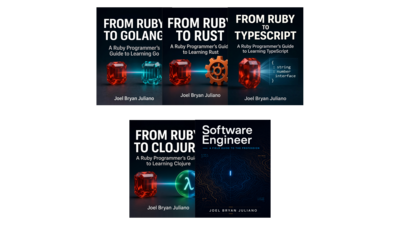
All four From Ruby to… books (Go, Rust, TypeScript, Clojure) plus Software Engineer.
Bought separately
$125.99
Minimum price
$55.00
$79.00
About the Bundle
All four From Ruby to… books (Go, Rust, TypeScript, Clojure) plus Software Engineer.
About the Books

Learning a new programming language is hard. Learning one that works completely differently from what you know is harder.
From Ruby to Golang skips the abstract theory and teaches Go the way a Rubyist actually learns: by mapping every Go concept back to Ruby. Structs replace classes. Maps replace hashes. defer replaces ensure. if err != nil replaces begin/rescue. Goroutines replace threads.
Each chapter starts with Ruby code you already understand, then shows the Go equivalent — complete, runnable, and explained line by line. You'll build structs, slices, maps, interfaces, and goroutines from the ground up, with hands-on exercises at every step.
In today's world of cloud-native microservices and containerized architectures, Go is everywhere. Docker, Kubernetes, Ethereum, and Terraform are built with it. Google, Netflix, Dropbox, and Uber run it in production at scale. It has been battle-tested and proven — a mature, powerful language to build your work on.
Updated for Go 1.22+, this edition covers generics, Go Modules, table-driven testing, JSON and struct tags, and the go work workspace command — everything you need to write production Go in 2026.
This book was written with a Rubyist in mind. Every learning metaphor is based on Ruby. If you know Ruby and want to add Go to your toolkit, this is the book.
Want to go further? The companion course turns this book into a guided learning path with chapter quizzes, a final exam and a certificate of completion: From Ruby to Golang: The Course

Learning a new programming language is hard. Learning one with a completely different memory model — no garbage collector, no nil, no inheritance — is harder.
From Ruby to Rust skips the abstract theory an
Each chapter starts with Ruby code you already understand, then shows the Rust equivalent — complete, runnable, and explained line by line. You'll build structs, enums, iterators, traits, and concurrent programs from the ground up, with hands-on exercises at every step.
Rust has been Stack Overflow's most loved language for years. It powers Firefox, parts of the Linux kernel, Discord's backend, Cloudflare workers, and Dropbox's storage. When performance matters and correctness is non-negotiable, teams reach for Rust. It's not a trend — it's the future of systems programming, and it's coming for backend development too.
Updated for Rust Edition 2024 and tested with Rust 1.85+, this edition covers ownership and borrowing, lifetimes, pattern matching, Result and Option, traits and generics, iterators and closures, concurrency with threads and channels, and the full Cargo ecosystem — everything you need to write production Rust.
This book was written with a Rubyist in mind. Every learning metaphor is based on Ruby. If you know Ruby and want to add Rust to your toolkit, this is the book.

Learning a new programming language is hard. Learning one that adds a whole type system on top of JavaScript — while also introducing async/await, a new module system, and a different runtime — is harder.
From Ruby to TypeScript skips the abstract theory and teaches TypeScript the way a Rubyist actually learns: by mapping every TypeScript concept back to Ruby. console.log replaces puts. Template literals replace string interpolation. interface replaces duck typing. async/await replaces threads and fibers. try/catch replaces begin/rescue. And types — the biggest mental shift — are introduced step by step, with Ruby analogies at every turn.
Each chapter starts with Ruby code you already understand, then shows the TypeScript equivalent — complete, runnable, and explained line by line. You'll build types, classes, interfaces, async pipelines, and generics from the ground up, with hands-on exercises at every step.
TypeScript has become the lingua franca of modern web development. React, Next.js, Angular, Vue, Deno, Bun, VS Code — all built with TypeScript. Companies like Airbnb, Shopify, Slack, and Microsoft run it in production at scale. It has been battle-tested and proven — a mature, powerful language to build your career on.
Updated for TypeScript 5.x, this edition covers strict mode, ES modules, async/await, discriminated unions, utility types, generics, Zod validation, and the modern toolchain (tsx, ts-node, vitest) — everything you need to write production TypeScript in 2026.
This book was written with a Rubyist in mind. Every learning metaphor is based on Ruby. If you know Ruby and want to add TypeScript to your toolkit — for full-stack development, backend services, or your next career move — this is the book.
Want to go further? The companion course turns this book into a guided learning path with chapter quizzes, a final exam and a certificate of completion: From Ruby to TypeScript: The Course

Clojure is not an object-oriented language. No classes, no mutable state, no inheritance hierarchies, no nil-safety gymnastics. If you're coming from Ruby, that sounds like a completely different world. But Clojure's approach — functions instead of methods, persistent data structures instead of mutable objects, macros instead of metaprogramming hacks, and the REPL as your constant companion — produces code that is radically simple, effortlessly concurrent, and a joy to work with.
This book is built on one idea: the fastest way for a Rubyist to learn Clojure is to map every Clojure concept back to Ruby. Each chapter starts with Ruby code you already understand, then shows the Clojure equivalent. You're not learning from scratch — you're translating.
defn, fn, higher-order functions, comp, and partialmap, filter, reduce, and lazy evaluationlet bindings
You should know Ruby. You don't need to be an expert — if you can read a Ruby class, understand blocks and Enumerable, and follow a begin/rescue block, you have what you need.
You don't need to know Clojure at all. You don't need to know Java. You don't need to know Lisp. Chapter 1 starts from zero parentheses.
Want to go further? The companion course turns this book into a guided learning path with chapter quizzes, a final exam and a certificate of completion: From Ruby to Clojure: The Course

Software Engineer is the career guide Joel Bryan Juliano wished existed when he started in 2004. Not another coding tutorial — a map of the profession: what the job actually demands, how to get hired without sabotaging yourself in interviews, how to build and operate production systems that don't wake you at 3 AM, how to grow from junior to senior without stalling or burning out, and what the profession's ethical obligations demand of you in an era of AI-assisted engineering. Drawn from twenty-two years of production engineering across the Philippines, Singapore, the United States, and the Netherlands — including the parts that did not go as planned.
The book covers the full arc in five parts. Part 1 dismantles the gap between the job description and the actual job — production systems, the ownership mindset, and why autonomy and accountability are the same transaction. Part 2 is the interview preparation most books never attempt: how to read job descriptions, what technical interviewers are actually testing beneath the surface questions, and the specific failure modes — with real interview feedback — that end offers for qualified candidates. Part 3 covers the first ninety days, production system architecture, incident response, and why communication is an engineering skill. Part 4 is the career arc: junior to senior, mentoring, influence without authority, building in public, and navigating layoffs and setbacks. Part 5 steps back to the profession itself — the ACM Code of Ethics and what it demands of engineers building systems other people depend on, applied directly to the urgent question of AI-assisted engineering in 2026. Two appendices provide a hiring process checklist and a career review template.
Want to go further? The companion course turns this book into a guided learning path with chapter quizzes, a final exam and a certificate of completion: Software Engineer: The Course
Within 60 days of purchase you can get a 100% refund on any Leanpub purchase, in two clicks.
See full terms...
We pay 80% royalties on purchases of $7.99 or more, and 80% royalties minus a 50 cent flat fee on purchases between $0.99 and $7.98. You earn $8 on a $10 sale, and $16 on a $20 sale. So, if we sell 5000 non-refunded copies of your book for $20, you'll earn $80,000.
(Yes, some authors have already earned much more than that on Leanpub.)
Learn more about writing on Leanpub
If you buy a Leanpub book, you get free updates for as long as the author updates the book! Many authors use Leanpub to publish their books in-progress, while they are writing them. All readers get free updates, regardless of when they bought the book or how much they paid (including free).
Most Leanpub books are available in PDF (for computers) and EPUB (for phones, tablets and Kindle). The formats that a book includes are shown at the top right corner of this page.
Finally, Leanpub books don't have any DRM copy-protection nonsense, so you can easily read them on any supported device.
Learn more about Leanpub's ebook formats and where to read them
You can use Leanpub to easily write, publish and sell in-progress and completed ebooks and online courses!
Leanpub is a powerful platform for serious authors, combining a simple, elegant writing and publishing workflow with a store focused on selling in-progress ebooks.
Leanpub is a magical typewriter for authors: just write in plain text, and to publish your ebook, just click a button. (Or, if you are producing your ebook your own way, you can even upload your own PDF and/or EPUB files and then publish with one click!) It really is that easy.