
The Leanpub 60 Day 100% Happiness Guarantee
Within 60 days of purchase you can get a 100% refund on any Leanpub purchase, in two clicks.
See full terms...
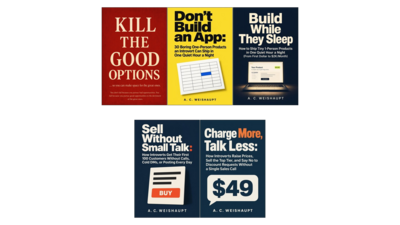
Five books for introverts with a day job: pick one idea, choose a boring product, ship it in quiet evenings, sell it in writing, and charge what it is worth without a single call.
Bought separately
$114.95
Minimum price
$44.99
$64.99
About the Bundle
You have a day job, one quiet hour a night, and zero interest in networking events, building an app, or defending your price on a call. Good. This kit is the whole path from "I should start something" to a product that sells at a price you are not embarrassed by, in the order you actually need it.
Step 1. Kill The Good Options. Most side projects die because you keep five half-good ideas alive at once. This book helps you cut them down to the one worth your evenings.
Step 2. Don't Build an App. Thirty boring one-person products (templates, spreadsheets, asset packs, short books, kits) with a 20-minute scorecard to pick one and a 14-evening plan to ship it.
Step 3. Build While They Sleep. The quiet-hour system for shipping tiny products while the house is asleep, from first dollar toward $2K a month, without burning out your day job.
Step 4. Sell Without Small Talk. How to get found and get paid with pages, listings, and written offers instead of calls, cold DMs, or posting every day.
Step 5. Charge More, Talk Less. Raise your price, add a top tier that adds assets instead of hours, and answer "Can I get a discount?" and "Can we hop on a quick call?" in writing, with copy-ready replies.
No hype and no income promises. Just a calm, repeatable way to build something small, sell it, and price it properly, written for people who would rather write than talk.
About the Books

Most people who stall aren't lazy. They're busy with good things: a decent client, a promising side project, a new platform, one more favor. Each yes makes sense on its own. Together they leave no room for the work that would actually change your life.
Kill The Good Options is a practical book about choosing on purpose. It starts with stories you may recognize: the founder avoiding the one wedge that matters, the investor diversified into mediocrity, the vibecoder hooked on prototypes, the creator chasing every platform wave, the author with five outlines and zero books, and the relationship that's only half committed.
Then it gives you the tools:
It also covers the part most productivity books skip: the relief, the loss, and the quiet void after you cut something, and how depth starts to compound once breadth is gone.
The hardest choices aren't between right and wrong. They're between good and great.

You have one quiet hour a night and no interest in becoming an influencer. Skip the app.
An app comes with a second list nobody puts on the whiteboard: uptime, logins, billing questions, support tickets, churn. That is a lot to carry after a full day at work. This book hands you something smaller that you can actually finish.
Inside are 30 boring one-person products: templates, spreadsheets, asset packs, short books, single videos, and kits. Each one gets its own card with a narrow buyer you can name, a price band, a real example or a clearly labeled worked example, where it gets found without you posting, an honest warning, and a first task for tonight.
Then you pick one with the 20-minute Boring Product Scorecard, price it in three tiers without selling your evenings (no calls, no reviews, no "email me anytime"), and ship it in 14 quiet evenings, test purchase included.
The real examples are dated and sourced: Rob Walling's stair step, the public spreadsheet that came before Nomad List, Vertex42's two decades of boring templates, Daniel Vassallo's 160-hour PDF next to his 16-hour video, and Nathan Barry's tier breakdown. No hype and no income promises. Just a first product small enough to finish and plain enough to be found.
Written for introverted professionals with a day job who would rather skip networking events, cold DMs, and posting every day.
What's inside
1. Don't Build an App (Yet)
2. The One-Hour Rule
3. The Stair Step Nobody Brags About
4. 16 Hours vs 160 Hours
5. The Catalog, Part 1: Spreadsheets, Templates and Systems (products 1 to 8)
6. The Catalog, Part 2: Assets for Makers (products 9 to 14)
7. The Catalog, Part 3: Small Books, Short Videos, Handbooks (products 15 to 22)
8. The Catalog, Part 4: Kits, Plugins, Lists and Packs (products 23 to 30)
9. Pick One in 20 Minutes
10. Price It in Tiers, Not Apologies
11. Ship in 14 Quiet Evenings
12. Where Boring Products Get Found Without You Posting
13. Traps That Eat Your Evenings
14. Product Number Two: Build a Catalog, Not a Bet
Appendix: Sources and Further Reading

You do not need a sabbatical to ship. After the house goes quiet, spend one focused hour building a tiny 1-person product. Ship one a week until something pays. Then stop starting and double down.

You built something useful. Now everyone tells you to network, jump on calls, and post every day. If that advice drains you, this book is for you.
Sell Without Small Talk shows introverts with a day job and one quiet evening hour how to sell in writing instead. You follow one recurring worked example, a $29 downloadable kit for freelance designers, from a vague headline to a page that answers buyer questions on its own.
Inside you will learn how to write an offer that explains itself, put the price where people can see it, and answer objections in an FAQ instead of a meeting. You will find quiet channels that keep working: warm written invitations to people you already know, helpful answers in communities that allow them, a short waitlist email sequence, and one evergreen page that buyers can find through search. You will also design a free sample that leads to a paid upgrade.
Finally, you will count buyers instead of likes with a weekly scorecard that takes minutes. Every chapter ends with a template or checklist you can use tonight. The money examples are illustrative, and your results will vary.

If that sentence makes your stomach drop, this book is for you.
You have a day job and one quiet hour in the evening. You sell one small thing: a spreadsheet template, a short ebook, a kit, a mini course, or a fixed-price service. And you priced it at $9 or $19 because anything higher felt arrogant.
Here is the catch. Cheap is loud. A low price does not protect you from questions, discount requests, or "quick calls". A clear price, written down, with three honest tiers, a refund line you can live with and a one-page discount policy, can answer most of them before they reach your inbox.
This is a pricing book for introverts. One rule runs through every chapter: if a pricing move needs you to talk live, you get the written version, or we drop it.
What you walk away withThe examples are real, dated and sourced: Adam Wathan's $29 / $59 / $135 ebook packages, Patrick McKenzie raising Bingo Card Creator from $24.95 to $29.95 while he still had a day job, Derek Sivers noticing that $35 felt about the same as $25, Josh Comeau's written discount policy, and the MIT chocolate study where cutting both prices by one cent made the free option win. Every study comes with its caveat, and the famous jam study, which does not replicate reliably, is flagged as such.
What this book refuses to teachNo fake "was" prices. No fake countdowns. No invented scarcity. No objection-handling scripts for calls. No income promises: it shows you how to price, not what you will earn.
What's inside14 short chapters, each ending with a "Tonight" box of tasks that fit in one evening hour, copy-ready templates throughout, three running worked examples (a pharmacist with a spreadsheet, a developer with an ebook, a bookkeeper with a small service), and a sources appendix.
Appendix: Sources and Further Reading
Who it's forIntroverted professionals with a day job who sell, or are about to sell, a template, ebook, kit, short course or productized service, and want to handle every money question in writing.
Who it's not forConsultants who enjoy discovery calls, agencies, SaaS founders tracking churn, or anyone looking for salary negotiation tips.
Also by A. C. WeishauptDon't Build an App (what to build), Kill The Good Options (what deserves your hour), Build While They Sleep (shipping in one quiet hour a night) and Sell Without Small Talk (your first 100 customers). This book is the money step.
Within 60 days of purchase you can get a 100% refund on any Leanpub purchase, in two clicks.
See full terms...
We pay 80% royalties on purchases of $7.99 or more, and 80% royalties minus a 50 cent flat fee on purchases between $0.99 and $7.98. You earn $8 on a $10 sale, and $16 on a $20 sale. So, if we sell 5000 non-refunded copies of your book for $20, you'll earn $80,000.
(Yes, some authors have already earned much more than that on Leanpub.)
Learn more about writing on Leanpub
If you buy a Leanpub book, you get free updates for as long as the author updates the book! Many authors use Leanpub to publish their books in-progress, while they are writing them. All readers get free updates, regardless of when they bought the book or how much they paid (including free).
Most Leanpub books are available in PDF (for computers) and EPUB (for phones, tablets and Kindle). The formats that a book includes are shown at the top right corner of this page.
Finally, Leanpub books don't have any DRM copy-protection nonsense, so you can easily read them on any supported device.
Learn more about Leanpub's ebook formats and where to read them
You can use Leanpub to easily write, publish and sell in-progress and completed ebooks and online courses!
Leanpub is a powerful platform for serious authors, combining a simple, elegant writing and publishing workflow with a store focused on selling in-progress ebooks.
Leanpub is a magical typewriter for authors: just write in plain text, and to publish your ebook, just click a button. (Or, if you are producing your ebook your own way, you can even upload your own PDF and/or EPUB files and then publish with one click!) It really is that easy.