
The Leanpub 60 Day 100% Happiness Guarantee
Within 60 days of purchase you can get a 100% refund on any Leanpub purchase, in two clicks.
See full terms...
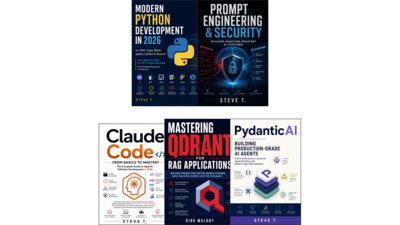
The future of software development is being built today through AI, modern Python tooling, intelligent agents, vector search, and secure engineering practices. This five-book bundle brings together the essential technologies every developer should understand in 2026. From mastering Claude Code and production-ready Python workflows to building AI agents with PydanticAI, creating scalable RAG systems with Qdrant, and defending applications against prompt injection attacks, this collection delivers practical knowledge for building reliable, high-performance AI software with confidence.
Bought separately
$157
Minimum price
$75.00
$89.00
About the Bundle
Stay ahead of the rapidly evolving AI and Python ecosystem with this comprehensive five-book collection covering the technologies, frameworks, and engineering practices defining software development in 2026.
Designed for developers, software engineers, AI practitioners, and technical leaders, this bundle provides overviews and deep technical guidance on building production-grade AI applications from AI-assisted software development and modern Python tooling to agentic AI frameworks, vector databases for Retrieval-Augmented Generation (RAG), and secure prompt engineering.
Inside this collection, you'll learn how to:
Each book combines practical implementation with in-depth explanations, helping you understand not only how to use these technologies but also why they work, when to apply them, and the trade-offs involved in real-world production systems. Throughout the collection, you'll find hands-on examples, architectural guidance, performance considerations, best practices, and real-world case studies that bridge the gap between experimentation and enterprise deployment.
Whether you're building AI-powered applications, modernizing Python development workflows, deploying large-scale RAG systems, or strengthening the security of LLM-based products, this bundle serves as a comprehensive reference for the tools and techniques shaping the next generation of software engineering.
Covering hundreds of practical examples across Python and multiple supporting technologies, this collection is an invaluable resource for anyone looking to build faster, smarter, and more secure AI-powered software with confidence.
About the Books

This is a comprehensive guide to Claude Code, Anthropic's agentic coding system that has fundamentally changed how software gets built. Whether you are a developer new to AI-assisted programming or an experienced engineer looking to master multi-agent workflows, this book takes you from first installation through enterprise deployment. It covers Claude Code's architecture, prompt engineering techniques, real-world case studies from Stripe and Wiz, CI/CD automation, security best practices, and the future of agentic coding. Every chapter includes practical examples, hands-on projects, and actionable guidance grounded in research on hundreds of thousands of real Claude Code sessions.

Retrieval-Augmented Generation has become the dominant architecture for production AI applications, and vector databases form its critical retrieval layer. This book takes you from the fundamentals of embeddings and similarity search through to advanced distributed deployments of Qdrant, the high-performance open-source vector database written in Rust. You will learn every facet of Qdrant's feature set: collections, points, payloads, HNSW indexing, quantization, hybrid search with dense and sparse vectors, metadata filtering, faceting, sharding, replication, security, monitoring, and scaling. Through detailed code examples in Python, JavaScript, Go, Java, C#, and Rust, you will build complete RAG pipelines integrated with LangChain, LlamaIndex, Haystack, and a wide range of embedding providers. This is not a tutorial collection; it is a comprehensive reference that explains the why behind every feature, the trade-offs between every configuration choice, and the production engineering practices that separate experimental prototypes from systems serving millions of queries per day.

This book is a comprehensive guide to PydanticAI, the Python agent framework that brings the rigor and developer experience of the Pydantic ecosystem to building production-grade generative AI applications. Whether you are a Python developer new to LLMs or an experienced AI practitioner looking for a framework that takes type safety seriously, this book will take you from your first agent to complex multi-agent systems with durable execution. Every chapter includes working code examples, real-world patterns, and practical exercises.

This book is a comprehensive, up-to-date reference for modern Python development in 2026. It covers the tools that define the contemporary Python workflow: package management with uv, pip, Poetry, and PDM; code quality with Ruff, Black, and mypy/Pyright; testing with pytest and Hypothesis; performance optimization with Cython, Numba, and PyO3; build systems, documentation, CI/CD pipelines, security scanning, and more. Whether you are starting a new project or migrating an existing codebase, this book gives you the knowledge to make informed tool choices backed by benchmarks, real-world data, and current best practices.

Large language models are not just text generators. They are instruction-processing engines that blur the boundary between data and commands. Every time an LLM ingests untrusted text, it faces a fundamental architectural challenge: determining what it should execute versus what it is merely being told about.
This book bridges the gap between prompt engineering and cybersecurity, giving developers, security professionals, and technology leaders the knowledge and practical tools needed to build AI systems that are both effective and resilient. From understanding how LLMs interpret instructions at a mechanistic level, to examining real-world attack case studies, to implementing enterprise-grade defense architectures, the book provides a comprehensive guide to developing trustworthy, injection-resistant AI systems for production environments.
Within 60 days of purchase you can get a 100% refund on any Leanpub purchase, in two clicks.
See full terms...
We pay 80% royalties on purchases of $7.99 or more, and 80% royalties minus a 50 cent flat fee on purchases between $0.99 and $7.98. You earn $8 on a $10 sale, and $16 on a $20 sale. So, if we sell 5000 non-refunded copies of your book for $20, you'll earn $80,000.
(Yes, some authors have already earned much more than that on Leanpub.)
Learn more about writing on Leanpub
If you buy a Leanpub book, you get free updates for as long as the author updates the book! Many authors use Leanpub to publish their books in-progress, while they are writing them. All readers get free updates, regardless of when they bought the book or how much they paid (including free).
Most Leanpub books are available in PDF (for computers) and EPUB (for phones, tablets and Kindle). The formats that a book includes are shown at the top right corner of this page.
Finally, Leanpub books don't have any DRM copy-protection nonsense, so you can easily read them on any supported device.
Learn more about Leanpub's ebook formats and where to read them
You can use Leanpub to easily write, publish and sell in-progress and completed ebooks and online courses!
Leanpub is a powerful platform for serious authors, combining a simple, elegant writing and publishing workflow with a store focused on selling in-progress ebooks.
Leanpub is a magical typewriter for authors: just write in plain text, and to publish your ebook, just click a button. (Or, if you are producing your ebook your own way, you can even upload your own PDF and/or EPUB files and then publish with one click!) It really is that easy.