
Leanpub Header

Skip to main content

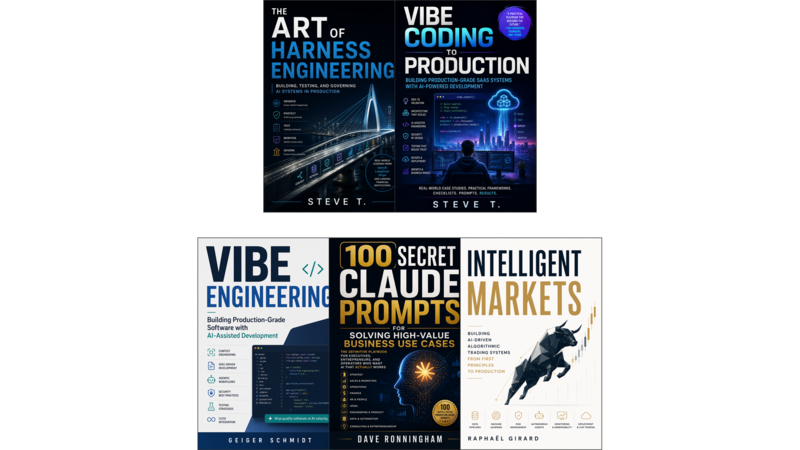
Vibe Engineering

Building Production-Grade Software with AI-Assisted Development

This book is 100% completeLast updated on 2026-07-13

AI can generate code in seconds, but shipping production-grade software requires far more than fast prompts. Vibe Engineering shows you how to work with AI coding assistants to build systems that are reliable, secure, and maintainable. Through practical examples and proven workflows, you will learn how to turn AI from a code generator into a trusted engineering partner.

Minimum price

$19.00

$29.00

You pay

Author earns

$

Also available for 1 book credit with a Reader Membership

PDF
EPUB
About

About

About the Book

This book teaches you how to build reliable, maintainable, production-grade software using AI coding assistants. You will learn context engineering, spec-driven development, agentic workflows, security practices, testing strategies, and CI/CD integration. Every chapter includes working code examples, configuration files, and step-by-step walkthroughs you can apply immediately. Whether you are a seasoned engineer looking to level up your AI workflow or a motivated beginner wanting to understand the modern development landscape, this book gives you the practical skills to ship quality software at AI velocity.

Bundle

Bundles that include this book

Author

About the Author

Steve T. Publications

Steve T. Publications is a specialized book publishing company dedicated to delivering high-quality technical resources for IT professionals, students, educators, and technology enthusiasts. Our mission is to make complex technology concepts accessible through well-structured, practical, and industry-relevant publications.

We focus on publishing books across a wide range of information technology disciplines, including software development, cloud computing, cybersecurity, artificial intelligence, data science, networking, DevOps, databases, and enterprise technologies. Every publication is designed to bridge the gap between theory and real-world application, helping readers build the skills needed to succeed in today's rapidly evolving digital landscape.

At Steve T. Publications, we collaborate with experienced industry experts, educators, and technology professionals to produce accurate, up-to-date, and engaging content. We are committed to maintaining the highest editorial standards while empowering learners and professionals with trusted technical knowledge.

Whether you're beginning your IT journey, preparing for professional certifications, or advancing your expertise in emerging technologies, Steve T. Publications is your trusted source for authoritative and practical technical books.

Contents

Table of Contents

Building Production-Grade Software with AI-Assisted Development

Introduction: The Vibe Engineering Revolution

  1. What Is Vibe Engineering
  2. The Karpathy Moment and Why It Matters
  3. Vibe Coding vs. Agentic Engineering
  4. What This Book Will Teach You

Chapter 1: The AI-Assisted Development Landscape

  1. From Autocomplete to Agentic Coding
  2. The Tool Landscape: IDEs, CLIs, and Platforms
  3. What the Data Says About Productivity
  4. The Code Quality Debate

Chapter 2: Your AI Development Toolkit

  1. IDE-Native Assistants: Cursor and Windsurf
  2. Terminal Agents: Claude Code and OpenAI Codex CLI
  3. Inline Autocomplete: GitHub Copilot and Alternatives
  4. Browser-Based Platforms: Replit, Bolt, and Lovable
  5. Building Your Tool Stack

Chapter 3: Context Engineering

  1. Why Context Is Your Most Valuable Resource
  2. The Anatomy of a Great CLAUDE.md
  3. Token Budgets and Attention Decay
  4. Just-in-Time Retrieval and Progressive Disclosure
  5. Structured Note-Taking and External Memory

Chapter 4: Prompt Strategies for Code Generation

  1. The Spec-First Prompt Pattern
  2. Chain-of-Thought for Architectural Decisions
  3. Few-Shot Examples and Negative Constraints
  4. Iterative Refinement Loops
  5. Model Selection by Task Type

Chapter 5: Spec-Driven Development

  1. From Vibe Coding to Specs
  2. Writing Effective Specifications

API Endpoints

Non-Functional Requirements

Out of Scope (for this iteration)

  1. The Plan-Build-Verify Cycle
  2. Tools That Support Spec-Driven Workflows

Chapter 6: Architecture and Design for AI-Assisted Development

  1. Designing for AI Generation
  2. Modular Monoliths and Bounded Contexts
  3. API-First Architecture
  4. Event-Driven Patterns and Async Workflows
  5. Anti-Patterns to Avoid

Chapter 7: Testing AI-Generated Code

  1. Why AI-Generated Code Needs Different Testing
  2. Test Generation with AI Assistants
  3. Catching Tautological Tests
  4. Fuzz Testing and Property-Based Testing
  5. Integration and End-to-End Coverage
  6. Troubleshooting: Common AI Testing Pitfalls
  7. The Testing Checklist for AI Code

Chapter 8: Debugging Strategies

  1. The Five-Step Debugging Methodology
  2. Common Failure Patterns in AI-Generated Code
  3. Production Debugging with AI Agents
  4. Observability and Distributed Tracing
  5. When to Fall Back to Classical Debugging

Chapter 9: Security and Supply Chain

  1. The Hallucination Attack Surface
  2. Slopsquatting and Supply Chain Risks
  3. Case Study: Slopsquatting Incident Post-Mortem
  4. Injection Vulnerabilities in AI Code
  5. Secrets Management and Credential Safety
  6. Security Scanning in the AI Pipeline

Chapter 10: CI/CD Integration

  1. The AI-Native CI/CD Pipeline
  2. Automated Code Review with AI
  3. AI-Augmented Test Generation in CI
  4. Self-Healing Pipelines
  5. Deployment Strategies for AI-Assisted Teams
  6. Knowledge Sharing and Context Propagation
  7. Onboarding and Team Standards
  8. Measuring What Matters: DORA Metrics and Beyond

Chapter 12: The Model Context Protocol (MCP)

  1. What Is MCP and Why It Matters
  2. The Client-Server Architecture
  3. Building Custom MCP Servers
  4. Security and Authorization in MCP
  5. The Growing Ecosystem

Chapter 13: Multi-Agent Orchestration

  1. From Single Agent to Multi-Agent Systems
  2. Orchestration Patterns: Planner, Supervisor, Hive Mind
  3. Frameworks: LangGraph, CrewAI, Microsoft Agent Framework
  4. Parallel Execution and Worktree Strategies
  5. Governance and Guardrails

Chapter 14: Real-World Project Walkthrough

  1. Project Brief: A Task Management API
  2. Phase 1: Specification and Planning
  3. Phase 2: Scaffold and Architecture
  4. Phase 3: Implementation with Agents
  5. Phase 4: Testing and Validation
  6. Phase 5: Deployment and Monitoring

Chapter 15: AI-Assisted Development Across Domains

  1. Mobile Development with AI Assistants
  2. Data Engineering Pipelines with AI
  3. Frontend Framework Integration
  4. Infrastructure as Code and DevOps with AI
  5. Cross-Domain AI Workflow Patterns

Chapter 16: Maintenance, Migration, and Evolution

  1. Refactoring AI-Generated Code
  2. Legacy System Migration
  3. Performance Optimization
  4. Managing Technical Debt at Scale
  5. Keeping Your Codebase AI-Friendly

Conclusion: The Future of Vibe Engineering

  1. The Skills That Will Endure
  2. What Comes Next
  3. Your Role in the AI-Native Future

References

Get the free sample chapters

Click the buttons to get the free sample in PDF or EPUB, or read the sample online here

The Leanpub 60 Day 100% Happiness Guarantee

Within 60 days of purchase you can get a 100% refund on any Leanpub purchase, in two clicks.

See full terms...

Earn $8 on a $10 Purchase, and $16 on a $20 Purchase

We pay 80% royalties on purchases of $7.99 or more, and 80% royalties minus a 50 cent flat fee on purchases between $0.99 and $7.98. You earn $8 on a $10 sale, and $16 on a $20 sale. So, if we sell 5000 non-refunded copies of your book for $20, you'll earn $80,000.

(Yes, some authors have already earned much more than that on Leanpub.)

In fact, authors have earned over $15 million writing, publishing and selling on Leanpub.

Learn more about writing on Leanpub

Free Updates. DRM Free.

If you buy a Leanpub book, you get free updates for as long as the author updates the book! Many authors use Leanpub to publish their books in-progress, while they are writing them. All readers get free updates, regardless of when they bought the book or how much they paid (including free).

Most Leanpub books are available in PDF (for computers) and EPUB (for phones, tablets and Kindle). The formats that a book includes are shown at the top right corner of this page.

Finally, Leanpub books don't have any DRM copy-protection nonsense, so you can easily read them on any supported device.

Learn more about Leanpub's ebook formats and where to read them

Write and Publish on Leanpub

You can use Leanpub to easily write, publish and sell in-progress and completed ebooks and online courses!

Leanpub is a powerful platform for serious authors, combining a simple, elegant writing and publishing workflow with a store focused on selling in-progress ebooks.

Leanpub is a magical typewriter for authors: just write in plain text, and to publish your ebook, just click a button. (Or, if you are producing your ebook your own way, you can even upload your own PDF and/or EPUB files and then publish with one click!) It really is that easy.

Learn more about writing on Leanpub