
Leanpub Header

Skip to main content

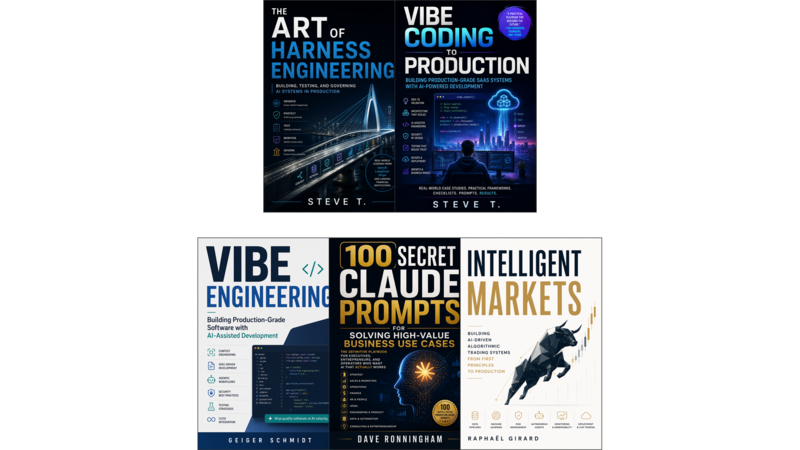
Vibe Coding to Production

Building Production-Grade SaaS Systems with AI-Powered Development

This book is 100% completeLast updated on 2026-07-13
Vibe coding has made it possible to build software faster than ever, but speed alone does not create great products. Vibe Coding to Production explores what it really takes to turn AI-generated code into reliable, secure, and scalable SaaS applications. Combining industry research, practical lessons, and real-world examples, this book shows how engineers and founders can use AI as a force…

Minimum price

$19.00

$29.00

You pay

Author earns

$

Also available for 1 book credit with a Reader Membership

PDF
EPUB
About

About

About the Book

Vibe coding has taken the software industry by storm since Andrej Karpathy coined the term in February 2025. What started as a provocative idea has become a $4.7 billion market, reshaping how startups build products and how enterprises approach software delivery. But can vibe coding be trusted to deliver production-grade systems? This book answers that question with evidence, not hype.

Drawing on the latest research from METR, CodeRabbit, Veracode, GitClear, and others, this book presents a comprehensive framework for building serious SaaS products using AI-assisted development workflows. It covers everything from idea validation through architecture, backend and frontend engineering, security, testing, DevOps, team governance, and business growth. Every chapter combines real-world case studies with practical frameworks, checklists, and reusable prompts that you can apply immediately.

Bundle

Bundles that include this book

Author

About the Author

Steve T. Publications

Steve T. Publications is a specialized book publishing company dedicated to delivering high-quality technical resources for IT professionals, students, educators, and technology enthusiasts. Our mission is to make complex technology concepts accessible through well-structured, practical, and industry-relevant publications.

We focus on publishing books across a wide range of information technology disciplines, including software development, cloud computing, cybersecurity, artificial intelligence, data science, networking, DevOps, databases, and enterprise technologies. Every publication is designed to bridge the gap between theory and real-world application, helping readers build the skills needed to succeed in today's rapidly evolving digital landscape.

At Steve T. Publications, we collaborate with experienced industry experts, educators, and technology professionals to produce accurate, up-to-date, and engaging content. We are committed to maintaining the highest editorial standards while empowering learners and professionals with trusted technical knowledge.

Whether you're beginning your IT journey, preparing for professional certifications, or advancing your expertise in emerging technologies, Steve T. Publications is your trusted source for authoritative and practical technical books.

Contents

Table of Contents

Building Production-Grade SaaS Systems with AI-Powered Development

  1. About This Book

Introduction: The Promise and Peril of Vibe Coding

  1. What This Book Is Not
  2. Who This Book Is For
  3. How to Read This Book

Chapter 1: Foundations of Vibe Coding

  1. What Is Vibe Coding, Precisely?
  2. The Evolution of AI-Assisted Development
  3. Core Principles: Context Windows, RAG, and Tool Use
  4. Model Selection for Every Task
  5. The Psychology of the AI Pair Programmer
  6. Exercise: Calibrate Your Perception-Reality Gap
  7. Exercise: Audit Your Team’s Code Review Standards Against the CodeRabbit Guardrails

Chapter 2: Idea Validation and Product Design with AI

  1. AI-Assisted Market Research and Competitive Analysis
  2. User Personas and Journey Mapping with LLMs
  3. Prompt Engineering for Product Requirements Documents
  4. Design Systems and UI/UX with AI Assistance
  5. Validating Ideas Before Writing Code

Chapter 3: Software Architecture for the AI Era

  1. Architectural Patterns That Play Well with Generation
  2. Modular Monolith vs. Microservices in an AI-Assisted World
  3. Designing for AI Code Review
  4. Architecture Decision Records in Vibe Coding Workflows
  5. Case Study: Multi-Tenant SaaS Platform

Chapter 4: Setting Up the AI Development Environment

  1. Choosing Your AI Toolchain
  2. Project Setup and AI-Generated Skeletons
  3. Prompt Libraries and Reusable Context Files
  4. Configuring Agent Behavior
  5. Version Control Strategies for AI-Generated Code
  6. Exercise: Build Your Team’s Shared Context Files

Chapter 5: Backend Engineering with AI

  1. API Design and Generation (REST, GraphQL, gRPC)
  2. Business Logic Implementation
  3. Database Schema Design and Migration Management
  4. Service-to-Service Communication and Event-Driven Architecture
  5. Case Study: Payment Processing Service
  6. Exercise: Generate and Audit a Payment Service with AI

Chapter 6: Frontend Engineering with AI

  1. Component Architecture and AI-Assisted Design Systems
  2. State Management Patterns for AI-Generated Code
  3. Styling and Theming with AI
  4. Performance Optimization in AI-Generated Frontends
  5. Case Study: Real-Time Dashboard

Chapter 7: Databases, Data Modeling, and AI-Assisted Queries

  1. Database Selection in an AI-Assisted World
  2. Schema Design and Normalization
  3. Query Optimization and Index Strategy
  4. Migration Management and Schema Evolution
  5. Data Access Patterns: Repositories, CQRS, Event Sourcing

Chapter 8: Authentication, Authorization, and Security by Design

  1. Authentication Flows with AI-Assisted Implementation
  2. Authorization Models: RBAC, ABAC, Policy-as-Code
  3. Security Vulnerabilities in AI-Generated Code
  4. Secrets Management and Key Rotation
  5. Compliance and Privacy: GDPR, SOC 2, HIPAA

Chapter 9: Testing, Quality Assurance, and AI-Assisted Verification

  1. Test Strategy for AI-Generated Codebases
  2. Unit Testing: Generation and Coverage
  3. Integration and End-to-End Testing
  4. Property-Based Testing and Fuzzing
  5. Quality Gates and Human-in-the-Loop Review
  6. Exercise: Implement Property-Based Testing for an AI-Generated Module

Chapter 10: DevOps, CI/CD, and Deployment at Scale

  1. CI/CD Pipeline Design for AI-Assisted Development
  2. Concrete CI/CD Pipeline: GitHub Actions for a Node.js SaaS Application
  3. Infrastructure as Code with AI
  4. Container Orchestration and Deployment Strategies
  5. Observability: Logging, Metrics, Tracing
  6. Disaster Recovery and Incident Response

Chapter 11: Team Workflows, Governance, and Scaling the Practice

  1. AI-Assisted Code Review Standards
  2. Prompt Governance and Versioning
  3. Exercise: Conduct a Prompt Regression Audit
  4. Managing Technical Debt in AI-Generated Codebases
  5. Team Training and Onboarding for Vibe Coding
  6. Measuring ROI: Metrics That Matter
  7. Exercise: Conduct a Prompt Regression Audit

Chapter 12: SaaS Business Growth and Operations

  1. Feature Velocity and Release Management
  2. Customer-Facing Applications and Support Automation
  3. Analytics, A/B Testing, and Data-Driven Decisions
  4. Pricing, Billing, and Revenue Operations
  5. Scaling the Engineering Team While Maintaining Quality
  6. Team Scaling Matrix: Roles, AI Proficiency, and Quality Ownership
  7. SaaS Metrics Dashboard Schema

Conclusion: The Future of Vibe Coding

  1. The Unified Thesis: Context Engineering as the Bridge
  2. The Evidence, Restated
  3. The Next 1-3 Years: Trajectory and Uncertainty
  4. When NOT to Use Vibe Coding
  5. Your 90-Day Action Plan for Adopting Vibe Coding
  6. Final Thoughts: The Amplifier Principle

References

Get the free sample chapters

Click the buttons to get the free sample in PDF or EPUB, or read the sample online here

The Leanpub 60 Day 100% Happiness Guarantee

Within 60 days of purchase you can get a 100% refund on any Leanpub purchase, in two clicks.

See full terms...

Earn $8 on a $10 Purchase, and $16 on a $20 Purchase

We pay 80% royalties on purchases of $7.99 or more, and 80% royalties minus a 50 cent flat fee on purchases between $0.99 and $7.98. You earn $8 on a $10 sale, and $16 on a $20 sale. So, if we sell 5000 non-refunded copies of your book for $20, you'll earn $80,000.

(Yes, some authors have already earned much more than that on Leanpub.)

In fact, authors have earned over $15 million writing, publishing and selling on Leanpub.

Learn more about writing on Leanpub

Free Updates. DRM Free.

If you buy a Leanpub book, you get free updates for as long as the author updates the book! Many authors use Leanpub to publish their books in-progress, while they are writing them. All readers get free updates, regardless of when they bought the book or how much they paid (including free).

Most Leanpub books are available in PDF (for computers) and EPUB (for phones, tablets and Kindle). The formats that a book includes are shown at the top right corner of this page.

Finally, Leanpub books don't have any DRM copy-protection nonsense, so you can easily read them on any supported device.

Learn more about Leanpub's ebook formats and where to read them

Write and Publish on Leanpub

You can use Leanpub to easily write, publish and sell in-progress and completed ebooks and online courses!

Leanpub is a powerful platform for serious authors, combining a simple, elegant writing and publishing workflow with a store focused on selling in-progress ebooks.

Leanpub is a magical typewriter for authors: just write in plain text, and to publish your ebook, just click a button. (Or, if you are producing your ebook your own way, you can even upload your own PDF and/or EPUB files and then publish with one click!) It really is that easy.

Learn more about writing on Leanpub