
Leanpub Header

Skip to main content

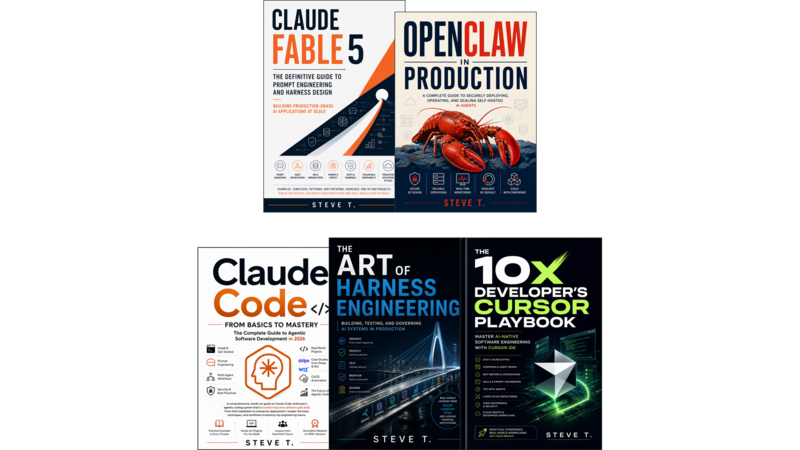
The 10x Developer's Cursor Playbook

Master AI-Native Software Engineering with Cursor IDE

This book is 100% completeLast updated on 2026-07-13
Most developers treat AI coding tools like a smarter autocomplete. The strongest developers use them as force multipliers. The 10x Developer’s Cursor Playbook is a practical guide to using Cursor as an AI-native engineering environment. It covers advanced prompting, agent-driven development, large-scale refactoring, MCP integrations, team workflows, and security practices. Whether you are…

Minimum price

$19.00

$29.00

You pay

Author earns

$

Also available for 1 book credit with a Reader Membership

PDF
EPUB
About

About

About the Book

Cursor is the fastest-growing developer tool in history, processing over 100 million lines of enterprise code daily and trusted by organizations like Stripe, OpenAI, NVIDIA, and PayPal. Yet most developers use it at 20 percent of its potential. This book teaches you how to squeeze every ounce of value from Cursor's Chat panel, inline editing, Composer mode, Agent mode, MCP servers, Skills, cloud agents, and security controls. You will learn prompt engineering techniques specific to AI-assisted coding, TDD workflows with agents, large-scale refactoring strategies, team governance patterns, and the research-backed truth about what AI actually does to your productivity and code quality. Written for intermediate developers through senior engineers, this is a practical field manual, not a marketing brochure.

Bundle

Bundles that include this book

Author

About the Author

Steve T. Publications

Steve T. Publications is a specialized book publishing company dedicated to delivering high-quality technical resources for IT professionals, students, educators, and technology enthusiasts. Our mission is to make complex technology concepts accessible through well-structured, practical, and industry-relevant publications.

We focus on publishing books across a wide range of information technology disciplines, including software development, cloud computing, cybersecurity, artificial intelligence, data science, networking, DevOps, databases, and enterprise technologies. Every publication is designed to bridge the gap between theory and real-world application, helping readers build the skills needed to succeed in today's rapidly evolving digital landscape.

At Steve T. Publications, we collaborate with experienced industry experts, educators, and technology professionals to produce accurate, up-to-date, and engaging content. We are committed to maintaining the highest editorial standards while empowering learners and professionals with trusted technical knowledge.

Whether you're beginning your IT journey, preparing for professional certifications, or advancing your expertise in emerging technologies, Steve T. Publications is your trusted source for authoritative and practical technical books.

Contents

Table of Contents

About This Book

  1. How to Use This Book
  2. Introduction: The End of the Keyboard as We Knew It
  3. A Day in the Life Before and After Cursor
  4. What Cursor Actually Is (and Isn’t)
  5. The Productivity Promise: What the Data Says

Chapter 1: Foundations — Understanding Cursor’s Architecture

  1. The VS Code Fork Advantage
  2. Model Routing and Selection
  3. The Agent Harness
  4. Context Engineering
  5. Architecture Diagram (Described in Text)
  6. Key Takeaways from Chapter 1
  7. Hands-On Exercise: Mapping Your First Agent Session

Chapter 2: Getting Started — Installation, Setup, and First Steps

  1. System Requirements and Installation
  2. Choosing Your AI Model
  3. Privacy Mode and Data Controls
  4. Your First Project with Cursor
  5. Essential Keyboard Shortcuts
  6. Key Takeaways from Chapter 2
  7. Hands-On Exercise: Your First Full Workflow

Chapter 3: Prompt Engineering for Developers

  1. The Anatomy of a Good Cursor Prompt
  2. Structured Prompting Patterns
  3. Context References That Work
  4. Model-Specific Prompt Tuning
  5. Writing .cursorrules
  6. Hands-On Exercise: Refactoring a Broken Function
  7. Key Takeaways from Chapter 3
  8. Hands-On Exercise: Building Your Prompt Template Library

Chapter 4: The Editor Experience — Chat, Inline Editing, and Copilot++

  1. The Chat Panel (Cmd+L)
  2. Inline Editing (Cmd+K)
  3. Copilot++ Autocomplete
  4. Hands-On Exercise: Using Chat + Inline Together
  5. Key Takeaways from Chapter 4
  6. Hands-On Exercise: Building Muscle Memory for Inline Editing

Chapter 5: Composer Mode — Multi-File Editing at Scale

  1. What Composer Is and When to Use It
  2. Opening and Scoping Composer
  3. The Review Workflow
  4. Multi-File Editing Mechanics
  5. Hands-On Exercise: Adding a Timestamp Across Files
  6. Key Takeaways from Chapter 5
  7. Hands-On Exercise: Practice Scoping and Review

Chapter 6: Agent Mode — Autonomous Coding Workflows

  1. Agent Mode vs. Composer
  2. Plan Mode (Shift+Tab)
  3. Long-Running Agents
  4. Debug Mode Deep Dive
  5. Parallel Agent Execution
  6. Hands-On Exercise: End-to-End Feature Implementation
  7. Key Takeaways from Chapter 6
  8. Hands-On Exercise: Building a Test-Fix Loop

Chapter 7: Agentic Architecture — Scaling Beyond a Single Developer

  1. Cloud Agents
  2. Skills (SKILL.md)
  3. Multi-Agent Coordination
  4. Automations
  5. Hands-On Exercise: Setting Up an Automated Test-Fix Loop
  6. Key Takeaways from Chapter 7
  7. Hands-On Exercise: Experimenting with Cloud Agents

Chapter 8: MCP Servers — Extending Cursor Beyond the Codebase

  1. What Is MCP?
  2. Setting Up MCP Servers in Cursor
  3. Useful MCP Integrations
  4. Security Considerations for MCP
  5. Hands-On Exercise: Connecting Jira to Cursor
  6. Key Takeaways from Chapter 8
  7. Hands-On Exercise: Building Your MCP Server Library

Chapter 9: Testing and TDD with Cursor

  1. Test-Driven Development with Agents
  2. Unit Test Generation
  3. End-to-End Testing
  4. Regression Suites
  5. Hands-On Exercise: Full TDD Cycle
  6. Key Takeaways from Chapter 9
  7. Hands-On Exercise: Building Your Project’s Test Suite

Chapter 10: Debugging and Codebase Navigation

  1. Treating the Agent as a Teammate
  2. Codebase Understanding at Scale
  3. Debug Mode Deep Dive
  4. Bugbot and PR Review
  5. Hands-On Exercise: Debugging a Race Condition
  6. Key Takeaways from Chapter 10
  7. Hands-On Exercise: Debugging Your Own Code

Chapter 11: Large-Scale Refactoring and Legacy Code

  1. The Refactoring Workflow
  2. Migration Case Studies
  3. Legacy Code Patterns
  4. Managing Context During Refactoring
  5. Hands-On Exercise: Monolithic Controller Refactor
  6. Key Takeaways from Chapter 11
  7. Hands-On Exercise: Refactoring Your Own Codebase

Chapter 12: Team Collaboration and Enterprise Adoption

  1. Teams vs. Enterprise Plans
  2. Governance and RBAC
  3. Shared Context Across Teams
  4. Code Review Culture with AI
  5. The Human Role Shift
  6. Key Takeaways from Chapter 12
  7. Hands-On Exercise: Establishing Team Standards

Chapter 13: Security, Privacy, and Risk Management

  1. The Expanded Attack Surface
  2. Native Security Controls
  3. CVEs and Vulnerabilities
  4. Enterprise Security Architecture
  5. The Secret Leakage Problem
  6. Key Takeaways from Chapter 13
  7. Hands-On Exercise: Security Audit of Your Cursor Setup

Chapter 14: The Productivity Paradox — What the Research Really Shows

  1. The UChicago Study (+39% Merged PRs)
  2. The METR RCT (-19% Speed for Early Models)
  3. The MSR Paper (Speed at the Cost of Quality)
  4. NVIDIA’s Enterprise Results
  5. Synthesis: The Productivity Curve
  6. Key Takeaways from Chapter 14
  7. Hands-On Exercise: Benchmarking Your Own Productivity

Chapter 15: The Future of AI-Native Software Engineering

  1. The Trajectory
  2. Model Economics
  3. What Gets Automated vs. What Doesn’t
  4. Speculative but Grounded
  5. Key Takeaways from Chapter 15
  6. Hands-On Exercise: Future-Proofing Your Skills
  7. Key Takeaways from Chapter 15
  8. Hands-On Exercise: Future-Proofing Your Skills

Conclusion: Your 10x Journey Starts Now

  1. The Ten Commandments of Cursor Development
  2. Your First 30 Days with Cursor
  3. When Not to Use Cursor
  4. Final Thoughts

References

Get the free sample chapters

Click the buttons to get the free sample in PDF or EPUB, or read the sample online here

The Leanpub 60 Day 100% Happiness Guarantee

Within 60 days of purchase you can get a 100% refund on any Leanpub purchase, in two clicks.

See full terms...

Earn $8 on a $10 Purchase, and $16 on a $20 Purchase

We pay 80% royalties on purchases of $7.99 or more, and 80% royalties minus a 50 cent flat fee on purchases between $0.99 and $7.98. You earn $8 on a $10 sale, and $16 on a $20 sale. So, if we sell 5000 non-refunded copies of your book for $20, you'll earn $80,000.

(Yes, some authors have already earned much more than that on Leanpub.)

In fact, authors have earned over $15 million writing, publishing and selling on Leanpub.

Learn more about writing on Leanpub

Free Updates. DRM Free.

If you buy a Leanpub book, you get free updates for as long as the author updates the book! Many authors use Leanpub to publish their books in-progress, while they are writing them. All readers get free updates, regardless of when they bought the book or how much they paid (including free).

Most Leanpub books are available in PDF (for computers) and EPUB (for phones, tablets and Kindle). The formats that a book includes are shown at the top right corner of this page.

Finally, Leanpub books don't have any DRM copy-protection nonsense, so you can easily read them on any supported device.

Learn more about Leanpub's ebook formats and where to read them

Write and Publish on Leanpub

You can use Leanpub to easily write, publish and sell in-progress and completed ebooks and online courses!

Leanpub is a powerful platform for serious authors, combining a simple, elegant writing and publishing workflow with a store focused on selling in-progress ebooks.

Leanpub is a magical typewriter for authors: just write in plain text, and to publish your ebook, just click a button. (Or, if you are producing your ebook your own way, you can even upload your own PDF and/or EPUB files and then publish with one click!) It really is that easy.

Learn more about writing on Leanpub