Reliable Generative AI
A Practical Guide to Prompt Design, RAG, Agents, and Safer AI Workflows


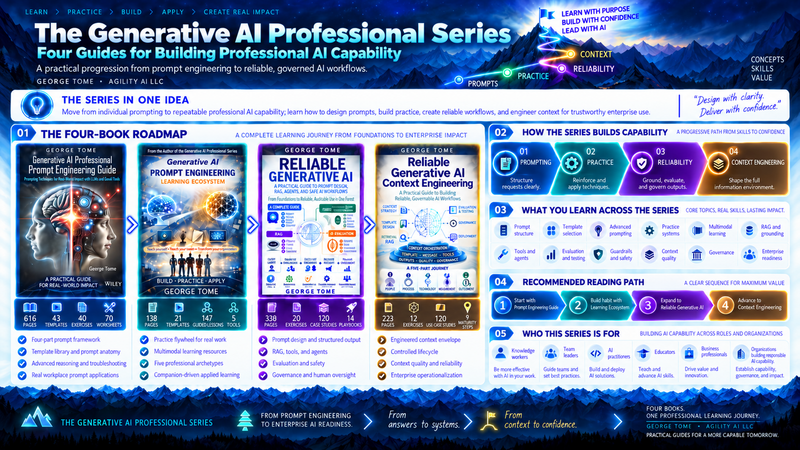
Reliable Generative AI bridges business use and technical architecture. It teaches the foundations of prompt design, RAG, agentic workflows, tool use, structured outputs, safety patterns, and evaluation without assuming the reader is a software engineer. The focus is practical: understanding how AI workflows fail, how to design around those failures, and how to build systems that professionals can trust.
With Membership
Free!
$29.00
You pay
Author earns
About
About the Book
Generative AI is easy to try, but much harder to use reliably. A good answer once is not enough when the work involves documents, decisions, professional judgment, or business risk. Reliable Generative AI helps you move beyond clever prompts and learn how to design AI workflows that are structured, grounded, repeatable, and safer to use.
This book teaches the practical foundations behind reliable AI work: how large language models represent meaning, why prompts drift, how structured prompt design improves consistency, how RAG grounds answers in documents, how agents use tools and handoffs, and why guardrails, evaluation, and human review matter when AI is used in real workflows.
You will learn how to think about AI as a system, not just a chatbot. The book explains prompt design, output schemas, retrieval, agents, tool use, multi-agent coordination, prompt injection risk, hallucination controls, citation verification, governance, and safer workflow patterns in language that is practical for professionals and serious learners.
The guide is also designed as a learning system. It connects the reading experience with companion resources such as interactive labs, exercise labs, video learning, flashcards, exam-style practice, terminology tools, and visual learning aids so you can practice, verify, and retain the concepts instead of only reading about them.
Reliable Generative AI is best for AI-enabled professionals, prompt designers, trainers, technical business leaders, product owners, governance and risk stewards, and learners preparing for structured AI knowledge work. If you want a practical foundation for building AI workflows you can trust, this book gives you the concepts, patterns, and practice path to get there.
Feedback
Bundles
Bundles that include this book
- Pricing
Free!
With MembershipBought separately$58.00Suggested price$34.00
- Pricing
Free!
With MembershipBought separately$116Suggested price$39.00

Author
About the Author

George Tome is an Enterprise AI Coach, Trainer, Author, and founder of Agility AI LLC, focused on helping professionals build practical, reliable AI capability through prompt design, workflow thinking, RAG, agents, governance, and hands-on learning systems with over 30 years of experience driving innovation and transformation. With a deep expertise in Agile training & methodologies, and global organizational change, George has led groundbreaking initiatives across multiple continents. His work has been recognized both internally and in the Harvard Business Review. George is passionate about developing strategic frameworks and comprehensive training programs that empower teams to harness AI and Agile practices for maximum impact. Holding certifications in AI, Agile training/coaching and project management from prestigious institutions including Stanford University, and the University of Chicago, George continues to inspire and lead in the fields of AI and Agile transformation.
Contents
Table of Contents
- Preface
- Learning Personas and Learning Paths
- Quick Start Checklist (Select Your Persona and Begin.)
- External Resources
- Interactive and Exercises Labs Hubs
- Reliable Generative AI Exam Application
- Reliable Generative AI Video Learning Hub
- Reliable Generative AI Flashcards Application
- Reliable Generative AI Definitions Applications
- Reliable Generative AI Infographics Application
- Generative AI Question Concepts Application
- Introduction - Looking Under the Hood of Generative AI
- Chapter 1: Foundational Mastery
- 1. The Geometry of Language - Latent Space, Embeddings, and Drift
- 1.1 Latent Space - The Model's Map of Meaning
- 1.2 Embeddings - Coordinates in that Space
- 1.3 Semantic Drift - When Meaning Slowly Slides Away
- 2. The Engine - How Transformers Actually Work
- 2.1 Multi-Head Attention - Many "Views" on the Same Text
- 2.2 Context Window - Big Memory, Selective Focus
- 2.3 Information Compression and the Economics of Tokens
- 3. The Controls - Temperature, Sampling, and Determinism
- 3.1 Temperature - The "Risk Dial"
- 3.2 Sampling Strategies - Top-K and Top-P
- 3.3 Entropy - How "Sure" Is the Model?
- 4. Structuring Thought - Prompt Design Beyond "Ask a Question"
- 4.1 System Messages - The Constitution of the Model
- 4.2 Chain-of-Thought and Anchor Thoughts
- 4.3 Controlling Output Format and Length
- 4.4 Complexity and Its Pitfalls
- 5. Systems Architecture - RAG, Tools, and Agents
- 5.1 RAG - Connecting the Model to Real Knowledge
- 5.2 Tools and Hybrid Intelligence
- 5.3 Multi-Agent Systems and Prompt Collisions
- 6. Evaluation, Safety, and Limits
- 6.1 The Alignment Tax - Safety vs. Raw Capability
- 6.2 Evaluating Quality - Beyond Word Overlap
- 6.3 Security Perspective - Training vs. Inference
- Conclusion - From User to Engineer
- Chapter 2: Applied Prompt Engineering & Scenario Design
- Introduction - From Clever Answers to Reliable Systems
- 2.1 Governing Output - Structure, Schemas, and Decisions
- 2.1.1 Why Structure Matters
- 2.1.2 Enforcing Compliance and Stability
- 2.1.3 Turning Free Text into Decisions
- 2.2 Advanced Reasoning Architectures - Keeping Logic on the Rails
- 2.2.1 The Error Cascade Problem
- 2.2.2 Stabilizing Math and Logic
- 2.2.3 Loops, Self-Critique, and Visible Reasoning
- 2.3 Grounding and RAG - Tethering the Model to Reality
- 2.3.1 Why Grounding Beats Personality
- 2.3.2 Citations That Can Be Verified
- 2.3.3 When the Model Disagrees with Your Documents
- 2.3.4 Knowledge Dilution and Multi-Step Retrieval
- 2.3.5 The Multilingual Edge
- 2.4 Agents, Roles, and Multi-Agent Systems
- 2.4.1 Role Prompts and "Bleed-Through"
- 2.4.2 Multi-Agent Workflows and Prompt Collisions
- 2.4.3 Utility Agents and Sandboxes
- 2.4.4 Managing Variance in Agent Chains
- 2.5 Domain-Specific Optimization - Law, Medicine, Translation, and More
- 2.5.1 Long Documents and Progressive Compression
- 2.5.2 Professional Translation with Glossaries
- 2.5.3 Controlling Verbosity and Staying in Domain
- 2.6 Evaluation, Security, and Tuning - Proving It Works
- 2.6.1 Testing Like a Scientist, Not by Vibes
- 2.6.2 Injection, Leakage, and Other Security Risks
- 2.6.3 Reproducibility, State Compression, and Adversarial Testing
- Conclusion - The Architect's Mindset
- Chapter 3: Agentic Workflows, RAG, and Production Systems
- Introduction - From Chatbots to Reliable AI Workflows
- 3.1 Advanced RAG Architecture - Giving AI a Reliable Memory
- 3.1.1 Retrieval as "Semantic GPS"
- 3.1.2 Chunking - Balancing Precision and Context
- 3.1.3 Hybrid Search - Combining Semantics and Exact Matches
- 3.1.4 Why RAG Still Hallucinates
- 3.2 Building Reliable Agents - Giving AI Hands and Tools
- 3.2.1 How Agents Use Tools
- 3.2.2 Handling Failures and Conflicts
- 3.2.3 Memory, Drift, and State
- 3.3 Orchestrating a Team of Agents
- 3.3.1 Handoffs and Structured Contracts
- 3.3.2 Scheduling Work
- 3.3.3 Verification as the Final Gate
- 3.4 Guardrails and Safety - Building the Shield
- 3.4.1 Defense Against Hallucinations
- 3.4.2 Safety Design Patterns and Constraint Density
- 3.4.3 Prompt Injection and Instruction Integrity
- 3.5 Production Operations - Running the AI Factory
- 3.5.1 Performance, Latency, and Batching
- 3.5.2 Caching - Smart Shortcuts
- 3.5.3 Scaling and Monitoring
- Conclusion - Thinking Like a System Architect
- Chapter 4: Ethics, Safety, Business Value & Failure Modes
- Introduction - The Guardrails of Intelligent Systems
- 4.1 The Human Factor - Trust, Drift, and Reliance
- 4.1.1 The Illusion of Confidence
- 4.1.2 Managing Expectations and Calibrating Trust
- 4.1.3 Task Substitution, Not Full Job Replacement
- 4.2 Governance, Law, and Accountability
- 4.2.1 The Three Pillars of AI Governance
- 4.2.2 Audit Trails and Legal Defensibility
- 4.2.3 The Privacy Paradox of Logging
- 4.2.4 Prompt Stability and Policy Boundaries
- 4.3 Technical Safety and Alignment
- 4.3.1 What Alignment Really Means
- 4.3.2 Bias and Fairness
- 4.3.3 Handling Excessive Refusals
- 4.3.4 Determinism in High-Stakes Domains
- 4.4 High-Stakes Architectures and Failure Modes
- 4.4.1 RAG and the Privacy Leak Problem
- 4.4.2 Legal and Medical Workflows
- 4.4.3 Emergent Risks in Multi-Agent Systems
- Conclusion - Becoming the Reliability Architect
- Index, About the Author, and Back Cover
Also by the Author
Also by the Author


The Leanpub 60 Day 100% Happiness Guarantee
Within 60 days of purchase you can get a 100% refund on any Leanpub purchase, in two clicks.
See full terms...
Earn $8 on a $10 Purchase, and $16 on a $20 Purchase
We pay 80% royalties on purchases of $7.99 or more, and 80% royalties minus a 50 cent flat fee on purchases between $0.99 and $7.98. You earn $8 on a $10 sale, and $16 on a $20 sale. So, if we sell 5000 non-refunded copies of your book for $20, you'll earn $80,000.
(Yes, some authors have already earned much more than that on Leanpub.)
Learn more about writing on Leanpub
Free Updates. DRM Free.
If you buy a Leanpub book, you get free updates for as long as the author updates the book! Many authors use Leanpub to publish their books in-progress, while they are writing them. All readers get free updates, regardless of when they bought the book or how much they paid (including free).
Most Leanpub books are available in PDF (for computers) and EPUB (for phones, tablets and Kindle). The formats that a book includes are shown at the top right corner of this page.
Finally, Leanpub books don't have any DRM copy-protection nonsense, so you can easily read them on any supported device.
Learn more about Leanpub's ebook formats and where to read them
Write and Publish on Leanpub
You can use Leanpub to easily write, publish and sell in-progress and completed ebooks and online courses!
Leanpub is a powerful platform for serious authors, combining a simple, elegant writing and publishing workflow with a store focused on selling in-progress ebooks.
Leanpub is a magical typewriter for authors: just write in plain text, and to publish your ebook, just click a button. (Or, if you are producing your ebook your own way, you can even upload your own PDF and/or EPUB files and then publish with one click!) It really is that easy.