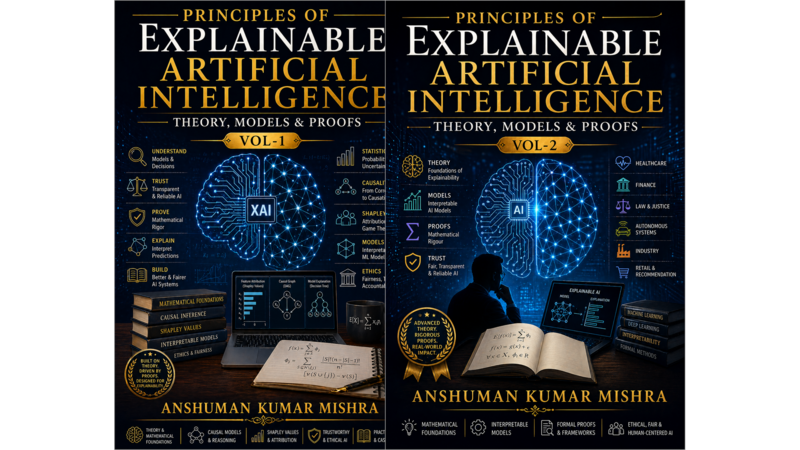
Principles of Explainable Artificial Intelligence Theory Models & Proofs VOL-1


WHO SHOULD READ THIS BOOK?
This book is ideal for:
· BCA, MCA, B.Tech, M.Tech students
· UGC NET aspirants
· AI/ML researchers
· Data scientists
· AI developers
· University professors
· PhD scholars
· Industry professionals working with black-box models
· Anyone who wants mathematical clarity on XAI
Its writing style balances mathematical rigor with readability, making it useful for self-study and classroom use.
TEACHING & LEARNING BENEFITS
· 50+ diagrams, proofs, and mathematical derivations.
· Step-by-step logical flow for each model.
· Case studies from healthcare, finance, law, and engineering.
· Practical coding references (without over-reliance on tools).
· Integration of statistics, calculus, causality, and deep learning.
· Real-world examples for intuitive understanding.
· Problems at the end of each chapter (optional addition).
Instructors can adopt this book for academic courses in:
· Explainable AI
· Machine Learning
· Statistical Inference
· Causality
· Artificial Intelligence Foundations
· Deep Learning Interpretability
UNIQUE CONTRIBUTIONS OF THIS BOOK
Unlike other XAI or ML books, this work by Anshuman Mishra offers:
· Mathematical derivations for SHAP, IG, LIME, and other explainability tools.
· Original proofs for fairness properties in attribution methods.
· Detailed causal diagrams and do-calculus explanations.
· A structured approach to XAI evaluation metrics.
· Coverage of transformer explainability—rare in academic books.
· Clarity in blending classical mathematical theory with modern AI systems.
This makes the book a reference-level resource for the next decade of AI learning.
Minimum price
$9.99
$19.99
You pay
Author earns
About
About the Book
Explainable Artificial Intelligence (XAI) has rapidly evolved into one of the most critical dimensions of modern AI research. As deep learning models have grown in size, complexity, and power, the opacity of their decision-making processes has raised significant concerns regarding fairness, accountability, regulatory compliance, trustworthiness, and ethical use. This book, Principles of Explainable Artificial Intelligence: Theory, Models & Proofs, written by Anshuman Mishra, addresses this global need by presenting a mathematically grounded, logically rigorous, and research-centric exploration of XAI principles.
The book is designed not only for students and beginners but also for researchers, practitioners, faculty members, competitive exam aspirants, and professionals seeking deep mathematical understanding behind the explainability mechanisms of AI systems. It emphasizes the foundational structures of interpretability—causal reasoning, attribution theory, game-theoretic fairness, statistical transparency, and formal mathematical proofs.
Rather than treating explainability tools like SHAP, LIME, or Grad-CAM as black-box techniques, this book dissects why these methods work, how they are derived mathematically, and what theoretical foundations justify their use. By combining classical mathematics, probability theory, statistical modeling, causal inference, and computational reasoning, this book enables the reader to understand explainability as a formal scientific discipline.
THE PURPOSE OF THIS BOOK
The primary objective of this book is to bridge the gap between “practical explainability tools” and the deep mathematical frameworks upon which they are built. Many books in the market offer high-level descriptions or code-based tutorials on XAI techniques. However, few provide a rigorous mathematical treatment of the field.
This book offers:
· A clear understanding of the mathematical foundations behind explainability.
· Detailed proofs explaining why certain XAI methods satisfy fairness or attribution properties.
· Derivations of Shapley values from cooperative game theory.
· Detailed causal reasoning with do-calculus, DAGs, interventions, and counterfactuals.
· Gradient-level interpretability used in deep learning and large language models.
· Evaluation metrics with formal definitions and proofs.
· Demonstrations of how statistical inference and causality form the backbone of transparency in AI.
The content ensures that readers master both theory and practical implementation, making it ideal for academic coursework, university syllabi, independent research, and data science industry roles.
WHY EXPLAINABLE AI IS NECESSARY
As AI systems increasingly influence critical decision-making areas—healthcare diagnoses, financial risk assessments, loan approvals, autonomous driving, medical imaging, legal judgments, industrial automation, and more—transparency becomes essential.
This book argues that explainability is not an optional feature; it is a fundamental requirement grounded in:
1. Ethics: Preventing discrimination and biases in model outcomes.
2. Trust: Helping users understand and trust AI-driven decisions.
3. Accountability: Allowing organizations to justify automated decisions.
4. Regulatory Compliance: Laws such as the EU AI Act, GDPR, and emerging Indian AI policies demand transparent AI.
5. Debugging & Improvement: Interpretability helps identify model weaknesses and data inconsistencies.
6. Safety: Especially crucial in autonomous and medical systems.
By combining mathematics with ethics and practical industry requirements, the book provides a holistic understanding of the need for explainability.
WHAT THIS BOOK OFFERS
This book is divided into well-structured parts that build knowledge progressively:
1. Mathematical FoundationsReaders begin with essential concepts—set theory, linear algebra, vector spaces, calculus, probability distributions, loss functions, gradients, optimization mechanics, and statistical inference techniques. These chapters ensure strong grounding for deeper XAI topics.
2. Statistical Explainability & TransparencyThis part explores how statistical relationships help interpret AI models. Concepts such as covariance, multicollinearity, variance decomposition, likelihood estimation, confidence intervals, hypothesis tests, and uncertainty quantification become tools for transparency.
3. Causality and ReasoningJudea Pearl’s causal hierarchy—association, intervention, and counterfactuals—is explained through examples, DAGs, do-calculus, backdoor/frontdoor criteria, instrumental variables, and causal discovery algorithms. This section links causal explainability with real-world decision systems.
4. Shapley Values and Attribution TheoryA full, mathematically rich exploration of cooperative game theory leads into Shapley values. From axiomatic definitions to uniqueness theorems and fairness proofs, readers understand feature attribution at a foundational level. Kernel SHAP, Tree SHAP, Deep SHAP, and Gradient SHAP are explained systematically.
5. Interpretability in Classical & Deep Learning ModelsReaders learn rule extraction, decision trees, gradients, saliency maps, Grad-CAM, LRP, visualization techniques, attention-based interpretability, and transformer-level explanations.
6. Fairness, Ethics & Evaluation MetricsExplainability must be measured and validated. The book explores sensitivity, completeness, consistency, fidelity, and human-centered metrics with mathematical rigor. Fairness and bias mitigation techniques are addressed clearly.
7. Explainability for Large Language ModelsSpecial emphasis is placed on modern transformer-based architectures (e.g., GPT-type and BERT-type models). Mechanistic interpretability, attribution at token level, head-level analysis, and probing are covered.
8. Future DirectionsNeuro-symbolic reasoning, causal-explainable AI integration, formal verification, explainability under regulations, interpreting AI safety, and open problems in research.
WHO SHOULD READ THIS BOOK?
This book is ideal for:
· BCA, MCA, B.Tech, M.Tech students
· UGC NET aspirants
· AI/ML researchers
· Data scientists
· AI developers
· University professors
· PhD scholars
· Industry professionals working with black-box models
· Anyone who wants mathematical clarity on XAI
Its writing style balances mathematical rigor with readability, making it useful for self-study and classroom use.
TEACHING & LEARNING BENEFITS
· 50+ diagrams, proofs, and mathematical derivations.
· Step-by-step logical flow for each model.
· Case studies from healthcare, finance, law, and engineering.
· Practical coding references (without over-reliance on tools).
· Integration of statistics, calculus, causality, and deep learning.
· Real-world examples for intuitive understanding.
· Problems at the end of each chapter (optional addition).
Instructors can adopt this book for academic courses in:
· Explainable AI
· Machine Learning
· Statistical Inference
· Causality
· Artificial Intelligence Foundations
· Deep Learning Interpretability
UNIQUE CONTRIBUTIONS OF THIS BOOK
Unlike other XAI or ML books, this work by Anshuman Mishra offers:
· Mathematical derivations for SHAP, IG, LIME, and other explainability tools.
· Original proofs for fairness properties in attribution methods.
· Detailed causal diagrams and do-calculus explanations.
· A structured approach to XAI evaluation metrics.
· Coverage of transformer explainability—rare in academic books.
· Clarity in blending classical mathematical theory with modern AI systems.
This makes the book a reference-level resource for the next decade of AI learning.
Bundle
Bundles that include this book
- Pricing
$29.00
Minimum priceBought separately$39.98Suggested price$29.00
Author
About the Author

Anshuman Kumar Mishra, M.Tech (Computer Science) Assistant Professor, Doranda College, Ranchi University
Prolific Author of 50+ Books on AI, Machine Learning & Computer Science | 20+ Years Experience
Anshuman Kumar Mishra is a dedicated educator, researcher, and highly prolific author with over 20 years of experience in Computer Science and Information Technology. Holding an M.Tech in Computer Science from BIT Mesra, he brings a rare combination of academic depth and practical teaching expertise.
Currently serving as Assistant Professor at Doranda College under Ranchi University, he has mentored thousands of students, helping them build strong foundations in programming, data science, and artificial intelligence. His student-centric teaching style emphasizes conceptual clarity, hands-on practice, and real-world application.
Anshuman is a prolific author with more than 50 books published across a wide spectrum of computer science and emerging technology domains. From foundational programming languages to advanced topics in Artificial Intelligence, Machine Learning, Reinforcement Learning, Decision Theory, and Computer Vision — his books are widely appreciated by students, educators, and professionals for their clear explanations, strong theoretical foundation, and practical approach.
His extensive body of work reflects his deep commitment to making complex subjects accessible and meaningful for learners at all levels. He is particularly recognized for creating well-structured learning paths that help readers progress from beginner to advanced levels with confidence.
Driven by the mission to democratize quality technical education, Anshuman continues to write and update books that bridge the gap between academic theory and industry practice.
When not teaching or writing, he actively follows and explores new developments in AI, Quantum Machine Learning, and Ethical Intelligence systems.
Contents
Table of Contents
The Leanpub 60 Day 100% Happiness Guarantee
Within 60 days of purchase you can get a 100% refund on any Leanpub purchase, in two clicks.
See full terms...
Earn $8 on a $10 Purchase, and $16 on a $20 Purchase
We pay 80% royalties on purchases of $7.99 or more, and 80% royalties minus a 50 cent flat fee on purchases between $0.99 and $7.98. You earn $8 on a $10 sale, and $16 on a $20 sale. So, if we sell 5000 non-refunded copies of your book for $20, you'll earn $80,000.
(Yes, some authors have already earned much more than that on Leanpub.)
Learn more about writing on Leanpub
Free Updates. DRM Free.
If you buy a Leanpub book, you get free updates for as long as the author updates the book! Many authors use Leanpub to publish their books in-progress, while they are writing them. All readers get free updates, regardless of when they bought the book or how much they paid (including free).
Most Leanpub books are available in PDF (for computers) and EPUB (for phones, tablets and Kindle). The formats that a book includes are shown at the top right corner of this page.
Finally, Leanpub books don't have any DRM copy-protection nonsense, so you can easily read them on any supported device.
Learn more about Leanpub's ebook formats and where to read them
Write and Publish on Leanpub
You can use Leanpub to easily write, publish and sell in-progress and completed ebooks and online courses!
Leanpub is a powerful platform for serious authors, combining a simple, elegant writing and publishing workflow with a store focused on selling in-progress ebooks.
Leanpub is a magical typewriter for authors: just write in plain text, and to publish your ebook, just click a button. (Or, if you are producing your ebook your own way, you can even upload your own PDF and/or EPUB files and then publish with one click!) It really is that easy.