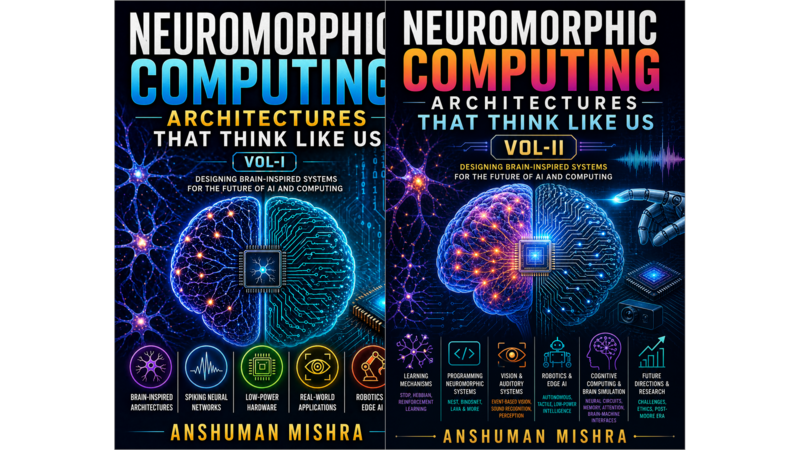
Neuromorphic Computing: Architectures That Think Like Us VOL-I


How to Use This Book
This book is structured to guide you through the complexities of neuromorphic computing in a logical and progressive manner:
- Part I: Foundations of Neuromorphic Computing lays the groundwork by introducing the core concepts, historical context, and the biological inspirations behind neuromorphic architectures. If you're new to the subject, start here to build a strong conceptual understanding.
- Part II: Hardware Architectures and Technologies dives deep into the silicon, exploring the leading neuromorphic chips and the emerging technologies that are making these brain-inspired systems a reality. This section is crucial for understanding the physical manifestation of neuromorphic principles.
- Part III: Algorithms and Learning Mechanisms focuses on the software side, detailing the learning rules and programming frameworks that enable neuromorphic systems to learn and adapt. For those looking to work with or develop for these systems, this part offers essential practical insights.
- Part IV: Applications and Case Studies showcases the diverse and impactful uses of neuromorphic computing across various domains, from computer vision to robotics and cognitive modeling. These chapters provide real-world context and inspiration.
- Part V: Future Directions and Research Frontiers looks ahead, addressing the challenges, ethical considerations, and the exciting future possibilities of neuromorphic computing in a post-Moore's Law era.
Feel free to read the book cover-to-cover for a comprehensive understanding, or jump to specific chapters based on your interests. Each chapter is designed to be largely self-contained while building upon previous concepts.
Minimum price
$9.99
$19.99
You pay
Author earns
About
About the Book
In the ever-evolving landscape of artificial intelligence and computing, neuromorphic computing stands as a beacon of innovation, promising a paradigm shift in how we design and build intelligent machines. For decades, the conventional Von Neumann architecture, while powerful, has grappled with the inherent limitations of separating processing and memory, leading to the infamous "memory wall." Meanwhile, the human brain, an organ of unparalleled complexity and efficiency, effortlessly processes vast amounts of information with remarkable speed and minimal energy consumption. Neuromorphic computing seeks to bridge this gap, drawing profound inspiration from the brain's intricate structure and function to create systems that are not just faster, but fundamentally smarter and more energy-efficient.
Purpose of the Book
The primary purpose of "Neuromorphic Computing: Architectures That Think Like Us" is to demystify this exciting and rapidly advancing field. We aim to provide a comprehensive and accessible exploration of neuromorphic computing, from its biological underpinnings to its cutting-edge hardware implementations and diverse applications. This book is designed to serve as a foundational guide for understanding the core principles, the technological advancements, and the immense potential of brain-inspired systems. We will delve into how these architectures are designed to overcome the limitations of traditional computing, enabling new frontiers in AI, robotics, and cognitive modeling. Ultimately, our goal is to empower readers with the knowledge to grasp the significance of this revolution and to contribute to its future.
Who Should Read This Book
This book is tailored for a diverse audience, including:
- Students and Researchers in computer science, electrical engineering, neuroscience, and artificial intelligence who are looking to understand the fundamentals and latest advancements in neuromorphic computing.
- Engineers and Developers interested in designing and programming brain-inspired hardware and software for real-world applications.
- AI Practitioners and Enthusiasts curious about the next generation of artificial intelligence and how biological principles are shaping its evolution.
- Anyone with a keen interest in the intersection of biology, technology, and the future of intelligent systems. Whether you are a seasoned expert or new to the field, this book offers valuable insights and practical knowledge.
How to Use This Book
This book is structured to guide you through the complexities of neuromorphic computing in a logical and progressive manner:
- Part I: Foundations of Neuromorphic Computing lays the groundwork by introducing the core concepts, historical context, and the biological inspirations behind neuromorphic architectures. If you're new to the subject, start here to build a strong conceptual understanding.
- Part II: Hardware Architectures and Technologies dives deep into the silicon, exploring the leading neuromorphic chips and the emerging technologies that are making these brain-inspired systems a reality. This section is crucial for understanding the physical manifestation of neuromorphic principles.
- Part III: Algorithms and Learning Mechanisms focuses on the software side, detailing the learning rules and programming frameworks that enable neuromorphic systems to learn and adapt. For those looking to work with or develop for these systems, this part offers essential practical insights.
- Part IV: Applications and Case Studies showcases the diverse and impactful uses of neuromorphic computing across various domains, from computer vision to robotics and cognitive modeling. These chapters provide real-world context and inspiration.
- Part V: Future Directions and Research Frontiers looks ahead, addressing the challenges, ethical considerations, and the exciting future possibilities of neuromorphic computing in a post-Moore's Law era.
Feel free to read the book cover-to-cover for a comprehensive understanding, or jump to specific chapters based on your interests. Each chapter is designed to be largely self-contained while building upon previous concepts.
Categories
Feedback
Bundle
Bundles that include this book
- Pricing
$29.00
Minimum priceBought separately$39.98Suggested price$29.00
Author
About the Author

Anshuman Kumar Mishra, M.Tech (Computer Science) Assistant Professor, Doranda College, Ranchi University
Prolific Author of 50+ Books on AI, Machine Learning & Computer Science | 20+ Years Experience
Anshuman Kumar Mishra is a dedicated educator, researcher, and highly prolific author with over 20 years of experience in Computer Science and Information Technology. Holding an M.Tech in Computer Science from BIT Mesra, he brings a rare combination of academic depth and practical teaching expertise.
Currently serving as Assistant Professor at Doranda College under Ranchi University, he has mentored thousands of students, helping them build strong foundations in programming, data science, and artificial intelligence. His student-centric teaching style emphasizes conceptual clarity, hands-on practice, and real-world application.
Anshuman is a prolific author with more than 50 books published across a wide spectrum of computer science and emerging technology domains. From foundational programming languages to advanced topics in Artificial Intelligence, Machine Learning, Reinforcement Learning, Decision Theory, and Computer Vision — his books are widely appreciated by students, educators, and professionals for their clear explanations, strong theoretical foundation, and practical approach.
His extensive body of work reflects his deep commitment to making complex subjects accessible and meaningful for learners at all levels. He is particularly recognized for creating well-structured learning paths that help readers progress from beginner to advanced levels with confidence.
Driven by the mission to democratize quality technical education, Anshuman continues to write and update books that bridge the gap between academic theory and industry practice.
When not teaching or writing, he actively follows and explores new developments in AI, Quantum Machine Learning, and Ethical Intelligence systems.
Contents
Table of Contents
The Leanpub 60 Day 100% Happiness Guarantee
Within 60 days of purchase you can get a 100% refund on any Leanpub purchase, in two clicks.
See full terms...
Earn $8 on a $10 Purchase, and $16 on a $20 Purchase
We pay 80% royalties on purchases of $7.99 or more, and 80% royalties minus a 50 cent flat fee on purchases between $0.99 and $7.98. You earn $8 on a $10 sale, and $16 on a $20 sale. So, if we sell 5000 non-refunded copies of your book for $20, you'll earn $80,000.
(Yes, some authors have already earned much more than that on Leanpub.)
Learn more about writing on Leanpub
Free Updates. DRM Free.
If you buy a Leanpub book, you get free updates for as long as the author updates the book! Many authors use Leanpub to publish their books in-progress, while they are writing them. All readers get free updates, regardless of when they bought the book or how much they paid (including free).
Most Leanpub books are available in PDF (for computers) and EPUB (for phones, tablets and Kindle). The formats that a book includes are shown at the top right corner of this page.
Finally, Leanpub books don't have any DRM copy-protection nonsense, so you can easily read them on any supported device.
Learn more about Leanpub's ebook formats and where to read them
Write and Publish on Leanpub
You can use Leanpub to easily write, publish and sell in-progress and completed ebooks and online courses!
Leanpub is a powerful platform for serious authors, combining a simple, elegant writing and publishing workflow with a store focused on selling in-progress ebooks.
Leanpub is a magical typewriter for authors: just write in plain text, and to publish your ebook, just click a button. (Or, if you are producing your ebook your own way, you can even upload your own PDF and/or EPUB files and then publish with one click!) It really is that easy.