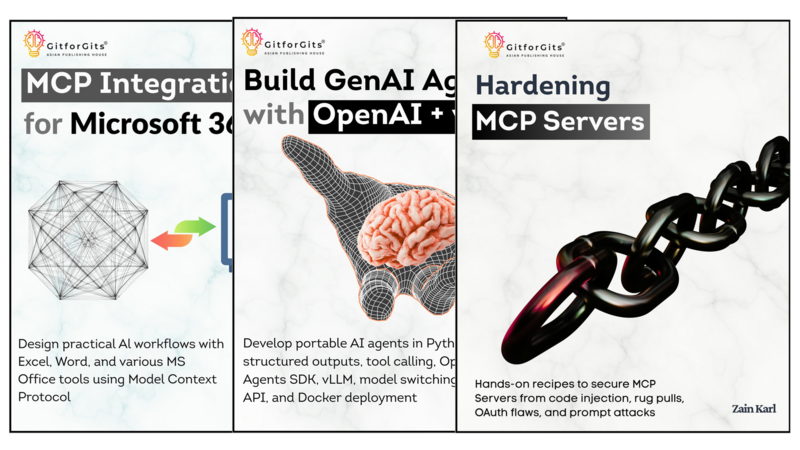
MCP Integrations for Microsoft 365
Design practical AI workflows with Excel, Word, and various MS Office tools using Model Context Protocol


I strongly recommend this book to developers, platform engineers, and technical architects who work with Microsoft 365. These professionals will learn to integrate AI-assisted workflows into existing business processes without unnecessary complexity.
About
About the Book
This book practically brings you the easy-to-follow solutions wherein you can connect AI-driven automation to everyday business tools using Model Context Protocol (MCP), with Microsoft Excel and Word as the primary execution and delivery surfaces. This book focuses on practical integration patterns that developers and technical teams can apply directly in real business environments. You won’t find any discussions of model internals or theoretical AI concepts here.
The book presents a structured approach to building governed, auditable workflows. It shows how Excel rows act as requests, YAML playbooks define execution logic, and tools such as Jira, databases, document repositories, and reporting systems are integrated through well-defined contracts. We use Microsoft Word as a controlled output surface for reports and deliverables. There are audit logs and approval mechanisms in place to ensure transparency and traceability throughout the workflow lifecycle. I will guide you through designing MCP tool contracts, mapping Excel columns to tool arguments, normalizing results for analytics, and shaping outputs for Excel and Power BI. In this book, you will learn to implement safety patterns such as idempotency, retries, policy allowlists, tenant isolation, and least-privilege access. It includes practical chapters on connector development, authentication and secrets handling, governance controls, diagnostics, testing strategies, and deployment patterns for both scheduled and on-demand execution.
I strongly recommend this book to developers, platform engineers, and technical architects who work with Microsoft 365. These professionals will learn to integrate AI-assisted workflows into existing business processes without unnecessary complexity.
Key Learnings- Turn Excel and Word into powerful AI-driven control and delivery hubs for business automation.
- Automate business workflows with AI Agents without exposing users, model internals and LLMs.
- Build predictable, auditable, and reusable automation using tool contracts and playbooks.
- Trigger real business actions across Jira, databases, and documents using Excel and Word.
- Make use of YAML playbooks to transform multi-step business processes into workflows.
- Make use of audit logs, approvals, and correlation IDs to execute transparent and compliant AI actions.
- Prevent duplicate actions using idempotency and request tracking.
- Practice versioning, policies, and strict access controls for scaling MCP connectors.
- Protect workflows from regressions and failures with operational diagnostics and testing.
- MCP and Agent Primer
- Microsoft 365 Project Blueprint
- Tool Contracts for Excel and Word Automation
- Building MCP Connectors as Business Actions
- Authentication and Secrets for Microsoft 365 and SaaS
- Governance, Approvals, and Audit Trails
- Workflow Runner with YAML Playbooks
- Jira Connector with Excel Requests
- Data and Knowledge Connectors
- Shipping MCP Integrations across Microsoft 365 Teams
Feedback
Packages
Pick Your Package
All packages include the ebook in the following formats: PDF and EPUB
This book only
Minimum price
Suggested price$29.99$29.99
This book + Extras Downloadable (Build GenAI Agents with OpenAI + vLLM)
Minimum price
Suggested price$54.99$49.99
- Build GenAI Agents with OpenAI + vLLMWe'll build an agent step-by-step, starting with a small loop that accepts input and produces structured output. As we go, we'll add tools, validation, model switching, runtime adapters, and packaging techniques that'll let the agent move from a simple script to a reusable application.
This book is also available in the following packages:
This book + Extras Downloadable (.NET 9 for Web Developers)
No Description Available
- .NET 9 for Web DevelopersGain Hands-On Development of Web APIs, Data Access, Dependency Injection, and WPF Clients with ASP.NET Core, Entity Framework Core, and MVVM in .NET 9. The book teaches combination of XAML and C# in WPF, interact with data, and the MVVM pattern. You will learn to connect the WPF client to a live Web API, handling real-time updates, and managing states.
- Minimum price
- $49.99
- Suggested price
- $54.99
- .NET 9 for Web Developers
This book + Extras Downloadable (Build GenAI Agents + GPU Programming + .NET for Developers)
No Description Available
- Build GenAI Agents with OpenAI + vLLMWe'll build an agent step-by-step, starting with a small loop that accepts input and produces structured output. As we go, we'll add tools, validation, model switching, runtime adapters, and packaging techniques that'll let the agent move from a simple script to a reusable application.
- Practical GPU ProgrammingThis book will walk you through the basics of GPU architectures, show you hands-on parallel programming techniques, and give you the know-how to confidently speed up real workloads in data processing, analytics, and engineering.
- .NET 9 for Web DevelopersGain Hands-On Development of Web APIs, Data Access, Dependency Injection, and WPF Clients with ASP.NET Core, Entity Framework Core, and MVVM in .NET 9. The book teaches combination of XAML and C# in WPF, interact with data, and the MVVM pattern. You will learn to connect the WPF client to a live Web API, handling real-time updates, and managing states.
- Minimum price
- $79.99
- Suggested price
- $89.99
- Build GenAI Agents with OpenAI + vLLM
Bundles
Bundles that include this book
AI Co-Worker Bundle

3 Books
- Pricing
$69.99
Minimum priceBought separately$89.97Suggested price$69.99
- Pricing
$69.99
Minimum priceBought separately$89.97Suggested price$76.99
Author
About the Author

We are the engineer’s publisher, the coder’s mentor, and the content alchemist—meticulously turning dense tech into practical gold. With a growing library of 100+ titles, we don’t just develop technical books, rather we build roadmaps for professionals across Python, MySQL, DevOps, Rust, AI, Kotlin, Arduino, Golang and everything around the massive IT ecosystem. Every chapter, every script, every project is a tool in the hands of developers who want to get things done.
Where others summarize, we construct step-by-step learning blueprints, cutting through clutter, banning the fluff, and ensuring every paragraph delivers hands-on value. Our audience isn’t learning from scratch—they’re leveling up with purpose, and we stand by them with code-first content, consistent project workflows, and a zero-redundancy approach.
Get the free Community Edition
You can get the free Community Edition in PDF or EPUB just by sharing your name and email address with the author.
The Leanpub 60 Day 100% Happiness Guarantee
Within 60 days of purchase you can get a 100% refund on any Leanpub purchase, in two clicks.
See full terms...
Earn $8 on a $10 Purchase, and $16 on a $20 Purchase
We pay 80% royalties on purchases of $7.99 or more, and 80% royalties minus a 50 cent flat fee on purchases between $0.99 and $7.98. You earn $8 on a $10 sale, and $16 on a $20 sale. So, if we sell 5000 non-refunded copies of your book for $20, you'll earn $80,000.
(Yes, some authors have already earned much more than that on Leanpub.)
Learn more about writing on Leanpub
Free Updates. DRM Free.
If you buy a Leanpub book, you get free updates for as long as the author updates the book! Many authors use Leanpub to publish their books in-progress, while they are writing them. All readers get free updates, regardless of when they bought the book or how much they paid (including free).
Most Leanpub books are available in PDF (for computers) and EPUB (for phones, tablets and Kindle). The formats that a book includes are shown at the top right corner of this page.
Finally, Leanpub books don't have any DRM copy-protection nonsense, so you can easily read them on any supported device.
Learn more about Leanpub's ebook formats and where to read them
Write and Publish on Leanpub
You can use Leanpub to easily write, publish and sell in-progress and completed ebooks and online courses!
Leanpub is a powerful platform for serious authors, combining a simple, elegant writing and publishing workflow with a store focused on selling in-progress ebooks.
Leanpub is a magical typewriter for authors: just write in plain text, and to publish your ebook, just click a button. (Or, if you are producing your ebook your own way, you can even upload your own PDF and/or EPUB files and then publish with one click!) It really is that easy.