Mathematics for artificial intelligence VOL-1
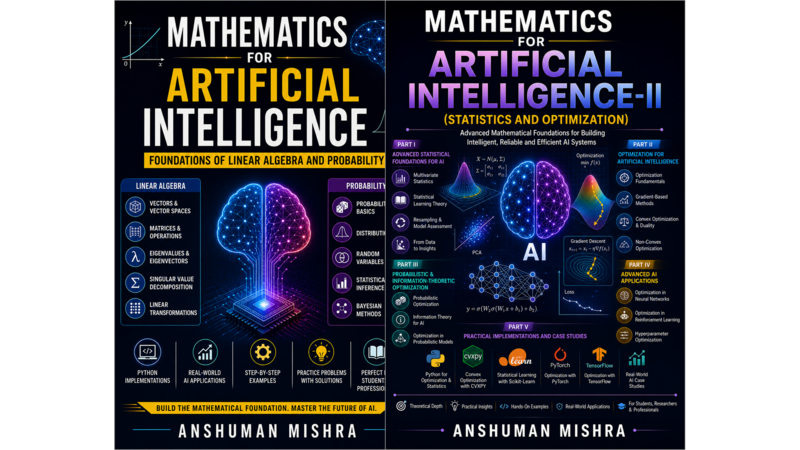
Foundation of linear algebra and probality A complete guide for data science machine learning and ai students


Benefits of Studying This Book
1. Deep Conceptual UnderstandingYou will understand why AI algorithms work, not just how to run them. This allows you to innovate, debug, and improve models.
2. Career AdvantageStrong mathematical foundations make you stand out in interviews for AI, ML, and DS roles. Many recruiters test candidates on linear algebra and probability skills.
3. Research ReadinessPostgraduate students and researchers can directly apply these mathematical tools to design and analyze experiments.
4. Practical AI SkillsPython-based implementation examples ensure that you can directly apply mathematical concepts in real-world AI systems.
5. Interdisciplinary EdgeMathematics learned here is not limited to AI — it can be applied in robotics, quantum computing, finance, bioinformatics, and more.
How This Book Helps After Study
After completing this book, you will be able to:
· Build AI models from scratch, knowing exactly what mathematical operations are happening inside.
· Optimize models for performance using a deep understanding of linear algebra operations.
· Analyze and interpret model predictions probabilistically.
· Handle uncertainty and noise in datasets effectively.
· Implement advanced AI concepts like PCA, SVD, Bayesian inference, and Markov models without relying solely on pre-built libraries.
This knowledge will directly help in:
· Academics: Scoring well in AI/ML/DS university courses.
· Industry: Working as an AI engineer, data scientist, ML engineer, or research scientist.
· Competitive Exams: Preparing for GATE, NET, and other AI-related exams where mathematics is heavily tested.
· Research: Publishing papers where mathematical rigor is required to explain new AI techniques.
Minimum price
$9.99
$19.99
You pay
Author earns
About
About the Book
Book Description
Title:Mathematics for Artificial Intelligence: Foundations of Linear Algebra and Probability
A Complete Guide for Data Science, Machine Learning, and AI Students
Preface
Mathematics is the heartbeat of Artificial Intelligence (AI). Every algorithm that predicts, classifies, generates, or optimizes is, at its core, a set of mathematical operations executed at high speed by a computer. While the modern AI revolution is often presented in terms of "neural networks," "deep learning," or "big data," the reality is that none of these technologies could exist without the solid mathematical foundations provided by Linear Algebra and Probability.
This book, Mathematics for Artificial Intelligence: Foundations of Linear Algebra and Probability, has been designed with a singular purpose: to equip undergraduate and postgraduate students, researchers, and professionals with the essential mathematical knowledge required to understand, develop, and innovate in AI, Machine Learning (ML), and Data Science (DS).
Unlike generic math textbooks, this book is not an abstract treatment of mathematical theory. Instead, it is a context-driven, application-oriented guide where every formula, theorem, and concept is directly linked to AI applications. Each chapter contains not only the theoretical explanations but also step-by-step worked examples, visual illustrations, Python implementations, and case studies showing how the mathematics is applied in real AI models.
Why This Book is Needed
The AI education landscape faces a persistent gap. Many students are introduced to machine learning or deep learning without fully understanding the mathematical machinery that powers these models. This results in a "black box" understanding: they can use libraries like TensorFlow, PyTorch, or scikit-learn, but they cannot explain why these models work, how to tune them effectively, or how to build new ones from scratch.
By focusing on Linear Algebra and Probability, this book addresses that gap. These two branches of mathematics are the twin pillars of AI:
· Linear Algebra powers vector representations, transformations, embeddings, convolution operations, dimensionality reduction, and deep learning computations.
· Probability enables reasoning under uncertainty, statistical inference, probabilistic models, Bayesian learning, and reinforcement learning.
By mastering these topics, readers will gain the ability to not just use AI tools but to innovate and optimize AI algorithms for specific problems.
Who This Book is For
This book has been designed for:
1. Undergraduate Students of Computer Science, AI, Data Science, Electronics, and related fields who need a solid math foundation for later AI/ML courses.
2. Postgraduate Students in AI, ML, and DS who wish to strengthen their theoretical foundations while working on advanced research or applied projects.
3. Educators looking for a comprehensive, structured curriculum that bridges pure mathematics and AI applications.
4. Professionals transitioning into AI/ML from other fields, who may not have touched mathematics for years but need a refresher with application focus.
5. Researchers who want a ready reference for mathematical concepts used in developing novel AI algorithms.
How the Book is Structured
The book is divided into six parts, each logically building upon the previous one.
Part I – Fundamentals and Prerequisites
We begin with a gentle introduction to mathematical notation, sets, functions, number systems, and basic calculus. This ensures that even readers with minimal recent exposure to mathematics can comfortably follow the later chapters. A strong emphasis is placed on how these basic concepts directly relate to AI tasks.
For example:
· Understanding the concept of functions leads to grasping neural network architectures.
· Learning about sets prepares readers for understanding sample spaces in probability.
Part II – Linear Algebra for AI
This is the backbone of the book. You will start with vectors and vector spaces, gradually moving to matrices, matrix operations, eigenvalues, eigenvectors, and singular value decomposition (SVD).
· In Vectors and Vector Spaces, you will understand how data points in AI are represented as vectors and how distances and similarities between them are measured.
· In Matrices, you will see how large datasets are stored, manipulated, and transformed. For example, in computer vision, an image is essentially a matrix of pixel values.
· In Eigenvalues and Eigenvectors, you will learn their role in PCA (Principal Component Analysis) for dimensionality reduction, which is critical in preprocessing high-dimensional datasets.
· Linear Transformations will be linked directly to transformations in neural networks and feature engineering.
Every linear algebra concept will be tied to AI applications:
· Word embeddings in NLP → Vector spaces
· Image compression → SVD
· Face recognition → PCA
Part III – Probability for AI
AI systems often work in environments full of uncertainty. Probability provides the mathematical framework to make decisions in such scenarios.
You will learn:
· Basics of Probability: Events, sample spaces, conditional probability, and Bayes’ theorem.
· Random Variables and Distributions: How AI models use distributions to represent data uncertainty.
· Joint, Marginal, and Conditional Distributions: Critical for understanding probabilistic graphical models.
· Statistical Inference: The core of model evaluation, A/B testing, and hypothesis testing in AI research.
Real-world connections include:
· Spam filtering using Naive Bayes.
· Predicting customer churn using probability distributions.
· Speech recognition using Hidden Markov Models (HMMs).
Part IV – Advanced Probability in AI Context
Here we dive deeper into probabilistic models:
· Bayesian Methods for updating beliefs with new data.
· Markov Chains for modeling state-based systems in reinforcement learning.
· Stochastic Processes for understanding randomness in time-series data.
· Probabilistic Deep Learning for uncertainty estimation in AI models.
Part V – Practical Applications and Case Studies
This is where theory meets practice. Each mathematical concept is linked to actual AI problems. Examples include:
· Image recognition with matrix operations.
· NLP with vector embeddings.
· Time-series forecasting using probability models.
· AI in healthcare with probabilistic reasoning.
Python code examples with NumPy, SciPy, and scikit-learn make it easy for students to implement what they learn.
Part VI – Appendices
Quick references, formulas, Python tips, and problem sets with solutions allow for quick revision and self-assessment.
Benefits of Studying This Book
1. Deep Conceptual UnderstandingYou will understand why AI algorithms work, not just how to run them. This allows you to innovate, debug, and improve models.
2. Career AdvantageStrong mathematical foundations make you stand out in interviews for AI, ML, and DS roles. Many recruiters test candidates on linear algebra and probability skills.
3. Research ReadinessPostgraduate students and researchers can directly apply these mathematical tools to design and analyze experiments.
4. Practical AI SkillsPython-based implementation examples ensure that you can directly apply mathematical concepts in real-world AI systems.
5. Interdisciplinary EdgeMathematics learned here is not limited to AI — it can be applied in robotics, quantum computing, finance, bioinformatics, and more.
How This Book Helps After Study
After completing this book, you will be able to:
· Build AI models from scratch, knowing exactly what mathematical operations are happening inside.
· Optimize models for performance using a deep understanding of linear algebra operations.
· Analyze and interpret model predictions probabilistically.
· Handle uncertainty and noise in datasets effectively.
· Implement advanced AI concepts like PCA, SVD, Bayesian inference, and Markov models without relying solely on pre-built libraries.
This knowledge will directly help in:
· Academics: Scoring well in AI/ML/DS university courses.
· Industry: Working as an AI engineer, data scientist, ML engineer, or research scientist.
· Competitive Exams: Preparing for GATE, NET, and other AI-related exams where mathematics is heavily tested.
Research: Publishing papers where mathematical rigor is required to explain
Bundle
Bundles that include this book
- Pricing
$29.00
Minimum priceBought separately$39.98Suggested price$29.00
Author
About the Author

Anshuman Kumar Mishra, M.Tech (Computer Science) Assistant Professor, Doranda College, Ranchi University
Prolific Author of 50+ Books on AI, Machine Learning & Computer Science | 20+ Years Experience
Anshuman Kumar Mishra is a dedicated educator, researcher, and highly prolific author with over 20 years of experience in Computer Science and Information Technology. Holding an M.Tech in Computer Science from BIT Mesra, he brings a rare combination of academic depth and practical teaching expertise.
Currently serving as Assistant Professor at Doranda College under Ranchi University, he has mentored thousands of students, helping them build strong foundations in programming, data science, and artificial intelligence. His student-centric teaching style emphasizes conceptual clarity, hands-on practice, and real-world application.
Anshuman is a prolific author with more than 50 books published across a wide spectrum of computer science and emerging technology domains. From foundational programming languages to advanced topics in Artificial Intelligence, Machine Learning, Reinforcement Learning, Decision Theory, and Computer Vision — his books are widely appreciated by students, educators, and professionals for their clear explanations, strong theoretical foundation, and practical approach.
His extensive body of work reflects his deep commitment to making complex subjects accessible and meaningful for learners at all levels. He is particularly recognized for creating well-structured learning paths that help readers progress from beginner to advanced levels with confidence.
Driven by the mission to democratize quality technical education, Anshuman continues to write and update books that bridge the gap between academic theory and industry practice.
When not teaching or writing, he actively follows and explores new developments in AI, Quantum Machine Learning, and Ethical Intelligence systems.
Contents
Table of Contents
The Leanpub 60 Day 100% Happiness Guarantee
Within 60 days of purchase you can get a 100% refund on any Leanpub purchase, in two clicks.
See full terms...
Earn $8 on a $10 Purchase, and $16 on a $20 Purchase
We pay 80% royalties on purchases of $7.99 or more, and 80% royalties minus a 50 cent flat fee on purchases between $0.99 and $7.98. You earn $8 on a $10 sale, and $16 on a $20 sale. So, if we sell 5000 non-refunded copies of your book for $20, you'll earn $80,000.
(Yes, some authors have already earned much more than that on Leanpub.)
Learn more about writing on Leanpub
Free Updates. DRM Free.
If you buy a Leanpub book, you get free updates for as long as the author updates the book! Many authors use Leanpub to publish their books in-progress, while they are writing them. All readers get free updates, regardless of when they bought the book or how much they paid (including free).
Most Leanpub books are available in PDF (for computers) and EPUB (for phones, tablets and Kindle). The formats that a book includes are shown at the top right corner of this page.
Finally, Leanpub books don't have any DRM copy-protection nonsense, so you can easily read them on any supported device.
Learn more about Leanpub's ebook formats and where to read them
Write and Publish on Leanpub
You can use Leanpub to easily write, publish and sell in-progress and completed ebooks and online courses!
Leanpub is a powerful platform for serious authors, combining a simple, elegant writing and publishing workflow with a store focused on selling in-progress ebooks.
Leanpub is a magical typewriter for authors: just write in plain text, and to publish your ebook, just click a button. (Or, if you are producing your ebook your own way, you can even upload your own PDF and/or EPUB files and then publish with one click!) It really is that easy.