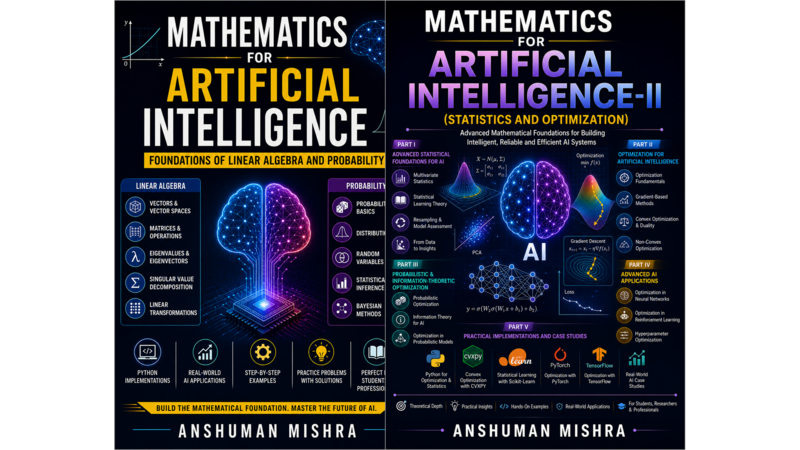
Mathematics for artificial Intelligence-ii
(statistics and optimization)


Closing Thoughts
“Mathematics for Artificial Intelligence – II (Statistics and Optimization)” is more than a textbook—it is a guidebook for mastering the mathematics behind AI. While Volume I laid the foundation and your other book covered data science statistics, this volume pushes students, researchers, and practitioners into the advanced territory where modern AI thrives.
Whether you want to become a machine learning engineer, AI researcher, data scientist, or academic scholar, mastering the material in this book will give you the edge to not only use AI tools but also innovate and push the boundaries of artificial intelligence.
Minimum price
$9.99
$19.99
You pay
Author earns
About
About the Book
Book Description
Mathematics for Artificial Intelligence – II (Statistics and Optimization)
Introduction
Artificial Intelligence (AI) is no longer a futuristic dream; it has become the backbone of today’s digital society, influencing everything from healthcare and finance to robotics, autonomous vehicles, and natural language processing. At the heart of every intelligent algorithm lies one common foundation: mathematics. While Volume I of this series established the fundamentals of linear algebra and probability, and your separate book on Statistics for Data Science covered the practical essentials, this Volume II is designed to take the learner deeper into the advanced statistical methods and optimization techniques that truly power state-of-the-art AI models.
If Volume I was about building the walls of the AI temple, Volume II is about reinforcing its pillars and giving it strength to stand against the complexity of modern challenges. This book is not just about formulas and theorems—it is about understanding the mathematical reasoning that makes artificial intelligence systems reliable, efficient, and robust.
Today’s deep learning models with billions of parameters, reinforcement learning agents capable of defeating world champions, and generative AI systems that create human-like text, images, and music—all owe their success to statistics and optimization. Without advanced statistical methods, we cannot understand uncertainty, reliability, or the generalization capacity of a model. Without optimization, we cannot train networks, tune hyperparameters, or find efficient solutions to real-world problems.
This book is a roadmap designed for students, researchers, data scientists, engineers, and AI enthusiasts who are eager to push beyond the basics and understand the mathematics that makes modern AI possible.
Structure of the Book
This volume is divided into five parts with sixteen chapters, carefully structured to cover advanced statistics and optimization for artificial intelligence.
Part I – Advanced Statistical Foundations for AIHere, we explore the statistical decision theories, multivariate statistics, and resampling methods that go beyond descriptive statistics. Readers will learn about covariance structures, multivariate normal distributions, factor analysis, and the crucial bias-variance trade-off in AI systems.
Part II – Optimization for Artificial IntelligenceThis part introduces optimization in its purest form. Starting with the fundamentals of convex and non-convex optimization, it explores gradient-based optimization methods such as Adam, RMSProp, and NAG. It also covers convex optimization duality and real-world applications like Support Vector Machines (SVMs).
Part III – Probabilistic and Information-Theoretic OptimizationModern AI does not rely only on deterministic optimization. This part focuses on probabilistic approaches like Monte Carlo methods, Bayesian optimization, and Expectation-Maximization. It also dives into information theory concepts such as entropy, KL divergence, and mutual information—tools critical in deep learning and generative models.
Part IV – Advanced AI ApplicationsHere, the focus is on practical applications: optimization in neural networks, reinforcement learning, and hyperparameter tuning. Readers learn how to address problems like vanishing gradients, saddle points, and overfitting in real-world training.
Part V – Practical Implementations and Case StudiesThis part brings everything together through coding examples and case studies. Using Python libraries like NumPy, CVXPY, TensorFlow, and PyTorch, readers can directly implement optimization techniques and apply them to computer vision, NLP, reinforcement learning, and healthcare applications.
Why This Book is Important
1. Bridging the Gap Between Theory and AI PracticeMany students and professionals learn machine learning by directly jumping into code, ignoring the mathematical intuition behind algorithms. This often creates a shallow understanding. This book fills that gap by connecting advanced mathematical reasoning with real AI implementations, ensuring readers don’t just apply algorithms but also understand why they work.
2. Focus on Advanced Statistics Relevant to AIMost textbooks stop at descriptive and inferential statistics, regression, or ANOVA. While these are essential, AI requires higher-order statistical tools such as multivariate analysis, statistical learning theory, bootstrapping, permutation testing, and Bayesian methods. This book provides these advanced concepts in a way that is directly linked to AI challenges.
3. Optimization is the Engine of AIEvery modern AI system—from logistic regression to GPT-based transformers—is powered by optimization. Training involves minimizing a loss function over millions of data points and parameters. This book explains not only basic gradient descent but also advanced optimizers, convex duality, non-convex optimization, Bayesian optimization, and hyperparameter tuning.
4. Focus on Real AI ChallengesConcepts like vanishing gradients, exploding gradients, saddle points, and local minima are not just mathematical curiosities—they are real obstacles encountered by AI researchers. This book equips readers with the mathematical tools to overcome these challenges.
5. Statistical and Probabilistic Thinking for AI ReliabilityAI is not only about achieving accuracy but also about ensuring reliability and robustness. This requires statistical inference, uncertainty estimation, and probabilistic optimization. Readers learn how to measure confidence in AI predictions, how to handle noisy data, and how to build trustworthy models.
How This Book Helps in Study and Career
· For Students (B.Tech, BCA, MCA, MSc, PhD)
This book provides the advanced mathematics needed to understand modern AI deeply. It prepares students for competitive exams like UGC NET, GATE, GRE, and also equips them for academic research.
· For Data Scientists and AI Engineers
Practical implementations ensure professionals can apply statistical and optimization techniques directly to projects. Whether it’s hyperparameter tuning, reinforcement learning, or deep learning optimization, the book provides hands-on guidance.
· For Researchers
Those pursuing research in machine learning or AI will benefit from advanced chapters like EM algorithm, variational inference, and probabilistic optimization methods.
· For Professionals Preparing for Interviews
Many AI/ML job interviews include deep mathematical questions about optimization, statistical inference, or probabilistic reasoning. This book strengthens candidates’ problem-solving ability and mathematical confidence.
Unique Features of This Book
1. No Overlap with Basic Statistics Books – avoids topics like descriptive statistics, ANOVA, regression, and probability distributions (covered in your other book).
2. AI-Oriented Approach – every mathematical technique is linked with real AI applications.
3. Case Studies and Python Implementation – bridges theory with practice.
4. Advanced Yet Accessible – concepts like convex optimization, Bayesian optimization, and variational inference are explained with clarity.
5. End-to-End Coverage – from theory to hands-on coding, readers gain a complete toolkit.
Real-World Applications Highlighted
· Healthcare – Bayesian optimization for personalized treatment plans.
· Finance – risk optimization in portfolio management.
· Natural Language Processing – entropy and cross-entropy in language models.
· Computer Vision – optimization for CNN and transformer models.
· Reinforcement Learning – policy gradient methods in robotics and game AI.
· Generative AI – variational inference in VAEs and diffusion models.
Learning Outcomes and Benefits
After completing this book, readers will be able to:
1. Master advanced statistics including multivariate analysis, statistical learning, and resampling methods.
2. Understand optimization deeply—both convex and non-convex.
3. Apply advanced optimization algorithms like Adam, RMSProp, Bayesian optimization, and EM.
4. Use information theory in AI, including entropy, KL divergence, and mutual information.
5. Tackle real-world AI challenges such as hyperparameter tuning, reinforcement learning optimization, and generative models.
6. Implement mathematical concepts in Python using NumPy, CVXPY, TensorFlow, and PyTorch.
7. Develop strong mathematical intuition—not just coding skills.
8. Bridge academia and industry by applying theory to practical projects.
Closing Thoughts
“Mathematics for Artificial Intelligence – II (Statistics and Optimization)” is more than a textbook—it is a guidebook for mastering the mathematics behind AI. While Volume I laid the foundation and your other book covered data science statistics, this volume pushes students, researchers, and practitioners into the advanced territory where modern AI thrives.
Whether you want to become a machine learning engineer, AI researcher, data scientist, or academic scholar, mastering the material in this book will give you the edge to not only use AI tools but also innovate and push the boundaries of artificial intelligence.
Bundle
Bundles that include this book
- Pricing
$29.00
Minimum priceBought separately$39.98Suggested price$29.00
Author
About the Author

Anshuman Kumar Mishra, M.Tech (Computer Science) Assistant Professor, Doranda College, Ranchi University
Prolific Author of 50+ Books on AI, Machine Learning & Computer Science | 20+ Years Experience
Anshuman Kumar Mishra is a dedicated educator, researcher, and highly prolific author with over 20 years of experience in Computer Science and Information Technology. Holding an M.Tech in Computer Science from BIT Mesra, he brings a rare combination of academic depth and practical teaching expertise.
Currently serving as Assistant Professor at Doranda College under Ranchi University, he has mentored thousands of students, helping them build strong foundations in programming, data science, and artificial intelligence. His student-centric teaching style emphasizes conceptual clarity, hands-on practice, and real-world application.
Anshuman is a prolific author with more than 50 books published across a wide spectrum of computer science and emerging technology domains. From foundational programming languages to advanced topics in Artificial Intelligence, Machine Learning, Reinforcement Learning, Decision Theory, and Computer Vision — his books are widely appreciated by students, educators, and professionals for their clear explanations, strong theoretical foundation, and practical approach.
His extensive body of work reflects his deep commitment to making complex subjects accessible and meaningful for learners at all levels. He is particularly recognized for creating well-structured learning paths that help readers progress from beginner to advanced levels with confidence.
Driven by the mission to democratize quality technical education, Anshuman continues to write and update books that bridge the gap between academic theory and industry practice.
When not teaching or writing, he actively follows and explores new developments in AI, Quantum Machine Learning, and Ethical Intelligence systems.
Contents
Table of Contents
The Leanpub 60 Day 100% Happiness Guarantee
Within 60 days of purchase you can get a 100% refund on any Leanpub purchase, in two clicks.
See full terms...
Earn $8 on a $10 Purchase, and $16 on a $20 Purchase
We pay 80% royalties on purchases of $7.99 or more, and 80% royalties minus a 50 cent flat fee on purchases between $0.99 and $7.98. You earn $8 on a $10 sale, and $16 on a $20 sale. So, if we sell 5000 non-refunded copies of your book for $20, you'll earn $80,000.
(Yes, some authors have already earned much more than that on Leanpub.)
Learn more about writing on Leanpub
Free Updates. DRM Free.
If you buy a Leanpub book, you get free updates for as long as the author updates the book! Many authors use Leanpub to publish their books in-progress, while they are writing them. All readers get free updates, regardless of when they bought the book or how much they paid (including free).
Most Leanpub books are available in PDF (for computers) and EPUB (for phones, tablets and Kindle). The formats that a book includes are shown at the top right corner of this page.
Finally, Leanpub books don't have any DRM copy-protection nonsense, so you can easily read them on any supported device.
Learn more about Leanpub's ebook formats and where to read them
Write and Publish on Leanpub
You can use Leanpub to easily write, publish and sell in-progress and completed ebooks and online courses!
Leanpub is a powerful platform for serious authors, combining a simple, elegant writing and publishing workflow with a store focused on selling in-progress ebooks.
Leanpub is a magical typewriter for authors: just write in plain text, and to publish your ebook, just click a button. (Or, if you are producing your ebook your own way, you can even upload your own PDF and/or EPUB files and then publish with one click!) It really is that easy.