

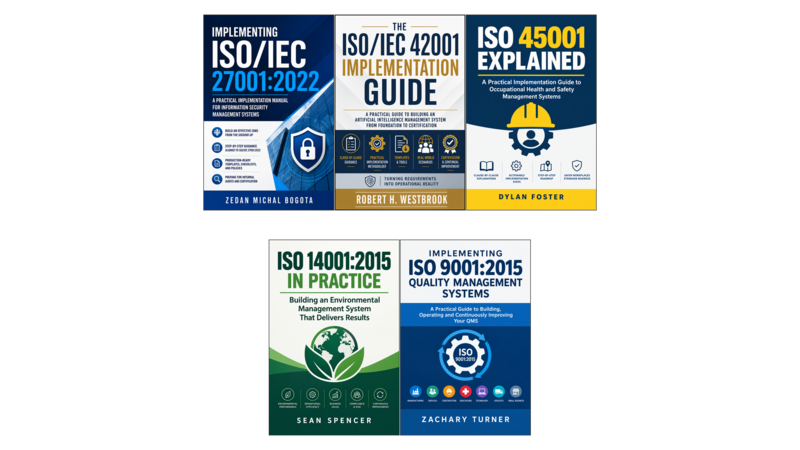

Building an Environmental Management System That Delivers Results
Introduction
Chapter 1: What ISO 14001:2015 Is and Why It Exists
- The global challenge of organizational environmental impact
- What ISO 14001 is and what it is not
- The evolution from ISO 14001:1996 through ISO 14001:2015
- Why organizations implement ISO 14001: legitimate drivers and questionable motives
- Certification versus implementation: what the certificate actually means
- The author’s thesis and how this book is organized
Chapter 2: The Environmental Management System Concept
- What “management system” means in ISO terminology
- EMS versus environmental programs: the structural difference
- The ISO high-level structure: alignment across management systems
- Plan-Do-Check-Act: the logic and its real-world application
- The risk-based thinking approach in ISO 14001:2015
- When an EMS adds value and when it is unnecessary overhead
Chapter 3: Key Terms, Concepts and Foundational Principles
- Core definitions: environment, environmental aspect, environmental impact
- Compliance obligations and their centrality to ISO 14001
- Interested parties and context: what these really mean in practice
- The life-cycle perspective: requirement, expectation and common misunderstandings
- Environmental objectives, targets and indicators: clarifying the distinctions
- The continuum: improvement, enhancement and performance
Chapter 4: The Organizational Context of ISO 14001:2015
- Understanding your organization: internal and external issues that matter
- Identifying interested parties and their legitimate requirements
- Defining the scope of your EMS: strategic choices and common errors
- Integrating context into ongoing EMS decision-making
- Practical methods: PESTLE, stakeholder mapping, SWOT and when they help versus when they are filler
- Evidence of effective implementation
Chapter 5: Leadership and Commitment
- What leadership means in ISO 14001:2015: beyond delegation
- The role of top management: specific responsibilities under the standard
- Accountability and integration: making environmental management part of business decisions
- Environmental policy: purpose, requirements and how to write one that matters
- Roles, responsibilities and authorities: how to assign them without confusion
- Common failure modes: weak leadership, rubber-stamp approval and policy theater
Chapter 6: Planning: Environmental Aspects and Impacts
- What aspects and impacts are: precise definitions in practical terms
- The identification process: operations, products, services and indirect effects
- Significance criteria: developing them and applying them consistently
- Including the life-cycle perspective in aspect evaluation
- Dynamic nature: when and how to reassess aspects and impacts
- Typical weaknesses: missing significant aspects, arbitrary criteria and the “it’s covered somewhere” problem
Chapter 7: Planning: Compliance Obligations
- What counts as a compliance obligation under ISO 14001
- Systematic approaches to identifying applicable requirements
- Keeping track: how to maintain up-to-date compliance obligations
- Connecting obligations to aspects, operations and the organization
- Substantive obligations versus aspirational commitments
- Common failures: incomplete registers, outdated requirements and confusion over applicability
Chapter 8: Planning: Risks, Opportunities and Objectives
- Risk and opportunities in ISO 14001:2015: what the standard actually requires
- Connecting risks to aspects, obligations, context and performance
- Setting environmental objectives: SMART criteria, alignment and meaningfulness
- Developing plans for objectives: what, how, when, with what and who
- Performance indicators: designing ones that matter versus ones that measure vanity
- Planning integration: making the pieces fit together instead of existing separately
Chapter 9: Support: Resources, Competence and Awareness
- Resources: budget, infrastructure, technology and what is reasonable to expect
- Competence: what it means and how to verify it without bureaucracy
- Awareness: what personnel need to understand and how to make them understand it
- Documented information: how much, what format and what to avoid
- Record-keeping: evidence versus bureaucracy
- Efficiency strategies: integrating with existing HR, training and information systems
Chapter 10: Support: Communication
- Internal communication: what is needed and how to structure it
- External communication: requirements, expectations and common missteps
- Deciding what to communicate and what not to: criteria and judgment
- Communication channels: choosing appropriate methods
- Documenting communication: when and when not to
- Practical approaches for different organizational sizes and cultures
Chapter 11: Operational Planning and Control
- What operational controls are: the concept behind the requirement
- Criteria and controls: matching control design to the risk being managed
- Documenting procedures: when documentation is necessary and when it is not
- Procurement and supplier controls: extent, approaches and realism
- Contractor management: responsibilities, boundaries and practical control
- Emergency preparedness and response: planning, testing and continual improvement
Chapter 12: Monitoring, Measurement and Performance Evaluation
- What to monitor: aligning measurement with aspects, objectives and obligations
- Monitoring methods: instruments, sampling, self-reporting and their limitations
- Calibration and accuracy: what is reasonable and why it matters
- Evaluating environmental performance: turning numbers into understanding
- Compliance evaluation: methods, frequency and what to do with results
- Avoiding the KPI trap: designing measurement programs that inform decisions
Chapter 13: Internal Auditing
- Purpose and scope of the internal audit program
- Audit criteria, frequency and independence
- Competence of internal auditors: what is required and how to develop it
- Planning and conducting the audit: practical approaches
- Reporting and follow-up: making audit findings lead to action
- Common weaknesses: audits conducted by the unqualified, superficial checklists and suppressed findings
Chapter 14: Management Review
- What management review is and why it matters
- Required inputs: the standard’s requirements and their purpose
- Required outputs: decisions, actions and resource commitments
- Scheduling and format: practical considerations
- Making management review substantive: avoiding the annual PowerPoint ritual
- Linking review outcomes to actual organizational decisions and changes
Chapter 15: Nonconformity and Corrective Action
- Detecting nonconformities: sources and triggers
- Responding to nonconformities: containment versus correction versus corrective action
- Root cause analysis: methods, when they are useful and common failures
- Implementing corrective action: ensuring it works and does not create new problems
- Using corrective action for continual improvement
- The difference between fixing symptoms and fixing the system
Chapter 16: Continual Improvement
- Continual improvement: definition, expectations and the improvement cycle
- Where improvement comes from: audits, objectives, performance data and innovation
- The spectrum of improvement: incremental, breakthrough and transformational
- Embedding improvement in organizational culture
- Practical improvement methods and tools
- When improvement slows: recognizing plateaus and addressing them
Chapter 17: End-to-End Implementation Methodology
- Phase 1: preparation, commitment and gap analysis
- Phase 2: design and planning: scope, context, aspects, obligations, objectives
- Phase 3: system development: procedures, controls, documented information
- Phase 4: implementation: training, communication, operational controls
- Phase 5: initial operation, monitoring and correction
- Phase 6: internal audit, management review and readiness assessment
- Timeline, resourcing and realistic expectations for implementation
Chapter 18: Implementing ISO 14001 Across Organizational Types and Sectors
- Small businesses and startups: proportionality, lean implementation and constraints
- Medium-sized organizations: scaling up while maintaining simplicity
- Large organizations and multinationals: complexity, consistency and coordination
- Manufacturing and industrial operations: high-impact aspects and intensive controls
- Offices and administrative operations: low-impact contexts and meaningful objectives
- Construction, logistics, service organizations and specialized contexts
- Integrating ISO 14001 with ISO 9001, ISO 45001 and ISO 50001: practical integration
Chapter 19: Preparation for ISO 14001 Certification
- The certification process: stages, timeline and costs
- Selecting a certification body: criteria and questions to ask
- Stage 1 audit: document review, what auditors look for and how to prepare
- Stage 2 audit: on-site audit, typical areas of scrutiny and evidence expectations
- Responding to findings: nonconformities, opportunities for improvement and professional conduct
- Maintaining certification: surveillance audits, recertification and changes
- What certification actually demonstrates: strengths and limitations
Chapter 20: Critical Assessment of ISO 14001:2015
- Documented benefits: what the evidence actually shows about ISO 14001 performance
- The gap between certification and performance: documented limitations
- Common implementation failures: why organizations fail to realize value
- Weaknesses of the standard versus weaknesses of implementation
- Hidden costs and unintended consequences
- ISO 14001 and the broader landscape: ESG, climate, circular economy and where ISO 14001 fits and falls short
- The author’s synthesis: when ISO 14001 creates value and when it does not