

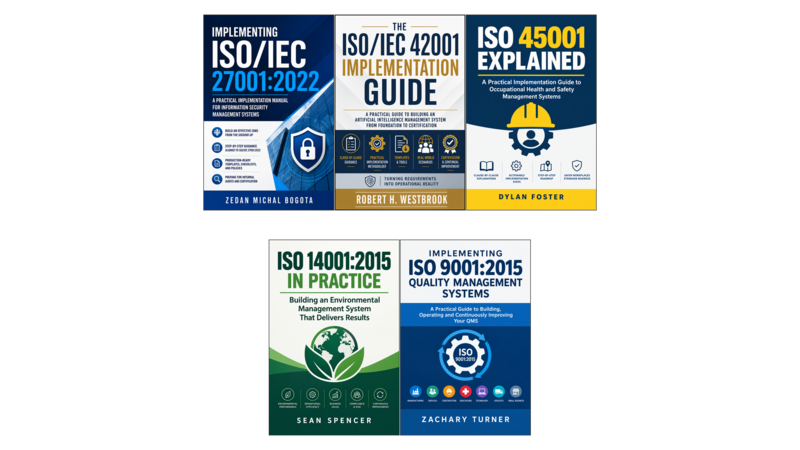

A Practical Implementation Manual for Information Security Management Systems
Introduction
Chapter 1: Getting Started with ISO/IEC 27001
- What ISO/IEC 27001:2022 Actually Is
- Why Organizations Pursue Certification
- Understanding the ISMS Lifecycle
- Who Needs to Be Involved
- Assessing Your Organization’s Starting Point
- Planning the Implementation Journey
Chapter 2: Executive Sponsorship and Project Governance
- Winning Executive Buy-In
- Defining Leadership Responsibilities Under Clause 5
- Establishing the ISMS Governance Structure
- Roles and RACI Matrix for Implementation
- Project Charter and Scope of Work
- Budgeting, Resourcing and Timeline Planning
Chapter 3: Defining Scope and Organizational Context
- Understanding Organizational Context Under Clause 4.1
- Identifying Interested Parties and Their Requirements
- Defining the ISMS Scope Under Clause 4.3
- Documenting Decisions About What Is In and Out
- Common Scoping Mistakes and How to Avoid Them
- The Scope Document: Template and Examples
Chapter 4: Risk Assessment Methodology and Execution
- Understanding Risk Assessment Requirements Under Clause 6.1.2
- Designing Your Risk Assessment Methodology
- Asset Identification and Classification
- Threat and Vulnerability Analysis
- Calculating and Evaluating Risk
- Documenting the Risk Assessment Process and Results
Chapter 5: Risk Treatment and the Statement of Applicability
- Understanding Risk Treatment Options Under Clause 6.1.3
- Developing the Risk Treatment Plan
- Navigating Annex A: The 93 Controls in Four Themes
- Building the Statement of Applicability Step by Step
- Justifying Control Inclusions and Exclusions
- SoA Template and Completed Example
Chapter 6: Information Security Policies and Documentation
- The Documentation Hierarchy Under Clause 7.5
- Writing the Top-Level Information Security Policy
- Developing Supporting Policies and Standards
- Procedures, Work Instructions and Records
- Document Control: Versioning, Approval, Distribution
- Sample Policy Templates for Key Areas
Chapter 7: People Security - Awareness, Training and HR Controls
- Competence Requirements Under Clause 7.2
- Building an Awareness Program Under Clause 7.3
- Pre-Employment Security Checks and Background Screening
- During Employment: Training, Responsibilities and Disciplinary Action
- Leaving Employment: Offboarding and Access Revocation
Chapter 8: Asset Management, Supplier Relationships and Cryptography
- Inventorying Information Assets Under Control A.5
- Classification Schemes: Labels, Handling Rules and Enforcement
- Supplier Risk Management and Due Diligence
- Contractual Security Requirements for Third Parties
- Cryptographic Policy and Key Management
- Templates: Asset Register, Supplier Assessment, Classification Matrix
Chapter 9: Technical Controls - Infrastructure, Applications and Access
- Access Control: Policies, MFA, Least Privilege and Reviews
- Operations Security: Logging, Monitoring, Backups and Change Management
- Network Security: Segmentation, Firewalls and Secure Configurations
- System Development Life Cycle Security Integration
- Cloud Security and SaaS Controls
- Technical Baselines and Configuration Standards
Chapter 10: Physical Security, Incident Management and Business Continuity
- Physical Security Zones, Access Controls and Environmental Protections
- Designing an Incident Management Process Under A.5.24-A.5.29
- Incident Response Plan: Structure, Roles and Procedures
- Escalation, Communication and Post-Incident Review
- Business Continuity Integration with the ISMS
- Testing and Exercising Your Incident and Continuity Plans
Chapter 11: Performance Evaluation - Monitoring, Auditing and Management Review
- Monitoring and Measurement Under Clause 9.1
- Defining ISMS Metrics and KPIs That Matter
- Planning and Executing Internal Audits Under Clause 9.2
- Internal Audit Program: Scope, Checklists and Reporting
- Conducting Management Reviews Under Clause 9.3
- Templates: Audit Plan, Audit Report, Management Review Agenda
Chapter 12: Nonconformities, Corrective Actions and Continual Improvement
- Understanding Nonconformity Under Clause 10.1
- Root Cause Analysis Methods: 5 Whys, Fishbone and More
- Corrective Action Requests: From Identification to Closure
- Continual Improvement Under Clause 10.2
- Maintaining ISMS Health Between Audits
- Templates: Nonconformity Report, CAR Tracker, Improvement Register
Chapter 13: Certification Readiness and the External Audit Process
- Choosing a Certification Body
- Preparing for Stage 1: The Documentation Review
- Preparing for Stage 2: The On-Site Audit
- What Auditors Actually Look For: Evidence Requirements
- Responding to Findings and Nonconformities
- After Certification: Surveillance Audits and Recertification
Chapter 14: Sustaining the ISMS - Operations, Maturity and Integration
- Embedding the ISMS into Daily Operations
- Integrating with Other Standards and Frameworks
- Measuring ISMS Maturity Over Time
- Adapting to Change: New Technologies, Regulations and Threats
- Common Failure Modes and How to Avoid Them
- The Long-Term Value of a Living ISMS