Hidden Markov Models and AI VOL-3
Sequential Data, Speech Recognition & NLP Applications


Can Hidden Markov Models predict financial market regimes?
How are genes discovered from DNA sequences?
How do robots determine their location in uncertain environments?
Can probabilistic AI still compete with Transformers and Deep Learning?
Volume-3 of Hidden Markov Models and AI answers these questions through real-world applications, Python implementations, industrial case studies, advanced projects, and future AI research.
Explore how Hidden Markov Models are used in bioinformatics, cybersecurity, finance, robotics, autonomous systems, anomaly detection, and scientific discovery. Learn to build HMM systems from scratch, work with professional AI libraries, and understand the evolving relationship between probabilistic models and deep learning.
This volume is designed for readers who want to move beyond theory and develop practical expertise in modern sequential artificial intelligence.
Minimum price
$9.99
$19.99
You pay
Author earns
About
About the Book
Hidden Markov Models and AI: Sequential Data, Speech Recognition & NLP Applications (VOL-3)
Advanced Applications, Industry Implementations, Projects, and the Future of Sequential Artificial Intelligence
Artificial Intelligence has evolved far beyond laboratory experiments and academic theory. Today, intelligent systems operate in healthcare, finance, cybersecurity, robotics, autonomous vehicles, smart cities, industrial automation, bioinformatics, and scientific research. At the heart of many of these systems lies a fundamental challenge: understanding and predicting sequential behavior under uncertainty.
Hidden Markov Models (HMMs) remain one of the most powerful probabilistic frameworks ever developed for modeling temporal patterns, hidden structures, and dynamic systems. While modern deep learning architectures dominate many AI headlines, HMMs continue to provide interpretability, mathematical rigor, computational efficiency, and reliability in numerous mission-critical applications.
Hidden Markov Models and AI: Sequential Data, Speech Recognition & NLP Applications (VOL-3) is the culmination of a comprehensive three-volume journey into probabilistic sequence modeling and intelligent systems. This volume focuses on real-world applications, practical implementation, industrial projects, modern AI libraries, and the future evolution of HMMs in the age of deep learning and Artificial General Intelligence (AGI).
Where Volume-1 established theoretical foundations and Volume-2 explored speech and language applications, Volume-3 demonstrates how Hidden Markov Models are deployed across diverse industries and how they continue to influence next-generation AI systems.
What This Volume Covers
Part VI — Multi-Domain Applications of Hidden Markov ModelsOne of the greatest strengths of Hidden Markov Models is their ability to model uncertainty across completely different domains.
This volume explores how HMMs are applied in:
Bioinformatics & Computational BiologyBiological systems generate vast quantities of sequential data. DNA, RNA, proteins, and genomes all contain hidden structures that can be modeled probabilistically.
Readers learn:
- DNA sequence analysis
- Biological sequence modeling
- Protein secondary structure prediction
- CpG island identification
- Gene discovery techniques
- Computational genomics
- Biological pattern recognition
A complete case study demonstrates how Hidden Markov Models are used in modern gene prediction systems.
Finance, IoT and CybersecurityFinancial markets and connected devices generate continuous streams of uncertain events.
This section demonstrates how HMMs help identify hidden market states, detect anomalies, and forecast future behavior.
Topics include:
- Market regime switching
- Trend detection and forecasting
- Stock market state modeling
- Sequential fraud detection
- Risk assessment systems
- IoT activity recognition
- Sensor event prediction
- Network intrusion detection
- Cybersecurity anomaly detection
Readers gain insight into how probabilistic AI contributes to robust decision-making in high-stakes environments.
Robotics & Autonomous SystemsModern robots operate in uncertain environments and must continuously infer hidden states from noisy observations.
This chapter explores:
- Robot localization
- Path estimation
- Motion prediction
- Sensor fusion
- Navigation systems
- Sequential planning
- Autonomous decision making
A detailed autonomous navigation case study illustrates how Hidden Markov Models contribute to intelligent robotic behavior.
Part VII — Implementation, Practicals & Real-World Projects
Understanding algorithms is important.
Building them is essential.
This part provides practical implementation guidance for developing Hidden Markov Model systems from scratch.
Readers learn how to:
Build HMMs in Python- Environment setup
- Markov Chain implementation
- Forward Algorithm coding
- Viterbi implementation
- Baum-Welch training
- Parameter optimization
- Model debugging
- Performance evaluation
Step-by-step examples transform mathematical concepts into deployable software solutions.
Modern HMM Libraries and ToolsThis section introduces professional tools used by researchers and engineers.
Coverage includes:
- hmmlearn
- PyTorch HMM frameworks
- TensorFlow hybrid architectures
- HTK
- Kaldi
- NLTK
- spaCy
- Scikit-learn integrations
Readers learn how modern development ecosystems support sequence modeling applications.
Industry-Oriented ProjectsPractical projects include:
- HMM Part-of-Speech Tagger
- Speech Recognition System
- Weather Forecasting Model
- DNA Segmentation Tool
- IoT Activity Recognition Platform
- Financial Trend Prediction System
These projects help students, researchers, and professionals build portfolios while developing practical expertise.
Part VIII — The Future of Hidden Markov Models in Artificial Intelligence
One of the most important questions in AI today is:
Do Hidden Markov Models still matter in the age of Deep Learning?
This volume answers that question through a balanced and research-oriented perspective.
Deep Learning vs Hidden Markov ModelsReaders explore:
- RNNs
- LSTMs
- GRUs
- Transformers
- Attention Mechanisms
- Sequence-to-Sequence Models
Comparisons highlight:
- Strengths of probabilistic modeling
- Explainability advantages
- Data efficiency considerations
- Interpretability challenges
- Computational trade-offs
The book demonstrates situations where HMMs continue to outperform modern deep architectures.
Hybrid Deep-HMM SystemsRather than viewing HMMs and deep learning as competitors, this section explores how they can be combined.
Topics include:
- Neural-HMM architectures
- Deep probabilistic models
- Hybrid speech systems
- Sequence prediction frameworks
- Explainable AI systems
Readers discover emerging research that combines statistical reasoning with neural representation learning.
Future Research DirectionsThe final chapters investigate frontier areas of Artificial Intelligence:
- Explainable AI (XAI)
- Responsible AI
- Probabilistic Programming
- Neuro-Symbolic Systems
- Causal Sequential Learning
- Human-Centered AI
- Artificial General Intelligence (AGI)
The book concludes with a forward-looking vision of how probabilistic sequence modeling may contribute to the next generation of intelligent systems.
Why This Volume Is Unique
Unlike most books that focus exclusively on theory or deep learning, this volume integrates:
✓ Multi-domain industrial applications
✓ Python implementation from scratch
✓ Professional AI toolkits and frameworks
✓ Real-world projects and assignments
✓ Deep Learning vs HMM comparisons
✓ Explainable AI perspectives
✓ Emerging AGI research discussions
✓ Industry-ready case studies
✓ Research-oriented future directions
Who Should Read This Volume?
Students- B.Tech
- BCA
- MCA
- MSc Computer Science
- M.Tech Artificial Intelligence
- AI Researchers
- Machine Learning Scientists
- Computational Biologists
- Robotics Researchers
- NLP Researchers
- Cybersecurity Researchers
- Data Scientists
- Machine Learning Engineers
- AI Architects
- Quantitative Analysts
- Robotics Engineers
- Bioinformatics Specialists
- Security Analysts
- Research Engineers
Completing the Three-Volume Journey
Together, the three volumes provide a complete roadmap:
Volume-1Foundations, Mathematics, Markov Chains, HMM Theory, Viterbi, Forward-Backward, Baum-Welch.
Volume-2Sequence Learning, Speech Recognition, Natural Language Processing, Machine Translation, Conversational AI.
Volume-3Industry Applications, Bioinformatics, Finance, Robotics, Cybersecurity, Python Projects, Modern AI Tools, Deep Learning Comparisons, Future Research Directions.
This volume transforms readers from learners of Hidden Markov Models into practitioners capable of applying probabilistic AI across research, industry, and emerging intelligent technologies.
Categories
Feedback
Bundle
Bundles that include this book
Hidden Markov Models and AI
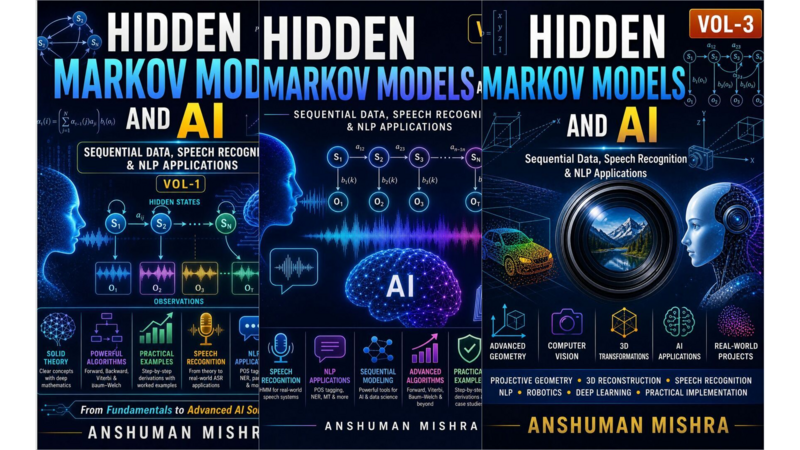
3 Books
- Pricing
$29.00
Minimum priceBought separately$59.97Suggested price$29.00
Author
About the Author

Anshuman Kumar Mishra, M.Tech (Computer Science) Assistant Professor, Doranda College, Ranchi University
Prolific Author of 50+ Books on AI, Machine Learning & Computer Science | 20+ Years Experience
Anshuman Kumar Mishra is a dedicated educator, researcher, and highly prolific author with over 20 years of experience in Computer Science and Information Technology. Holding an M.Tech in Computer Science from BIT Mesra, he brings a rare combination of academic depth and practical teaching expertise.
Currently serving as Assistant Professor at Doranda College under Ranchi University, he has mentored thousands of students, helping them build strong foundations in programming, data science, and artificial intelligence. His student-centric teaching style emphasizes conceptual clarity, hands-on practice, and real-world application.
Anshuman is a prolific author with more than 50 books published across a wide spectrum of computer science and emerging technology domains. From foundational programming languages to advanced topics in Artificial Intelligence, Machine Learning, Reinforcement Learning, Decision Theory, and Computer Vision — his books are widely appreciated by students, educators, and professionals for their clear explanations, strong theoretical foundation, and practical approach.
His extensive body of work reflects his deep commitment to making complex subjects accessible and meaningful for learners at all levels. He is particularly recognized for creating well-structured learning paths that help readers progress from beginner to advanced levels with confidence.
Driven by the mission to democratize quality technical education, Anshuman continues to write and update books that bridge the gap between academic theory and industry practice.
When not teaching or writing, he actively follows and explores new developments in AI, Quantum Machine Learning, and Ethical Intelligence systems.
Contents
Table of Contents
The Leanpub 60 Day 100% Happiness Guarantee
Within 60 days of purchase you can get a 100% refund on any Leanpub purchase, in two clicks.
See full terms...
Earn $8 on a $10 Purchase, and $16 on a $20 Purchase
We pay 80% royalties on purchases of $7.99 or more, and 80% royalties minus a 50 cent flat fee on purchases between $0.99 and $7.98. You earn $8 on a $10 sale, and $16 on a $20 sale. So, if we sell 5000 non-refunded copies of your book for $20, you'll earn $80,000.
(Yes, some authors have already earned much more than that on Leanpub.)
Learn more about writing on Leanpub
Free Updates. DRM Free.
If you buy a Leanpub book, you get free updates for as long as the author updates the book! Many authors use Leanpub to publish their books in-progress, while they are writing them. All readers get free updates, regardless of when they bought the book or how much they paid (including free).
Most Leanpub books are available in PDF (for computers) and EPUB (for phones, tablets and Kindle). The formats that a book includes are shown at the top right corner of this page.
Finally, Leanpub books don't have any DRM copy-protection nonsense, so you can easily read them on any supported device.
Learn more about Leanpub's ebook formats and where to read them
Write and Publish on Leanpub
You can use Leanpub to easily write, publish and sell in-progress and completed ebooks and online courses!
Leanpub is a powerful platform for serious authors, combining a simple, elegant writing and publishing workflow with a store focused on selling in-progress ebooks.
Leanpub is a magical typewriter for authors: just write in plain text, and to publish your ebook, just click a button. (Or, if you are producing your ebook your own way, you can even upload your own PDF and/or EPUB files and then publish with one click!) It really is that easy.