Hidden Markov Models and AI VOL-1
Sequential Data, Speech Recognition & NLP Applications


Artificial Intelligence is not only about neural networks and transformers. Behind many of the world's most influential AI systems lies a powerful probabilistic framework known as the Hidden Markov Model (HMM).
From speech recognition and natural language processing to robotics, cybersecurity, finance, and bioinformatics, HMMs remain one of the most important sequence modeling techniques ever developed.
This book takes readers on a complete journey through Markov Chains, probabilistic reasoning, Hidden Markov Models, Forward-Backward algorithms, Viterbi decoding, Baum-Welch training, and advanced HMM architectures.
Designed for students, researchers, and AI professionals, the book combines rigorous mathematics with practical applications, making complex concepts accessible and immediately useful.
If you want to truly understand how intelligent systems model uncertainty, learn from temporal patterns, and reason about hidden information, this book provides the foundation.
Minimum price
$9.99
$19.99
You pay
Author earns
About
About the Book
Hidden Markov Models and AI: Sequential Data, Speech Recognition & NLP Applications (VOL-1)
Mastering the Mathematical Foundations of Sequential Intelligence
Artificial Intelligence is increasingly driven by sequential data. Speech signals, natural language, financial markets, biological sequences, sensor streams, user interactions, and autonomous systems all generate information that unfolds over time. Understanding how to model these temporal patterns is essential for building intelligent systems that can learn, predict, and make decisions under uncertainty.
Hidden Markov Models and AI: Sequential Data, Speech Recognition & NLP Applications (VOL-1) provides a rigorous, comprehensive, and practical introduction to the mathematical foundations of sequential artificial intelligence through Markov Models and Hidden Markov Models (HMMs).
Despite the rapid rise of deep learning architectures such as RNNs, LSTMs, GRUs, and Transformers, Hidden Markov Models remain among the most important probabilistic frameworks ever developed. They continue to influence modern AI systems in speech recognition, natural language processing, bioinformatics, robotics, finance, cybersecurity, and explainable machine learning.
This volume is designed to help readers develop a deep understanding of probabilistic sequence modeling, beginning with fundamental concepts and progressing toward advanced HMM algorithms and modern extensions.
What You'll Learn
Inside this volume, readers will explore:
Foundations of Sequential Artificial Intelligence- Understanding sequential and temporal data
- Probabilistic reasoning in AI systems
- The Markov Property and memoryless processes
- Historical evolution of Markov Models
- Modern relevance of HMMs in the era of deep learning
- Probability theory for AI
- Random variables and probability distributions
- Bayesian inference
- Conditional probability
- Information theory
- Entropy and mutual information
- Stochastic processes and time-series concepts
- Discrete-Time Markov Chains
- Continuous-Time Markov Chains
- Transition matrices
- Stationary distributions
- Ergodicity and absorbing states
- Real-world simulation techniques
- Hidden states and observation sequences
- State transition modeling
- Emission probability estimation
- HMM architectures and topologies
- Practical modeling assumptions
- Forward Algorithm
- Backward Algorithm
- Forward-Backward Algorithm
- Viterbi Decoding Algorithm
- Baum-Welch Training Algorithm
- Expectation-Maximization (EM)
- Continuous Density HMM
- Gaussian Mixture HMM
- Hierarchical HMM
- Hidden Semi-Markov Models
- Factorial HMMs
- Deep Neural HMM Hybrids
Why This Book Matters
Many modern AI professionals learn deep learning without fully understanding probabilistic sequence modeling. However, HMMs provide a mathematically transparent framework for understanding uncertainty, temporal dependencies, and hidden structure in data.
This book bridges the gap between classical statistical AI and contemporary machine learning by explaining:
- Why HMMs remain relevant
- When probabilistic models outperform neural approaches
- How interpretable AI systems are designed
- How sequential intelligence evolved before deep learning
- How HMMs continue to influence modern NLP and speech systems
Ideal For
This book is written for:
Students- B.Tech
- BCA
- MCA
- MSc Computer Science
- M.Tech
- Artificial Intelligence Programs
- PhD Scholars
- Academic Researchers
- AI Research Scientists
- Machine Learning Engineers
- NLP Engineers
- Speech Recognition Engineers
- Data Scientists
- Robotics Developers
- Software Architects
- Cybersecurity Analysts
Key Features
✓ Comprehensive mathematical explanations
✓ Step-by-step derivations
✓ Algorithmic walkthroughs
✓ Real-world examples
✓ Practical case studies
✓ Research-oriented discussions
✓ Industry-focused applications
✓ Foundation for advanced AI learning
✓ Suitable as both textbook and professional reference
Volume Structure
This first volume covers:
Part I — Foundations of Markov Models & Sequential AI
Part II — Hidden Markov Models: Theory, Mathematics & Algorithms
Subsequent volumes continue into:
- Sequence Modeling
- Speech Recognition
- Natural Language Processing
- Bioinformatics
- Cybersecurity
- Robotics
- Financial Modeling
- Python Implementations
- Deep Learning Comparisons
- Future Research Directions
Whether you are a student beginning your AI journey or a professional seeking a deeper understanding of probabilistic sequence modeling, this book offers the theoretical depth and practical insight necessary to master Hidden Markov Models and their role in modern Artificial Intelligence.
Categories
Feedback
Bundle
Bundles that include this book
Hidden Markov Models and AI
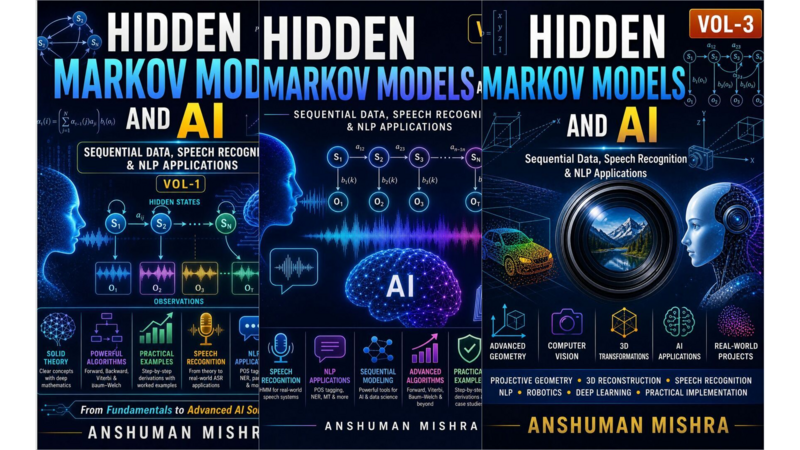
3 Books
- Pricing
$29.00
Minimum priceBought separately$59.97Suggested price$29.00
Author
About the Author

Anshuman Kumar Mishra, M.Tech (Computer Science) Assistant Professor, Doranda College, Ranchi University
Prolific Author of 50+ Books on AI, Machine Learning & Computer Science | 20+ Years Experience
Anshuman Kumar Mishra is a dedicated educator, researcher, and highly prolific author with over 20 years of experience in Computer Science and Information Technology. Holding an M.Tech in Computer Science from BIT Mesra, he brings a rare combination of academic depth and practical teaching expertise.
Currently serving as Assistant Professor at Doranda College under Ranchi University, he has mentored thousands of students, helping them build strong foundations in programming, data science, and artificial intelligence. His student-centric teaching style emphasizes conceptual clarity, hands-on practice, and real-world application.
Anshuman is a prolific author with more than 50 books published across a wide spectrum of computer science and emerging technology domains. From foundational programming languages to advanced topics in Artificial Intelligence, Machine Learning, Reinforcement Learning, Decision Theory, and Computer Vision — his books are widely appreciated by students, educators, and professionals for their clear explanations, strong theoretical foundation, and practical approach.
His extensive body of work reflects his deep commitment to making complex subjects accessible and meaningful for learners at all levels. He is particularly recognized for creating well-structured learning paths that help readers progress from beginner to advanced levels with confidence.
Driven by the mission to democratize quality technical education, Anshuman continues to write and update books that bridge the gap between academic theory and industry practice.
When not teaching or writing, he actively follows and explores new developments in AI, Quantum Machine Learning, and Ethical Intelligence systems.
Contents
Table of Contents
The Leanpub 60 Day 100% Happiness Guarantee
Within 60 days of purchase you can get a 100% refund on any Leanpub purchase, in two clicks.
See full terms...
Earn $8 on a $10 Purchase, and $16 on a $20 Purchase
We pay 80% royalties on purchases of $7.99 or more, and 80% royalties minus a 50 cent flat fee on purchases between $0.99 and $7.98. You earn $8 on a $10 sale, and $16 on a $20 sale. So, if we sell 5000 non-refunded copies of your book for $20, you'll earn $80,000.
(Yes, some authors have already earned much more than that on Leanpub.)
Learn more about writing on Leanpub
Free Updates. DRM Free.
If you buy a Leanpub book, you get free updates for as long as the author updates the book! Many authors use Leanpub to publish their books in-progress, while they are writing them. All readers get free updates, regardless of when they bought the book or how much they paid (including free).
Most Leanpub books are available in PDF (for computers) and EPUB (for phones, tablets and Kindle). The formats that a book includes are shown at the top right corner of this page.
Finally, Leanpub books don't have any DRM copy-protection nonsense, so you can easily read them on any supported device.
Learn more about Leanpub's ebook formats and where to read them
Write and Publish on Leanpub
You can use Leanpub to easily write, publish and sell in-progress and completed ebooks and online courses!
Leanpub is a powerful platform for serious authors, combining a simple, elegant writing and publishing workflow with a store focused on selling in-progress ebooks.
Leanpub is a magical typewriter for authors: just write in plain text, and to publish your ebook, just click a button. (Or, if you are producing your ebook your own way, you can even upload your own PDF and/or EPUB files and then publish with one click!) It really is that easy.