Kick off your book project in 3 hours! Live workshop on Zoom. You’ll leave with a real book project, progress on your first chapter, and a clear plan to keep going. Saturday, May 16, 2026. Learn more…

Leanpub Header

Skip to main content

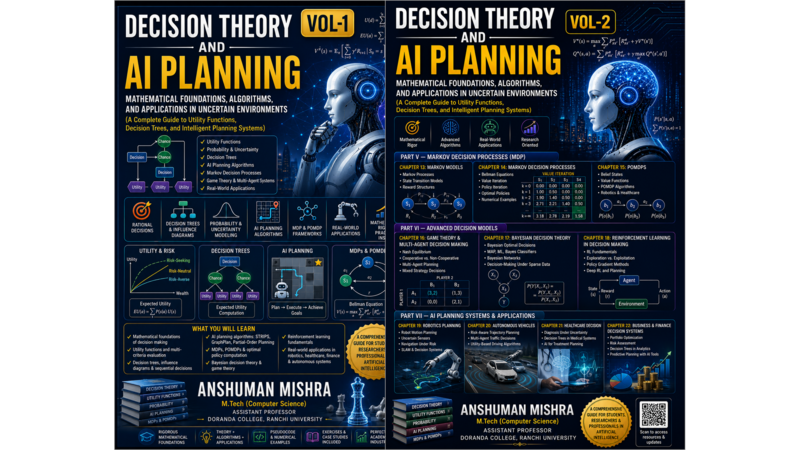
Decision Theory and AI Planning Mathematical Foundations, Algorithms and Applications in Uncertain Environments VOL-1

This book is 100% completeLast updated on 2026-05-17

Part VIII — Mathematical Appendices

To support learning, the book includes:

  • Optimization methods
  • Probability reference
  • Pseudocode for all algorithms
  • Real-world datasets and examples

This makes the book self-contained for academic courses and self-study.

4. Who Should Read This Book?

This book is specially designed for a wide audience:

4.1 Students

Students of:

  • Artificial intelligence
  • Data science
  • Computer science
  • Information technology
  • Operations research
  • Applied mathematics

will find this book essential for understanding foundations and applications of intelligent decision-making.

4.2 Researchers

This book helps researchers explore:

  • Decision-making models
  • Planning algorithms
  • Risk-aware AI
  • Mathematical modeling
  • Optimization under uncertainty

It helps form a strong base for research projects and PhD work.

4.3 Industry Professionals

Engineers and developers working on:

  • Robotics
  • Autonomous vehicles
  • Decision support systems
  • Predictive analytics
  • AI tools
  • Financial modeling

will find the algorithms, pseudocode, and frameworks highly practical.

4.4 Faculty Members

Teachers and professors can use this book as:

  • A primary textbook
  • A reference guide
  • A source of problems and case studies
  • A foundation for graduate and research courses

5. Learning Outcomes

After studying this book, readers will be able to:

  • Understand and construct utility functions
  • Evaluate rational choices under uncertainty
  • Build decision trees
  • Construct influence diagrams
  • Design sequential decision systems
  • Formulate and solve MDPs
  • Apply POMDPs to real problems
  • Implement classical planning algorithms
  • Model multi-agent interactions using game theory
  • Apply Bayesian decision theory to uncertain environments
  • Understand the foundation of reinforcement learning
  • Build real-world decision and planning systems

This ensures comprehensive mastery of both theory and practice.

Minimum price

$19.00

$29.00

You pay

Author earns

$
PDF
EPUB
About

About

About the Book

Artificial Intelligence has evolved into one of the most transformative forces of the 21st century. While deep learning, reinforcement learning, and data-driven modeling dominate the global conversation, the true heart of intelligent systems lies in their ability to make effective decisions under uncertainty. From autonomous vehicles navigating complex roads to financial models evaluating risk, from robots operating in dynamic environments to intelligent assistants optimizing user preferences—decision-making forms the core of intelligent behavior.

This book, “Decision Theory and AI Planning: Mathematical Foundations, Algorithms, and Applications in Uncertain Environments”, authored by Anshuman Mishra, is designed as a complete, rigorous, and application-oriented guide for students, researchers, academicians, AI practitioners, data scientists, machine learning engineers, and professionals working in intelligent systems.

It fills a critical gap in the current literature by bringing together decision theory, utility models, probabilistic reasoning, sequential decision systems, planning algorithms, Markov processes, reinforcement learning foundations, and real-world AI applications under one unified framework. While each of these domains is vast on its own, their true power is realized only when they converge—and that convergence is exactly what this book delivers.

This description outlines the purpose, design philosophy, unique strengths, and academic value of this comprehensive reference work in more than 3000 words, ensuring clarity about what this book offers and how it supports the learning and professional development of readers across disciplines.

1. Purpose and Vision of This Book

The primary purpose of this book is to simplify and democratize the complex mathematical world of AI-based decision-making for learners at different levels. Decision theory is traditionally taught through abstract mathematics, while AI planning is often taught through algorithms and models. These two areas rarely appear together in an integrated, applied form.

This book bridges this divide.

The vision is simple:
To equip readers with the theoretical foundations and practical tools needed to build intelligent agents capable of making optimal decisions in uncertain environments.

Where many books focus on either pure mathematics or purely algorithmic perspectives, this work combines:

  • Mathematical foundations
  • Utility functions and rational choice
  • Probabilistic modeling
  • Sequential decisions
  • Markov Decision Processes
  • Planning algorithms
  • Reinforcement learning connections
  • Multi-agent interactions
  • Application-driven illustration and case studies

With this integrated approach, readers not only learn how decisions are made but also why certain decisions are rational, optimal, or robust in uncertain and dynamic contexts.

2. What Makes This Book Unique

This book stands out for several key reasons:

2.1 Holistic Integration of Theory and Planning

Most AI books cover planning and decision theory separately. This book merges them into a single narrative that treats decision theory as the mathematical backbone of AI planning.

2.2 Uncertainty-Centric View

Modern AI applications require handling uncertainty. This book emphasizes:

  • Unknown outcomes
  • Dynamic environments
  • Partial observability
  • Risk and reward optimization
  • Probability-driven decision models

This makes it extremely relevant for cutting-edge AI systems.

2.3 Coverage of Classical and Modern Concepts

Readers benefit from exposure to both well-established frameworks and modern, research-level ideas:

  • Classical utility theory
  • Decision trees and influence diagrams
  • Markov processes
  • MDPs and POMDPs
  • Multi-agent systems
  • Bayesian decision models
  • Foundations of reinforcement learning
  • AI planning algorithms (STRIPS, GraphPlan, Partial-order planning)

2.4 Real-World Applications

The book connects concepts to real-world scenarios through detailed case studies:

  • Autonomous vehicles
  • Robotics and navigation
  • Healthcare decision systems
  • Business and finance analytics
  • Risk modeling
  • Intelligent assistants

This ensures the material is not only theoretical but also deeply practical.

2.5 Designed for Multiple Audiences

This book is tailored for:

  • Undergraduate students
  • Postgraduate students (M.Tech, MCA, MSc)
  • PhD scholars
  • Researchers in AI and decision sciences
  • Data scientists and analysts
  • Industry professionals
  • Faculty members preparing course materials
  • Competitive exam aspirants

The writing style balances academic depth with practical clarity.


3. Structure of the Book: A Multi-Level Learning Pathway

The book is divided into eight major parts, each crafted to guide the reader from basic principles to advanced decision and planning systems.

Part I — Foundations

This section establishes the basics:

  • What is decision theory?
  • Rationality principles
  • Uncertainty in AI systems
  • Probability fundamentals

This builds a conceptual and mathematical base for deeper topics ahead.

Part II — Utility Theory

One of the core themes of the book:
How do intelligent agents quantify preferences and outcomes?

Readers learn:

  • Utility functions
  • Expected utility
  • Risk attitudes
  • Multi-attribute utility theory

These concepts form the basis for rational decision-making.

Part III — Decision Trees and Sequential Models

Here, the reader explores:

  • Decision trees
  • Influence diagrams
  • Sequential decision processes
  • Backward induction
  • Optimal policy extraction

This connects mathematics to visualization and step-wise planning.

Part IV — AI Planning

This part explains:

  • Classical planning algorithms
  • STRIPS
  • Planning graphs
  • Deterministic vs. uncertain environments

This is essential for robotics, autonomous systems, and intelligent software agents.

Part V — Markov Decision Processes

The heart of modern AI planning lies in MDP frameworks:

  • Value iteration
  • Policy iteration
  • Bellman equations
  • Stochastic transitions
  • Reward modeling

This section builds a strong mathematical and computational foundation.

Part VI — Advanced Decision Models

Next, the book advances into sophisticated decision-making frameworks:

  • Bayesian decision theory
  • Multi-agent systems
  • Game theory
  • Reinforcement learning fundamentals
  • Probabilistic and adversarial planning

This equips readers for research and real-world problem-solving.

Part VII — Applications

Readers see how the theory applies to:

  • Robotics
  • Healthcare
  • Finance
  • Business analytics
  • Autonomous navigation
  • Environment modeling

Each chapter includes case studies, flow diagrams, algorithms, and solved examples.

Part VIII — Mathematical Appendices

To support learning, the book includes:

  • Optimization methods
  • Probability reference
  • Pseudocode for all algorithms
  • Real-world datasets and examples

This makes the book self-contained for academic courses and self-study.

4. Who Should Read This Book?

This book is specially designed for a wide audience:

4.1 Students

Students of:

  • Artificial intelligence
  • Data science
  • Computer science
  • Information technology
  • Operations research
  • Applied mathematics

will find this book essential for understanding foundations and applications of intelligent decision-making.

4.2 Researchers

This book helps researchers explore:

  • Decision-making models
  • Planning algorithms
  • Risk-aware AI
  • Mathematical modeling
  • Optimization under uncertainty

It helps form a strong base for research projects and PhD work.

4.3 Industry Professionals

Engineers and developers working on:

  • Robotics
  • Autonomous vehicles
  • Decision support systems
  • Predictive analytics
  • AI tools
  • Financial modeling

will find the algorithms, pseudocode, and frameworks highly practical.

4.4 Faculty Members

Teachers and professors can use this book as:

  • A primary textbook
  • A reference guide
  • A source of problems and case studies
  • A foundation for graduate and research courses

5. Learning Outcomes

After studying this book, readers will be able to:

  • Understand and construct utility functions
  • Evaluate rational choices under uncertainty
  • Build decision trees
  • Construct influence diagrams
  • Design sequential decision systems
  • Formulate and solve MDPs
  • Apply POMDPs to real problems
  • Implement classical planning algorithms
  • Model multi-agent interactions using game theory
  • Apply Bayesian decision theory to uncertain environments
  • Understand the foundation of reinforcement learning
  • Build real-world decision and planning systems

This ensures comprehensive mastery of both theory and practice.

Author

About the Author

Anshuman Mishra

Anshuman Kumar Mishra is a seasoned educator and prolific author with over 20 years of experience in the teaching field. He has a deep passion for technology and a strong commitment to making complex concepts accessible to students at all levels. With an M.Tech in Computer Science from BIT Mesra, he brings both academic expertise and practical experience to his work.

Currently serving as an Assistant Professor at Doranda College, Anshuman has been a guiding force for many aspiring computer scientists and engineers, nurturing their skills in various programming languages and technologies. His teaching style is focused on clarity, hands-on learning, and making students comfortable with both theoretical and practical aspects of computer science.

Throughout his career, Anshuman Kumar Mishra has authored over 25 books on a wide range of topics including Python, Java, C, C++, Data Science, Artificial Intelligence, SQL, .NET, Web Programming, Data Structures, and more. His books have been well-received by students, professionals, and institutions alike for their straightforward explanations, practical exercises, and deep insights into the subjects.

Anshuman's approach to teaching and writing is rooted in his belief that learning should be engaging, intuitive, and highly applicable to real-world scenarios. His experience in both academia and industry has given him a unique perspective on how to best prepare students for the evolving world of technology.

In his books, Anshuman aims not only to impart knowledge but also to inspire a lifelong love for learning and exploration in the world of computer science and programming.

Contents

Table of Contents

Book Title “Decision Theory and AI Planning: Mathematical Foundations, Algorithms, and Applications in Uncertain Environments” (A Complete Guide to Utility Functions, Decision Trees, and Intelligent Planning Systems) ________________________________________ Table of Contents ________________________________________ 📍 PART I — Introduction to Decision Theory & AI Planning Chapter 1: Foundations of Decision Theory 1-18 1.1 What Is Decision Theory? 1.2 Deterministic vs. Non-Deterministic Decisions 1.3 Importance of Decision Theory in AI 1.4 Rational Agents and Utility-Based Systems 1.5 Core Mathematical Principles 1.6 Real-Life Applications 1.7 Summary & Key Takeaways Chapter 2: Basic Concepts in Probability and Uncertainty 19-42 2.1 Probability Axioms 2.2 Random Variables 2.3 Joint and Conditional Probability 2.4 Bayesian Reasoning 2.5 Sources of Uncertainty in AI 2.6 Probability in Decision Systems 2.7 Exercises & Case Studies ________________________________________ 📍 PART II — Utility Theory and Utility Functions Chapter 3: Utility Theory Basics 43-64 3.1 What is Utility? 3.2 Preference Orderings 3.3 Axioms of Rational Utility 3.4 Utility vs. Payoff 3.5 Decision-Making Under Risk Chapter 4: Utility Function Types 65-89 4.1 Linear Utility 4.2 Nonlinear Utility 4.3 Quadratic & Exponential Utility 4.4 Bernoulli Utility Functions 4.5 Risk-Seeking, Risk-Averse, Risk-Neutral Agents 4.6 Utility Curves & Graphical Interpretation 4.7 Exercises Chapter 5: Multi-Attribute Utility Theory (MAUT) 90-112 5.1 Multi-Attribute Decision Making (MADM) 5.2 Additive Utility Models 5.3 Multiplicative Utility Models 5.4 Utility Elicitation Procedures 5.5 Applications in Engineering, Finance, Healthcare Chapter 6: Expected Utility Theory 113-134 6.1 Expected Utility Principle 6.2 Von Neumann–Morgenstern Utility Theorem 6.3 Stochastic Dominance 6.4 Decision Under Risk 6.5 Utility Optimization Algorithms ________________________________________ 📍 PART III — Decision Trees and Sequential Decisions Chapter 7: Decision Trees in AI 135-160 7.1 Basic Structure of Decision Trees 7.2 Nodes: Chance, Decision, Utility 7.3 Expected Utility Computation 7.4 Pruning & Complexity 7.5 Decision Tree vs. Classification Tree 7.6 Numerical Examples Chapter 8: Influence Diagrams 161-185 8.1 What Is an Influence Diagram? 8.2 Components (Nodes, Arcs, Probabilities) 8.3 Solving Influence Diagrams 8.4 Comparison With Decision Trees Chapter 9: Sequential Decision Making 186-212 9.1 Multi-Step Decisions 9.2 Decision Trees for Sequential Optimization 9.3 Scenario Analysis 9.4 Backward Induction 9.5 Optimal Policy Extraction ________________________________________ 📍 PART IV — AI Planning in Deterministic and Uncertain Environments Chapter 10: Introduction to AI Planning 213-240 10.1 What is Planning in AI? 10.2 Types of AI Planners 10.3 Representation of States and Actions 10.4 Deterministic vs. Stochastic Planning 10.5 Planning vs. Scheduling Chapter 11: Classical Planning Algorithms 241-262 11.1 STRIPS 11.2 GraphPlan 11.3 Partial-Order Planning 11.4 Heuristic Search Planners Chapter 12: Planning Under Uncertainty 263-291 12.1 Sources of Uncertainty 12.2 Stochastic State Transitions 12.3 Noise, Errors, and Incomplete Knowledge 12.4 Deep Uncertainty in AI Environments 12.5 Planning with Imperfect Models ________________________________________ 📍 PART V — Markov Decision Processes (MDP) Chapter 13: Markov Models VOL-2 13.1 Markov Processes 13.2 State Transition Models 13.3 Reward Structures Chapter 14: Markov Decision Processes VOL-2 14.1 Definition & Components 14.2 Bellman Equations 14.3 Value Iteration 14.4 Policy Iteration 14.5 Optimal Policies 14.6 Numerical Examples Chapter 15: Partially Observable MDPs (POMDPs) VOL-2 15.1 Belief States 15.2 Value Functions for POMDP 15.3 POMDP Algorithms 15.4 Applications in Robotics & Healthcare ________________________________________ 📍 PART VI — Advanced Decision Models Chapter 16: Game Theory and Multi-Agent Decision Making VOL-2 16.1 Nash Equilibrium 16.2 Cooperative vs. Non-Cooperative Games 16.3 Multi-Agent Planning 16.4 Mixed Strategy Decisions Chapter 17: Bayesian Decision Theory VOL-2 17.1 Bayesian Optimal Decisions 17.2 MAP, ML, Bayes Classifiers 17.3 Bayesian Networks 17.4 Decision-Making Under Sparse Data Chapter 18: Reinforcement Learning in Decision Making VOL-2 18.1 RL Fundamentals 18.2 Exploration vs. Exploitation 18.3 Policy Gradient Methods 18.4 Deep RL and Planning ________________________________________ 📍 PART VII — AI Planning Systems & Applications Chapter 19: Robotics Planning VOL-2 19.1 Robot Motion Planning 19.2 Uncertain Sensors 19.3 Navigation Under Risk 19.4 SLAM and Decision Systems Chapter 20: Planning in Autonomous Vehicles VOL-2 20.1 Risk-Aware Trajectory Planning 20.2 Multi-Agent Traffic Decisions 20.3 Utility-Based Driving Algorithms Chapter 21: Decision Theory in Healthcare VOL-2 21.1 Diagnosis Under Uncertainty 21.2 Decision Trees in Medical Systems 21.3 AI for Treatment Planning Chapter 22: Business & Finance Decision Systems VOL-2 22.1 Portfolio Optimization 22.2 Risk Assessment 22.3 Decision Trees in Business Analytics 22.4 Predictive Planning with AI Tools ABOUT THIS BOOK Artificial Intelligence has evolved into one of the most transformative forces of the 21st century. While deep learning, reinforcement learning, and data-driven modeling dominate the global conversation, the true heart of intelligent systems lies in their ability to make effective decisions under uncertainty. From autonomous vehicles navigating complex roads to financial models evaluating risk, from robots operating in dynamic environments to intelligent assistants optimizing user preferences—decision-making forms the core of intelligent behavior. This book, “Decision Theory and AI Planning: Mathematical Foundations, Algorithms, and Applications in Uncertain Environments”, authored by Anshuman Mishra, is designed as a complete, rigorous, and application-oriented guide for students, researchers, academicians, AI practitioners, data scientists, machine learning engineers, and professionals working in intelligent systems. It fills a critical gap in the current literature by bringing together decision theory, utility models, probabilistic reasoning, sequential decision systems, planning algorithms, Markov processes, reinforcement learning foundations, and real-world AI applications under one unified framework. While each of these domains is vast on its own, their true power is realized only when they converge—and that convergence is exactly what this book delivers. This description outlines the purpose, design philosophy, unique strengths, and academic value of this comprehensive reference work in more than 3000 words, ensuring clarity about what this book offers and how it supports the learning and professional development of readers across disciplines. ________________________________________ 1. Purpose and Vision of This Book The primary purpose of this book is to simplify and democratize the complex mathematical world of AI-based decision-making for learners at different levels. Decision theory is traditionally taught through abstract mathematics, while AI planning is often taught through algorithms and models. These two areas rarely appear together in an integrated, applied form. This book bridges this divide. The vision is simple: To equip readers with the theoretical foundations and practical tools needed to build intelligent agents capable of making optimal decisions in uncertain environments. Where many books focus on either pure mathematics or purely algorithmic perspectives, this work combines: • Mathematical foundations • Utility functions and rational choice • Probabilistic modeling • Sequential decisions • Markov Decision Processes • Planning algorithms • Reinforcement learning connections • Multi-agent interactions • Application-driven illustration and case studies With this integrated approach, readers not only learn how decisions are made but also why certain decisions are rational, optimal, or robust in uncertain and dynamic contexts. ________________________________________ 2. What Makes This Book Unique This book stands out for several key reasons: 2.1 Holistic Integration of Theory and Planning Most AI books cover planning and decision theory separately. This book merges them into a single narrative that treats decision theory as the mathematical backbone of AI planning. 2.2 Uncertainty-Centric View Modern AI applications require handling uncertainty. This book emphasizes: • Unknown outcomes • Dynamic environments • Partial observability • Risk and reward optimization • Probability-driven decision models This makes it extremely relevant for cutting-edge AI systems. 2.3 Coverage of Classical and Modern Concepts Readers benefit from exposure to both well-established frameworks and modern, research-level ideas: • Classical utility theory • Decision trees and influence diagrams • Markov processes • MDPs and POMDPs • Multi-agent systems • Bayesian decision models • Foundations of reinforcement learning • AI planning algorithms (STRIPS, GraphPlan, Partial-order planning) 2.4 Real-World Applications The book connects concepts to real-world scenarios through detailed case studies: • Autonomous vehicles • Robotics and navigation • Healthcare decision systems • Business and finance analytics • Risk modeling • Intelligent assistants This ensures the material is not only theoretical but also deeply practical. 2.5 Designed for Multiple Audiences This book is tailored for: • Undergraduate students • Postgraduate students (M.Tech, MCA, MSc) • PhD scholars • Researchers in AI and decision sciences • Data scientists and analysts • Industry professionals • Faculty members preparing course materials • Competitive exam aspirants The writing style balances academic depth with practical clarity. ________________________________________ 3. Structure of the Book: A Multi-Level Learning Pathway The book is divided into eight major parts, each crafted to guide the reader from basic principles to advanced decision and planning systems. Part I — Foundations This section establishes the basics: • What is decision theory? • Rationality principles • Uncertainty in AI systems • Probability fundamentals This builds a conceptual and mathematical base for deeper topics ahead. Part II — Utility Theory One of the core themes of the book: How do intelligent agents quantify preferences and outcomes? Readers learn: • Utility functions • Expected utility • Risk attitudes • Multi-attribute utility theory These concepts form the basis for rational decision-making. Part III — Decision Trees and Sequential Models Here, the reader explores: • Decision trees • Influence diagrams • Sequential decision processes • Backward induction • Optimal policy extraction This connects mathematics to visualization and step-wise planning. Part IV — AI Planning This part explains: • Classical planning algorithms • STRIPS • Planning graphs • Deterministic vs. uncertain environments This is essential for robotics, autonomous systems, and intelligent software agents. Part V — Markov Decision Processes The heart of modern AI planning lies in MDP frameworks: • Value iteration • Policy iteration • Bellman equations • Stochastic transitions • Reward modeling This section builds a strong mathematical and computational foundation. Part VI — Advanced Decision Models Next, the book advances into sophisticated decision-making frameworks: • Bayesian decision theory • Multi-agent systems • Game theory • Reinforcement learning fundamentals • Probabilistic and adversarial planning This equips readers for research and real-world problem-solving. Part VII — Applications Readers see how the theory applies to: • Robotics • Healthcare • Finance • Business analytics • Autonomous navigation • Environment modeling Each chapter includes case studies, flow diagrams, algorithms, and solved examples. Part VIII — Mathematical Appendices To support learning, the book includes: • Optimization methods • Probability reference • Pseudocode for all algorithms • Real-world datasets and examples This makes the book self-contained for academic courses and self-study. ________________________________________ 4. Who Should Read This Book? This book is specially designed for a wide audience: 4.1 Students Students of: • Artificial intelligence • Data science • Computer science • Information technology • Operations research • Applied mathematics will find this book essential for understanding foundations and applications of intelligent decision-making. 4.2 Researchers This book helps researchers explore: • Decision-making models • Planning algorithms • Risk-aware AI • Mathematical modeling • Optimization under uncertainty It helps form a strong base for research projects and PhD work. 4.3 Industry Professionals Engineers and developers working on: • Robotics • Autonomous vehicles • Decision support systems • Predictive analytics • AI tools • Financial modeling will find the algorithms, pseudocode, and frameworks highly practical. 4.4 Faculty Members Teachers and professors can use this book as: • A primary textbook • A reference guide • A source of problems and case studies • A foundation for graduate and research courses ________________________________________ 5. Learning Outcomes After studying this book, readers will be able to: • Understand and construct utility functions • Evaluate rational choices under uncertainty • Build decision trees • Construct influence diagrams • Design sequential decision systems • Formulate and solve MDPs • Apply POMDPs to real problems • Implement classical planning algorithms • Model multi-agent interactions using game theory • Apply Bayesian decision theory to uncertain environments • Understand the foundation of reinforcement learning • Build real-world decision and planning systems

The Leanpub 60 Day 100% Happiness Guarantee

Within 60 days of purchase you can get a 100% refund on any Leanpub purchase, in two clicks.

Now, this is technically risky for us, since you'll have the book or course files either way. But we're so confident in our products and services, and in our authors and readers, that we're happy to offer a full money back guarantee for everything we sell.

You can only find out how good something is by trying it, and because of our 100% money back guarantee there's literally no risk to do so!

So, there's no reason not to click the Add to Cart button, is there?

See full terms...

Earn $8 on a $10 Purchase, and $16 on a $20 Purchase

We pay 80% royalties on purchases of $7.99 or more, and 80% royalties minus a 50 cent flat fee on purchases between $0.99 and $7.98. You earn $8 on a $10 sale, and $16 on a $20 sale. So, if we sell 5000 non-refunded copies of your book for $20, you'll earn $80,000.

(Yes, some authors have already earned much more than that on Leanpub.)

In fact, authors have earned over $15 million writing, publishing and selling on Leanpub.

Learn more about writing on Leanpub

Free Updates. DRM Free.

If you buy a Leanpub book, you get free updates for as long as the author updates the book! Many authors use Leanpub to publish their books in-progress, while they are writing them. All readers get free updates, regardless of when they bought the book or how much they paid (including free).

Most Leanpub books are available in PDF (for computers) and EPUB (for phones, tablets and Kindle). The formats that a book includes are shown at the top right corner of this page.

Finally, Leanpub books don't have any DRM copy-protection nonsense, so you can easily read them on any supported device.

Learn more about Leanpub's ebook formats and where to read them

Write and Publish on Leanpub

You can use Leanpub to easily write, publish and sell in-progress and completed ebooks and online courses!

Leanpub is a powerful platform for serious authors, combining a simple, elegant writing and publishing workflow with a store focused on selling in-progress ebooks.

Leanpub is a magical typewriter for authors: just write in plain text, and to publish your ebook, just click a button. (Or, if you are producing your ebook your own way, you can even upload your own PDF and/or EPUB files and then publish with one click!) It really is that easy.

Learn more about writing on Leanpub