Leanpub Header

Skip to main content

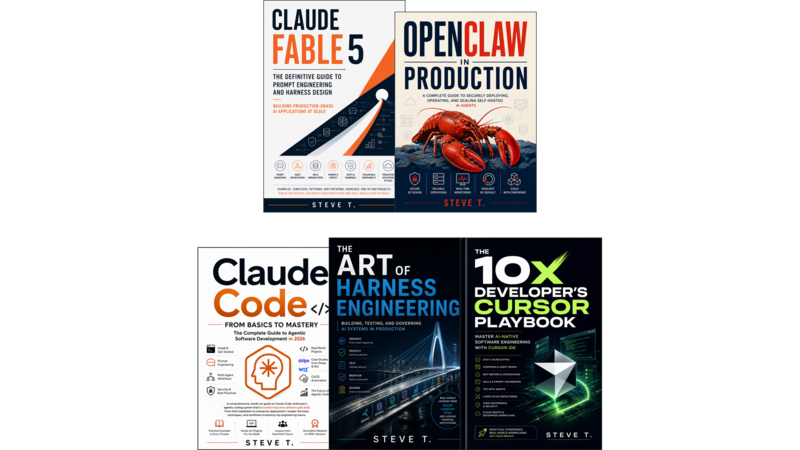
Claude Fable 5: The Definitive Guide to Prompt Engineering and Harness Design

Building Production-Grade AI Applications at Scale

This book is 100% completeLast updated on 2026-07-13

Unlock the full potential of Claude Fable 5 with a practical guide built for developers who are shipping real AI applications. From prompt engineering and agent orchestration to RAG, memory, safety, evaluation, and production deployment, this definitive reference delivers proven patterns, hands-on examples, and reusable templates to help you build reliable, scalable AI systems with confidence.

Minimum price

$19.00

$29.00

You pay

Author earns

$

Also available for 1 book credit with a Reader Membership

PDF
EPUB
128
Pages
About

About

About the Book

This book is a complete reference for developers building applications with Claude Fable 5. It covers everything from foundational prompt techniques to complex agent orchestration, RAG pipelines, memory systems, safety guardrails, evaluation frameworks, and production deployment. Every chapter includes concrete examples, reusable templates, design patterns, anti-patterns, exercises, and end-to-end projects based on official Anthropic documentation and real-world case studies.

Bundle

Bundles that include this book

Author

About the Author

Steve Publications

Steve is a technology professional with more than 20 years of experience in software development, server infrastructure, cybersecurity, vulnerability research and reverse engineering. Throughout his career, he has designed, secured, analyzed and tested complex software and infrastructure, with a particular focus on understanding how systems fail and how they can be made more secure.

He currently works in the advanced research division of a leading cybersecurity company, where he performs vulnerability research alongside a team of experienced researchers and engineers. His work includes discovering security vulnerabilities, reverse engineering software and malware, analyzing emerging threats and developing new techniques to improve the security of modern computing environments.

Outside of work, Steve enjoys sharing knowledge with the technology community. He collaborates with researchers, industry experts and technology professionals to write practical books covering software development, cybersecurity, cloud computing, networking, DevOps, artificial intelligence and enterprise technologies. His books focus on practical learning through clear explanations, real-world examples and hands-on exercises. With more than two decades of industry experience, his goal is to help IT professionals, students and technology enthusiasts build useful skills and stay current in a rapidly changing industry.

We believe readers deserve to know how our books are created. Most of our authors are not native English speakers, so we use AI to help translate, proofread manuscripts, fix grammar, improve sentence structure and make technical explanations easier to read. AI is used as an editing tool only. It does not replace the research, technical knowledge or hands-on experience behind our books.

Some of our authors also prefer to remain anonymous for privacy or professional reasons. In those cases, we publish their work under the a different name. The author's name may be different, but the quality of the content and our review process remain the same.

Every book is written, reviewed and maintained by experienced technology professionals, with contributions from our private technical community of more than 400 engineers and researchers from Ukraine, Belarus and Russia. We spend far more time validating technical accuracy and keeping our content up to date than generating text.

If you look through the contents of our books, you'll see practical examples, detailed explanations and material that is regularly updated. Our goal is to publish books that professionals can actually rely on, not low-effort AI-generated content. If you ever feel that one of our books does not meet that standard, Leanpub offers a 60-day money-back guarantee. Feel free to request a refund if you are not satisfied with your purchase.

Contents

Table of Contents

Building Production-Grade AI Applications at Scale

Introduction: Why Claude Fable 5 Changes the Game

Chapter 1: The Claude Fable 5 Model Landscape

  1. The Mythos Tier: Beyond Opus
  2. API Specifications and Configuration
  3. Safety Architecture and Refusal Handling
  4. Data Retention and Privacy
  5. Platform Availability and Migration
  6. Choosing Fable 5 vs. Other Models
  7. Key Takeaways

Chapter 2: Foundations of Claude Prompting

  1. Clarity and Directness
  2. Role Assignment
  3. Few-Shot and Multishot Examples
  4. XML Structuring
  5. Chain-of-Thought Reasoning and Adaptive Thinking
  6. Output Format Steering
  7. Long Context Best Practices
  8. Model Identity and API Nuances
  9. Common Prompt Mistakes
  10. Exercises
  11. Key Takeaways

Chapter 3: System Prompt Architecture

  1. Anatomy of a Claude System Prompt
  2. Role Definition and Behavioral Constraints
  3. Tool-Use Defaults and Overtriggering Prevention
  4. Multi-Prompt Strategies and CLAUDE.md
  5. Prompt Versioning and Testing
  6. Anti-Patterns in System Prompt Design
  7. System Prompt Templates
  8. Exercises
  9. Key Takeaways

Chapter 4: Context Engineering at Scale

  1. Prompt Caching: Mechanics and Strategy
  2. Caching Pricing and Token Accounting
  3. Minimum Content Lengths for Caching
  4. Cache Invalidation Rules
  5. Server-Side Compaction
  6. Context Editing (Beta)
  7. Context Management Strategies for Long-Running Applications
  8. Token Budgeting and Cost Optimization
  9. Limitations and Edge Cases
  10. Exercises
  11. Key Takeaways

Chapter 5: Tool Use and MCP Integration

  1. Programmatic Tool Calling Patterns
  2. Tool Description Design
  3. Parallel vs. Sequential Tool Calling
  4. Security and Path Traversal Protection
  5. The Model Context Protocol (MCP)
  6. Building Custom MCP Servers
  7. MCP Client Integration
  8. Combining MCP with Programmatic Tools
  9. Debugging Tool Use Issues
  10. Exercises
  11. Key Takeaways

Chapter 6: Memory Systems and Cross-Session Persistence

  1. The Memory Tool: Architecture and Operations
  2. Client-Side Implementation
  3. Just-in-Time Retrieval Patterns
  4. Multi-Session Development Workflows
  5. Context Editing + Memory: The 39% Improvement
  6. Hybrid Memory Architectures
  7. Security and Data Hygiene
  8. Memory File Organization
  9. Exercises
  10. Key Takeaways

Chapter 7: RAG and Knowledge-Augmented Generation

  1. The RAG Pipeline: From Documents to Answers
  2. Baseline RAG Performance
  3. Level 2: Summary Indexing
  4. Level 3: Re-Ranking with Claude
  5. Contextual Retrieval: Anthropic’s Approach
  6. Chunking Strategies for Long-Context Models
  7. Embedding Model Selection
  8. Prompt Design for RAG Generation
  9. Evaluation Framework
  10. Trade-offs and Design Decisions
  11. Exercises
  12. Key Takeaways

Chapter 8: Agent Workflows and Orchestration

  1. Sequential Workflows
  2. Parallel Workflows
  3. Evaluator-Optimizer Workflows
  4. Dynamic Workflows: Subagent Orchestration at Scale
  5. State Management Across Sessions and Context Windows
  6. Failure Handling and Graceful Degradation
  7. Choosing the Right Workflow Pattern
  8. Combining Patterns
  9. Exercises
  10. Key Takeaways

Chapter 9: Evaluation and Testing Frameworks

  1. The Structure of an Evaluation
  2. Grader Types: Code-Based, Model-Based, and Human
  3. pass@k vs pass^k Metrics
  4. Capability vs. Regression Evals
  5. Evaluating Different Agent Types
  6. Building Evals: A Step-by-Step Roadmap
  7. Promptfoo Integration
  8. Beyond Automated Evals: A Holistic View
  9. Eval Frameworks and Tools
  10. Exercises
  11. Key Takeaways

Chapter 10: Safety, Guardrails, and Responsible Deployment

  1. Fable 5’s Safety Classifiers
  2. Refusal Handling: The New Normal
  3. Prompt Injection Defenses
  4. Jailbreak Resistance and Red-Teaming
  5. Data Privacy and Zero Data Retention
  6. Compliance Considerations
  7. Safety in Agent Workflows
  8. Compliance Checklist
  9. Exercises
  10. Key Takeaways

Chapter 11: Debugging, Optimization, and Production Deployment

  1. The Five Categories of Prompt Failure
  2. The Systematic Debugging Workflow
  3. Common Claude Code Anti-Patterns
  4. Latency Optimization
  5. Cost Optimization
  6. Production Deployment Practices
  7. Claude Code Best Practices for Production
  8. Debugging Common Production Issues
  9. Exercises
  10. Key Takeaways

Chapter 12: End-to-End Projects and Real-World Case Studies

  1. Project A: Customer Support Agent with RAG, Memory, and MCP Integration
  2. Project B: Research Agent with Parallel Subagents and Evaluation Harness
  3. Case Study 1: Stripe’s Fifty-Million-Line Migration Using Claude Fable 5
  4. Case Study 2: Drug Design Acceleration in Life Sciences
  5. Reusable Template Library
  6. Exercises
  7. Key Takeaways
  8. Conclusion

References

Get the free sample chapters

Click the buttons to get the free sample in PDF or EPUB, or read the sample online here

The Leanpub 60 Day 100% Happiness Guarantee

Within 60 days of purchase you can get a 100% refund on any Leanpub purchase, in two clicks.

See full terms...

Earn $8 on a $10 Purchase, and $16 on a $20 Purchase

We pay 80% royalties on purchases of $7.99 or more, and 80% royalties minus a 50 cent flat fee on purchases between $0.99 and $7.98. You earn $8 on a $10 sale, and $16 on a $20 sale. So, if we sell 5000 non-refunded copies of your book for $20, you'll earn $80,000.

(Yes, some authors have already earned much more than that on Leanpub.)

In fact, authors have earned over $15 million writing, publishing and selling on Leanpub.

Learn more about writing on Leanpub

Free Updates. DRM Free.

If you buy a Leanpub book, you get free updates for as long as the author updates the book! Many authors use Leanpub to publish their books in-progress, while they are writing them. All readers get free updates, regardless of when they bought the book or how much they paid (including free).

Most Leanpub books are available in PDF (for computers) and EPUB (for phones, tablets and Kindle). The formats that a book includes are shown at the top right corner of this page.

Finally, Leanpub books don't have any DRM copy-protection nonsense, so you can easily read them on any supported device.

Learn more about Leanpub's ebook formats and where to read them

Write and Publish on Leanpub

You can use Leanpub to easily write, publish and sell in-progress and completed ebooks and online courses!

Leanpub is a powerful platform for serious authors, combining a simple, elegant writing and publishing workflow with a store focused on selling in-progress ebooks.

Leanpub is a magical typewriter for authors: just write in plain text, and to publish your ebook, just click a button. (Or, if you are producing your ebook your own way, you can even upload your own PDF and/or EPUB files and then publish with one click!) It really is that easy.

Learn more about writing on Leanpub