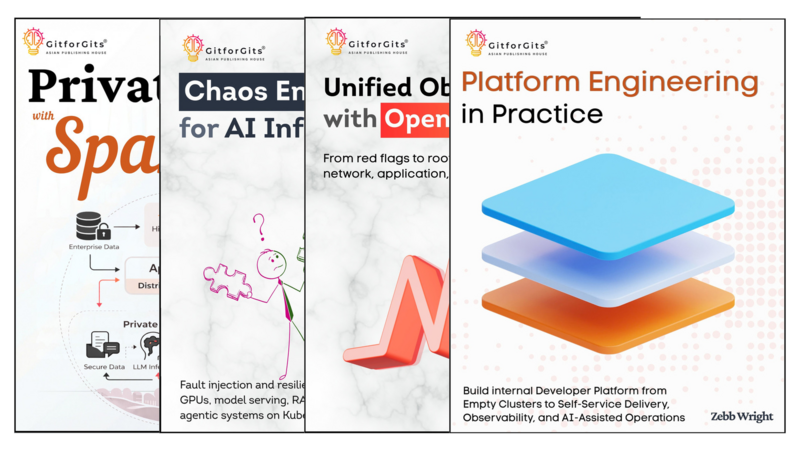
Chaos Engineering for AI Infrastructure
Fault injection and resilience testing for GPUs, model serving, RAG pipelines, and agentic systems on Kubernetes


This book is all about testing and closing the gap between infrastructure health and output quality, and how easily that gap can be filled for weeks by a failure that's gone unnoticed.
This book looks at the less obvious side of the problem. In the next few chapters, we're going to run 41 experiments on one application. About half of them will give you a result that the system doesn't report. It's not a dig at anyone's engineering, since the systems in question are competently built and mostly behave well.
About
About the Book
How long do you think it would take you to notice if your AI system started giving worse answers?
Honestly, for most teams, it's weeks, and the news comes from a customer. Chaos engineering answers that question for infrastructure in about thirty seconds, because if a server goes down, it either reroutes or it doesn't. And language models completely shatter all those assumptions. Their output varies for real, their decay builds up instead of happening straight away, and those failures are confident, plausible, and wrong while latency, error rate, and pod health stay exactly where they should be.
This book sets out the new framework for AI infrastructure. You'll find that, working through one support-assistant application across twelve chapters, everything moves from defining steady state for probabilistic systems to injecting faults at every layer, including accelerators, inference servers, model artefacts, retrieval pipelines, model APIs, autonomous agents, distributed training and the monitoring stack itself.
Just to be clear, the toolchain is intentionally kept small. The LitmusChaos orchestrates, the Chaos Mesh reaches the kernel and filesystem, and the mitmproxy handles the content-level faults that neither can touch, extended with custom injectors where nothing suitable exists. So, every experiment comes to one of these four conclusions, and then the last chapter sums them all up as a programme scorecard.
Key Learnings
- Write down what "working correctly" means when your system's output legitimately varies.
- Break GPUs and inference servers on purpose, with a restore path that always runs.
- Spot the failures that keep every dashboard green and every alert silent.
- Check model weights for damage before loading them, not after serving starts.
- Catch the model release that scores better overall while getting worse where it matters.
- Find out whether your RAG pipeline is helping, or quietly making answers worse.
- Corrupt what the model returns, then watch whether your agent notices.
- Stop your remediation agent from making an incident worse than it was.
- Prove your training checkpoints actually resume the run they claim to continue.
- Catch slow decay in hours instead of days by changing how you alert.
Table of Content
- Why AI Systems Fail Differently?
- Steady State for Probabilistic System
- Lab and the Toolchain
- Accelerator and Compute Chaos
- Inference Serving Chaos
- Model Artifacts, Registries, and Version Skew
- Retrieval and Context Chaos
- Model-Boundary Chaos
- Agentic and Multi-Agent Chaos
- Distributed Training and Choas Fine-Tuning
- Observing Probabilistic Degradation
- Operationalizing Chaos
Packages
Pick Your Package
All packages include the ebook in the following formats: PDF and EPUB
This book only
Minimum price
Suggested price$29.99$29.99
This book + Extras Downloadable (Go Programming Cookbook, Second Edition)
Minimum price
Suggested price$56.99$49.99
- Go Programming Cookbook, Second Edition100+ solutions across scaling concurrency, resource budgets, gRPC, databases, profiling, and network security. This book is for every Go programmer who wants to bring error-free performance, immediate troubleshooting to issues, better reliability and active security. All you need is basics of Go and nothing beyond to pursue this book.
This book is also available in the following packages:
This book + Extras Downloadable (Production Debugging with Sentry)
No Description Available
- Production Debugging with SentryA Practical SRE Playbook for Tracing, Logging, Profiling and Alerting Across Full-Stack Production Systems. Whether you're an engineer, SRE or tech lead, you'll find everything you need to scale your company. All the tasks are routine, you can reproduce them and verify the results. Basics of application monitoring and knowing the lifecycle of application development is all you need to get through this book.
- Minimum price
- $49.99
- Suggested price
- $56.99
- Production Debugging with Sentry
This book + Extras Downloadable (Go Programming Cookbook, 2 Edn + Production Debugging with Sentry)
No Description Available
- Go Programming Cookbook, Second Edition100+ solutions across scaling concurrency, resource budgets, gRPC, databases, profiling, and network security. This book is for every Go programmer who wants to bring error-free performance, immediate troubleshooting to issues, better reliability and active security. All you need is basics of Go and nothing beyond to pursue this book.
- Production Debugging with SentryA Practical SRE Playbook for Tracing, Logging, Profiling and Alerting Across Full-Stack Production Systems. Whether you're an engineer, SRE or tech lead, you'll find everything you need to scale your company. All the tasks are routine, you can reproduce them and verify the results. Basics of application monitoring and knowing the lifecycle of application development is all you need to get through this book.
- Minimum price
- $69.99
- Suggested price
- $76.99
- Go Programming Cookbook, Second Edition
Bundles
Bundles that include this book
- Pricing
$74.99
Minimum priceBought separately$89.97Suggested price$79.99
- Pricing
$77.99
Minimum priceBought separately$119.96Suggested price$84.99

Author
About the Author

We are the engineer’s publisher, the coder’s mentor, and the content alchemist—meticulously turning dense tech into practical gold. With a growing library of 100+ titles, we don’t just develop technical books, rather we build roadmaps for professionals across Python, MySQL, DevOps, Rust, AI, Kotlin, Arduino, Golang and everything around the massive IT ecosystem. Every chapter, every script, every project is a tool in the hands of developers who want to get things done.
Where others summarize, we construct step-by-step learning blueprints, cutting through clutter, banning the fluff, and ensuring every paragraph delivers hands-on value. Our audience isn’t learning from scratch—they’re leveling up with purpose, and we stand by them with code-first content, consistent project workflows, and a zero-redundancy approach.
The Leanpub 60 Day 100% Happiness Guarantee
Within 60 days of purchase you can get a 100% refund on any Leanpub purchase, in two clicks.
See full terms...
Earn $8 on a $10 Purchase, and $16 on a $20 Purchase
We pay 80% royalties on purchases of $7.99 or more, and 80% royalties minus a 50 cent flat fee on purchases between $0.99 and $7.98. You earn $8 on a $10 sale, and $16 on a $20 sale. So, if we sell 5000 non-refunded copies of your book for $20, you'll earn $80,000.
(Yes, some authors have already earned much more than that on Leanpub.)
Learn more about writing on Leanpub
Free Updates. DRM Free.
If you buy a Leanpub book, you get free updates for as long as the author updates the book! Many authors use Leanpub to publish their books in-progress, while they are writing them. All readers get free updates, regardless of when they bought the book or how much they paid (including free).
Most Leanpub books are available in PDF (for computers) and EPUB (for phones, tablets and Kindle). The formats that a book includes are shown at the top right corner of this page.
Finally, Leanpub books don't have any DRM copy-protection nonsense, so you can easily read them on any supported device.
Learn more about Leanpub's ebook formats and where to read them
Write and Publish on Leanpub
You can use Leanpub to easily write, publish and sell in-progress and completed ebooks and online courses!
Leanpub is a powerful platform for serious authors, combining a simple, elegant writing and publishing workflow with a store focused on selling in-progress ebooks.
Leanpub is a magical typewriter for authors: just write in plain text, and to publish your ebook, just click a button. (Or, if you are producing your ebook your own way, you can even upload your own PDF and/or EPUB files and then publish with one click!) It really is that easy.