
The Leanpub 60 Day 100% Happiness Guarantee
Within 60 days of purchase you can get a 100% refund on any Leanpub purchase, in two clicks.
See full terms...
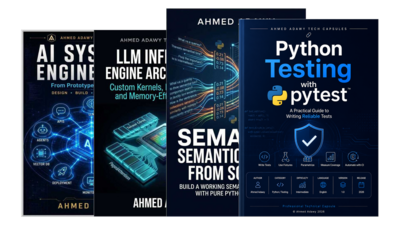
Stop building fragile AI toys. Master the complete engineering stack for production-grade LLMs, vector search, high-performance inference, and autonomous AI agents.
LLM Engineering, AI Architecture, Agentic AI, Semantic Search, Vector Databases, AI Infrastructure, Python Performance, Machine Learning Systems, DevOps for AI, RAG Pipelines
Bought separately
$61.96
Minimum price
$21.99
$31.99
About the Bundle
The Ultimate Agentic AI & LLM Production Mastery Bundle
Transitioning from a basic AI prototype to a robust, scalable production system requires deep architectural knowledge. This curated bundle brings together your core engineering guides to give you the exact blueprint needed to build, optimize, and scale modern AI applications.
What is Inside This Bundle?
Who is This Bundle For?
Get the complete engineering toolkit today and build AI systems that scale reliably in production.
About the Books

Master the Transition from AI Prototypes to Production-Grade Systems
Moving artificial intelligence and generative models from experimental Jupyter notebooks to scalable, reliable production environments requires robust systems engineering. This book is a practical, hands-on guide for software engineers, machine learning practitioners, and technical architects building end-to-end AI infrastructure.
What You Will Learn:
• Foundations & Architecture: Deep dive into LLM architectures, Generative AI mechanisms, and core Machine Learning principles.
• Performance Optimization: Eliminate computational bottlenecks, optimize pure Python execution, and leverage high-performance vectorized operations.
• Production Deployment: Build secure, scalable containerized microservices and backend architectures for AI workloads.
• Real-World Implementation: Construct robust AI pipelines using modern Python frameworks and production best practices.
Whether you are an engineer looking to scale your AI prototypes or an architect designing enterprise systems, this book bridges the gap between machine learning concepts and production-grade deployment.

Running an LLM is one problem. Understanding its memory footprint, execution phases, and serving behavior is another.
LLM Inference Engine Architecture explores the engineering behind language-model inference—from prefill and decode to KV-cache management, attention kernels, quantization, and request scheduling.
Written for software engineers and ML engineers with a working knowledge of Python and transformer fundamentals, the book connects mathematical explanations with implementation examples and serving-system design considerations.
The book includes numerical examples, reference code, and an educational asynchronous serving simulator. These examples are intended to explain mechanisms and trade-offs—not to replace hardware-specific profiling or production validation.
Read the sample to review the mathematical level, coding style, and scope before purchasing.

Modern AI systems retrieve information by meaning rather than exact keyword matches. Under the hood, this capability relies on a surprisingly simple foundation: representing text as vectors, measuring similarity, and ranking results.
In Semantic Search from Scratch, you will build this core mechanism yourself from first principles using only Python and NumPy.
We deliberately avoid third-party vector databases, machine-learning frameworks, and high-level retrieval libraries. The goal isn't to build a production platform, but to demystify the mathematical mechanics behind semantic retrieval, vector spaces, and Retrieval-Augmented Generation (RAG).
What You Will Learn & Build:
Who Is This Capsule For?
This guide is designed for intermediate Python developers, AI engineers, and curiosity-driven builders who want to peel back the layers of high-level AI libraries and truly understand how semantic search works under the hood.

Python Testing with pytest is a practical guide to building reliable Python software through automated testing.
Writing code that works is only the beginning. As projects grow, refactoring, new features, and changing requirements can introduce unexpected regressions. A well-designed test suite provides the safety net developers need to change their code with confidence.
This capsule introduces pytest from the ground up and gradually moves toward the practices used in real-world Python projects.
You will learn how to write clear and focused tests, use assertions effectively, test normal and edge-case behavior, verify exceptions, organize test code, understand pytest output, and build a repeatable testing workflow.
The book also introduces the principles behind Arrange–Act–Assert, reusable testing patterns, parametrization, fixtures, test organization, code coverage, continuous integration, and professional testing practices.
Rather than treating testing as an afterthought, this book presents it as an essential part of software development.
Whether you are a Python developer, a student learning software engineering, or a developer moving from small scripts toward larger applications, this capsule gives you a practical foundation for writing software that is easier to maintain, refactor, and trust.
Learn the tools. Understand the principles. Build with confidence.
Ahmed Adawy Tech Capsules
Practical engineering knowledge, one focused capsule at a time.
Within 60 days of purchase you can get a 100% refund on any Leanpub purchase, in two clicks.
See full terms...
We pay 80% royalties on purchases of $7.99 or more, and 80% royalties minus a 50 cent flat fee on purchases between $0.99 and $7.98. You earn $8 on a $10 sale, and $16 on a $20 sale. So, if we sell 5000 non-refunded copies of your book for $20, you'll earn $80,000.
(Yes, some authors have already earned much more than that on Leanpub.)
Learn more about writing on Leanpub
If you buy a Leanpub book, you get free updates for as long as the author updates the book! Many authors use Leanpub to publish their books in-progress, while they are writing them. All readers get free updates, regardless of when they bought the book or how much they paid (including free).
Most Leanpub books are available in PDF (for computers) and EPUB (for phones, tablets and Kindle). The formats that a book includes are shown at the top right corner of this page.
Finally, Leanpub books don't have any DRM copy-protection nonsense, so you can easily read them on any supported device.
Learn more about Leanpub's ebook formats and where to read them
You can use Leanpub to easily write, publish and sell in-progress and completed ebooks and online courses!
Leanpub is a powerful platform for serious authors, combining a simple, elegant writing and publishing workflow with a store focused on selling in-progress ebooks.
Leanpub is a magical typewriter for authors: just write in plain text, and to publish your ebook, just click a button. (Or, if you are producing your ebook your own way, you can even upload your own PDF and/or EPUB files and then publish with one click!) It really is that easy.