
The Leanpub 60 Day 100% Happiness Guarantee
Within 60 days of purchase you can get a 100% refund on any Leanpub purchase, in two clicks.
See full terms...
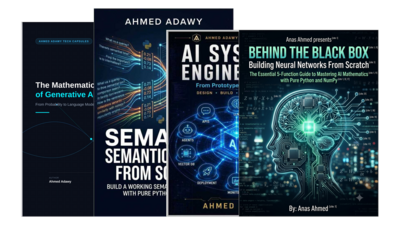
Stop treating Large Language Models like black-box APIs.
Master the complete Generative AI engineering stack—from probability equations and neural networks built from scratch to vector semantic search and production-grade LLM system architecture. This 4-book curriculum equips developers and software architects with the first-principles intuition needed to build, scale, and innovate with confidence.
Bought separately
$53.97
Minimum price
$22.99
$31.99
About the Bundle
Stop treating Large Language Models like black-box APIs.
The Generative AI & LLM Engineering Bundle is a complete, 4-book curriculum engineered for developers, software architects, and ML practitioners who want to build, understand, and scale modern AI systems from first principles.
Instead of superficial tutorials, this bundle provides a seamless learning path: from the core equations and neural network code up to high-dimensional semantic search and production-grade system architecture.
📦 What’s Included in This Bundle?1. The Mathematics of Generative AI: From Probability to Language Models
Demystify the exact equations driving modern LLMs. Learn probability distributions, vector geometry, and scaled dot-product attention through clear intuition and code-first mappings.
2. Behind the Black Box: Building Neural Networks From Scratch
Understand deep learning by building it. Implement feedforward networks, backpropagation, and fundamental neural building blocks from scratch without relying on heavy frameworks.
3. Semantic Search From Scratch
Master vector embeddings, similarity metrics, and retrieval mechanisms. Learn how to architect fast, reliable semantic search engines and Retrieval-Augmented Generation (RAG) pipelines.
4. AI Systems Engineering
Bridge the gap from prototype to production. Learn how to architect, optimize, monitor, and deploy scalable LLM infrastructure capable of handling real-world enterprise traffic.
🎯 What You Will Learn & BuildBuying these books together gives you a complete, end-to-end curriculum—from theory to code to production deployment—at a discounted bundle price.
Master the mathematics. Build the algorithms. Scale the systems.
About the Books

Generative AI can often feel like magic, but behind every token prediction, attention weight, and context window lies a clean foundation of applied mathematics. The Mathematics of Generative AI: From Probability to Language Models bridges the gap between abstract equations and modern engineering, providing developers and AI practitioners with a clear, code-first roadmap.
Instead of drowning in academic proofs, this capsule translates essential mathematical concepts—probability theory, high-dimensional vector spaces, and linear transformations—directly into practical intuition for building and understanding modern Large Language Models (LLMs).
Key Takeaways & Core Topics
Modern AI systems retrieve information by meaning rather than exact keyword matches. Under the hood, this capability relies on a surprisingly simple foundation: representing text as vectors, measuring similarity, and ranking results.
In Semantic Search from Scratch, you will build this core mechanism yourself from first principles using only Python and NumPy.
We deliberately avoid third-party vector databases, machine-learning frameworks, and high-level retrieval libraries. The goal isn't to build a production platform, but to demystify the mathematical mechanics behind semantic retrieval, vector spaces, and Retrieval-Augmented Generation (RAG).
What You Will Learn & Build:
Who Is This Capsule For?
This guide is designed for intermediate Python developers, AI engineers, and curiosity-driven builders who want to peel back the layers of high-level AI libraries and truly understand how semantic search works under the hood.

Master the Transition from AI Prototypes to Production-Grade Systems
Moving artificial intelligence and generative models from experimental Jupyter notebooks to scalable, reliable production environments requires robust systems engineering. This book is a practical, hands-on guide for software engineers, machine learning practitioners, and technical architects building end-to-end AI infrastructure.
What You Will Learn:
• Foundations & Architecture: Deep dive into LLM architectures, Generative AI mechanisms, and core Machine Learning principles.
• Performance Optimization: Eliminate computational bottlenecks, optimize pure Python execution, and leverage high-performance vectorized operations.
• Production Deployment: Build secure, scalable containerized microservices and backend architectures for AI workloads.
• Real-World Implementation: Construct robust AI pipelines using modern Python frameworks and production best practices.
Whether you are an engineer looking to scale your AI prototypes or an architect designing enterprise systems, this book bridges the gap between machine learning concepts and production-grade deployment.

Build a Neural Network From Scratch
Most machine-learning tutorials stop after calling model.fit(). This book goes further: it shows you how to build, train, validate, and evaluate a small neural network using only Python and NumPy.
You will implement a two-layer binary classifier from first principles. You will learn how data flows through a network, how predictions become probabilities, how errors become gradients, and how gradients update parameters.
You will build a practical understanding of:
- The linear forward pass
- ReLU and sigmoid activation functions
- Binary cross-entropy
- Numerically stable loss calculation using logits
- Backpropagation and the chain rule
- Gradient descent
- Mini-batch training and epochs
- L2 regularization
- Gradient clipping
- Gradient checking
- Train, validation, and test splits
- Classification metrics
- Leakage-safe model evaluation
- Reproducible machine-learning workflows
This book is for Python developers, students, and aspiring machine-learning engineers who want to understand what happens inside a neural network before relying entirely on high-level frameworks.
You do not need prior deep-learning experience. Basic Python and high-school-level algebra are enough to follow along.
This is not a collection of copied code snippets. Each concept is connected to a clear implementation. You will see how a forward pass produces predictions, how a loss measures mistakes, how backpropagation calculates gradients, and how gradient descent updates parameters.
You will also learn how to evaluate a model honestly. The book distinguishes training performance from generalization, explains why validation data guides model selection, and shows why a test set should be evaluated only after the final configuration has been selected.
Important note: This is an early-access edition. The book is actively being developed and expanded. It focuses on building a strong, honest foundation in neural networks and responsible model evaluation.
Within 60 days of purchase you can get a 100% refund on any Leanpub purchase, in two clicks.
See full terms...
We pay 80% royalties on purchases of $7.99 or more, and 80% royalties minus a 50 cent flat fee on purchases between $0.99 and $7.98. You earn $8 on a $10 sale, and $16 on a $20 sale. So, if we sell 5000 non-refunded copies of your book for $20, you'll earn $80,000.
(Yes, some authors have already earned much more than that on Leanpub.)
Learn more about writing on Leanpub
If you buy a Leanpub book, you get free updates for as long as the author updates the book! Many authors use Leanpub to publish their books in-progress, while they are writing them. All readers get free updates, regardless of when they bought the book or how much they paid (including free).
Most Leanpub books are available in PDF (for computers) and EPUB (for phones, tablets and Kindle). The formats that a book includes are shown at the top right corner of this page.
Finally, Leanpub books don't have any DRM copy-protection nonsense, so you can easily read them on any supported device.
Learn more about Leanpub's ebook formats and where to read them
You can use Leanpub to easily write, publish and sell in-progress and completed ebooks and online courses!
Leanpub is a powerful platform for serious authors, combining a simple, elegant writing and publishing workflow with a store focused on selling in-progress ebooks.
Leanpub is a magical typewriter for authors: just write in plain text, and to publish your ebook, just click a button. (Or, if you are producing your ebook your own way, you can even upload your own PDF and/or EPUB files and then publish with one click!) It really is that easy.