
The Leanpub 60 Day 100% Happiness Guarantee
Within 60 days of purchase you can get a 100% refund on any Leanpub purchase, in two clicks.
See full terms...
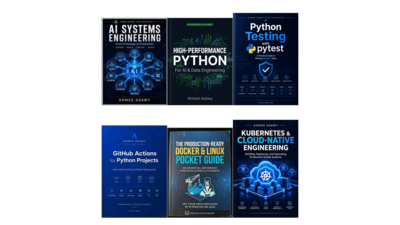
Stop writing scripts that only work on your local machine. Master the complete stack of AI engineering, high-performance Python optimization, robust testing, CI/CD automation, and Kubernetes production deployment.
https://leanpub.com/b/thefull-stackaiengineeringmlopsmasterybundle
Stop writing scripts that only work on your local machine. Master the complete stack of AI engineering, high-performance Python, testing, CI/CD, and Kubernetes production deployment. Get 6 complete books with over 70% savings and free lifetime updates!
Bought separately
$86.95
Minimum price
$15.99
$28.99
About the Bundle
Most AI and Python tutorials stop the moment a script runs successfully on a local machine. But building real-world software and production-ready AI systems requires a completely different set of skills. You need to write high-performance code, ensure reliability through rigorous testing, automate deployments using CI/CD pipelines, containerize applications with Docker, and orchestrate them at scale on Kubernetes.
This comprehensive bundle bridges the gap between raw code and enterprise-grade production systems. Designed for software engineers, backend developers, and AI practitioners, these books provide a hands-on, practical roadmap to building robust infrastructure from scratch. By grabbing this bundle, you get all 6 books at a massive discount (saving over 70% compared to buying them individually). Plus, any future updates, revisions, or added chapters to these books are 100% free forever on Leanpub.
What you will learn inside this bundle:
- How to architect, design, and scale AI systems from initial prototype to robust production environments.
- Low-level Python optimization techniques to eliminate performance bottlenecks in data-heavy and AI workloads.
- Professional software testing strategies using pytest to ensure maintainable, reliable, and bug-free codebases.
- Seamless CI/CD pipeline automation with GitHub Actions and Python projects.
- Best practices for containerizing Linux environments securely using production-ready Docker workflows.
- Kubernetes and cloud-native architecture patterns to deploy and manage distributed systems reliably.
If you are tired of fragmented tutorials and want a complete engineering blueprint that takes your technical stack to senior level, this bundle gives you the exact tools, architectures, and production strategies you need, backed by lifetime updates.
About the Books

Master the Transition from AI Prototypes to Production-Grade Systems
Moving artificial intelligence and generative models from experimental Jupyter notebooks to scalable, reliable production environments requires robust systems engineering. This book is a practical, hands-on guide for software engineers, machine learning practitioners, and technical architects building end-to-end AI infrastructure.
What You Will Learn:
• Foundations & Architecture: Deep dive into LLM architectures, Generative AI mechanisms, and core Machine Learning principles.
• Performance Optimization: Eliminate computational bottlenecks, optimize pure Python execution, and leverage high-performance vectorized operations.
• Production Deployment: Build secure, scalable containerized microservices and backend architectures for AI workloads.
• Real-World Implementation: Construct robust AI pipelines using modern Python frameworks and production best practices.
Whether you are an engineer looking to scale your AI prototypes or an architect designing enterprise systems, this book bridges the gap between machine learning concepts and production-grade deployment.

Stop letting unoptimized loops and memory bottlenecks cripple your Python pipelines and AI models.
"High-Performance Python for AI & Data Engineering" is a tactical, no-fluff engineering blueprint designed to strip away execution overhead and scale your code from sluggish prototypes to lightning-fast production systems.
Whether you are processing massive vector embeddings, training deep learning architectures, or handling high-throughput data streams, this guide reveals how to bypass CPython limitations and leverage hardware-accelerated optimization.
What’s Inside the Blueprint:
Who is this for?

Python Testing with pytest is a practical guide to building reliable Python software through automated testing.
Writing code that works is only the beginning. As projects grow, refactoring, new features, and changing requirements can introduce unexpected regressions. A well-designed test suite provides the safety net developers need to change their code with confidence.
This capsule introduces pytest from the ground up and gradually moves toward the practices used in real-world Python projects.
You will learn how to write clear and focused tests, use assertions effectively, test normal and edge-case behavior, verify exceptions, organize test code, understand pytest output, and build a repeatable testing workflow.
The book also introduces the principles behind Arrange–Act–Assert, reusable testing patterns, parametrization, fixtures, test organization, code coverage, continuous integration, and professional testing practices.
Rather than treating testing as an afterthought, this book presents it as an essential part of software development.
Whether you are a Python developer, a student learning software engineering, or a developer moving from small scripts toward larger applications, this capsule gives you a practical foundation for writing software that is easier to maintain, refactor, and trust.
Learn the tools. Understand the principles. Build with confidence.
Ahmed Adawy Tech Capsules
Practical engineering knowledge, one focused capsule at a time.

GitHub Actions for Python Projects is a practical, developer-focused guide to automating Python project workflows with GitHub Actions. Instead of treating CI/CD as abstract DevOps theory, this technical capsule focuses on the workflow concepts developers actually need when building and maintaining real Python projects. You will work through practical examples covering automated testing, code coverage, documentation builds, artifact generation, and deployment-oriented workflows. The goal is not simply to explain GitHub Actions, but to show how its components fit together into a reliable and maintainable automation workflow. You will learn: 1. How GitHub Actions workflows are structured 2. How to configure Python environments in CI 3. How to install and manage project dependencies 4. How to automate testing with pytest 5. How to generate and use test coverage reports 6. How to build project documentation automatically 7. How to upload and preserve workflow artifacts 8. How to organize jobs and steps effectively 9. How to design a practical workflow execution order 10. How to build reusable CI patterns for real Python projects Whether you are building a small Python project, maintaining an open-source repository, or moving toward a more professional CI/CD workflow, this capsule provides a concise and practical foundation for integrating automation into your development process. The focus throughout the capsule is on implementation, workflow design, and reusable engineering patterns rather than lengthy theoretical discussions. A compact technical guide for developers who want to move from manually running project tasks to building reliable, automated workflows with GitHub Actions.

Stop struggling with server deployment and multi-container setups. Get battle-tested, production-ready configurations in minutes.
The Production-Ready Docker & Linux Pocket Guide is a concise, hands-on reference designed for software developers, computer science students, and engineers who want to bridge the gap between local development and real-world cloud deployment.
Instead of wading through hundreds of pages of abstract theory, this guide cuts straight to the chase with actionable commands, practical Dockerfiles, and security best practices you can copy-paste directly into your projects.
🚀 What’s Inside:Students & Beginners learning Docker and Linux CLI for real-world application
Freelancers & Engineers deploying applications to VPS platforms like AWS, DigitalOcean, or Hetzner

Master Production-Grade Kubernetes & Cloud-Native Systems
Modern production platforms consist of distributed services, containers, automated deployment pipelines, cloud infrastructure, observability frameworks, and increasingly, complex AI workloads. Managing this scale manually is no longer sustainable.
Kubernetes & Cloud-Native Engineering approaches Kubernetes not as a random collection of commands to memorize, but as a complete declarative system. It bridges the gap between basic container orchestration and engineering resilient, enterprise-ready platforms.
What You Will Master:
Who This Book Is For:
This guide is engineered specifically for:
Table of Contents at a Glance:
Within 60 days of purchase you can get a 100% refund on any Leanpub purchase, in two clicks.
See full terms...
We pay 80% royalties on purchases of $7.99 or more, and 80% royalties minus a 50 cent flat fee on purchases between $0.99 and $7.98. You earn $8 on a $10 sale, and $16 on a $20 sale. So, if we sell 5000 non-refunded copies of your book for $20, you'll earn $80,000.
(Yes, some authors have already earned much more than that on Leanpub.)
Learn more about writing on Leanpub
If you buy a Leanpub book, you get free updates for as long as the author updates the book! Many authors use Leanpub to publish their books in-progress, while they are writing them. All readers get free updates, regardless of when they bought the book or how much they paid (including free).
Most Leanpub books are available in PDF (for computers) and EPUB (for phones, tablets and Kindle). The formats that a book includes are shown at the top right corner of this page.
Finally, Leanpub books don't have any DRM copy-protection nonsense, so you can easily read them on any supported device.
Learn more about Leanpub's ebook formats and where to read them
You can use Leanpub to easily write, publish and sell in-progress and completed ebooks and online courses!
Leanpub is a powerful platform for serious authors, combining a simple, elegant writing and publishing workflow with a store focused on selling in-progress ebooks.
Leanpub is a magical typewriter for authors: just write in plain text, and to publish your ebook, just click a button. (Or, if you are producing your ebook your own way, you can even upload your own PDF and/or EPUB files and then publish with one click!) It really is that easy.