
The Leanpub 60 Day 100% Happiness Guarantee
Within 60 days of purchase you can get a 100% refund on any Leanpub purchase, in two clicks.
See full terms...
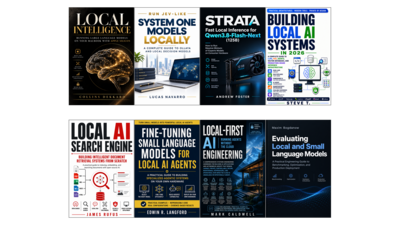
What if you could build, run and control your own AI systems without depending on the cloud? This bundle brings together 8 practical books covering everything from running LLMs on your MacBook and fine-tuning small models to building intelligent search engines, autonomous agents and production-ready local AI infrastructure. Discover how to turn your own hardware into a powerful AI workstation, keep your data private and take full control of your AI development workflow.
Bought separately
$270
Minimum price
$149
$169
About the Bundle
Take control of your AI stack with this comprehensive collection of 8 practical books on local AI engineering. Whether you're just getting started with running language models on your own hardware or looking to build production-ready AI systems, this bundle covers the tools, techniques and infrastructure you need to make it happen.
Learn how to run powerful open-source models without relying on cloud APIs, build intelligent applications with private data and deploy AI agents that operate entirely on your own machines. Each book focuses on real-world implementation, with practical examples, working code and engineering insights you can put to use immediately.
Here's what you'll discover inside:
This collection is ideal for software developers, AI engineers, ML practitioners, researchers, systems engineers and advanced hobbyists who want to build AI systems they fully control.
Whether your goal is to reduce API costs, protect sensitive data, fine-tune specialized models or deploy autonomous agents on consumer hardware, these books provide a practical foundation for getting there.
Build smarter. Run locally. Stay in control.
About the Books

This book is a complete, practical guide to running large language models entirely on your own Mac. If you have an M1, M2, or M3 MacBook and want to deploy open-source LLMs locally for privacy, cost savings, or independence from cloud APIs, this book takes you from zero to mastery. You will learn the hardware architecture that makes Apple Silicon uniquely suited for this work, master every major inference framework (llama.cpp, Ollama, MLX, and Hugging Face Transformers), understand quantization strategies that fit billion-parameter models into your unified memory, and build real applications with local AI. Every technique described is fully open-source, reproducible on macOS, and grounded in real benchmarks and working code.

This book teaches you how to run decision models, a distinct class of AI systems optimized for fast, structured judgments, entirely on your own hardware using the open-source Ollaya project. You will learn what Jev-style decision models are, how they differ from conventional large language models, and why that difference matters for building reliable software. From installation to production deployment, this guide walks you through installing Ollaya, pulling models, defining typed questions, calling the API from Python and JavaScript, integrating with AI agents via MCP, designing decision schemas that work in the real world, measuring performance, and operating a local decision service at scale. By the end, you will be able to take a problem that currently uses an LLM, cost money, and leaks data to the cloud, and replace it with a local model that answers in milliseconds with typed outputs your code can act on directly.

Strata is a purpose-built inference runtime that makes it possible to run the 125B-parameter Qwen3.8-Flash-Next model at interactive speed on a single gaming GPU with as little as 12 GB of VRAM. This book explains exactly how it works, why it works and how to make it work for you. You will learn the architecture of Qwen3.8-Flash-Next, the mechanics of extreme mixture-of-experts sparsity, the three-tier memory hierarchy that distributes the model across VRAM, system RAM and NVMe storage, the CPU/GPU heterogeneous execution model, the pipelined PCIe transfers that hide latency, the speculative decoding that multiplies throughput and the practical details of installation, configuration, performance tuning and troubleshooting. If you are an engineer, ML practitioner, or advanced hobbyist who wants to understand and deploy Strata locally, this book is your guide.

This book is a complete guide to building, deploying, and optimizing local large language model infrastructure for software development workflows. It covers everything from selecting the right GPU and assembling the workstation through serving quantized models, building RAG pipelines with vector databases, creating agentic coding assistants, and integrating local inference with Claude Code. Written for developers, researchers, and AI engineers who want full control over their AI stack. This is the practical reference you need to go from zero to a production-ready local AI development system.

This book teaches you how to build a complete, production-grade local search engine that indexes diverse document types, performs hybrid keyword and semantic retrieval, powers retrieval-augmented generation with local language models, and runs entirely on your own hardware. You will move from a minimal working prototype to a feature-rich system with OCR, multimodal embeddings, incremental indexing, caching, security, and crossplatform deployment. Every code example is complete, runnable Python built on current stable releases of open-source libraries including FastAPI, FAISS, Qdrant, Chroma, sentence-transformers, Ollama, and more.

This book teaches software engineers and ML practitioners how to select, fine-tune, evaluate, and deploy small language models as capable local AI agents. You will learn the foundations of transformer architectures and tokenization, master supervised fine-tuning and parameter-efficient methods like LoRA and QLoRA, build agentic capabilities for tool use and structured output, and ship production-ready systems on consumer hardware. Every chapter includes reproducible code, concrete configurations, and evidence-based comparisons so you can move from an unmodified base model to a specialized agent running entirely on your own machine.

A comprehensive systems-engineering handbook for building AI applications and autonomous agents that remain capable, private, controllable, secure, maintainable, reproducible, and operational even when the cloud is unavailable or intentionally absent. This book takes you from hardware selection through Linux configuration, inference optimization, RAG pipelines, agent architecture, security hardening, reliability engineering, and production operations with a complete reference implementation that evolves across every chapter. Designed for software engineers, AI/ML engineers, systems engineers, platform engineers, DevOps/SRE practitioners, security engineers, researchers, technical architects, and advanced developers who need to build real local-first AI systems they own end-to-end.

This book teaches engineers how to build reliable evaluation systems for small and locally deployed language models. You will learn to measure performance accurately, compare models across hardware and runtimes, interpret results without being misled by benchmarks, and make evidence-based deployment decisions for real-world workloads. The guide combines rigorous experimental methodology with example code so you can independently establish an evaluation laboratory and produce trustworthy, reproducible results.
Within 60 days of purchase you can get a 100% refund on any Leanpub purchase, in two clicks.
See full terms...
We pay 80% royalties on purchases of $7.99 or more, and 80% royalties minus a 50 cent flat fee on purchases between $0.99 and $7.98. You earn $8 on a $10 sale, and $16 on a $20 sale. So, if we sell 5000 non-refunded copies of your book for $20, you'll earn $80,000.
(Yes, some authors have already earned much more than that on Leanpub.)
Learn more about writing on Leanpub
If you buy a Leanpub book, you get free updates for as long as the author updates the book! Many authors use Leanpub to publish their books in-progress, while they are writing them. All readers get free updates, regardless of when they bought the book or how much they paid (including free).
Most Leanpub books are available in PDF (for computers) and EPUB (for phones, tablets and Kindle). The formats that a book includes are shown at the top right corner of this page.
Finally, Leanpub books don't have any DRM copy-protection nonsense, so you can easily read them on any supported device.
Learn more about Leanpub's ebook formats and where to read them
You can use Leanpub to easily write, publish and sell in-progress and completed ebooks and online courses!
Leanpub is a powerful platform for serious authors, combining a simple, elegant writing and publishing workflow with a store focused on selling in-progress ebooks.
Leanpub is a magical typewriter for authors: just write in plain text, and to publish your ebook, just click a button. (Or, if you are producing your ebook your own way, you can even upload your own PDF and/or EPUB files and then publish with one click!) It really is that easy.