
The Leanpub 60 Day 100% Happiness Guarantee
Within 60 days of purchase you can get a 100% refund on any Leanpub purchase, in two clicks.
See full terms...
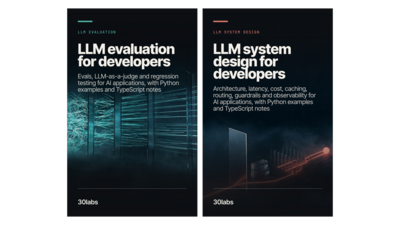
Know whether your LLM feature works, then build the system around it that you'd trust in production. Evaluation and system design for developers, with Python examples run before publication.
Bought separately
$39.98
Minimum price
$19.99
$29.99
About the Bundle
Two guides for developers who ship features built on language models, from the same series and written to be read together.
LLM evaluation for developers shows how to know whether an LLM feature works: read traces, build a golden set, decide what a code check, an LLM judge or a person should grade, calibrate the judge against people, tell a real improvement from noise on a small set, and turn it all into regression gates in CI.
LLM system design for developers takes a feature that works on your laptop to a system you'd trust in production: latency and token budgets, caching, retries and fallbacks, routing to cheaper models, structured output as a contract, guardrails, prompt injection, observability and the hosted-or-self-hosted question.
Both books close every chapter with a decision you could make on Monday and end with the interview questions AI engineering roles ask. Examples are in Python, each one run before publication, with TypeScript notes.
About the Books

The demo went well. What nobody can say yet is whether the feature works for the people using it, or whether it will still work after the next prompt tweak, model swap or change to retrieval.
The book starts from what you already have, unit tests and CI, and shows where they stop helping once a model sits behind the code. From there it works through evaluation on one system. You read traces and name the failures that actually matter, then build a golden set from them. You decide which checks belong in code, which need an LLM judge and which need a person. You design a judge and calibrate it against human labels. A chapter on statistics shows how to tell a real improvement from noise when the set is small. Retrieval is evaluated apart from generation, tool calls and agents get their own chapter, and it all ends up as regression gates in CI, with sampled production traffic and a look at what the whole thing costs.
Every chapter ends with a decision you could make on Monday. The final chapter takes the evaluation questions AI engineering interviewers ask and answers them starting from the trade-off.
Examples are in Python, each one run before publication, with a note wherever TypeScript does the job differently. Claims about papers, libraries and techniques are checked against the primary source. It's about evaluating products built on language models, not training them. You need to be able to program. You don't need machine learning or statistics.

Your LLM feature works on your laptop. Then real traffic shows up, the provider has a bad afternoon, the bill doubles, and someone pastes a prompt that talks your agent into touching things it shouldn't.
That gap, between a call that works and a system you'd trust in production, is what this book is about. It follows one assistant as it grows from a single team to a whole company, and each chapter fixes the next thing that breaks. You'll estimate load on the back of an envelope, budget latency and tokens, decide what's worth caching, add retries and fallbacks that don't make an outage worse, send easy requests to cheaper models, and treat structured output and tool calls as contracts. Later chapters put limits around agents, design against prompt injection instead of filtering for it, trace cost per feature, and wire evaluation into releases. Then comes the old question: hosted API, or run the model yourself?
Every chapter closes with a decision you could make on Monday, backed by measurement rather than defaults. The last chapter takes the system design questions AI engineering interviews tend to ask and answers them from the trade-offs.
The examples are in Python, and each one was run before publication. Where TypeScript does the job differently, there's a note. Claims about papers and libraries are checked against the original source. You should be at home writing code and know how a web service works. No machine learning background needed.
Within 60 days of purchase you can get a 100% refund on any Leanpub purchase, in two clicks.
See full terms...
We pay 80% royalties on purchases of $7.99 or more, and 80% royalties minus a 50 cent flat fee on purchases between $0.99 and $7.98. You earn $8 on a $10 sale, and $16 on a $20 sale. So, if we sell 5000 non-refunded copies of your book for $20, you'll earn $80,000.
(Yes, some authors have already earned much more than that on Leanpub.)
Learn more about writing on Leanpub
If you buy a Leanpub book, you get free updates for as long as the author updates the book! Many authors use Leanpub to publish their books in-progress, while they are writing them. All readers get free updates, regardless of when they bought the book or how much they paid (including free).
Most Leanpub books are available in PDF (for computers) and EPUB (for phones, tablets and Kindle). The formats that a book includes are shown at the top right corner of this page.
Finally, Leanpub books don't have any DRM copy-protection nonsense, so you can easily read them on any supported device.
Learn more about Leanpub's ebook formats and where to read them
You can use Leanpub to easily write, publish and sell in-progress and completed ebooks and online courses!
Leanpub is a powerful platform for serious authors, combining a simple, elegant writing and publishing workflow with a store focused on selling in-progress ebooks.
Leanpub is a magical typewriter for authors: just write in plain text, and to publish your ebook, just click a button. (Or, if you are producing your ebook your own way, you can even upload your own PDF and/or EPUB files and then publish with one click!) It really is that easy.