
The Leanpub 60 Day 100% Happiness Guarantee
Within 60 days of purchase you can get a 100% refund on any Leanpub purchase, in two clicks.
See full terms...
What is intelligence?
At its core, intelligence is the ability to acquire, compress, transform, communicate, and generate information.
The Information Theory and Artificial Intelligence Complete Series explores the mathematical foundations that power modern machine learning, deep learning, generative AI, reinforcement learning, and large language models.
Inside this two-volume series, you'll discover:
✓ Shannon Entropy and Information Measures
✓ Mutual Information and Representation Learning
✓ Cross-Entropy and KL Divergence
✓ Data Compression and Coding Theory
✓ Information Bottleneck Theory
✓ Variational Autoencoders (VAEs)
✓ Contrastive and Self-Supervised Learning
✓ Generative Adversarial Networks (GANs)
✓ Entropy-Driven Reinforcement Learning
✓ Fisher Information and Information Geometry
✓ Information Theory Behind Transformers and LLMs
✓ Federated Learning and Distributed Intelligence
✓ Explainable AI Through Entropy
✓ Quantum Information Theory
✓ AI Fairness, Safety, Alignment, and Future Research
Whether you are learning information theory for the first time or exploring the mathematical foundations of advanced AI systems, this bundle provides the tools, theory, and insights needed to understand how information becomes intelligence.
Learn not just how AI works—but why it works.
Bought separately
$39.98
$29.00
About the Bundle
Artificial Intelligence is fundamentally a science of information.
Every intelligent system—whether a neural network, reinforcement learning agent, large language model, generative model, or autonomous decision-making system—learns by acquiring, compressing, transforming, transmitting, and generating information.
Yet, despite the central role information plays in modern AI, information theory and artificial intelligence are often taught as separate disciplines.
The Information Theory and Artificial Intelligence Complete Series (Volume I & Volume II) bridges this gap by providing a unified and comprehensive exploration of the mathematical principles that govern intelligent systems.
This two-volume series takes readers on a journey from the foundational concepts introduced by Claude Shannon to the cutting-edge information-theoretic frameworks driving today's most advanced AI technologies.
The first volume establishes the mathematical foundations required to understand how information is measured, encoded, compressed, transmitted, and utilized by intelligent systems.
Readers will explore:
✓ Shannon Entropy and Information Measures
✓ Conditional Entropy and Mutual Information
✓ Cross-Entropy and KL Divergence
✓ Source Coding and Data Compression
✓ Huffman, Arithmetic, and Lempel–Ziv Coding
✓ Channel Capacity and Communication Limits
✓ Information-Theoretic Learning Principles
✓ Minimum Description Length (MDL)
✓ Information Bottleneck Theory
✓ Entropy-Based Regularization
✓ Neural Networks as Information Processing Systems
✓ Error-Correcting Codes and AI Robustness
✓ Neural Communication Systems
✓ Variational Inference and Variational Autoencoders (VAEs)
Volume I provides the theoretical framework necessary to understand why modern machine learning systems work and how information drives learning, compression, representation, and generalization.
Building upon the foundations of Volume I, the second volume explores the advanced frontier where information theory intersects with deep learning, generative AI, reinforcement learning, explainable AI, and large-scale intelligent systems.
Readers will discover:
✓ Contrastive Learning and Representation Learning
✓ InfoNCE Loss and Mutual Information Estimation
✓ Self-Supervised Learning Architectures
✓ Generative Adversarial Networks (GANs)
✓ Wasserstein GANs and InfoGAN
✓ Entropy-Based Reinforcement Learning
✓ Soft Actor-Critic Frameworks
✓ Fisher Information and Natural Gradients
✓ Information Geometry for Deep Learning
✓ Information Theory Behind Large Language Models
✓ Token Entropy and Perplexity
✓ Transformer Information Routing
✓ Federated Learning Communication Constraints
✓ Explainable AI Through Entropy and Mutual Information
✓ Quantum Information Theory for AI
✓ Information Bottleneck Theory
✓ AI Fairness, Safety, Alignment, and Future Research Challenges
Volume II reveals how information flows through modern AI systems and explains the mathematical foundations behind representation learning, generative modeling, optimization, communication, and intelligence.
Unlike traditional textbooks that treat information theory, machine learning, deep learning, and generative AI as separate subjects, this bundle presents them as interconnected components of a single scientific framework.
Readers will gain insights into:
• Why entropy appears in almost every modern AI loss function
• How neural networks function as information compression systems
• Why GANs, VAEs, and Transformers rely on divergence minimization
• How large language models process and route information
• Why information bottlenecks explain representation learning
• How communication constraints shape federated AI systems
• How information theory contributes to explainability, fairness, safety, and alignment
This series is ideal for:
• Undergraduate and Postgraduate Students
• AI and Machine Learning Researchers
• Data Scientists and Engineers
• Deep Learning Practitioners
• NLP and LLM Researchers
• Generative AI Developers
• Communication and Information Theory Researchers
• Faculty Members and Educators
• Industry Professionals working with AI Systems
• UGC-NET, GATE, PhD and Research Scholars
By completing this bundle, readers will be able to:
✓ Understand entropy, mutual information, coding, and communication theory.
✓ Analyze machine learning algorithms through an information-theoretic lens.
✓ Understand representation learning and self-supervised AI.
✓ Explain the mathematical foundations of GANs, VAEs, and LLMs.
✓ Apply information bottleneck principles to deep learning.
✓ Understand communication-efficient federated learning.
✓ Explore explainable AI using entropy and mutual information.
✓ Analyze AI fairness, safety, and alignment through information constraints.
✓ Understand future directions in quantum information and intelligent systems.
From Shannon’s groundbreaking theory of communication to today's large language models, generative AI systems, and future intelligent agents, information remains the fundamental currency of intelligence.
This bundle provides the mathematical rigor, conceptual clarity, and practical insight necessary to understand not only how artificial intelligence works—but why it works.
Whether you are a student, researcher, educator, or AI professional, this series offers a comprehensive roadmap to mastering the science of information and intellige
About the Books

Artificial Intelligence is fundamentally a science of information. Every machine learning model, neural network, reinforcement learning agent, and generative system operates by acquiring, compressing, transforming, transmitting, and generating information. Yet the mathematical principles governing these processes are often studied separately from modern AI.
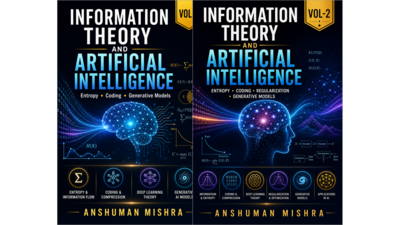
Information Theory and Artificial Intelligence: Entropy, Coding, Regularization, and Generative Models (Volume I) bridges this gap by presenting a unified framework that connects classical information theory with contemporary artificial intelligence and machine learning.
Beginning with the foundational concepts introduced by Claude Shannon, the book develops a deep understanding of entropy, uncertainty, information measures, coding theory, communication limits, and probabilistic reasoning. These concepts are then linked directly to modern AI systems, revealing how information-theoretic principles shape learning algorithms, neural networks, optimization methods, regularization techniques, representation learning, and generative models.
Readers will explore Shannon entropy, conditional entropy, mutual information, cross-entropy, KL divergence, source coding, data compression, channel capacity, information bottlenecks, entropy-based loss functions, coding theory, adversarial robustness, neural communication systems, and variational inference. The book demonstrates how these concepts influence model generalization, learning efficiency, representation quality, and AI system reliability.
Unlike traditional textbooks that treat information theory and AI as independent disciplines, this volume presents them as interconnected components of a single scientific framework. The result is a deeper understanding of why machine learning systems work, how they process information, and how future intelligent systems may evolve.
Designed for students, researchers, educators, and industry professionals, the book combines mathematical foundations with practical AI applications, making complex concepts accessible without sacrificing academic rigor.
• Comprehensive introduction to information theory for AI and machine learning
• Detailed coverage of entropy, mutual information, KL divergence, and coding theory
• Information-theoretic interpretation of neural networks and deep learning
• Entropy-based loss functions and regularization techniques
• Information Bottleneck and Minimum Description Length principles
• Source coding, data compression, and communication theory for AI systems
• Coding theory and neural approaches to error correction
• Variational inference and Variational Autoencoders (VAEs)
• AI applications in communication systems, federated learning, and distributed intelligence
• Mathematical rigor combined with practical relevance
This volume establishes the theoretical foundation required for understanding advanced topics explored in Volume II, including representation learning, GANs, reinforcement learning, large language models, information geometry, explainable AI, federated intelligence, and quantum information theory.

Artificial Intelligence is ultimately a science of information transformation. As AI systems become increasingly capable, their success depends not only on computational power and data availability but also on how efficiently they represent, compress, transmit, optimize, and generate information.
Information Theory and Artificial Intelligence: Entropy, Coding, Regularization, and Generative Models (Volume II) extends the foundations established in Volume I and explores the advanced frontiers where information theory intersects with modern machine learning, generative AI, reinforcement learning, large language models, distributed intelligence, explainable AI, and quantum computing.
This volume examines how information flows through deep neural networks, how representation learning extracts meaningful patterns from data, and how modern self-supervised learning techniques leverage mutual information to create powerful representations. Readers will gain a deep understanding of contrastive learning, InfoNCE loss, self-supervised architectures, and information-driven feature learning.
A major focus of the book is the information-theoretic foundation of Generative Adversarial Networks (GANs). The text explores Jensen–Shannon divergence, Wasserstein distance, mutual information maximization, entropy-based regularization, mode collapse, and stability challenges in generative modeling. Readers will learn why information flow governs the success and limitations of modern generative AI systems.
The book also investigates how information theory shapes reinforcement learning, optimization algorithms, large language models, federated learning systems, and distributed AI architectures. Advanced topics such as Fisher Information, Information Geometry, Information Bottleneck Theory, Explainable AI, Quantum Information Theory, and AI safety are presented in a structured and accessible manner.
Designed for advanced students, researchers, AI practitioners, and academics, this volume provides a modern theoretical framework for understanding the next generation of intelligent systems.
• Information-Theoretic Representation Learning
• Contrastive Learning and Self-Supervised AI
• Generative Adversarial Networks (GANs) and Divergence Minimization
• Information Flow in Deep Neural Networks
• Entropy-Based Reinforcement Learning
• Fisher Information and Information Geometry
• Information Theory Behind Large Language Models
• Communication-Efficient Federated Learning
• Explainable AI Through Information Measures
• Quantum Information Theory for AI
• Information Bottleneck Theory for Deep Learning
• Future Research Challenges in AI Safety, Fairness, and Alignment
This volume serves as an advanced guide for understanding how information governs learning, reasoning, optimization, communication, and intelligence in modern AI systems.
Within 60 days of purchase you can get a 100% refund on any Leanpub purchase, in two clicks.
See full terms...
We pay 80% royalties on purchases of $7.99 or more, and 80% royalties minus a 50 cent flat fee on purchases between $0.99 and $7.98. You earn $8 on a $10 sale, and $16 on a $20 sale. So, if we sell 5000 non-refunded copies of your book for $20, you'll earn $80,000.
(Yes, some authors have already earned much more than that on Leanpub.)
Learn more about writing on Leanpub
If you buy a Leanpub book, you get free updates for as long as the author updates the book! Many authors use Leanpub to publish their books in-progress, while they are writing them. All readers get free updates, regardless of when they bought the book or how much they paid (including free).
Most Leanpub books are available in PDF (for computers) and EPUB (for phones, tablets and Kindle). The formats that a book includes are shown at the top right corner of this page.
Finally, Leanpub books don't have any DRM copy-protection nonsense, so you can easily read them on any supported device.
Learn more about Leanpub's ebook formats and where to read them
You can use Leanpub to easily write, publish and sell in-progress and completed ebooks and online courses!
Leanpub is a powerful platform for serious authors, combining a simple, elegant writing and publishing workflow with a store focused on selling in-progress ebooks.
Leanpub is a magical typewriter for authors: just write in plain text, and to publish your ebook, just click a button. (Or, if you are producing your ebook your own way, you can even upload your own PDF and/or EPUB files and then publish with one click!) It really is that easy.