
The Leanpub 60 Day 100% Happiness Guarantee
Within 60 days of purchase you can get a 100% refund on any Leanpub purchase, in two clicks.
See full terms...
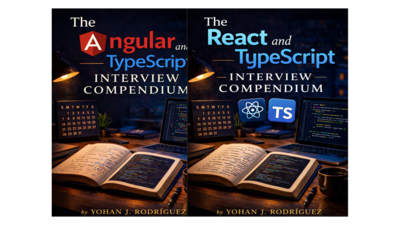
Two question-and-answer interview references for mid-level and senior frontend developers, covering modern Angular, React, and the TypeScript both depend on, with the mechanisms and trade-offs behind each answer.
Bought separately
$59.98
Minimum price
$34.99
$44.99
About the Bundle
This bundle collects two interview compendiums for the major component frameworks: The Angular and TypeScript Interview Compendium and The React and TypeScript Interview Compendium. Both are organized around the questions interviewers ask rather than a sample application, and both explain the mechanism and trade-off behind an answer so that readers can reason through a question they have not seen before.
The Angular and TypeScript Interview Compendium treats Angular and TypeScript as one discipline. Three chapters cover the TypeScript language, from narrowing and generics to runtime boundaries and tsconfig policy. The Angular material moves from components, data binding, directives, and dependency injection through RxJS, signals, state management with NgRx and signal stores, and typed forms, to HTTP, routing and guards, and frontend security. Later chapters cover change detection and performance, testing, debugging, server-side rendering and hydration, and architecture for large teams, with an emphasis on standalone components, signals, and other current patterns. More than three hundred code listings illustrate the recommended patterns.
The React and TypeScript Interview Compendium contains more than a thousand questions across fifteen chapters. It starts with the React rendering model and TypeScript for React developers, then covers components, state, effects, hooks, and forms, followed by context, routing, server state and caching, styling, performance, testing, and frontend security, deployment, and observability. It closes with senior scenarios: a method for turning a vague design prompt into a bounded answer, four capstone designs, and structured production troubleshooting. Most chapters pair a weak answer with a strong one and note what the interviewer is testing.
Together they prepare a frontend developer to explain how each framework renders and updates the screen, where TypeScript's guarantees end at runtime boundaries, who should own a piece of state and why, how routing, data fetching, and forms fit into an application's structure, and how to approach performance, testing, and security as trade-offs rather than rules. Developers who work with both frameworks, or are moving from one to the other, can compare how the same concerns are handled in each.
The bundle is written for mid-level and senior frontend developers preparing for interview loops, and for engineers who make and defend framework decisions at work. Neither book is a first tutorial; both assume hands-on experience with components and basic TypeScript. Each can be read in order as a study plan or consulted by chapter before a specific interview or design review.
About the Books

The Angular and TypeScript Interview Compendium is a question-and-answer reference for developers preparing for Angular and TypeScript interviews, and for anyone who wants to explain the modern Angular stack rather than only use it. Instead of walking through a sample application, it is organized around the questions interviewers actually ask, and each answer goes past the definition to the mechanism behind it, the tradeoff it carries, and how a strong candidate would frame it out loud.
Angular and TypeScript are treated as one discipline rather than two topics bolted together. The book opens with Angular's evolution and three chapters on the TypeScript language — fundamentals and narrowing, generics and advanced types, and runtime boundaries, modules, and tsconfig policy — and returns to the connection later with a chapter on how typed contracts shape components, forms, HTTP services, routes, and dependency injection.
Across six parts, the Angular material moves from workspace structure, components, data binding, directives, and dependency injection, through RxJS, signals, state management, and forms, to HTTP, routing and guards, and authentication and frontend security. It then turns to what keeps an application healthy in production — change detection and performance, testing, debugging and diagnostics, server-side rendering and hydration — and closes with architecture decision-making, scalable structure for large teams, and TypeScript code-reading scenarios. The emphasis is on modern Angular, including standalone components, signals, built-in control flow, functional guards and interceptors, and typed forms, with older NgModule- and RxJS-era patterns explained where they still appear in real codebases.
The reading experience is practical rather than tutorial. Every chapter ends with key takeaways, most include a section on common anti-patterns, and many include interview scenarios that describe what a strong answer covers. More than three hundred code listings illustrate recommended patterns and, in many chapters, the mistakes they replace.
Readers come away able to explain why Angular changed and how to migrate an aging codebase in stages, say where TypeScript's guarantees end, choose among component state, signals, RxJS, service state, and NgRx and defend the choice, and discuss testing, performance, security, and architecture in terms of tradeoffs rather than slogans. It is written for mid-level to senior developers who already have hands-on Angular and TypeScript experience, not as a first tutorial, and it works both as a front-to-back preparation course and as a chapter-by-chapter reference before a specific interview or design review.

React and TypeScript interviews reward precise mental models more than API trivia. Interviewers want to hear what React does when a component runs, who owns a piece of state, where a type stops protecting you, and what you would measure before you optimized anything.
The React and TypeScript Interview Compendium is a structured reference for developers who already know the basics and want sharper answers for mid-level and senior interviews. It contains more than a thousand questions across fifteen chapters, each tied to the reasoning an interviewer is listening for.
The book moves from the React rendering model and TypeScript for React developers, through components, state, effects, hooks, and forms, to context, routing, server state, styling, performance, testing, and frontend security, deployment, and observability. It closes with senior scenarios: a method for turning a vague design prompt into a bounded answer, four capstone designs, and a way to troubleshoot production problems.
Most chapters pair a weak answer with a strong one, then give each question an outline of a good answer, a note on what the interviewer is testing, and the mistake candidates most often make. Code walkthroughs, tradeoff discussions, debugging scenarios, exercises with solution sketches, and a review checklist complete each chapter.
The book teaches concepts rather than one ecosystem. It explains the underlying problem first, such as cache identity, cancellation, or scope, and treats any specific library as one way to solve it, so the reasoning still holds when your team's tools change.
Within 60 days of purchase you can get a 100% refund on any Leanpub purchase, in two clicks.
See full terms...
We pay 80% royalties on purchases of $7.99 or more, and 80% royalties minus a 50 cent flat fee on purchases between $0.99 and $7.98. You earn $8 on a $10 sale, and $16 on a $20 sale. So, if we sell 5000 non-refunded copies of your book for $20, you'll earn $80,000.
(Yes, some authors have already earned much more than that on Leanpub.)
Learn more about writing on Leanpub
If you buy a Leanpub book, you get free updates for as long as the author updates the book! Many authors use Leanpub to publish their books in-progress, while they are writing them. All readers get free updates, regardless of when they bought the book or how much they paid (including free).
Most Leanpub books are available in PDF (for computers) and EPUB (for phones, tablets and Kindle). The formats that a book includes are shown at the top right corner of this page.
Finally, Leanpub books don't have any DRM copy-protection nonsense, so you can easily read them on any supported device.
Learn more about Leanpub's ebook formats and where to read them
You can use Leanpub to easily write, publish and sell in-progress and completed ebooks and online courses!
Leanpub is a powerful platform for serious authors, combining a simple, elegant writing and publishing workflow with a store focused on selling in-progress ebooks.
Leanpub is a magical typewriter for authors: just write in plain text, and to publish your ebook, just click a button. (Or, if you are producing your ebook your own way, you can even upload your own PDF and/or EPUB files and then publish with one click!) It really is that easy.