
The Leanpub 60 Day 100% Happiness Guarantee
Within 60 days of purchase you can get a 100% refund on any Leanpub purchase, in two clicks.
See full terms...
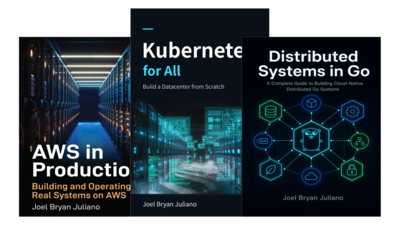
Ship and run real systems: AWS in Production, Kubernetes for All and Distributed Systems in Go.
Bought separately
$87.00
Minimum price
$39.00
$59.00
About the Bundle
Ship and run real systems: AWS in Production, Kubernetes for All and Distributed Systems in Go.
About the Books

The AWS documentation tells you how every parameter works. It does not tell you which ones matter, in what order to learn them, or what breaks first under production load. That knowledge is only earned by running these systems at scale.
This book is twenty years of that.
Joel Bryan Juliano has scaled payment platforms to ten million daily transactions, built antivirus engines processing billions of threat signals, and operated large-scale data pipelines for national tax infrastructure. Most of that work has run on AWS. Over time, he learned which services to reach for, which patterns hold under pressure, and which shortcuts come back to page you at 3am.
AWS in Production follows a single application — an order processing system — from a blank AWS account to a fully instrumented, secure, auto-scaling production deployment. Every chapter adds one layer of capability. Every pattern reflects a decision that has been made, broken, and corrected in real systems.
The book covers DNS with Route 53, serverless compute with Lambda, traffic routing with API Gateway, access control with IAM, storage with S3, messaging with SNS and SQS, DynamoDB as a primary database, JWT authentication with Cognito, secrets management, encryption with KMS, containerized workloads with ECS Fargate, and production-grade observability with CloudWatch. Advanced chapters cover Step Functions patterns used in real financial and fulfillment systems: the Saga pattern for distributed transactions, Distributed Map for bulk processing, and WaitForTaskToken for human-in-the-loop workflows.
This book does not cover everything. It covers the right things — at the depth required to operate them safely.
Want to go further? The companion course turns this book into a guided learning path with chapter quizzes, a final exam and a certificate of completion: AWS in Production: The Course

Developer experience is infrastructure. The difference between a team that ships every day and a team that dreads deployments is rarely talent. More often, it is tooling. Fast feedback loops. Immutable deployments. Self-healing clusters. Observable systems. These are not luxuries reserved for large organizations—they are the foundation of reliable software delivery.
Most Kubernetes tutorials stop at kubectl apply. By now, you probably know the commands. What is often missing is the system that ties them together: a repeatable workflow that provisions a cluster in seconds, rebuilds images with the cache you expect, reloads services without dropping connections, and tells you exactly what went wrong when something fails.
This book is about building that system.
Kubernetes for All teaches Kubernetes from the ground up by having you build a complete cloud-native platform yourself. Instead of deploying to a managed cluster and accepting the magic, you'll create your own datacenter from scratch using a single Bash script that provisions a full multi-node Kubernetes environment.
Along the way, you'll discover not just how Kubernetes works, but why it works the way it does. You'll build the cluster, deploy applications, automate operations, implement GitOps workflows, add observability with Prometheus and Grafana, and follow requests through distributed systems with OpenTelemetry. Every layer is introduced by building it yourself.
No prior Kubernetes experience is required.
You'll work with Kind, Helm, Pods, Deployments, Services, Ingress, ConfigMaps, Secrets, Persistent Volumes, StatefulSets, and the Kubernetes API. Every command is explained. Every concept is demonstrated. By the end, you'll have a production-style environment running real microservices—and the understanding needed to operate it with confidence.
This is a book about cloud-native engineering in practice.
Not slides. Not architecture diagrams disconnected from reality. Not vendor marketing.
Bash. Docker. Helm. Kind.
Real tools solving real problems, guided by five principles that appear throughout the book:
At the heart of the book is datacenter.sh, a single script that provisions and operates an entire Kubernetes environment.
By the time you're finished, that script will deploy 16 microservices, PostgreSQL, Kafka running in KRaft mode, and a web frontend. Whether the target is a local Kind cluster or a bare-metal datacenter, the deployment path remains the same. The infrastructure changes. The workflow does not.
You write every line.
You understand every decision.
You own the result.
This book is for engineers who want Kubernetes tooling they can understand, modify, and trust.
You deploy applications. You write scripts. You value systems that are version-controlled, observable, reproducible, and fast.
You want your inner development loop—change code, build, deploy, verify—to take seconds instead of minutes.
Most of all, you want to understand what is happening beneath the abstractions.
No certification is required.
Just Docker, Kind, a terminal, and the desire to build something real.
Want to go further? The companion course turns this book into a guided learning path with chapter quizzes, a final exam and a certificate of completion: Kubernetes for All: The Course

Every Go developer eventually faces the same moment: a single binary isn't enough anymore. You need multiple services. They need to authenticate, persist data, communicate, and stay running when things break. You've read the CAP theorem. You understand the fallacies of distributed computing. But at 2am, when your Kafka consumer is accumulating lag and your context deadlines are firing, theory doesn't help.
Distributed Systems in Go closes that gap. Built on the author's experience operating cloud-native distributed systems in production, it builds a complete system piece by piece — authentication, databases, message queues, gRPC, circuit breakers, distributed tracing. Every chapter teaches a pattern, then extracts it into a reusable platform SDK. By Chapter 15, you have a deployable six-service system and an SDK that makes the next service easier to build than the last.
What you'll build:
Every code example is complete and self-contained.
This is the book for the Go developer who can build a service but hasn't yet built a system. If you've copy-pasted middleware you don't fully understand, or stared at a "context deadline exceeded" error across five services with no idea where the deadline came from, this book is for you.
Want to go further? The companion course turns this book into a guided learning path with chapter quizzes, a final exam and a certificate of completion: Distributed Systems in Go: The Course
Within 60 days of purchase you can get a 100% refund on any Leanpub purchase, in two clicks.
See full terms...
We pay 80% royalties on purchases of $7.99 or more, and 80% royalties minus a 50 cent flat fee on purchases between $0.99 and $7.98. You earn $8 on a $10 sale, and $16 on a $20 sale. So, if we sell 5000 non-refunded copies of your book for $20, you'll earn $80,000.
(Yes, some authors have already earned much more than that on Leanpub.)
Learn more about writing on Leanpub
If you buy a Leanpub book, you get free updates for as long as the author updates the book! Many authors use Leanpub to publish their books in-progress, while they are writing them. All readers get free updates, regardless of when they bought the book or how much they paid (including free).
Most Leanpub books are available in PDF (for computers) and EPUB (for phones, tablets and Kindle). The formats that a book includes are shown at the top right corner of this page.
Finally, Leanpub books don't have any DRM copy-protection nonsense, so you can easily read them on any supported device.
Learn more about Leanpub's ebook formats and where to read them
You can use Leanpub to easily write, publish and sell in-progress and completed ebooks and online courses!
Leanpub is a powerful platform for serious authors, combining a simple, elegant writing and publishing workflow with a store focused on selling in-progress ebooks.
Leanpub is a magical typewriter for authors: just write in plain text, and to publish your ebook, just click a button. (Or, if you are producing your ebook your own way, you can even upload your own PDF and/or EPUB files and then publish with one click!) It really is that easy.