
The Leanpub 60 Day 100% Happiness Guarantee
Within 60 days of purchase you can get a 100% refund on any Leanpub purchase, in two clicks.
See full terms...
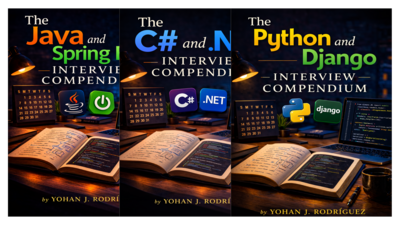
Three question-and-answer interview references for backend developers working in Java and Spring Boot, C# and .NET, and Python and Django, each explaining the mechanisms and trade-offs behind its answers.
Bought separately
$89.97
Minimum price
$49.99
$64.99
About the Bundle
This bundle collects three interview compendiums for the major backend platforms: The Java and Spring Boot Interview Compendium, The C# and .NET Interview Compendium – Second Edition, and The Python and Django Interview Compendium. Each is a structured question-and-answer reference that goes past definitions to the mechanisms and trade-offs an interviewer is likely to probe, with code listings alongside the answers.
The Java and Spring Boot Interview Compendium contains more than five hundred questions across fifteen chapters, roughly two-thirds Java and one-third Spring. The Java chapters cover language evolution from Java 8 to 21, collections, generics and streams, concurrency and the Java Memory Model, JVM internals and performance tuning, and design patterns. The Spring chapters cover the IoC container, Spring Boot and REST APIs, JPA and Hibernate, testing, security, and deployment.
The C# and .NET Interview Compendium – Second Edition spans fifteen chapters. It starts with .NET platform history and C# 14 / .NET 10 language features, then covers data structures and algorithms, object-oriented design and a 23-pattern catalog, memory management and performance, SQL Server and ORMs, and CLR internals. Later chapters cover distributed system design, concurrency, testing, ASP.NET Core Web APIs, Azure, and application security. Major sections are paired with runnable code examples.
The Python and Django Interview Compendium contains more than two hundred questions across fifteen chapters, split roughly evenly between Python and Django. The Python chapters cover the runtime and data model, functions and decorators, generators, typing and testing, and concurrency with threads, processes, and asyncio. The Django chapters cover the ORM and migrations, views and the admin, Django REST Framework, security, caching and scaling, and deployment and production troubleshooting.
Together they let a backend developer prepare for interview loops on more than one stack, and see how the same concerns, including concurrency, persistence, API design, testing, security, and deployment, are handled on the JVM, on .NET, and in Python. Each book can be read in order as a study plan or consulted by topic before an interview. They are written for working mid-level and senior developers, not as first tutorials.
About the Books

The Java and Spring Boot Interview Compendium is a question-and-answer reference for backend developers preparing for Java and Spring Boot interviews, and for anyone who wants to explain the platform rather than only use it. It contains more than five hundred questions across fifteen chapters, and each answer goes past the definition to the mechanism behind it and the trade-off it carries, so that readers can reason about a question they have not seen before instead of reciting a memorized reply. Almost every answer is paired with a Java code listing.
The material is roughly two-thirds Java and one-third Spring. It begins with how the language evolved from Java 8 to Java 21, then works through fundamentals and object-oriented programming, collections and data structures, generics, lambdas, and streams, exception handling and annotations, concurrency, JVM internals and performance tuning, design patterns, and object-oriented design. The second half turns to Spring: the IoC container, dependency injection, and proxies; Spring Boot and REST APIs; persistence with JPA and Hibernate; testing with JUnit 5, Mockito, and Spring Boot test slices; and Spring Security, architecture, and deployment. The two halves are connected throughout, so the Spring chapters keep returning to the Java mechanisms they are built on.
The book is practical rather than tutorial. In the Java chapters the listings are, with few exceptions, complete programs with their own main method, and in the Spring chapters they are focused excerpts written against the real Spring, JPA, JUnit, and Spring Security APIs. Chapters mix core concepts with production scenarios such as diagnosing a memory or CPU problem, migrating a Java 8 and Spring Boot 2 service to Java 21 and Spring Boot 3, designing idempotent APIs, and deploying without downtime, and nearly every chapter ends with a section of coding challenges. Along the way the book builds a hash map, an LRU cache, a rate limiter, a connection pool, and a circuit breaker by hand.
Readers come away able to explain how equality, immutability, generics, the Java Memory Model, and garbage collection actually behave, to choose between collections and concurrency tools and state what each choice costs, and to use thread dumps, heap dumps, and GC logs to narrow down a problem. On the Spring side they should be able to describe what the container, its proxies, and auto-configuration do on their behalf, design REST APIs and persistence layers with pitfalls such as N+1 queries and lost updates in view, test at the right level, and discuss security, architecture, resilience, and deployment in terms of trade-offs.
It is written for developers who already work in Java, from mid-level engineers preparing for senior interview loops to Spring developers refreshing the platform beneath the framework, and it is not a first tutorial. The chapters can be read in order or consulted by topic, which makes the book useful both as a study plan and as a reference before a technical interview.

**The C# and .NET Interview Compendium – Second Edition** is a large, structured question-and-answer reference built specifically for technical interview preparation in the C# and .NET ecosystem. Rather than teaching the language from scratch, it assumes working professional familiarity with C# and organizes the knowledge an interviewer is likely to probe — from language mechanics through system design — into clear, direct answers that explain not just *what* something is, but *why* it works that way and what the alternatives cost.
The book progresses deliberately across fifteen chapters rather than presenting an unordered topic list. It opens with the evolution of the .NET platform itself, current through .NET 10 and C# 14, and C# language fundamentals in depth. It then builds through the core computer-science material most interviews treat as a baseline — data structures (arrays through graphs, with real traversal and shortest-path algorithms) and algorithms (sorting, searching, and dynamic programming worked in full) — before moving into object-oriented design, SOLID principles, clean-code practice, and a complete catalog of 23 classic design patterns with working C# implementations. The remaining chapters address production-level concerns: memory management and performance, SQL Server/T-SQL and ORM usage, C# and CLR internals, distributed system design and architecture, concurrency and multithreading, testing and test automation, building and securing Web APIs in ASP.NET Core, deploying and operating on Azure, and defending an application against common security vulnerabilities.
Readers should expect a genuinely wide skill-level range within one book: some material revisits fundamentals precisely enough to be useful to a developer who has never had to explain *how* a `Dictionary` works internally, while other sections — advanced graph algorithms, distributed system design, Azure architecture — sit comfortably at senior or staff level. This breadth is intentional: the compendium is meant to serve as one reference across an entire interview-preparation journey, not a single difficulty band. Every major section pairs its explanation with a runnable code example, so the material can be read alongside real code rather than as abstract prose.
The compendium works both as a sequential preparation course and as a standing reference. Read front to back, it functions as a structured, multi-week study path. Used topic by topic, each chapter stands independently, so a reader with an interview focused on system design, Web API security, or a specific data-structure topic can go directly to the relevant chapter. This dual use — study guide and lookup reference — is the book's core practical value: it is meant to be revisited, not read once and shelved.

The Python and Django Interview Compendium is a question-and-answer reference for backend developers preparing for Python and Django interviews, and for anyone who wants to explain how the language and the framework behave rather than only use them. It contains more than two hundred questions across fifteen chapters, and each answer goes past the definition to the mechanism behind it and the trade-off it carries, so that readers can reason about a question they have not seen before instead of reciting a memorized reply. Almost every answer is paired with a code listing.
The material is split roughly evenly between the two subjects. The first eight chapters cover Python itself: its history and runtime model, fundamentals and the data model, functions, decorators, and closures, collections, iterators, and generators, object-oriented Python with dataclasses and protocols, exceptions, context managers, and packaging, typing, testing, and code quality, and concurrency with threads, processes, and asyncio. The last seven chapters cover Django: project structure and settings, models, the ORM, and migrations, views, forms, and the admin, Django REST Framework, authentication and security, caching, performance, and scaling, and deployment, observability, and production troubleshooting. The Django chapters keep returning to the Python mechanisms they are built on.
The book is practical rather than tutorial. In the Python chapters the listings are mostly self-contained scripts, and in the Django chapters they are focused excerpts, such as models, views, serializers, and settings, that assume a Django project around them. Chapters mix core concepts with scenario questions on topics such as detecting and fixing N+1 queries, running migrations safely on a live database, choosing between threads, processes, and asyncio, hardening a Django deployment, and debugging a slow request in production, and many answers end with a note on a common pitfall or a senior-level follow-up.
Readers come away able to explain how identity, mutability, hashing, closures, generators, and the GIL actually behave, to choose between concurrency models and state what each choice costs, and to write typed, tested Python. On the Django side they should be able to trace a request through middleware and views, reason about lazy QuerySets and query optimization, design REST APIs with sensible serializers, permissions, and throttling, and discuss authentication, caching, background tasks, and deployment in terms of trade-offs. The book covers Python and Django only; it does not teach other web frameworks or data-science libraries.
It is written for developers who already build with Python or Django, from mid-level engineers preparing for senior interview loops to developers moving into Django from another stack, and it is not a first tutorial. The chapters can be read in order or consulted by topic, which makes the book useful both as a study plan and as a reference before a technical interview.
Within 60 days of purchase you can get a 100% refund on any Leanpub purchase, in two clicks.
See full terms...
We pay 80% royalties on purchases of $7.99 or more, and 80% royalties minus a 50 cent flat fee on purchases between $0.99 and $7.98. You earn $8 on a $10 sale, and $16 on a $20 sale. So, if we sell 5000 non-refunded copies of your book for $20, you'll earn $80,000.
(Yes, some authors have already earned much more than that on Leanpub.)
Learn more about writing on Leanpub
If you buy a Leanpub book, you get free updates for as long as the author updates the book! Many authors use Leanpub to publish their books in-progress, while they are writing them. All readers get free updates, regardless of when they bought the book or how much they paid (including free).
Most Leanpub books are available in PDF (for computers) and EPUB (for phones, tablets and Kindle). The formats that a book includes are shown at the top right corner of this page.
Finally, Leanpub books don't have any DRM copy-protection nonsense, so you can easily read them on any supported device.
Learn more about Leanpub's ebook formats and where to read them
You can use Leanpub to easily write, publish and sell in-progress and completed ebooks and online courses!
Leanpub is a powerful platform for serious authors, combining a simple, elegant writing and publishing workflow with a store focused on selling in-progress ebooks.
Leanpub is a magical typewriter for authors: just write in plain text, and to publish your ebook, just click a button. (Or, if you are producing your ebook your own way, you can even upload your own PDF and/or EPUB files and then publish with one click!) It really is that easy.