

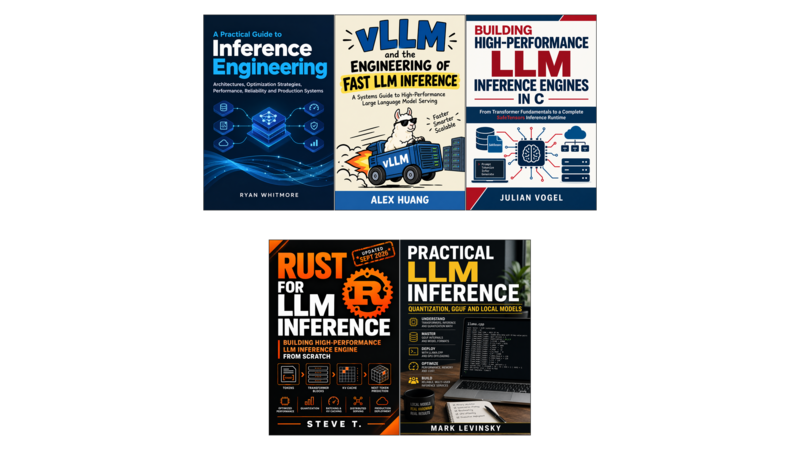

Architectures, Optimization Strategies, Performance, Reliability and Production Systems
Introduction: The Inference Problem
- The Scale of Inference Today
- Why Inference Is Hard
- Inference vs Training: Fundamental Asymmetries
- What This Book Covers (and What It Does Not)
- How to Use This Book
Chapter 1: Inference Workloads and Performance Fundamentals
- What Is an Inference Request: Structure, Inputs, Outputs, Metadata
- Latency: Definitions, Components and Why Tail Latency Matters
- Throughput and Utilization: The Tradeoff Landscape
- Request Arrival Patterns: Poisson, Bursts, Seasonality and Shock Load
- The Latency-Throughput-Cost Triangle
- Performance Metrics That Matter: p50, p95, p99, TTFT, ITL, QPS, Tokens/sec
- Capacity Planning Fundamentals: From Workload to Resource Estimates
Chapter 2: Model Serving Architectures and Patterns
- The Serving Stack: API, Runtime, Model, Hardware
- Monolithic Serving vs Microservice Serving
- Online, Nearline and Batch Serving: When to Use Each
- Stateful vs Stateless Serving Design
- Request Routing and Load Balancing Strategies
- Scaling Dimensions: Replication, Sharding, Partitioning
- API Design for Inference: Synchronous, Asynchronous, Streaming, WebSockets
Chapter 3: Computing Hardware for Inference
- Compute Paradigms: Tensor Operations, Matrix Multiplication, Sparsity
- GPUs: Architecture, Memory Hierarchy, Streaming Multiprocessors, Tensor Cores
- TPUs and ASIC Accelerators: Fixed-function vs Configurable
- CPUs for Inference: When They Make Sense, Vector Instructions, Memory
- Memory Hierarchy and Bandwidth: DRAM, HBM, SRAM, PCIe
- Interconnects: NVLink, InfiniBand, Ethernet, NUMA Effects
- Hardware Cost Models: CapEx, OpEx, Power, Cooling
Chapter 4: Model Serving Systems and Runtimes
- What a Serving System Does: Beyond “Loading a Model”
- Request Lifecycle: From HTTP to Model Execution to Response
- Model Loading, Initialization and Warmup
- Inference Engines: TorchServe, Triton, vLLM, TensorRT Serving, ONNX Runtime and Others
- Runtime Responsibilities: Memory Management, Scheduling, Optimization
- Containerization and Deployment: Docker, Kubernetes Integration
- Choosing a Serving System: Evaluation Criteria
Chapter 5: Concurrency, Batching and Scheduling
- Why Batching Works: Amortizing Overhead and Exploiting Parallelism
- Static vs Dynamic Batching: Trade-offs and Implementation
- Continuous Batching: Mechanism, Benefits and Limitations
- Queueing Theory Basics for Inference: Arrival, Service, Waiting
- Scheduling Algorithms: FIFO, Priority, Fairness, ML-Specific Scheduling
- Concurrency Control and Thread Pool Design
- Admission Control and Load Shedding Strategies
- Overlapping Computation and Communication
Chapter 6: Memory Management and KV Cache Systems
- Memory in Inference: Model Weights, Activations, KV Cache, Temporaries
- The KV Cache: Purpose, Growth, Memory Implications
- Paged Attention: How It Works, Memory Savings, Implementation
- Memory Fragmentation and Compaction
- GPU Memory Management: Allocations, Caching, Pinning
- Spilling KV Cache to Host Memory: Trade-offs
- Memory-Aware Batching and Eviction Strategies
Chapter 7: Model Optimization: Quantization
- Why Quantization Works: Redundancy in Learned Parameters
- Fixed-Point Arithmetic: Formats, Ranges, Scaling Factors
- Post-Training Quantization: PTQ Methods and Accuracy
- Quantization-Aware Training: Mechanism and When to Use It
- Per-Tensor, Per-Channel, Per-Token Quantization
- Mixed Precision Strategies
- Hardware Support and Compatibility
- Quantization Impact: Accuracy, Latency, Memory, Power
- Common Pitfalls and Debugging Quantization Issues
Chapter 8: Model Optimization: Pruning, Distillation and Compression
- Pruning: Motivation, Mechanisms and Types (Unstructured, Structured, Layer)
- Pruning Algorithms: Magnitude-Based, Gradient-Based, Iterative Methods
- Knowledge Distillation: Teacher-Student Framework, Loss Functions
- Pruning and Distillation Combined: Synergistic Benefits
- Compression Formats and Packaging
- Structured Sparsity and Hardware Acceleration
- Accuracy Trade-offs and Calibration
- When Optimization Is Worth the Effort
Chapter 9: Compilation and Graph Optimization
- Computation Graphs and Their Optimization Opportunities
- Graph Transformations: Constant Folding, Dead Code Elimination, Type Canonicalization
- Operator Fusion: Mechanism, Patterns, Performance Impact
- Memory Planning and Optimization: Allocation, Reuse, Graph Coloring
- Kernel Selection and Specialization
- Hardware-Aware Compilation: Loop Tiling, Blocking, Vectorization
- End-to-End Compilers: TVM, MLIR, XLA, TensorRT
- Compilation Time vs Inference Gain: The Trade-off
Chapter 10: Kernel-Level and Runtime Optimization
- Understanding Compute Kernels: What They Do, How They Execute
- Memory Access Patterns: Coalescing, Bank Conflicts, Cache Locality
- Cache Optimization: Register, L1, L2, Shared Memory
- Custom Kernel Development: When It Is Worth It
- CUDA and GPU-Specific Optimization Techniques
- CPU-Specific Optimizations: AVX, AMX, Loop Unrolling
- Runtime Optimizations: JIT Compilation, Caching, Warmup
- Profiling at the Kernel Level
Chapter 11: Performance Engineering Methodology
- The Performance Engineering Loop: Measure, Profile, Hypothesize, Optimize, Validate
- Establishing a Measurable Baseline
- Profiling Tools and Techniques: System, Runtime, Model, Kernel Levels
- Identifying Bottlenecks: Compute, Memory, Network, Queue
- The Roofline Model for Inference
- Benchmarking Correctly: Workload Representation, Warmup, Statistical Validity
- Avoiding Benchmark Pitfalls and Misleading Measurements
- Regression Detection and Continuous Performance Testing
- Capacity Modeling and Saturation Analysis
Chapter 12: Distributed Inference and Parallelism Strategies
- Why Distribute Inference: Memory, Throughput, Latency Requirements
- Data Parallelism for Inference: Replicated Models, Load Distribution
- Tensor Parallelism: Mechanism, Communication Patterns, Use Cases
- Pipeline Parallelism: Stages, Bubbles, Throughput Implications
- Hybrid Parallelism: Combining Strategies
- Distributed Communication: All-Reduce, All-Gather, Point-to-Point
- Fault Tolerance in Distributed Inference
- Scaling Laws for Inference: Where Scaling Stops Helping
- When Distributed Inference Is Overkill
Chapter 13: LLM Inference: Prefill, Decode and Beyond
- Autoregressive Generation: Mechanics and Asymmetry
- Prefill and Decode: Two Distinct Workloads
- Attention Complexity: Quadratic Scaling and Its Consequences
- Efficient Attention Mechanisms: FlashAttention, Linear Attention, Sparse Attention
- Speculative Decoding: How It Works, Speedup Analysis, Error Handling
- Long-Context Inference: Challenges, Strategies, Trade-offs
- Multi-Turn Conversations and Session Management
- LLM-Specific Metrics and Monitoring
Chapter 14: Advanced LLM Optimization Techniques
- Prefix and Prompt Caching: Mechanism, Hit Rates, Memory Costs
- Chunked Prefill: Balancing Latency and Throughput
- Early Exit: Confidence-Based Premature Termination
- Layer Skipping and Adaptive Computation
- Request-Level Optimization: Priority, Slicing, Merging
- Context Window Optimization: Summarization, Retrieval, Sliding Window
- Tokenization Efficiency and Vocabulary Trade-offs
- Multi-Model Systems: Routing, Cascading, Speculative Hierarchies
Chapter 15: Inference for Different Workload Classes
- Computer Vision Inference: Image Models, Batching Patterns, Hardware Fit
- Speech and Audio Inference: Streaming, Chunking, Real-Time Constraints
- Recommendation and Ranking: Scale, Low Latency, Batch Scoring
- Embedding Inference: High Throughput, Dimensionality, Caching
- Multimodal Inference: Composed Workflows, Asynchronous Stages
- Conventional ML: Trees, Linear Models, XGBoost, LightGBM
- Generalizable Principles vs Workload-Specific Techniques
- Polyglot Inference Platforms
Chapter 16: Production Operations: Observability, SLOs and Reliability
- Defining SLOs and SLIs for Inference: Latency, Availability, Quality
- Metrics That Matter: What to Collect and Why
- Logging for Inference: Request-Level Observability
- Distributed Tracing for Inference Systems
- Alerting: Signal vs Noise, Smart Alerting Policies
- Health Checks and Self-Diagnostics
- Fault Isolation and Blast Radius Control
- Graceful Degradation Strategies
- Incident Response for Inference Systems
Chapter 17: Deployment, Lifecycle Management and Versioning
- Model Versioning and Identification
- Deployment Strategies: Rolling, Blue-Green, Canary
- A/B Testing and Shadow Deployment for Models
- Rollback and Rapid Recovery
- Model Registry and Lifecycle Tracking
- Configuration Management for Inference
- Automated Testing: Functional, Performance, Drift
- Security: Authentication, Authorization, Isolation, Data Protection
- Abuse Prevention and Rate Limiting
Chapter 18: Cost and Infrastructure Efficiency
- Cost Drivers in Inference: Hardware, Memory, Compute, Network, Energy
- Cloud vs On-Prem vs Hybrid: Cost and Control Trade-offs
- Instance Selection and Right-Sizing
- Autoscaling Policies: Metrics, Thresholds, Hysteresis
- Reserved, Spot and On-Demand Capacity Strategies
- Utilization Optimization: Packing, Sharing, Overcommitting
- Inference Cost Modeling: Per-Request, Per-Token, Per-User
- Energy Efficiency and Environmental Considerations
- Total Cost of Ownership: Beyond Infrastructure Bills
- Quality-Cost Trade-offs: When to Spend More for Better Performance
Chapter 19: End-to-End System Design: Realistic Scenarios
- Design Process: From Requirements to Architecture
- Scenario 1: High-Traffic Chat API with Strict Latency SLOs
- Scenario 2: Batch Embedding Pipeline for Search Indexing
- Scenario 3: Real-Time Recommendation System at Scale
- Scenario 4: Multi-Model Platform Serving Heterogeneous Workloads
- Capacity Estimation Walkthrough: Step by Step
- Hardware Selection Framework
- Optimization Strategy Selection Decision Tree
- Monitoring and Continuous Improvement
- Common Architectural Anti-Patterns and How to Avoid Them
Conclusion: Principles, Patterns and the Future
- Enduring Principles of Inference Engineering
- Patterns That Recur Across Systems
- Emerging Trends: New Hardware, New Models, New Techniques
- What to Learn Next
- The Future of Inference: Speculation Grounded in Evidence