

- Character Quick Links
- Setting Up
- Setting up Chinese Input on Apple computers
- setting-up-chinese-input-on-windows
- Setting up Chinese input on an iOS device (Apple Smartphone or tablet
- setting-up-chinese-input-on-an-android-device
- Beginner Basics
- Cangjie Codes Basics for Beginners
- 24 Mnemonics
- Four Sets
- Primary Shapes
- A and B, Part 1 of the Philosophical Set
- C to G, Part 2 of the Philosophic Set
- Exercises, Philosophic Set
- H to N, Memorizing The Stroke Set Primary shapes
- Exercises, Stroke Set 1
- H to N, Memorizing The Brush Set Stroke shapes
- Exercises, Stroke Set 2
- O to R, Memorizing The Body Parts Set
- Exercises, Body Parts Set
- S to U, Memorizing The Character Form Set part 1
- Exercises, Character Forms Set 1
- V, W and Y, Memorizing The Character Form Set part 2
- Exercises, Character Forms Set 2
- Derived and Special Shapes
- Derived and special shapes a, b, c
- Exercises, Derived Shapes: a, b, c
- Derived and special shapes d, e, f (and g)
- Exercises, Derived Shapes: d, e, f, g
- Derived and special shapes h, i, j, k
- Exercises, Derived Shapes: h, i, j, k
- Derived and special shapes l, m and n
- Exercises, Derived Shapes: l, m, n
- Derived and special shapes o, p and q
- Exercises, Derived Shapes: o, p, q
- Derived and special shapes s, t, u
- Exercises, Derived Shapes: s, t, u
- Derived and special shapes v, w, y
- Exercises, Derived Shapes: v, w, y
- Noteworthy and difficult shapes (avoiding frustration)
- Difficult shapes and x
- Exercises, Difficult Shapes: x
- Codes that change
- Two element codes
- Exercises, Changeable Plus
- Overlapped shapes
- Partitionable or Not
- Leads, Bodies, Tails
- Special leads
- Tricky leads (and tails)
- Element counts, beginnings and endings
- Examples
- Exercises: non-partitionable 1
- Exercises: non-partitionable 2
- Exercises: left-right partitionable
- Exercises: top-bottom partitionable
- Exercises: wrapped partitionable
- Extraction Rule Special cases
- Simplest Last
- Splitting
- Dotted Leads
- Wrapped Finals
- Cangjie Code Reference Section (Characters with their cangjie input codes)
- a: 日
- b: 月
- c: 金
- d: 木
- e: 水
- f: 火
- g: 土
- h: 竹
- i: 戈
- j: 十
- k: 大
- l: 中
- m: 一
- n: 弓
- o: 人
- p: 心
- q: 手
- r: 口
- s: 尸
- t: 廿
- u: 山
- v: 女
- w: 田
- x: 臼
- y: 卜
- Initials Index (Index of characters sorted by initial/starting element)
- a-日: 日艮眉巴門}
- b-月: 月爫豸冖⺆冂咼骨目且皿冊
- c-金: 金八分公谷父丷
- d-木: 木來東束朿末寸夬皮韋
- e-水: 水氵又
- f-火: 火灬𤇾⺌脊光半米
- g-土: 土士
- h-竹: 竹丿𠂆氏臼几舟白向血自身甶
- i-戈: 戈广丶厶冫礻
- j-十: 十事疌古車宀穴
- k-大: 大乂㐅𠂇犭疒
- l-中: 中丨央儿片非北巾虫衤
- m-一: 一王干雨西亞开厂丆豕歹石
- n-弓: 弓亅乛⺄⺈夕久龴 子夃阝
- o-人: 人从亻丘𠂉
- p-心: 心忄勹匕七屯世
- q-手: 手扌丰耒青𡗗夫
- r-口: 口吅足叚民巳
- s-尸: 尸𠃌羽⺕匚長镸馬耳
- t-艹: 艹䒑廿龷 廾曹冓曲甘其菐
- u-山: 山凵豐
- v-女: 女𠄌彑ㄑ乡幺糸
- w-田: 田囗罒黑
- y-卜: 卜亠立言辶⺀
- Index Finals (Index of characters sorted by final/ending element)
- a-日: 日者朁旬昔音白習皆百
- b-月: 月肖青肙甫冂高而鬲甬扁侖龠朿冉禸禺巾帀帚雨內兩
- c-金: 金八貝賁貴員貞真頁黃共其兼並朮赤亦
- d-木: 木余枼喿果米禾未爭于子享也
- e-水: 水暴求又叔皮反支及叚殳夂夌夋复
- f-火: 火灬魚馬鳥不示宗小原尞京糸系累柬
- g-土: 土士圭壬王全至坐丑里童隹雚
- h-竹: 竹丿弟才牙刀分少必勿昜彡㐱參翏
- i-戈: 戈戔我丶戍瓦兔令夕令勺刃厶去厷幺虫風寸付寺吋
- j-十: 十千卑平單華卒斗早章車軍干丰幸辛耳
- k-大: 大天夭犬矢契莫夬央乂丈史犮文交攵敖敦凶因
- l-中: 中申肀丨川介斤片阝卩卬
- m-一: 一垂韭⺕堇二亞旦亘且直生氐冫羽工巠止正
- n-弓: 弓弗乛今⺄几乙亅刂利俞丁寧予了
- o-人: 人亾从夾僉曷失久欠之龰從㇏瓜兆飛豕象
- p-心: 心念忄㣺匕它尼比昆乇弋民龍
- q-手: 手扌牛聿半羊㐄舛韋
- r-口: 口吅冋周咼可奇句司回谷吉舌各台唐古石合占言
- s-尸: 尸巨乍𠃌方旁力幼丂亏乃
- t-廿: 廿廾开冊皿益盧豆立
- u-山: 山出缶凵目乚奄屯毛巴己包㔾卷儿見允兀堯元
- v-女: 女嬰婁𠄌艮良辰長𧘇衣襄鼠ㄑ亡
- w-田: 田當番畐東由囗母毋
- x-臼: 臼肅齊
- y-卜: 卜下斥非⺀冬於亠
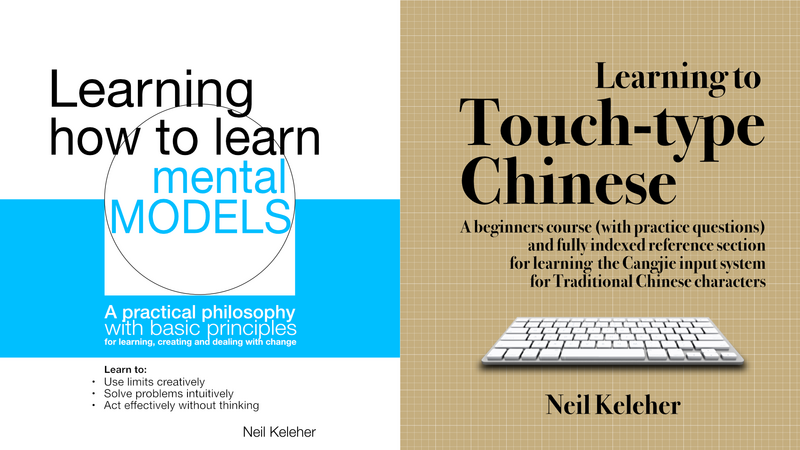
Learn to Touch Type Chinese
A beginners course (with practice questions) plus fully indexed reference section for learning the Cangjie input system for Traditional Chinese characters
Minimum price
$50.00
$70.00
You pay
Author earns
PDF
About
About the Book
Imagine being able to touch type Chinese.
Most people type Chinese characters phonetically, based on their sound. And because each sound in Chinese (in Mandarin at least) is associated with many characters, that means you have to pick the desired character from a drop down menu. You have to type, and look, and type and look.
Imagine being able to type Chinese characters without having to use drop down menus. Imagine being able to touch type Chinese characters as easily as touch typing English. Imagine having already learned how to touch type in English and then learning to touch type Chinese on top of that skill.
This book is designed for people who want to be able to touch type Chinese. It uses an input system that is free and comes preloaded on apple systems, and is free (and relatively easy to load on windows and android systems).
It assumes the ability to touch type in English, and while some basic knowledge of Chinese characters is helpful, it isn't necessary.
Perhaps the most important aspect of this book, apart from teaching you the basics of touch typing Chinese is that it provides an easy to use reference for looking up typing (or input codes for characters that you just can't figure out.
Why I learned to Touch-type Chinese
I learned to touch type Chinese a long time ago when I got tired of using a paper dictionary to look up characters. I thought I'd build my own database that I could enter characters in once I'd looked them up, so that I wouldn't have to look them up again. Instead I'd use my spreadsheet. I'm not quite sure what my thinking was, perhaps just that anything was better than having to figure out radicals or worse yet, count strokes.
To build my database, I'd lookup a character, find it's pronunciation and then use pinyin to type the character into my database. The challenge was searching through endless dropdown menus (they seem endless when you have to keep using them). This coupled with the fact that at the time the display font was quite small. I wondered if there was another way.
That way turned out to be an input method called the cangjie input method.
I found a few handy websites that helped me learn the basics of the method. However, I ran into some problems with certain characters. So while it was an improvement, there were teething problems. And that's what this text is designed to help you avoid. It, ideally, makes it easy to learn this method and provides a, hopefully, easy to use index so that you can easily lookup the codes for characters that you are having trouble typing.
Very basically, the cangjie input method requires you to break down charcters into elements. When you understand the breakdown method, and once you've memorized 24 shapes and the letters of the alphabet they are associated with, you can get touch-typing Chinese.
I already had a lot of experience with Chinese characters when I learned the method. It took me less than a day to memorize the character-letter associations, but I was fairly motivated. I've include the mnemonics that helped me.
I've also created a short but comprehensive beginners course at the beginning of this book to make it easy to learn this input system.
You'll have to do some work, but I've chunked the learning to make it easy to get this work done.
The nice thing is, with this method, you can type characters based on their shape. As a result this makes it easy to input characters, say in google translate, so that you can look them up. Sure you can use your phone.
And as a side note, I used this method as a basis for an indexing system for my own Chinese character website.
Reducing Dependencies
But if you learn this method you aren't dependent on ai or tech, at least not completely. You'll have a bit of agency. Plus it offers a tool to help break down characters so that you learn them. So if I see a character, and I haven't got my phone, I can try to remember it by breaking it down using the cangjie input codes.
Then when I do have access to my phone or computer I can type it in.
Sure there are methods where you can use brush strokes to write the character. But that means you have to write the whole character and sometimes with some characters, the system won't be able to figure out what you've written.
The cangjie method isn't always fool proof, hence this book, but you can use it to type any character with a maximum of five key strokes (plus one extra to *enter* it).
I've used it to copy Chinese characters from books and other paper sources that I've then pinyinized so that I can then practice reading them. (I like to find books that are translated from books that I like or an interested in in English.)
A quick alternative
If you aren't interested in touch typing but do want a method that you can use that doesn't rely on you knowing the vocalization of a character, there is the quick cangjie input method that just used the first and last element of a characters' cangjie code. This method is relatively easier to learn because you simply have to figure out the first and last elements of a character and their associated codes.
Why the first and last elements? Because they are the easiest to see at a glance. I've also used that idea as a way to subsort the reference section of this book. Characters are sorted alphabetically by their cangjie input codes. And then characters are subgrouped based on the final letter of their cangjie code.
Since letters don't correspond to a single shape but a range of associated shapes, I've also sub sorted characters based on the actual shapes that the character contains. Why go through all of this trouble? To make a lookup system that is easy to use, particularly when all you can figure out is the first (and possibly last) element of a character's code.
Benefits
While touch-typing Chinese is cool, is there a better reason for learning this (or any other) shape-based input system? It removes one of the biggest hinderances to learning Chinese, being able to find information on a character easily. If you can enter a character based soley on it's shape, you have agency. You can freely type characters which means you can easily look them up in electronic media.
Another more general benefit of this method is that it gives you practice in breaking things down. You start being able to see characters in terms of their structural components. These aren't necessarily meaning, or phonic based, but they are clearly recognizable. And the thing is, these elements, which relate to 24 letters of the latin alphabet, allow you to freely input any commonly used Chinese character.
The reference section in this book includes 7200 characters (characters that I've come across at some point or another in the process of building my database). Characters are grouped by their ending elements so that it is easier to get a sense of how cangjie input codes are extracted. (The rules of extraction for cangjie input codes are covered in the included Beginners Guide. But the layout of the reference section ideally makes it easier to get a handle on those rules.)
To make character lookup easier, I've included an Initial elements index. In this index characters are sorted by their first element. I've also included a Final Elements index. Here, characters are sorted by their final elements. There is also a quick index that, once you are more comfortable with the cangjie input system, can make looking up a particular character a bit easier.
The book also includes a section on how to install the cangjie input system on your computer, phone or smart device.
Bundle
Bundles that include this book
- Pricing
$75.00
Minimum priceBought separately$99.00Suggested price$85.00
Author
About the Author
Neil Keleher
Neil Keleher has lived in Taiwan for twenty years. He is the editor (creator?) of indexing-matters, a free resource to make looking up and learning Chinese characters and words easier. He's also the author of Learning how to Learn—Mental Models, a practical philosophy for learning, creativity and problem solving, and Think Clearly, Know to Flow.
The Leanpub Podcast
Podcast
Podcast Episode
Contents
Table of Contents
The Leanpub 60 Day 100% Happiness Guarantee
Within 60 days of purchase you can get a 100% refund on any Leanpub purchase, in two clicks.
See full terms...
Earn $8 on a $10 Purchase, and $16 on a $20 Purchase
We pay 80% royalties on purchases of $7.99 or more, and 80% royalties minus a 50 cent flat fee on purchases between $0.99 and $7.98. You earn $8 on a $10 sale, and $16 on a $20 sale. So, if we sell 5000 non-refunded copies of your book for $20, you'll earn $80,000.
(Yes, some authors have already earned much more than that on Leanpub.)
Learn more about writing on Leanpub
Free Updates. DRM Free.
If you buy a Leanpub book, you get free updates for as long as the author updates the book! Many authors use Leanpub to publish their books in-progress, while they are writing them. All readers get free updates, regardless of when they bought the book or how much they paid (including free).
Most Leanpub books are available in PDF (for computers) and EPUB (for phones, tablets and Kindle). The formats that a book includes are shown at the top right corner of this page.
Finally, Leanpub books don't have any DRM copy-protection nonsense, so you can easily read them on any supported device.
Learn more about Leanpub's ebook formats and where to read them
Write and Publish on Leanpub
You can use Leanpub to easily write, publish and sell in-progress and completed ebooks and online courses!
Leanpub is a powerful platform for serious authors, combining a simple, elegant writing and publishing workflow with a store focused on selling in-progress ebooks.
Leanpub is a magical typewriter for authors: just write in plain text, and to publish your ebook, just click a button. (Or, if you are producing your ebook your own way, you can even upload your own PDF and/or EPUB files and then publish with one click!) It really is that easy.