
Leanpub Header

Skip to main content

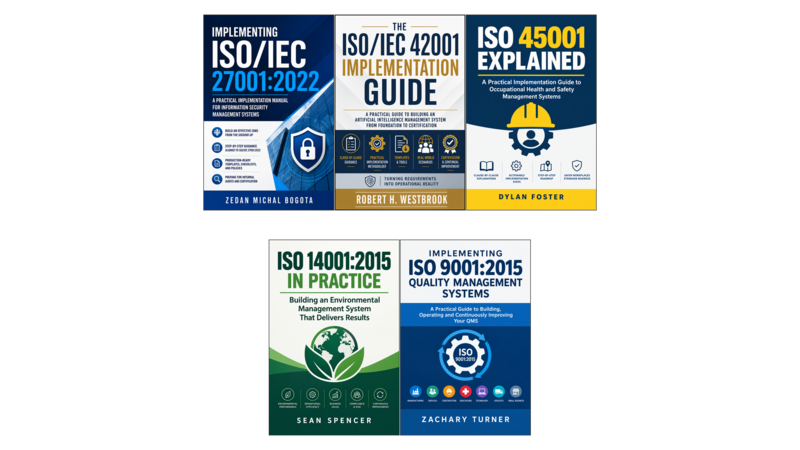
The ISO/IEC 42001 Implementation Guide

A Practical Guide to Building an Artificial Intelligence Management System from Foundation to Certification

This book is 100% completeLast updated on 2026-08-13

AI governance is moving from principle to practice. This hands-on guide shows you how to build, implement and certify an ISO/IEC 42001 AI management system with confidence. From clause-by-clause guidance to practical templates, integration strategies and real-world scenarios, it turns a complex standard into a clear path from foundation to certification.

Minimum price

$19.00

$29.00

You pay

Author earns

$

Also available for 1 book credit with a Reader Membership

PDF
EPUB
WEB
APP
331
Pages
About

About

About the Book

This book takes you from complete beginner to advanced practitioner in implementing ISO/IEC 42001, the world's first certifiable standard for AI management systems. Whether you are a governance professional building an AIMS from scratch, a compliance team extending an existing management system, or a consultant guiding clients through certification, this guide provides clause-by-clause analysis, implementation methodology, practical templates and real-world scenarios that translate requirements into operational reality. Designed to serve as both a learning resource and a hands-on reference, it covers everything from foundational concepts of responsible AI and governance through detailed requirement interpretation, phased implementation planning, integration with ISO 27001 and other frameworks, certification preparation and continual improvement strategies for mature organizations.

Author

About the Author

Steve Publications

Steve is a technology professional with more than 20 years of experience in software development, server infrastructure, cybersecurity, vulnerability research and reverse engineering. Throughout his career, he has designed, secured, analyzed and tested complex software and infrastructure, with a particular focus on understanding how systems fail and how they can be made more secure.

Outside of work, Steve enjoys sharing knowledge with the technology community. He collaborates with researchers, industry experts and technology professionals to write practical books covering software development, cybersecurity, cloud computing, networking, DevOps, artificial intelligence and enterprise technologies. His books focus on practical learning through clear explanations, real-world examples and hands-on exercises. With more than two decades of industry experience, his goal is to help IT professionals, students and technology enthusiasts build useful skills and stay current in a rapidly changing industry.

We believe readers deserve to know how our books are created. Most of our authors are not native English speakers, so we use AI to help translate, proofread manuscripts, fix grammar, improve sentence structure and make technical explanations easier to read. AI is used as an editing tool only. It does not replace the research, technical knowledge or hands-on experience behind our books. Some of our authors also prefer to remain anonymous for privacy or professional reasons. In those cases, we publish their work under a different name. The author's name may be different, but the quality of the content and our review process remain the same.

Every book is written, reviewed and maintained by experienced technology professionals, with contributions from our private technical community of more than 420 engineers and researchers. We spend far more time validating technical accuracy and keeping our content up to date than generating text. We are always interested in working with experienced professionals who have deep expertise in a particular technology or domain. If you would like to publish a book with us or help review an existing manuscript, we'd love to hear from you. Send us a message describing your area of expertise. We are especially interested in niche technologies, specialized skills and emerging topics that are underrepresented in existing technical literature.

If you look through the contents of our books, you'll see practical examples, detailed explanations and material that is regularly updated. Our goal is to publish books that professionals can actually rely on, not low-effort AI-generated content. If you ever feel that one of our books does not meet that standard, Leanpub offers a 60-day money-back guarantee. Feel free to request a refund if you are not satisfied with your purchase.

Contents

Table of Contents

A Practical Guide to Building an Artificial Intelligence Management System from Foundation to Certification

Introduction: Why Your Organization Needs an AI Management System

  1. What You Will Know After Reading This Book
  2. Who This Book Is For
  3. How This Book Is Organized
  4. How to Use This Book

Chapter 1: The Imperative for AI Governance

  1. Why AI Governance Matters Now
  2. From Ad Hoc Controls to Systematic Management
  3. The Cost of Unmanaged AI Risk
  4. What an AIMS Delivers

Chapter 2: Understanding Responsible AI and Management Systems

  1. Responsible AI Principles in Practice
  2. Management System Fundamentals
  3. The Plan-Do-Check-Act Cycle for AI
  4. How ISO/IEC 42001 Bridges Governance and Operations

Chapter 3: ISO/IEC 42001 in Context

  1. The ISO/IEC 42001 Development Story
  2. Relationship to ISO/IEC 23894 and Other AI Standards
  3. Alignment with NIST AI RMF and OECD Principles
  4. Regulatory Landscape: EU AI Act, Sectoral Laws and Global Trends
  5. Integration with ISO 9001, ISO/IEC 27001 and Other Management Systems

Chapter 4: Structure, Scope and Terminology of ISO/IEC 42001

  1. High-Level Structure and Clause Organization
  2. What Is In Scope and What Is Not
  3. Key Terms and Definitions You Must Know
  4. Roles: Developer, Provider, Deployer, User
  5. How to Read the Standard Correctly

Chapter 5: Context of the Organization (Clause 4)

  1. Understanding Internal and External Issues
  2. Identifying Interested Parties and Their Requirements
  3. Defining the AIMS Scope with Precision
  4. The AI Management System as an Integrated Component

Chapter 6: Leadership (Clause 5)

  1. Top Management Commitment Beyond Symbolism
  2. Developing an Effective AI Policy
  3. Assigning Roles, Responsibilities and Authorities
  4. Embedding AIMS into Organizational Governance

Chapter 7: Planning (Clause 6)

  1. Addressing Risks and Opportunities Systematically
  2. AI Risk Assessment Methods and Approaches
  3. Setting Measurable AI Objectives
  4. Planning Changes to the AIMS

Chapter 8: Support (Clause 7)

  1. Resources and Infrastructure for AI Governance
  2. Building Competence in Responsible AI
  3. Awareness Programs That Work
  4. Internal and External Communication on AI
  5. Managing Documented Information Effectively

Chapter 9: Operation (Clause 8)

  1. Operational Planning and Control Design
  2. AI Lifecycle Governance from Concept to Decommissioning
  3. AI Risk Assessment and Impact Evaluation in Practice
  4. AI Risk Treatment and Control Selection
  5. Third-Party and Supply Chain AI Management

Chapter 10: Performance Evaluation (Clause 9)

  1. Monitoring, Measurement, Analysis and Evaluation
  2. Internal Audit Program Design for AIMS
  3. Management Review Input, Process and Output

Chapter 11: Improvement (Clause 10)

  1. Nonconformity and Incident Response for AI Systems
  2. Root Cause Analysis and Corrective Action
  3. Building a Continual Improvement Culture

Chapter 12: Annexes and Specific Requirements

  1. Understanding Normative vs Informative Annexes
  2. AI Risk Assessment Framework (Annex A)
  3. AI Impact Assessment Methodology (Annex B)
  4. Applying the Annexes to Real Scenarios

Chapter 13: Getting Started - Project Initiation and Gap Assessment

  1. Securing Leadership Buy-In and Resources
  2. Establishing the Implementation Team
  3. Conducting a Comprehensive Gap Assessment
  4. Building Your Implementation Roadmap

Chapter 14: Designing Your AIMS

  1. Governance Structures and Decision Rights
  2. Policy Architecture and Document Hierarchy
  3. Process Design for AI Lifecycle Management
  4. Control Framework Selection and Customization

Chapter 15: Implementing Controls and Processes

  1. Phased Rollout Strategies
  2. Operationalizing Risk Assessment and Treatment
  3. Building Data Governance for AI Systems
  4. Model Governance and Technical Controls
  5. Training, Awareness and Cultural Change

Chapter 16: Operating and Maintaining Your AIMS

  1. Documentation Discipline and Record Keeping
  2. Ongoing Monitoring and Performance Tracking
  3. AI Incident Management Procedures
  4. Managing Changes to AI Systems and the AIMS

Chapter 17: Preparing for Certification Audit

  1. Certification Readiness Assessment
  2. Selecting the Right Certification Body
  3. Stage 1 Documentation Review Preparation
  4. Stage 2 On-Site Audit Execution

Chapter 18: Maintaining Certification and Advancing Maturity

  1. Surveillance Audits and Recertification
  2. Handling Nonconformities and Findings
  3. Sustaining AIMS Effectiveness Over Time
  4. Advanced Optimization and Maturity Models

Chapter 19: Integration Strategies for Existing Management Systems

  1. Integrated Management System Design Principles
  2. Mapping ISO/IEC 42001 to ISO/IEC 27001 Controls
  3. Leveraging ISO 9001 Quality Processes for AI
  4. Integrating with ISO 31000 Risk Management
  5. Practical Integration Patterns and Pitfalls

Conclusion: The Future of AI Governance

References

Get the free sample chapters

Click the buttons to get the free sample in PDF or EPUB, or read the sample online here

The Leanpub 60 Day 100% Happiness Guarantee

Within 60 days of purchase you can get a 100% refund on any Leanpub purchase, in two clicks.

See full terms...

Earn $8 on a $10 Purchase, and $16 on a $20 Purchase

We pay 80% royalties on purchases of $7.99 or more, and 80% royalties minus a 50 cent flat fee on purchases between $0.99 and $7.98. You earn $8 on a $10 sale, and $16 on a $20 sale. So, if we sell 5000 non-refunded copies of your book for $20, you'll earn $80,000.

(Yes, some authors have already earned much more than that on Leanpub.)

In fact, authors have earned over $15 million writing, publishing and selling on Leanpub.

Learn more about writing on Leanpub

Free Updates. DRM Free.

If you buy a Leanpub book, you get free updates for as long as the author updates the book! Many authors use Leanpub to publish their books in-progress, while they are writing them. All readers get free updates, regardless of when they bought the book or how much they paid (including free).

Most Leanpub books are available in PDF (for computers) and EPUB (for phones, tablets and Kindle). The formats that a book includes are shown at the top right corner of this page.

Finally, Leanpub books don't have any DRM copy-protection nonsense, so you can easily read them on any supported device.

Learn more about Leanpub's ebook formats and where to read them

Write and Publish on Leanpub

You can use Leanpub to easily write, publish and sell in-progress and completed ebooks and online courses!

Leanpub is a powerful platform for serious authors, combining a simple, elegant writing and publishing workflow with a store focused on selling in-progress ebooks.

Leanpub is a magical typewriter for authors: just write in plain text, and to publish your ebook, just click a button. (Or, if you are producing your ebook your own way, you can even upload your own PDF and/or EPUB files and then publish with one click!) It really is that easy.

Learn more about writing on Leanpub