
Leanpub Header

Skip to main content

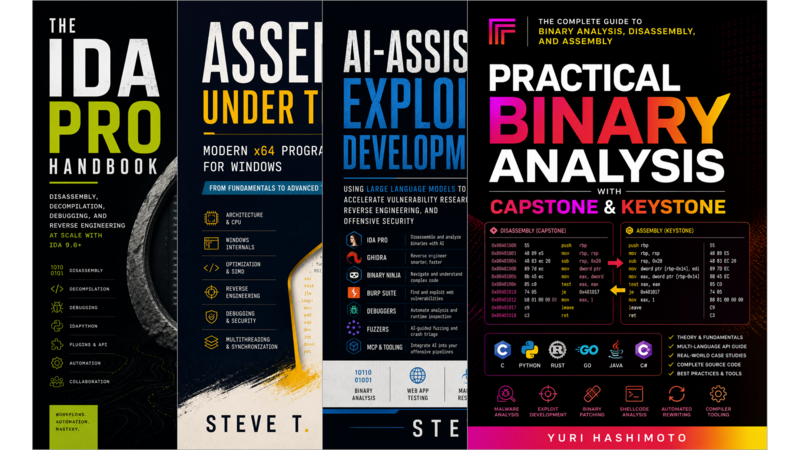
The IDA Pro Handbook

Disassembly, Decompilation, Debugging, and Reverse Engineering at Scale with IDA 9.0+

This book is 100% completeLast updated on 2026-07-03

Master IDA Pro 9.x with a practical, comprehensive guide to modern reverse engineering. From disassembly and decompilation to debugging, IDAPython, automation, malware analysis, and binary patching, this book equips you with the skills and workflows needed to analyze real-world binaries with confidence.

Minimum price

$19.00

$29.00

You pay

Author earns

$

Also available for 1 book credit with a Reader Membership

PDF
EPUB
About

About

About the Book

This is a complete, technically accurate guide to the latest version of IDA Pro (9.0 through 9.4 beta). It covers every major feature, workflow, and capability that a reverse engineer needs: installation and licensing, interface navigation, disassembly, decompilation, debugging, IDAPython scripting, IDC, plugin development, automation, proprietary APIs, reverse engineering methodologies, malware analysis, binary patching, collaborative workflows, performance optimization, and real-world case studies. It is written for junior reverse engineers who know the basics but want mastery, security researchers, malware analysts, exploit developers, and software engineers doing binary analysis.

Share this book

Bundle

Bundles that include this book

Author

About the Author

Steve T. Publications

Steve T. is a cybersecurity leader, researcher, and engineer with more than 20 years of experience across application security, infrastructure security, vulnerability management, software development, and secure engineering practices. Having built his career alongside the growth of the modern internet, he has worked through multiple generations of technology, evolving security threats, and changing development methodologies.

He is currently part of the advanced research organization at a leading cybersecurity company, where he focuses on emerging threats, security innovation, and the practical application of research. His work involves investigating new attack techniques, evaluating emerging technologies, conducting deep technical analysis, and helping organizations better understand and manage complex security risks.

In addition to his research responsibilities, Steve leads a team of senior engineers and subject matter experts who create technical books, training programs, and educational resources for security professionals. Through this work, he helps engineers, developers, architects, and security practitioners strengthen their skills and build more secure systems.

Steve's technical expertise spans software development, reverse engineering, web application security, penetration testing, security architecture, incident response, vulnerability research, operating system internals, and secure software development. His ability to analyze systems at both the source code and binary levels enables him to bridge the worlds of software engineering, security research, and practical defense.

Over the course of his career, Steve has worked with organizations across a wide range of industries, helping them identify, assess, and remediate security weaknesses in critical applications and infrastructure. He is recognized for combining deep technical expertise with a pragmatic approach to security, focusing on solutions that are effective, sustainable, and aligned with business goals.

Through his work in research, engineering, leadership, and education, Steve continues to contribute to the advancement of cybersecurity and the development of secure, resilient technology systems.

Contents

Table of Contents

Chapter 1: What Is IDA Pro?

  1. What Is IDA Pro, Exactly?
  2. The IDA Pro 9.x Architecture
  3. IDA Pro vs. Alternatives
  4. What This Book Covers

Chapter 2: Installation and Environment Setup

  1. System Requirements
  2. Downloading IDA Pro
  3. Installing on Windows
  4. Installing on Linux
  5. Installing on macOS
  6. License Activation
  7. License Server for Floating Licenses
  8. Configuring Python Environment
  9. Troubleshooting Common Installation Issues
  10. Unattended Installation

Chapter 3: The IDA Interface

  1. The Main Window Layout
  2. The Disassembly View
  3. The Functions Window
  4. The Hexadecimal View
  5. Keyboard Shortcuts That Matter
  6. Customizing the Interface
  7. Building a Productive Workflow

Chapter 4: Disassembly Fundamentals

  1. x86/x64 Instruction Decoding
  2. ARM64/AArch64 Instruction Sets
  3. Control Flow Graphs and Basic Blocks
  4. Function Prologues and Epilogues
  5. Recognizing Common Code Patterns
  6. Handling Obfuscation Techniques

Chapter 5: The Hex-Rays Decompiler

  1. How the Decompiler Works
  2. Interpreting Pseudocode Output
  3. Fixing Decompiler Errors
  4. The Decompiler Window Layout
  5. Advanced Decompiler Features
  6. When the Decompiler Fails

Chapter 6: IDA Python — Automation and Scripting

  1. IDA Python Basics
  2. Writing Your First Script
  3. Iterating Over Addresses, Functions, and Segments
  4. Modifying the Database
  5. Using IDAPython with External Tools
  6. Debugging IDA Python Scripts
  7. Best Practices for Production-Quality Scripts

Chapter 7: IDC — The Legacy Scripting Language

  1. IDC Syntax and Semantics
  2. Porting IDC Scripts to IDA Python
  3. When You Still Need IDC
  4. Limitations of IDC That IDA Python Solves

Chapter 8: Debugging in IDA Pro

  1. Setting Up the Local Debugger
  2. Attaching to Running Processes
  3. Breakpoints
  4. Stepping Through Code
  5. Watching Variables, Registers, and Memory
  6. Remote Debugging with GDB Server
  7. Symbol Resolution

Chapter 9: Analysis Techniques — Methodologies for Real-World Reverse Engineering

  1. Top-Down vs. Bottom-Up Analysis Strategies
  2. Static Analysis Workflow
  3. Identifying Malicious Behavior Patterns
  4. API Hooking Detection and Shellcode Identification
  5. String and Constant Analysis
  6. Control Flow Flattening and Deobfuscation Techniques

Chapter 10: Malware Analysis with IDA Pro

  1. Analyzing PE Files, ELF Binaries, and Mach-O Binaries
  2. Identifying Common Malware Techniques
  3. Extracting and Analyzing Embedded Resources
  4. Dynamic Analysis Integration
  5. Case Study: Dissecting a Real-World Ransomware Sample
  6. Case Study: Unpacking a VMP-Protected Binary

Chapter 11: Binary Patching — Modifying Binaries at the Byte Level

  1. Understanding Patches: NOP Insertion, Instruction Replacement, Jump Redirection
  2. Using IDA’s Patch Editor and Hex View for Manual Changes
  3. Automating Patches with IDA Python Scripts
  4. Handling Position-Independent Code and Relocations During Patching
  5. Creating Delta Patches and Binary Diffing Workflows
  6. Preserving Function Signatures and Types After Patching

Chapter 12: Plugin Development — Extending IDA Pro

  1. The Plugin API: plugin_t Structure, RUNTIME, PLUGIN_ARG, and Entry Points
  2. Writing Your First Plugin in C++ and Python
  3. Creating Menu Items, Toolbar Buttons, and Keyboard Shortcuts
  4. Accessing and Modifying the IDA Database from Plugins
  5. Building GUI Dialogs with Qt or Native Widgets
  6. Distributing Plugins: Packaging, Installation, and Version Management
  7. Debugging Plugin Issues and Common Pitfalls

Chapter 13: Collaborative Workflows — Team-Based Reverse Engineering

  1. Database Sharing Formats: IDC, IDB vs. IDB7, and Compatibility
  2. Version Control for Binary Analysis Databases
  3. Comment and Naming Conventions for Team Coordination
  4. Using IDA’s Built-in Collaboration Features (When Available)
  5. Integrating with Git, Perforce, and Other VCS Systems
  6. Managing Large-Scale Projects Across Multiple Analysts

Chapter 14: Performance Optimization — Working with Large Binaries Efficiently

  1. Understanding IDA’s Memory Usage and Optimization Settings
  2. Handling Huge Files: Chunk Loading, Lazy Analysis, and Selective Processing
  3. Optimizing Decompiler Performance for Large Functions
  4. Managing Plugin Load Times and Startup Performance
  5. Troubleshooting Slow Analysis and Unresponsive UI
  6. Hardware Requirements and When to Invest in Better Machines

Chapter 15: Real-World Case Studies

  1. Case Study 1: Dissecting a Closed-Source Windows Driver
  2. Case Study 2: Reverse Engineering a Linux Kernel Module
  3. Case Study 3: Analyzing an Embedded ARM Firmware Image
  4. Case Study 4: Deobfuscating a Heavily Obfuscated CTF Challenge
  5. Case Study 5: Extracting Data from a Proprietary Protocol Binary

Conclusion

Get the free sample chapters

Click the buttons to get the free sample in PDF or EPUB, or read the sample online here

The Leanpub 60 Day 100% Happiness Guarantee

Within 60 days of purchase you can get a 100% refund on any Leanpub purchase, in two clicks.

See full terms...

Earn $8 on a $10 Purchase, and $16 on a $20 Purchase

We pay 80% royalties on purchases of $7.99 or more, and 80% royalties minus a 50 cent flat fee on purchases between $0.99 and $7.98. You earn $8 on a $10 sale, and $16 on a $20 sale. So, if we sell 5000 non-refunded copies of your book for $20, you'll earn $80,000.

(Yes, some authors have already earned much more than that on Leanpub.)

In fact, authors have earned over $15 million writing, publishing and selling on Leanpub.

Learn more about writing on Leanpub

Free Updates. DRM Free.

If you buy a Leanpub book, you get free updates for as long as the author updates the book! Many authors use Leanpub to publish their books in-progress, while they are writing them. All readers get free updates, regardless of when they bought the book or how much they paid (including free).

Most Leanpub books are available in PDF (for computers) and EPUB (for phones, tablets and Kindle). The formats that a book includes are shown at the top right corner of this page.

Finally, Leanpub books don't have any DRM copy-protection nonsense, so you can easily read them on any supported device.

Learn more about Leanpub's ebook formats and where to read them

Write and Publish on Leanpub

You can use Leanpub to easily write, publish and sell in-progress and completed ebooks and online courses!

Leanpub is a powerful platform for serious authors, combining a simple, elegant writing and publishing workflow with a store focused on selling in-progress ebooks.

Leanpub is a magical typewriter for authors: just write in plain text, and to publish your ebook, just click a button. (Or, if you are producing your ebook your own way, you can even upload your own PDF and/or EPUB files and then publish with one click!) It really is that easy.

Learn more about writing on Leanpub