

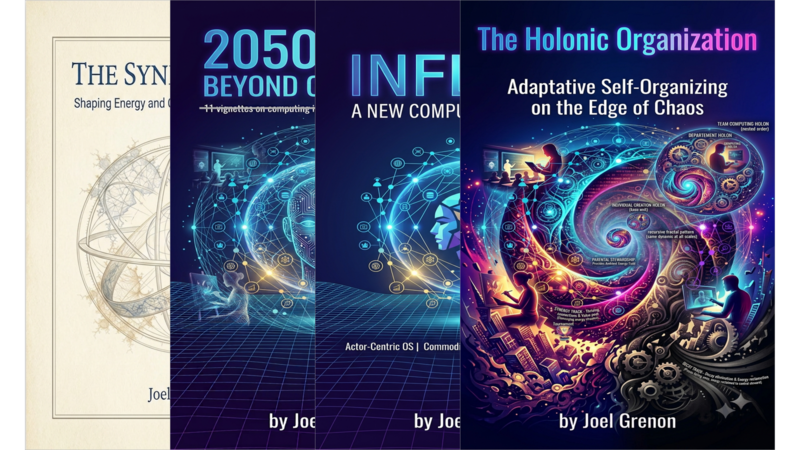

Preface: Where This Book Fits
- The Series So Far
- This Book — Book 3
- Who This Book Is For
- How to Read This Book
- A Note on Voice
Core Thesis
Chapter 1 — The Holon Model: A Recap for Organizations
- The Core Idea
- The Energy Budget
- The Tournament
- Key Concepts for Organizations
- What This Means for Organizations
- InflectOS Preview
Chapter 2 — What Breaks Organizations
- The Snapshot Fallacy in Org Design
- The Reification Trap
- Concentration of Power
- The Greedy Child Collapse
- Information Asymmetry and the Silo Effect
- The Limits of Existing Alternatives
- Why Blockchain Alone Doesn’t Fix This
- The Pattern Beneath All Failures
- InflectOS: What We’re Trying Not to Break
Chapter 3 — The Architecture of a Holonic Organization
- The Fractal Structure
- Domains: The Persistent Organizing Structure
- Ambiences: How Holons Share State
- Parent Holon Responsibilities
- Child Holon Responsibilities
- Boundaries and Interfaces
- The Levels in Detail
- Why Collective Holons Don’t Govern
- InflectOS Architecture
Chapter 4 — The Ambient Field
- What the Ambient Field Contains
- The Vision as a Fractal Process
- Initiatives: How the Vision Becomes Action
- How the Parent Stewards the Field
- The Field Must Remain Accessible
- InflectOS: The Ambient Field in Practice
Chapter 5 — Roles and Holons: The People Part
- The Individual as the Smallest Sovereign Holon
- Teams: Temporary Coalitions
- Circles: Persistent Domains
- Guilds: Cross-Cutting Communities of Practice
- The Difference Between Circles, Guilds, Teams, and Associations
- How Individuals Navigate Between Holons
- What Happens to Management
- AI Agents and Concierges: Holons Are Not Only Human
- InflectOS: Roles in Practice
Chapter 6 — Turns, Phases, and Iterations: The Organizational Clock
- The Turn as the Heartbeat
- Phases: Turn Stereotypes
- Iterations: The Smallest Unit
- Pulses: The Quarterly Health Check
- Begin/End of Phase Ceremonies
- The Global Rhythm
- Continuous Governance, Phase Gates
- InflectOS: The Phase Plan
Chapter 7 — Synergy and Decay: Detection, Metrics, and Response
- Defining Synergy and Decay in Organizational Terms
- The Metrics Framework
- The Detection Process
- How Metrics Flow Through the Fractal
- Self-Diagnostic Metrics: What Every Holon Should Ask Itself
- Response Patterns
- Common Pitfalls
- InflectOS: The Synergy/Decay Dashboard
Chapter 8 — Self-Organization: How Holons Form, Evolve, and Dissolve
- The Proposal Mechanism
- How Holons Form
- Associations: Lightweight Emergent Groups
- The Tournament Within
- Trust Levels
- Holon Lifecycle
- Cross-Level Emergence
- Physical Emergence: How Locations Form
- InflectOS: Self-Organization in Practice
Chapter 9 — Blockchain as Organizational Substrate
- Why Blockchain
- What Blockchain Doesn’t Do
- The Substrate Architecture
- On-Chain vs. Off-Chain
- The Substrate as Organizational Concierge
- DAO Patterns That Work (and Those That Don’t)
- InflectOS: The Blockchain Architecture
Chapter 10 — Governance Without Central Authority
- Stakeholder Governance
- Continuous Governance
- Voice Allocation
- The Stakeholder Council
- Anti-Capture Mechanisms
- Protocol Governance
- InflectOS: Governance in Practice
Chapter 11 — Resource Allocation: The Token Model
- The Token Model
- How Tokens Differ from Money and Equity
- Treasury Management
- Compensation: How Contributors Are Rewarded
- Resource Pull in Practice
- What Happens When Resources Are Misallocated
- InflectOS: Resource Allocation in Practice
Chapter 12 — External Ambiences: Thriving Across Worlds
- The Two-World Problem
- External Ambiences: How the Organization Interacts Economically
- The Legal Entity
- Partnerships and Ecosystem
- Reputation and the External Gaze
- Decay From the Outside
- Synergy From the Outside
- InflectOS and the Outside World
Chapter 13 — The Transition: From Founder-Led to Autonomous
- The Founder Paradox
- Transition Stages and Organizational Phases
- The Four Transition Stages
- Conditions for Advancing Between Stages
- Transition Pulses: Measuring Governance Maturity
- What the Founder Relinquishes (and When)
- What the Founder Keeps
- The Trap of Founder Exceptionalism
- Signs the Transition Is Working
- Signs the Transition Is Failing
- What to Do If the Transition Is Failing
- InflectOS: The Transition in Progress
Chapter 14 — Building Your Holonic Organization
- Who This Is For
- Preconditions: When the Holonic Model Fits
- Step 1: Define the Vision
- Step 2: Establish the Minimal Ambient Field
- Step 3: Choose Your Blockchain Substrate
- Step 4: Define Your First Phase, Pulses, and Iterations
- Step 5: Recruit the First Contributors
- Step 6: Launch the Proposal Process
- Step 7: Set Up Synergy and Decay Detection
- Step 8: Run the First Phase — and Decide
- Common Pitfalls
- InflectOS: Our Path
Chapter 15 — The Evolutionary Organization
- Why This Model Works Across Domains
- The Organization as a Living System
- The Tournament Is the Teacher
- InflectOS and the Experiment
Appendix A — Synergy and Decay Metrics Reference
- Synergy Metrics
- Decay Metrics
- Detection Process
- Metric Governance
Appendix B — Phase Templates
- Phase 0 — Inception
- Phase 1 — Exploration
- Phase 2 — Adoption
- Phase 3 — Expansion
- Phase 4 — Explosion
- Phase 5 — Revolution
- Phase 6 — Evolution
- Using These Templates
Appendix C — Proposal Templates
- Template 1: Initiative Proposal
- Template 2: Resource Pull Request
- Template 3: Holon Dissolution Proposal
- Template 4: Governance Change Proposal
- Template 5: Phase Transition Proposal
- Using These Templates
Appendix D — InflectOS Technical Architecture
- Overview
- Identity Layer
- Content Chain
- Treasury
- Governance
- Synergy/Decay Metrics
- Tooling Stack
- Design Decisions
- Current Phase 0-1 Priorities
- Physical Locations and Hubs
- Key Repositories
- Contact & Participation
Appendix E — Glossary
- A
- B
- C
- D
- E
- F
- G
- H
- I
- M
- P
- R
- S
- T
- V
- W