
Leanpub Header

Skip to main content

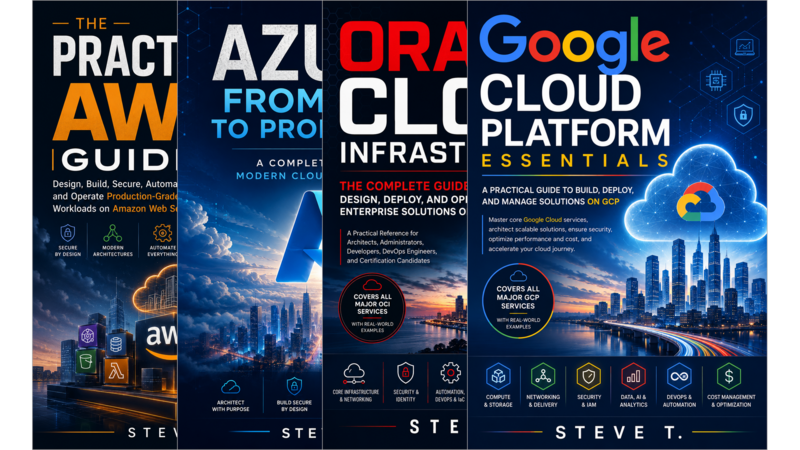
Oracle Cloud Infrastructure

A Practical Reference for Architects, Administrators, Developers, DevOps Engineers, and Certification Candidates

This book is 100% completeLast updated on 2026-07-03
Oracle Cloud Infrastructure is rapidly becoming the platform of choice for organizations running mission-critical workloads, yet mastering OCI requires understanding a cloud ecosystem unlike any other. Oracle Cloud Infrastructure: The Complete Guide to Design, Deploy, and Operate Enterprise Solutions on OCI delivers a practical, end-to-end roadmap for architects, administrators, developers, and…

Minimum price

$19.00

$29.00

You pay

Author earns

$

Also available for 1 book credit with a Reader Membership

PDF
EPUB
About

About

About the Book

Oracle Cloud Infrastructure (OCI) is one of the world's largest and most comprehensive cloud platforms. It powers everything from simple web applications to mission-critical enterprise databases running at planetary scale. Yet many practitioners approach OCI with assumptions carried over from AWS, Azure, or Google Cloud, only to find that its architecture, services, and design philosophy are distinctly different.

This book bridges that gap. It takes you from the fundamentals of OCI's global infrastructure through every major service category, showing how the pieces fit together in real-world architectures. You will learn how to design secure, performant, cost-effective solutions; automate deployments with DevOps pipelines and Terraform; build AI and analytics workloads; plan disaster recovery strategies that meet strict RTO and RPO targets; and navigate OCI's unique networking, security, and database capabilities.

Whether you are starting your OCI journey, preparing for certification, or designing a production environment for an enterprise workload, this book is structured to serve as both a learning resource and a professional reference you will return to again and again.

Share this book

Bundle

Bundles that include this book

Author

About the Author

Steve T. Publications

Steve T. is a cybersecurity leader, researcher, and engineer with more than 20 years of experience across application security, infrastructure security, vulnerability management, software development, and secure engineering practices. Having built his career alongside the growth of the modern internet, he has worked through multiple generations of technology, evolving security threats, and changing development methodologies.

He is currently part of the advanced research organization at a leading cybersecurity company, where he focuses on emerging threats, security innovation, and the practical application of research. His work involves investigating new attack techniques, evaluating emerging technologies, conducting deep technical analysis, and helping organizations better understand and manage complex security risks.

In addition to his research responsibilities, Steve leads a team of senior engineers and subject matter experts who create technical books, training programs, and educational resources for security professionals. Through this work, he helps engineers, developers, architects, and security practitioners strengthen their skills and build more secure systems.

Steve's technical expertise spans software development, reverse engineering, web application security, penetration testing, security architecture, incident response, vulnerability research, operating system internals, and secure software development. His ability to analyze systems at both the source code and binary levels enables him to bridge the worlds of software engineering, security research, and practical defense.

Over the course of his career, Steve has worked with organizations across a wide range of industries, helping them identify, assess, and remediate security weaknesses in critical applications and infrastructure. He is recognized for combining deep technical expertise with a pragmatic approach to security, focusing on solutions that are effective, sustainable, and aligned with business goals.

Through his work in research, engineering, leadership, and education, Steve continues to contribute to the advancement of cybersecurity and the development of secure, resilient technology systems.

Contents

Table of Contents

A Practical Reference for Architects, Administrators, Developers, DevOps Engineers, and Certification Candidates

  1. About This Book

Chapter 1: Foundations of Oracle Cloud Infrastructure

  1. What Is OCI? A Platform Built from the Ground Up
  2. Global Footprint: Regions, Availability Domains, and Fault Domains
  3. The OCI Resource Hierarchy: Tenancy, Compartments, and Identity Domains
  4. Compute Units: OCPU vs. vCPU Explained
  5. Billing Models and the Always-Free Tier
  6. Learning Objectives
  7. Hands-On Lab: Exploring Your OCI Environment
  8. Review Questions
  9. Real-World Case Study: Global Financial Services Provider

Chapter 2: Tenancy and Identity and Access Management (IAM)

  1. Setting Up Your First Tenancy and Identity Domain
  2. Users, Groups, and Dynamic Groups
  3. IAM Policy Syntax and Best Practices
  4. Multi-Factor Authentication and API Keys
  5. Cross-Tenancy Access and Organization Management
  6. Learning Objectives
  7. Hands-On Lab: Building an IAM Architecture
  8. Review Questions
  9. Real-World Case Study: Healthcare Technology Company

Chapter 3: Virtual Cloud Networks and Networking

  1. VCN Fundamentals: Subnets, Route Tables, and Security
  2. Gateways: Internet, NAT, Service, and Dynamic Routing
  3. VCN Peering and Transit Routing
  4. Hybrid Connectivity: FastConnect and Site-to-Site VPN
  5. IP Addressing, DNS, and BYOIP
  6. Learning Objectives
  7. Hands-On Lab: Building a Production-Grade VCN
  8. Review Questions
  9. Real-World Case Study: E-Commerce Platform During Peak Traffic

Chapter 4: Compute and Containers

  1. VM Shapes: Standard, DenseIO, GPU, and HPC
  2. Bare Metal Instances and Dedicated VM Hosts
  3. Oracle Acceleron and Arm-Based Compute
  4. OCI Container Registry and Container Instances
  5. Kubernetes Engine (OKE) Overview
  6. Instance Lifecycle, Images, and Scaling
  7. Learning Objectives
  8. Hands-On Lab: Compute Deployment and Configuration
  9. Review Questions
  10. Real-World Case Study: AI Research Laboratory

Chapter 5: Storage Services

  1. Block Volumes: Performance Tiers and Replication
  2. Object Storage: Standard, Infrequent Access, and Archive
  3. File Storage Service and NFS Decisions
  4. NVMe Local Storage and Ephemeral Storage
  5. Data Transfer Service and Backup Service
  6. Learning Objectives
  7. Hands-On Lab: Storage Configuration
  8. Review Questions
  9. Real-World Case Study: Media Streaming Platform

Chapter 6: Databases and Data Management

  1. Autonomous Database: Serverless, Dedicated, and Exadata
  2. Oracle Database Base Service and Exadata Cloud Service
  3. MySQL HeatWave and Open-Source Database Options
  4. Maximum Availability Architecture: Bronze Through Platinum
  5. Migration Tools and Strategies
  6. Learning Objectives
  7. Hands-On Lab: Database Deployment
  8. Review Questions
  9. Real-World Case Study: Healthcare Data Platform

Chapter 7: Security and Compliance

  1. OCI Vault and Key Management Service
  2. Encryption at Rest and in Transit
  3. Network Security: WAF, Network Firewall, and ZPR
  4. Oracle Cloud Guard and Audit Services
  5. Compliance Certifications and the Shared Responsibility Model
  6. Learning Objectives
  7. Hands-On Lab: Security Configuration
  8. Review Questions
  9. Real-World Case Study: Financial Services Data Protection

Chapter 8: Kubernetes, Containers, and DevOps

  1. OKE Cluster Architecture and Node Pools
  2. OCI DevOps: Projects, Repositories, and Pipelines
  3. Infrastructure as Code with Terraform
  4. Container Security and GitOps Workflows
  5. Learning Objectives
  6. Hands-On Lab: Building a DevOps Pipeline
  7. Review Questions
  8. Real-World Case Study: SaaS Platform Modernization

Chapter 9: Observability and Management

  1. Monitoring: Metrics, MQL, Alarms, and Dashboards
  2. Logging, Log Analytics, and Event-Driven Automation
  3. Cloud Advisor and Resource Utilization
  4. Third-Party Integration and Stack Monitoring
  5. Learning Objectives
  6. Hands-On Lab: Setting Up Observability
  7. Review Questions
  8. Real-World Case Study: E-Commerce Performance Monitoring

Chapter 10: AI, Analytics, and Machine Learning

  1. OCI Data Science: Notebooks, Model Deployment, and MLOps
  2. OCI AI Services: Vision, Speech, Language, and Document Understanding
  3. Oracle Analytics Cloud and Big Data Service
  4. Autonomous AI Database with Vector Search
  5. Enterprise AI Agent Platform
  6. Learning Objectives
  7. Hands-On Lab: AI and ML on OCI
  8. Review Questions
  9. Real-World Case Study: Healthcare AI Initiative

Chapter 11: FinOps and Cost Optimization

  1. OCI Cost Management Tools and FOCUS Compliance
  2. Tagging Strategies and Compartments-Based Cost Allocation
  3. Reserved Capacity, Savings Plans, and Preemptible Instances
  4. Real-World Cost Optimization Case Studies
  5. Learning Objectives
  6. Hands-On Lab: Cost Management
  7. Review Questions
  8. Real-World Case Study: Enterprise Cost Optimization Program

Chapter 12: Disaster Recovery and High Availability

  1. DR Fundamentals: RTO, RPO, and Strategy Selection
  2. OCI Full Stack Disaster Recovery (FSDR)
  3. Cross-Region Replication Across Services
  4. Database Resilience: Data Guard and GoldenGate
  5. Testing and Validating DR Plans
  6. Learning Objectives
  7. Hands-On Lab: Disaster Recovery Configuration
  8. Review Questions
  9. Real-World Case Study: Financial Services DR Strategy

Chapter 13: Hybrid and Multi-Cloud Strategies

  1. FastConnect and Site-to-Site VPN for On-Premises Connectivity
  2. Oracle Database@AWS, @Azure, and @Google Cloud
  3. Partner Cross-Cloud Interconnects
  4. Landing Zones and Multicloud Networking Patterns
  5. Learning Objectives
  6. Hands-On Lab: Hybrid Connectivity
  7. Review Questions
  8. Real-World Case Study: Global Manufacturing Multicloud Strategy

Chapter 14: Migration and Modernization

  1. Lift-and-Shift Migrations: Tools and Techniques
  2. Database Migration Strategies and Zero Downtime Migration
  3. Application Modernization to Cloud-Native Architectures
  4. Oracle Cloud Lift Services and Partner Ecosystems
  5. Learning Objectives
  6. Hands-On Lab: Database Migration
  7. Review Questions
  8. Real-World Case Study: Enterprise ERP Migration

Chapter 15: Certification Preparation and Career Path

  1. OCI Certification Landscape and Exam Formats
  2. Study Strategies and Recommended Resources
  3. Building an OCI Portfolio with Real-World Projects
  4. Career Progression Paths in the Oracle Cloud Ecosystem
  5. Learning Objectives
  6. Hands-On Lab: Certification Practice
  7. Review Questions
  8. Real-World Case Study: Career Transition Through Certification

Conclusion: Your OCI Journey Continues

References / Endnotes

Glossary

Get the free sample chapters

Click the buttons to get the free sample in PDF or EPUB, or read the sample online here

The Leanpub 60 Day 100% Happiness Guarantee

Within 60 days of purchase you can get a 100% refund on any Leanpub purchase, in two clicks.

See full terms...

Earn $8 on a $10 Purchase, and $16 on a $20 Purchase

We pay 80% royalties on purchases of $7.99 or more, and 80% royalties minus a 50 cent flat fee on purchases between $0.99 and $7.98. You earn $8 on a $10 sale, and $16 on a $20 sale. So, if we sell 5000 non-refunded copies of your book for $20, you'll earn $80,000.

(Yes, some authors have already earned much more than that on Leanpub.)

In fact, authors have earned over $15 million writing, publishing and selling on Leanpub.

Learn more about writing on Leanpub

Free Updates. DRM Free.

If you buy a Leanpub book, you get free updates for as long as the author updates the book! Many authors use Leanpub to publish their books in-progress, while they are writing them. All readers get free updates, regardless of when they bought the book or how much they paid (including free).

Most Leanpub books are available in PDF (for computers) and EPUB (for phones, tablets and Kindle). The formats that a book includes are shown at the top right corner of this page.

Finally, Leanpub books don't have any DRM copy-protection nonsense, so you can easily read them on any supported device.

Learn more about Leanpub's ebook formats and where to read them

Write and Publish on Leanpub

You can use Leanpub to easily write, publish and sell in-progress and completed ebooks and online courses!

Leanpub is a powerful platform for serious authors, combining a simple, elegant writing and publishing workflow with a store focused on selling in-progress ebooks.

Leanpub is a magical typewriter for authors: just write in plain text, and to publish your ebook, just click a button. (Or, if you are producing your ebook your own way, you can even upload your own PDF and/or EPUB files and then publish with one click!) It really is that easy.

Learn more about writing on Leanpub