Leanpub Header

Skip to main content

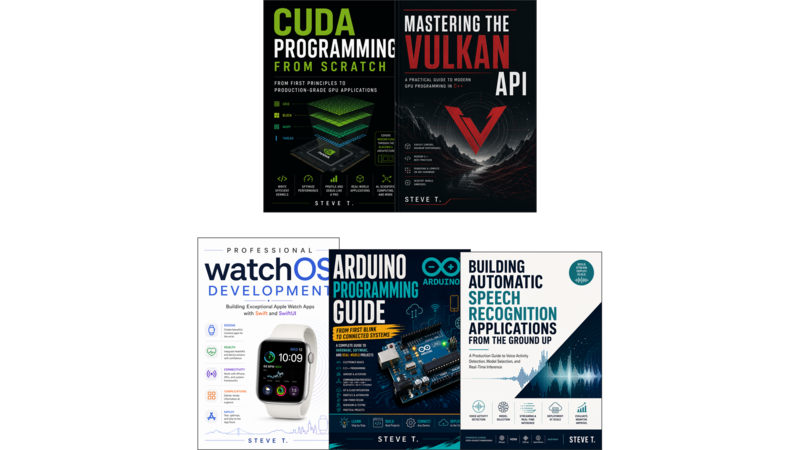
Mastering the Vulkan API

A Practical Guide to Modern GPU Programming in C++

This book is 100% completeLast updated on 2026-07-03

Unlock the full power of modern GPU programming with Mastering the Vulkan API. This practical guide helps intermediate C++ developers build high-performance graphics and compute applications through clear explanations, hands-on examples, and production-inspired best practices.

Minimum price

$19.00

$29.00

You pay

Author earns

$

Also available for 1 book credit with a Reader Membership

PDF
EPUB
About

About

About the Book

This book takes intermediate C++ developers from their first lines of Vulkan code to a deep understanding of how modern graphics APIs work under the hood. You will learn to initialize a Vulkan instance, select and configure a physical device, compile shaders into SPIR-V, manage memory explicitly, synchronize rendering across frames, and build robust applications that push GPU hardware to its limits. Each chapter builds on the last with idiomatic C++ code examples, real-world best practices drawn from production engines, and honest discussions of where Vulkan's explicit control pays dividends and where it introduces genuine complexity. By the end, you will have the knowledge and confidence to write high-performance graphics and compute applications that run efficiently across desktop, mobile, and embedded hardware.

Share this book

Bundle

Bundles that include this book

Author

About the Author

Steve T. Publications

Steve T. is a cybersecurity leader, researcher, and engineer with more than 20 years of experience across application security, infrastructure security, vulnerability management, software development, and secure engineering practices. Having built his career alongside the growth of the modern internet, he has worked through multiple generations of technology, evolving security threats, and changing development methodologies.

He is currently part of the advanced research organization at a leading cybersecurity company, where he focuses on emerging threats, security innovation, and the practical application of research. His work involves investigating new attack techniques, evaluating emerging technologies, conducting deep technical analysis, and helping organizations better understand and manage complex security risks.

In addition to his research responsibilities, Steve leads a team of senior engineers and subject matter experts who create technical books, training programs, and educational resources for security professionals. Through this work, he helps engineers, developers, architects, and security practitioners strengthen their skills and build more secure systems.

Steve's technical expertise spans software development, reverse engineering, web application security, penetration testing, security architecture, incident response, vulnerability research, operating system internals, and secure software development. His ability to analyze systems at both the source code and binary levels enables him to bridge the worlds of software engineering, security research, and practical defense.

Over the course of his career, Steve has worked with organizations across a wide range of industries, helping them identify, assess, and remediate security weaknesses in critical applications and infrastructure. He is recognized for combining deep technical expertise with a pragmatic approach to security, focusing on solutions that are effective, sustainable, and aligned with business goals.

Through his work in research, engineering, leadership, and education, Steve continues to contribute to the advancement of cybersecurity and the development of secure, resilient technology systems.

Contents

Table of Contents

A Practical Guide to Modern GPU Programming in C++

Introduction: Why Vulkan, Why Now?

Chapter 1: The Vulkan Philosophy

  1. From OpenGL to Vulkan: A Brief History
  2. Explicit vs. Implicit Control
  3. The Layered Architecture
  4. Platform Support and Cross-Platform Goals
  5. When to Choose Vulkan

Chapter 2: Setting Up Your Development Environment

  1. Installing the Vulkan SDK
  2. Build System Configuration
  3. Required Headers and Libraries
  4. Validation Layers and Their Importance
  5. Debugging Tools and Profilers

Chapter 3: Instance Creation and Extension Management

  1. Understanding VkInstance
  2. Required Extensions: VK_KHR_surface
  3. Optional Extensions for Windowing Systems
  4. Validation Layers Configuration
  5. Error Handling and Result Codes

Chapter 4: Physical Device Selection and Queue Families

  1. Enumerating Physical Devices
  2. Querying Device Properties and Features
  3. Understanding Queue Families
  4. Selecting the Right Device
  5. Creating a Logical Device

Chapter 5: Surface Creation and Swapchain Management

  1. Surface Extension Requirements
  2. Creating a VkSurfaceKHR
  3. Querying Surface Capabilities
  4. Swapchain Creation and Image Acquisition
  5. Presentation Modes and Composite Alpha

Chapter 6: Shader Compilation and Pipeline Setup

  1. SPIR-V: The Universal Shader Language
  2. Compiling GLSL to SPIR-V with glslangValidator
  3. Shader Modules and Descriptor Sets
  4. Pipeline Layout and Descriptor Types
  5. Creating a Graphics Pipeline

Chapter 7: Command Buffer Recording and Submission

  1. Command Pool and Command Buffer Hierarchy
  2. Begin and End Recording
  3. Render Passes and Subpasses
  4. Draw Calls and Vertex Buffers
  5. Submitting to the Queue

Chapter 8: Memory Management Fundamentals

  1. Why Vulkan Doesn’t Have a Heap
  2. Memory Types and Properties
  3. vkAllocateMemory and vkFreeMemory
  4. Binding Memory to Objects
  5. Best Practices for Allocation Strategies

Chapter 9: Buffer Creation and Data Transfer

  1. Buffer Creation and Usage Flags
  2. Staging Buffers for CPU-to-GPU Transfer
  3. Copy Commands (vkCmdCopyBuffer)
  4. Persistent Mappings vs. Explicit Transfers
  5. Uniform Buffers and Push Constants

Chapter 10: Image Resources and Texture Management

  1. Image vs. Buffer: When to Use Which
  2. Creating Images with VkImage
  3. Image Views and Format Selection
  4. Memory Allocation for Images
  5. Sampler Objects and Filtering

Chapter 11: Synchronization Primitives

  1. Why Synchronization is Explicit in Vulkan
  2. Semaphores for GPU-GPU Signaling
  3. Fences for CPU-GPU Synchronization
  4. Pipeline Stages and Access Masks
  5. Render Pass Layout Transitions
  6. Best Practices for Frame Management

Chapter 12: Advanced Topics and Modern Patterns

  1. Descriptor Updates and Updates vs. Push
  2. Multi-Frame In-Flight Rendering
  3. Dynamic Rendering (VK_KHR_dynamic_rendering)
  4. Performance Profiling and Optimization
  5. Conclusion to Advanced Topics

Conclusion: Building on the Foundation

References

Get the free sample chapters

Click the buttons to get the free sample in PDF or EPUB, or read the sample online here

The Leanpub 60 Day 100% Happiness Guarantee

Within 60 days of purchase you can get a 100% refund on any Leanpub purchase, in two clicks.

See full terms...

Earn $8 on a $10 Purchase, and $16 on a $20 Purchase

We pay 80% royalties on purchases of $7.99 or more, and 80% royalties minus a 50 cent flat fee on purchases between $0.99 and $7.98. You earn $8 on a $10 sale, and $16 on a $20 sale. So, if we sell 5000 non-refunded copies of your book for $20, you'll earn $80,000.

(Yes, some authors have already earned much more than that on Leanpub.)

In fact, authors have earned over $15 million writing, publishing and selling on Leanpub.

Learn more about writing on Leanpub

Free Updates. DRM Free.

If you buy a Leanpub book, you get free updates for as long as the author updates the book! Many authors use Leanpub to publish their books in-progress, while they are writing them. All readers get free updates, regardless of when they bought the book or how much they paid (including free).

Most Leanpub books are available in PDF (for computers) and EPUB (for phones, tablets and Kindle). The formats that a book includes are shown at the top right corner of this page.

Finally, Leanpub books don't have any DRM copy-protection nonsense, so you can easily read them on any supported device.

Learn more about Leanpub's ebook formats and where to read them

Write and Publish on Leanpub

You can use Leanpub to easily write, publish and sell in-progress and completed ebooks and online courses!

Leanpub is a powerful platform for serious authors, combining a simple, elegant writing and publishing workflow with a store focused on selling in-progress ebooks.

Leanpub is a magical typewriter for authors: just write in plain text, and to publish your ebook, just click a button. (Or, if you are producing your ebook your own way, you can even upload your own PDF and/or EPUB files and then publish with one click!) It really is that easy.

Learn more about writing on Leanpub