Mastering data structure using c question bank
1000 conceptual questions for students and professionals


Mastering Data Structures Using C – QUESTION BANK: 1000+ Conceptual Questions for Students and Professionals is a comprehensive practice resource featuring MCQs, short-answer questions, detailed mid-length questions with answers, and solved programming questions.
Covering arrays, linked lists, stacks, queues, trees, graphs, searching, sorting, hashing, file organization, recursion, backtracking.
Minimum price
$9.99
$19.99
You pay
Author earns
About
About the Book
Mastering Data Structures Using C – QUESTION BANK: 1000+ Conceptual Questions for Students and Professionals is a comprehensive, structured, and practice-oriented question bank designed to help students, educators, programmers, and software professionals develop a strong understanding of data structures and their implementation using the C programming language.
Data structures are among the most important foundations of computer science, programming, algorithm design, and software development. A clear understanding of how data is organized, stored, accessed, processed, and managed is essential for developing efficient programs and solving complex computational problems. However, mastering data structures requires more than reading theoretical explanations—it requires continuous practice, conceptual assessment, algorithmic thinking, and hands-on programming.
This book has been developed to meet that need by providing more than 1,000 carefully organized conceptual, analytical, and programming-oriented questions covering fundamental, intermediate, and advanced topics in data structures.
The book follows a progressive chapter-wise approach, beginning with the basic concepts of data structures, Abstract Data Types (ADTs), linear and non-linear data structures, and time and space complexity. It then advances through arrays, structures, linked lists, stacks, queues, trees, graphs, searching and sorting algorithms, hashing, file organization, recursion, backtracking, and advanced data structures.
Each chapter contains a carefully designed combination of:
- 50 Multiple-Choice Questions (MCQs) for objective assessment and rapid revision
- 25 Short-Answer Questions for strengthening definitions and fundamental concepts
- 15 Mid-Length Questions with Answers for developing analytical understanding and descriptive writing skills
- 20 Programming Questions with Answers for improving practical implementation and problem-solving abilities using C
This structured format enables readers to test their knowledge at multiple levels. The MCQs help learners evaluate conceptual accuracy, prepare for objective examinations, and identify areas requiring further study. The short-answer questions strengthen understanding of terminology, operations, applications, advantages, limitations, and important differences between related concepts.
The mid-length questions encourage readers to explain concepts systematically, analyze algorithms, compare data structures, and develop well-organized answers suitable for university examinations. The programming questions connect theoretical knowledge with practical implementation and help readers understand how data structures and algorithms can be translated into working C programs.
The book provides extensive coverage of arrays and structures, including one-dimensional and multidimensional arrays, traversal, insertion, deletion, searching, sparse-array representation, and the integration of structures with arrays.
Linked data structures are explored through singly linked lists, circular linked lists, and doubly linked lists. Questions address important operations such as node creation, insertion, deletion, searching, traversal, memory allocation, and comparisons between arrays and linked lists.
Dedicated chapters on stacks and queues cover their fundamental operations, array-based and linked-list implementations, overflow and underflow conditions, circular queues, double-ended queues, priority queues, expression evaluation, parenthesis matching, and other practical applications.
The book provides comprehensive practice on trees, including binary trees, Binary Search Trees (BSTs), tree traversals, node counting, height, depth, AVL trees, and balancing techniques. Graph-related questions cover adjacency matrices, adjacency lists, Breadth-First Search (BFS), Depth-First Search (DFS), spanning trees, Dijkstra’s algorithm, Prim’s algorithm, and real-world applications of graph structures.
Searching and sorting techniques receive detailed coverage through conceptual and programming questions on linear search, binary search, bubble sort, selection sort, insertion sort, merge sort, and quick sort. Readers are encouraged to understand not only the implementation of these algorithms but also their performance, time complexity, advantages, limitations, and practical applications.
The chapter on hashing introduces hash tables, hash functions, collision-resolution methods, applications of hashing, and comparisons between hash-based structures and search trees.
File organization and access methods are addressed through questions on sequential files, direct-access files, indexing techniques, file organization, and the use of C structures for file-based data management.
Recursion and backtracking are explored through conceptual explanations and programming applications, including the Tower of Hanoi, maze-solving problems, the N-Queens problem, and Sudoku-solving approaches. Readers are encouraged to compare recursive and iterative methods and understand the role of the call stack in recursive execution.
The final chapter introduces advanced data structures, including tries, suffix trees, segment trees, Fenwick trees, disjoint-set structures, Union-Find operations, Red-Black Trees, and B-Trees. These topics provide learners with exposure to modern and specialized structures used in competitive programming, database systems, information retrieval, network connectivity, and advanced algorithm design.
This book is especially suitable for students pursuing BCA, MCA, B.Tech, M.Tech, B.Sc. Computer Science, B.Sc. Information Technology, Diploma in Computer Science, and related academic programs. It can also serve as a valuable resource for educators preparing assignments, tutorials, quizzes, laboratory examinations, internal assessments, semester examinations, and question papers.
For aspiring software professionals, the book provides structured practice for technical interviews, coding assessments, placement examinations, programming tests, and competitive examinations where data-structure concepts are frequently evaluated.
Whether you are preparing for a university examination, strengthening your conceptual understanding, practicing C programming, revising important topics, preparing for placements, or assessing your readiness for a software interview, Mastering Data Structures Using C – QUESTION BANK provides a comprehensive and practical pathway toward mastering data structures.
Feedback
Bundle
Bundles that include this book
Question bank
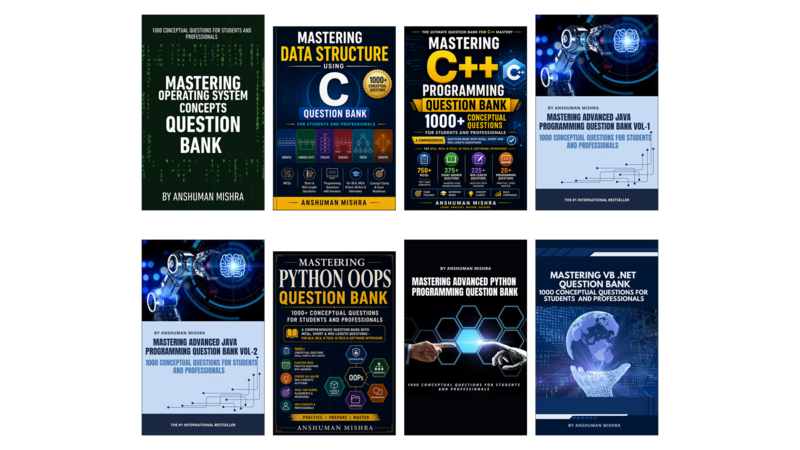
8 Books
- Pricing
$49.99
Minimum priceBought separately$159.92Suggested price$79.99
Author
About the Author

Anshuman Kumar Mishra, M.Tech (Computer Science) Assistant Professor, Doranda College, Ranchi University
Prolific Author of 50+ Books on AI, Machine Learning & Computer Science | 20+ Years Experience
Anshuman Kumar Mishra is a dedicated educator, researcher, and highly prolific author with over 20 years of experience in Computer Science and Information Technology. Holding an M.Tech in Computer Science from BIT Mesra, he brings a rare combination of academic depth and practical teaching expertise.
Currently serving as Assistant Professor at Doranda College under Ranchi University, he has mentored thousands of students, helping them build strong foundations in programming, data science, and artificial intelligence. His student-centric teaching style emphasizes conceptual clarity, hands-on practice, and real-world application.
Anshuman is a prolific author with more than 50 books published across a wide spectrum of computer science and emerging technology domains. From foundational programming languages to advanced topics in Artificial Intelligence, Machine Learning, Reinforcement Learning, Decision Theory, and Computer Vision — his books are widely appreciated by students, educators, and professionals for their clear explanations, strong theoretical foundation, and practical approach.
His extensive body of work reflects his deep commitment to making complex subjects accessible and meaningful for learners at all levels. He is particularly recognized for creating well-structured learning paths that help readers progress from beginner to advanced levels with confidence.
Driven by the mission to democratize quality technical education, Anshuman continues to write and update books that bridge the gap between academic theory and industry practice.
When not teaching or writing, he actively follows and explores new developments in AI, Quantum Machine Learning, and Ethical Intelligence systems.
Contents
Table of Contents
The Leanpub 60 Day 100% Happiness Guarantee
Within 60 days of purchase you can get a 100% refund on any Leanpub purchase, in two clicks.
See full terms...
Earn $8 on a $10 Purchase, and $16 on a $20 Purchase
We pay 80% royalties on purchases of $7.99 or more, and 80% royalties minus a 50 cent flat fee on purchases between $0.99 and $7.98. You earn $8 on a $10 sale, and $16 on a $20 sale. So, if we sell 5000 non-refunded copies of your book for $20, you'll earn $80,000.
(Yes, some authors have already earned much more than that on Leanpub.)
Learn more about writing on Leanpub
Free Updates. DRM Free.
If you buy a Leanpub book, you get free updates for as long as the author updates the book! Many authors use Leanpub to publish their books in-progress, while they are writing them. All readers get free updates, regardless of when they bought the book or how much they paid (including free).
Most Leanpub books are available in PDF (for computers) and EPUB (for phones, tablets and Kindle). The formats that a book includes are shown at the top right corner of this page.
Finally, Leanpub books don't have any DRM copy-protection nonsense, so you can easily read them on any supported device.
Learn more about Leanpub's ebook formats and where to read them
Write and Publish on Leanpub
You can use Leanpub to easily write, publish and sell in-progress and completed ebooks and online courses!
Leanpub is a powerful platform for serious authors, combining a simple, elegant writing and publishing workflow with a store focused on selling in-progress ebooks.
Leanpub is a magical typewriter for authors: just write in plain text, and to publish your ebook, just click a button. (Or, if you are producing your ebook your own way, you can even upload your own PDF and/or EPUB files and then publish with one click!) It really is that easy.